A product costs $4 at the factory and sells for $20. There should be plenty left over. Then freight, packaging, fulfillment and advertising start taking their share.
A landed cost calculator shows what inventory costs when it reaches the location you chose. To find the margin on a customer order, keep going: add fulfillment, selling fees, returns and advertising.
Use the worksheet to compare the inventory purchase and the customer order separately. The example uses hypothetical U.S. dollar amounts, not freight quotes or tax estimates.
Define where your landed cost ends
Choose an endpoint before entering numbers: your China fulfillment warehouse, a U.S. 3PL receiving location, or another named destination. Write it at the top of the calculation. A cost to a Chinese warehouse cannot be compared directly with a cost to a U.S. warehouse.
The U.S. International Trade Administration describes landed cost as including the product, freight, insurance, tariffs, taxes and other relevant charges. Its page discusses exports generally; its illustrative tax examples are not current China-to-U.S. duty instructions.
For the purchasing worksheet here, include the costs required to put usable inventory at your chosen location. Track consumer delivery and selling expenses separately. That makes it easier to see which part of the business needs attention.
This is an operational buying model. Your accounting treatment of inventory, development costs and recoverable taxes may differ. Keep a separate cash requirement for amounts you must pay now but expect to recover later.
Build the landed cost calculation
Use one currency and record the exchange rate and date. Mark each figure as estimated or confirmed. A total to two decimal places can still be based on an incomplete quote.
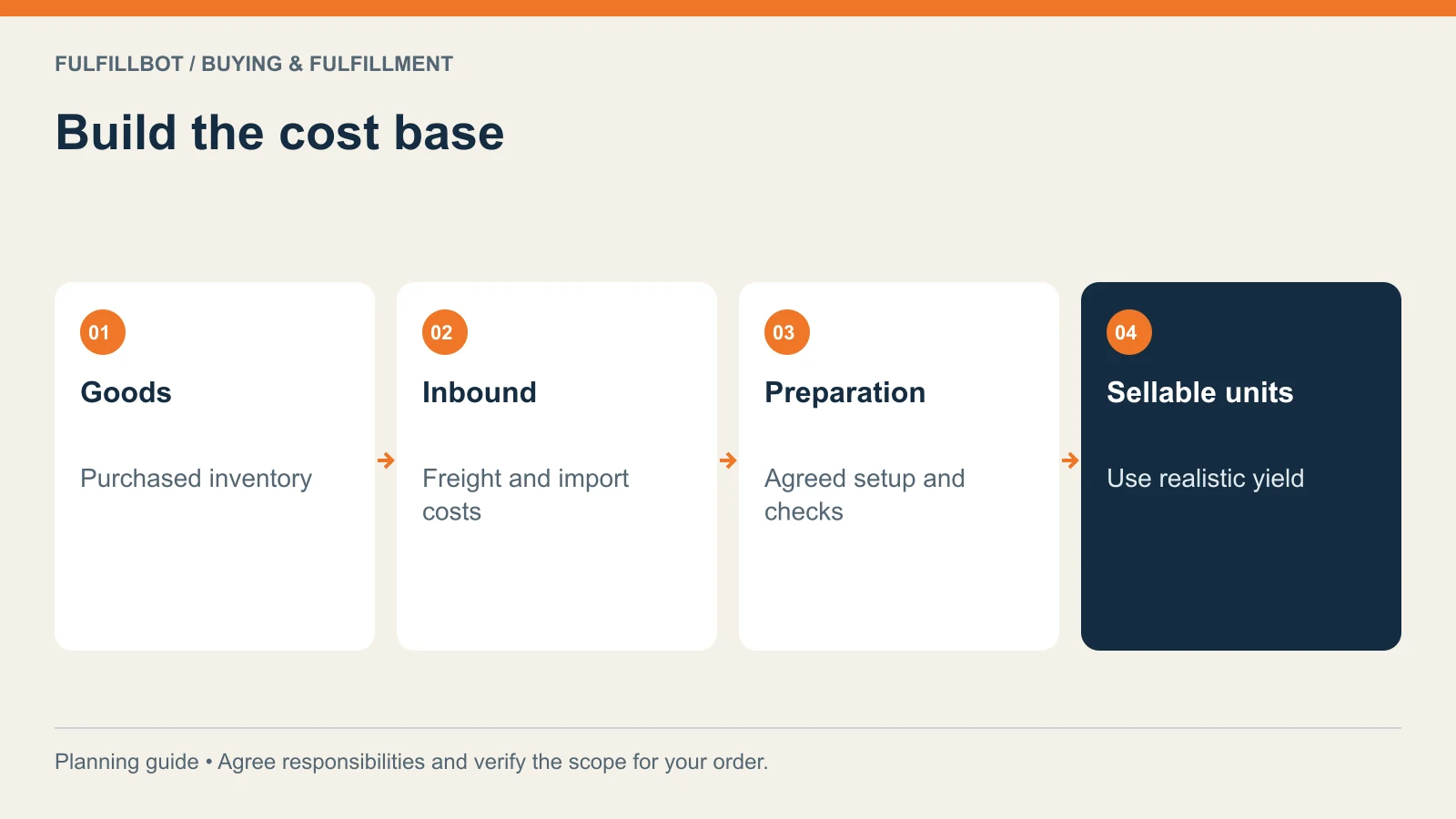
Landed cost per sellable unit = included shipment and preparation costs ÷ expected sellable units.
| Cost category | What to enter | Common mistake |
|---|---|---|
| Goods | Quantity multiplied by the agreed product price | Comparing different product specifications |
| Setup and checks | The share of sampling, tooling or inspection assigned to this order | Charging the same setup cost again on every reorder |
| Packaging | Materials and packing work included in this shipment | Adding a box cost already included in the product quote |
| Inbound transport | Pickup, main transport and delivery to the chosen endpoint | Comparing port delivery with warehouse delivery |
| Import costs | Applicable duties, taxes and clearance charges from a shipment-specific assessment | Applying a headline tariff to every product |
| Insurance and handling | Agreed cover and handling not included elsewhere | Assuming every DDP quote includes insurance |
| Payment costs | Currency conversion and payment charges you actually bear | Using an exchange rate unavailable for the payment |
Check what a bundled quote includes before adding separate fees. If your confirmed DDP price already covers import duties and destination delivery, do not add them again. Mark those lines as included in that quote and retain the supporting explanation.
For transportation options, start with the China-to-USA shipping guide. Then request a quote for the packed shipment, including its actual destination. Generic cost tables are too broad for a purchasing decision.
Work through a 500-unit example
Suppose you are comparing one purchase of 500 units. The chosen endpoint is inventory received and ready to sell at a U.S. warehouse. None of these numbers is a market benchmark.
| Item | Hypothetical amount |
|---|---|
| Goods: 500 × $4.00 | $2,000 |
| Packaging assigned to this batch | $150 |
| Inspection and setup allocation | $200 |
| Inbound freight and handling | $650 |
| Assumed import charges supplied for this example | $300 |
| Payment and currency costs | $50 |
| Total included cost | $3,350 |
At a planning yield of 490 sellable units, the cost is $3,350 ÷ 490 = $6.84 per sellable unit, rounded. The ten-unit shortfall is an assumption for this calculation, not an expected industry defect rate. Enter your own allowance and replace it with actual receipts when the order arrives.
Using the full purchased quantity would give $6.70. That is a different planning assumption. Neither denominator should be chosen merely because it makes the margin look better.
An unsold but undamaged unit remains inventory; it is not automatically a defective unit. Track slow-moving stock separately from receiving losses. Otherwise, the worksheet can conceal a demand problem inside a quality allowance.
Use the companion landed cost calculator to change the totals and unit count. It performs arithmetic on your inputs; it does not classify products or retrieve tariff rates.
Landed cost calculator
Choose one inventory arrival endpoint, enter the complete batch cost once, then check the contribution from a one-unit customer order. All currency inputs use USD. The prefilled numbers are hypothetical.
Your calculation
Landed cost / sellable unit
Batch cost
Contribution / one-unit order
Contribution = net revenue − landed unit cost − per-order variable expenses.
Contribution is before other overhead and income tax. This tool does not determine tariff classification, fetch tax rates or calculate accounting profit. Do not add duties twice if a confirmed bundled quote already includes them.
JavaScript is needed for the interactive calculation. The formula and worked example in this article can also be used manually.
Calculate contribution after the sale
Now price the customer order. In this example one order contains one unit, net product revenue is $20, and shipping revenue is zero. Taxes collected for remittance are excluded from that revenue figure.
| Per-order item | Hypothetical amount |
|---|---|
| Net revenue | $20.00 |
| Landed inventory cost | $6.84 |
| Fulfillment and customer delivery | $5.20 |
| Selling and payment fees | $1.20 |
| Returns and support allowance | $0.60 |
| Advertising attributed to the order | $3.50 |
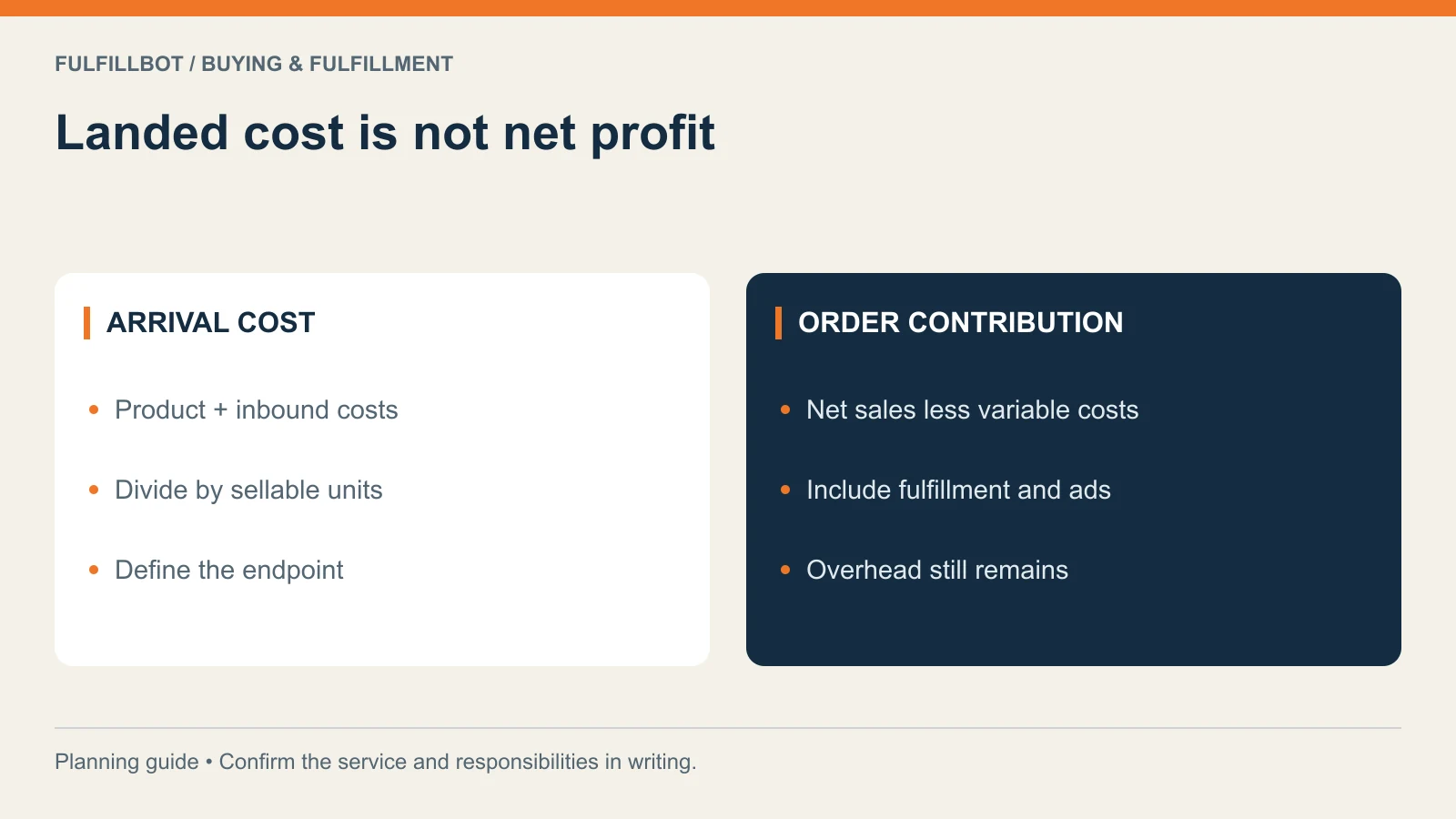
| Contribution remaining | $2.66 |
The unrounded calculation leaves about $2.6633, or $2.66 after rounding. Contribution is what remains before other overhead and income taxes. Calling it net profit would overstate the result.
For bundles, use the cost of all units in the order and the actual packing work. For marketplaces, include the relevant selling and fulfillment charges without duplicating postage that is already bundled into another fee. If advertising attribution is incomplete, label that assumption rather than presenting a false margin certainty.
Reconcile product, fulfillment, storage, advertising and return costs for each SKU in the same worksheet. Separate invoices can hide the combined effect on the margin.
Stress-test the order before paying
Start with the uncertain inputs that could change your decision. In the example, adding $250 to inbound cost raises unit cost by about $0.51. Increasing advertising by $1 per order reduces contribution by another dollar. The remaining $2.66 does not offer much room for both changes.
Make a small scenario table with your expected case and a less favorable case. Change variables for a reason: a confirmed second freight quote, a slower sales period, a revised carton size or an observed return pattern. For each changed input, note what could cause it and which quote or past order supports the assumption.
Also test the cash requirement. The supplier deposit, balance, packaging purchase and freight payment may all happen before customers pay you. A profitable unit model can still require more working capital than you have available.
Do not spread a tooling bill over thousands of future units unless that volume is credible. Show the first order with its actual cash burden, then show a repeat-order view separately. Show both views when a supplier offers a lower unit price at a higher MOQ.
Turn estimates into a repeatable buying decision
Keep the approved quote, packing list and cost worksheet together. When the shipment arrives, compare the planned costs with the invoices and sellable quantity actually received. Record the reason for each meaningful difference.
For mixed-SKU shipments, allocate shared costs using a defensible basis. Freight may be better allocated by the charging measure or space consumed than by product value. For example, allocating freight by product value could load most of the bill onto a small expensive item, even when a bulky item occupies most of the shipment. Keep the allocation method consistent enough to compare reorders.
Before approving the next purchase, answer these questions:
- Is the product specification unchanged?
- Does the quote end at the same receiving location?
- Are bundled charges counted only once?
- Which estimates still lack a written basis?
- Does the order leave acceptable contribution under a realistic adverse case?
- Can the business fund the payment schedule and carry the stock?
If you already have supplier offers, Fulfillbot’s China sourcing service can help coordinate the purchasing and logistics work. Send the product details, quantity, packed dimensions and destination so the discussion starts with a shipment that can actually be priced.