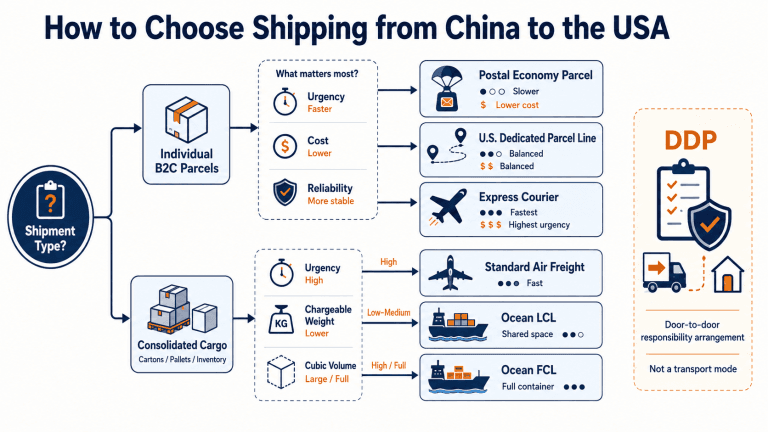
The cheapest way to ship from China to the USA depends on the shipment, not the country pair alone. Express courier usually makes sense for samples and small urgent parcels. A U.S. dedicated parcel line can be a better fit for ecommerce sellers sending repeat B2C orders from a China warehouse directly to American customers. Standard air freight becomes more attractive for consolidated cartons or pallets as chargeable weight increases. Ocean freight is normally the first option to price for heavy or high-volume cargo, but an LCL shipment can collect enough origin, consolidation and destination fees to lose its apparent advantage.
For planning purposes, allow roughly 3–8 business days for express, about 5–12 business days for many dedicated parcel-line products, 7–14 days for standard air freight and 30–50 days for a normal door-to-door ocean shipment. Those are working ranges, not carrier guarantees. The origin city, U.S. destination ZIP code, cargo type, customs entry, last-mile carrier, season and Incoterm can move the result in either direction.
Rate and policy note: Freight rates change weekly, sometimes daily. The market figures in this guide were checked on June 23, 2026. They are reference points, not a Fulfillbot quote. U.S. tariff treatment is also product-specific. Confirm the current HTS classification, customs rules and written quote before shipping.
Quick answer: which shipping method should you use?
| Shipping method | Planning time to the U.S. | Usually best for | How it is priced | Main trap |
|---|---|---|---|---|
| Express courier | 3–8 business days | Samples, documents and small urgent cartons | Actual or dimensional weight | A light but bulky box can cost far more than expected |
| U.S. dedicated parcel line | Often about 5–12 business days, depending on the product and ZIP code | Repeat B2C parcels sent from a China warehouse to U.S. consumers | Chargeable weight per parcel, service tier | Some companies use invalid tracking numbers, resulting in packages failing to be delivered properly. |
| Standard air freight | 7–14 days door to door | Time-sensitive commercial cargo that is too large for economical courier service | Chargeable weight, route and handling | Airport charges, pickup and final delivery may sit outside the headline rate |
| Ocean LCL | 30–55 days door to door | Cargo too large for air but too small for a full container | CBM or weight/measure, plus consolidation and local charges | Destination CFS and handling fees can erase a cheap ocean rate |
| Ocean FCL | 25–45 days door to door | Larger, repeatable inventory shipments | Flat container rate plus local charges | Paying for a container does not mean pickup, customs or delivery is included |
| DDP by air or sea | Depends on the underlying mode | Buyers who want one door-to-door price and less coordination | All-in quote from the seller or forwarder | Unclear importer-of-record, valuation or duty arrangements |
| Postal or economy parcel | Often 8–20+ days | Low-weight, low-urgency parcels when the service is available | Parcel weight, size, service and duty collection method | Weak predictability, limited tracking and no blanket U.S. duty-free treatment under $800 |
There is no universal weight at which one mode suddenly becomes cheapest. A useful first pass is:
- price express for a small sample or a few compact cartons;
- compare a dedicated parcel line with express when individual ecommerce orders will be fulfilled directly from China;
- price air and LCL side by side once the shipment becomes commercial freight;
- price FCL as the cargo approaches roughly 12–15 CBM, because LCL handling and destination fees start to matter more;
- compare door-to-door totals, not a courier rate against a port-to-port ocean rate.
The 12–15 CBM point is a prompt to request an FCL quote, not a rule. Dense cargo, port charges, container availability and the delivery address can move the crossover substantially.
How much does shipping from China to the USA cost?
An accurate quote needs an origin, destination, cargo description, carton dimensions, weight, Incoterm and delivery scope. Without those details, a per-kilo or per-container number is closer to advertising than a shipping plan.
A June 2026 market snapshot
Freightos publishes route data based on its freight-market platform. On June 22, 2026, its public China–U.S. series showed the following examples:
| Public market series | June 22, 2026 reference |
|---|---|
| Air freight, Shanghai to Houston | about $6.73/kg |
| Air freight, Shanghai to Los Angeles | about $10.68/kg |
| Air freight, Shanghai to New York | about $11.55/kg |
| FCL route series, Ningbo to Los Angeles | about $7,250 |
| FCL route series, Ningbo to New York | about $8,813 |
| FCL route series, Ningbo to Houston | about $8,951 |
These figures show why an old claim such as “air is $4 per kilogram” or “a container costs $3,000” cannot sit in a guide without a date. They also are not door-to-door quotes: the public route series says nothing about pickup, destination handling, customs, duty, insurance or final delivery.
For LCL, a forwarder may quote an ocean amount per CBM and then add origin handling, consolidation, documentation, destination CFS charges, customs clearance and local delivery. For express, the final parcel price depends heavily on dimensional weight and the account discount available to the shipper. Ask for the complete cost to your actual address.
What makes the quote move?
The biggest cost drivers are:
- actual weight and packed dimensions;
- whether the shipment is one consolidated cargo lot or many consumer parcels;
- daily parcel volume, average parcel weight and destination ZIP-code mix for a dedicated line;
- product type, especially batteries, liquids, magnets, powders, chemicals and other restricted cargo;
- pickup city in China and destination ZIP code in the United States;
- express, air, LCL or FCL service;
- airport-to-airport, port-to-port or door-to-door scope;
- EXW, FOB, CIF, DAP or DDP terms;
- fuel, peak-season and security surcharges;
- customs brokerage, bonds, duties and product-specific fees;
- inspection, demurrage, detention and storage if something is delayed;
- residential, liftgate, appointment or Amazon delivery requirements;
- cargo insurance.
If one forwarder is dramatically cheaper than the others, compare the exclusions before celebrating. The missing money often reappears as a destination charge.
Actual weight versus dimensional weight
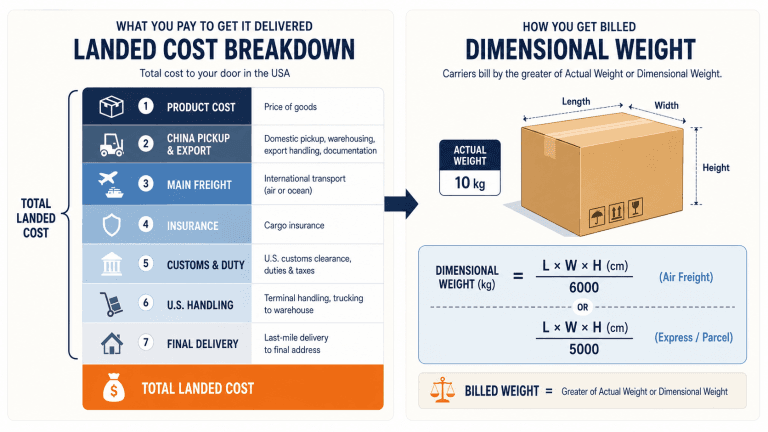
Couriers and airlines cannot sell the same cargo space twice. A box that weighs 10 kg but occupies the space of a much heavier box may be billed on dimensional weight.
A common air or courier formula is:
Length × width × height in centimeters ÷ divisor = dimensional weight in kilograms
The divisor is often 5,000 or 6,000, depending on the carrier and service. Always use the divisor shown in the quote.
Suppose one carton is 60 × 40 × 40 cm and actually weighs 10 kg:
- using 6,000: 60 × 40 × 40 ÷ 6,000 = 16 kg;
- using 5,000: 60 × 40 × 40 ÷ 5,000 = 19.2 kg.
The carrier normally bills the higher of actual and dimensional weight. That 10 kg carton could therefore be charged as 16 or 19.2 kg.
For LCL ocean freight, volume is commonly expressed in cubic meters. Some quotes use weight/measure rules, meaning a dense shipment may be billed by weight instead of volume. Ask the forwarder to show the revenue tons, minimum charge and local fees used in the calculation.
How dedicated parcel-line pricing works
U.S. dedicated parcel line is normally quoted per parcel using the higher of actual weight and the service’s dimensional weight. The price can also depend on the daily or monthly parcel volume, product category, delivery zone, last-mile carrier and selected speed tier.
Do not reuse a courier or air-freight divisor without checking the product rules. Divisors can differ by dedicated-line service; for example, one current YunExpress/4PX standard product publishes length × width × height in centimeters ÷ 8,000 for volumetric weight in many markets. Other products may use a different divisor or size rule.
Ask whether the quote includes:
- pickup or warehouse processing in China;(Not every city is covered, so we need to confirm whether door-to-door pickup is available in your area.)
- duty collection or a clearly documented duty-paid arrangement;
- delivery to a residential ZIP code;
- return, refusal, failed-delivery and destruction fees;
- loss and damage compensation limits.
The main difference in pricing comes from flight allocation. Therefore, higher-priced routes usually have faster transit times and can sometimes be as fast as express courier services.
Compare landed cost, not just freight
The useful number is the cost of getting sellable inventory to the place where you need it. A basic landed-cost model is:
Product cost + China pickup/export charges + main freight + insurance + customs/brokerage + duties/fees + U.S. delivery + handling = landed cost
For a clean comparison, send every forwarder the same shipment data and request the same delivery scope. Comparing an EXW air quote with a DDP ocean quote tells you very little.
Our guide to why a supplier shipping quote can look so expensive explains how freight, customs work, duty, local delivery and supplier markup can be bundled into one number. The separate guide to Alibaba shipping costs covers supplier quote problems in more detail.
What is the cheapest shipping method from China?
The cheapest method is the one with the lowest acceptable door-to-door cost for your shipment. The word “acceptable” matters. A slower ocean service can reduce freight cost but create a stockout, tie up cash for another month or arrive after a selling season.
Express is often sensible for samples
Use express when the shipment is small, compact and worth receiving quickly. A sample sent by DHL, UPS or FedEx is simple to track and usually clears through the courier’s network. You also get an early test of the supplier’s packing and paperwork before committing to a larger order.
Do not assume express has a low per-kilo rate. Its advantage is low setup friction and fast door-to-door handling, not cheap large-volume transport.
Dedicated parcel line
In fact, for small parcels (1–20 kg) shipped to the United States, I would actually recommend using dedicated shipping lines instead of express couriers. The overall transit time is similar to express delivery, and they can deliver directly to your address.
The only thing you need to confirm is whether your supplier can support this service (they need a proper shipping account and a logistics provider that offers pickup service). Many trading companies and factories are simply not aware of this shipping option.
Air freight works when time has a real cost
Air freight suits inventory that is too large for a sensible courier quote but cannot wait for ocean freight; it can also protect a launch or prevent a stockout. Ask for the complete door-to-door price, not just the airline rate—pickup, export handling, screening, terminal fees, customs and final delivery sit outside the headline number.
LCL works for smaller ocean shipments, with caveats
LCL lets your cargo share a container—a good fit for a few pallets or several cubic meters of non-urgent stock. The trade-off is more handling: cargo is consolidated at origin, unloaded at a destination facility and released separately, which adds time, raises the risk of delay or damage, and creates CFS and documentation fees at both ends. Get the destination charge schedule before booking.
FCL becomes attractive before the container is physically full
FCL gives your shipment dedicated container space. It has fewer consolidation steps and is usually easier to track than LCL. You do not need to fill every cubic meter for FCL to make financial sense.
Once a shipment approaches the low-to-mid teens in CBM, request both LCL and FCL quotes. Compare the same pickup, destination, customs and delivery scope. FCL may win because the flat container cost replaces a rising stack of per-CBM and handling charges.
DDP is not a transport mode
DDP means Delivered Duty Paid. It describes the seller’s delivery and import obligations under the agreed Incoterm; the physical shipment can still move by express, air or sea.8
DDP can be convenient. It can also hide the importer-of-record, customs value, HTS code and duty calculation. Treat “all included” as the beginning of the conversation, not the end.
Dedicated parcel line, express, air freight or sea freight: a closer comparison
Express courier
Express is built around parcels and a tightly managed door-to-door network.
Choose it when:
- you are sending samples or replacement parts;
- the shipment is small and easy to pack;
- delivery speed matters more than the lowest per-unit freight cost;
- you want simple online tracking.
Check the carrier’s rules before shipping batteries, liquids, aerosols, perfume, magnets or other restricted items. A supplier saying “we ship batteries every day” is not a substitute for correct packaging, labeling and documentation.
U.S. dedicated parcel line
A U.S. dedicated parcel line is a cross-border B2C parcel product. Chinese logistics providers may call it a U.S. special line, cross-border B2C dedicated line or direct-line parcel service. In this guide, all of those labels refer to the same basic operating model:
- receive and label individual orders in China;
- consolidate many parcels for the international movement;
- move the consolidated load to the United States, usually by air;
- complete the applicable U.S. customs process;
- deconsolidate the load after arrival;
- hand each parcel to a contracted U.S. last-mile carrier.
It sits between postal economy and premium international express, but it should not be confused with standard air freight.
| Question | Postal economy parcel | U.S. dedicated parcel line | International express | Standard air freight |
|---|---|---|---|---|
| What is shipped? | Individual parcels | Individual B2C orders | Individual parcels or small cartons | Consolidated cartons, pallets or cargo lots |
| Main network | Postal or economy network | Specialist line-haul plus contracted U.S. last mile | DHL, UPS, FedEx or another integrated express network | Airline and freight-forwarder network |
| Typical use | Low-value, low-urgency parcel | Repeat ecommerce fulfillment from China | Samples, urgent or high-value parcels | Inventory replenishment and commercial cargo |
| Tracking | Often limited or slower to update | Parcel-level tracking, often with a second last-mile number | Detailed end-to-end courier tracking | Air waybill and forwarder milestones |
| Main risk to check | Predictability and customs treatment | Customs method, handoff, restrictions and returns | Dimensional weight and surcharges | Terminal, brokerage and final-delivery charges |
Dedicated line does not mean duty-free, and it is not automatically DDP. A line may be sold with a duty-paid or duty-collected option, but the transport product and the customs responsibility arrangement are separate decisions—so apply the same customs checks set out under U.S. customs below.
Choose it when:
- you ship repeat orders from a China warehouse to U.S. residential addresses;
- most parcels fall inside the line’s weight, dimension and product limits;
- you can provide accurate item-level descriptions, values, origin and classification data;
- a delivery window around one to two weeks is acceptable;
- the provider has a workable U.S. return and claims process.
Standard air freight
Air freight is commercial cargo that moves through airport terminals rather than a parcel network. It often needs a freight forwarder to arrange pickup, screening, export handling, the air waybill, U.S. customs coordination and final delivery.
Choose it when:
- the shipment is time-sensitive but too large for a good express rate;
- the goods have enough margin to absorb a higher freight cost;
- stockout cost is greater than the air/ocean price difference;
- the cargo is suitable for air transport.
Air freight is not automatically allowed for every product. Batteries and other dangerous goods require the correct service, packaging and paperwork.
Ocean LCL and FCL
Ocean freight usually has the lowest variable cost for heavy cargo. It also has more moving parts: container booking, cut-off dates, export declaration, port handling, sailing, arrival notice, customs release and final drayage.
Choose LCL when the shipment is too large for economical air freight but still well below a practical FCL load. Choose FCL when the LCL total approaches a container quote, or when reducing handling and improving predictability matters.
The cheapest ocean quote can become the most expensive shipment if it excludes destination charges or uses an unreliable routing. Ask which carrier and service will be used, whether the sailing is direct and what happens if cargo misses the planned vessel.
How long does shipping from China to the USA take?
Shipping time can mean four different things:
- factory-to-port or factory-to-airport preparation;
- the main international transit;
- customs clearance and terminal release;
- final delivery to a home, warehouse, 3PL or Amazon facility.
A forwarder quoting 18 days may be describing port-to-port transit. A buyer hearing 18 days may be imagining factory-to-warehouse delivery. Put the start and end point in writing.
Typical planning ranges
| Mode | Main movement | Practical door-to-door planning range |
|---|---|---|
| Express courier | 2–5 business days on many standard services | 3–8 business days |
| U.S. dedicated parcel line | Consolidated international line-haul plus U.S. parcel delivery | often about 5–12 business days from warehouse acceptance, depending on the product and ZIP code |
| Standard air freight | often 3–7 days airport to airport | 7–14 days |
| Ocean FCL to U.S. West Coast | often about 15–30 days port to port | 25–45 days |
| Ocean FCL to Gulf/East Coast | often about 25–40+ days port to port | 35–55+ days |
| Ocean LCL | similar sailing plus consolidation time | often 5–14 days longer than comparable FCL |
These are normal-condition ranges assembled from current route guidance and common forwarder workflows. Weather, port congestion, customs exams, missed cut-offs, holidays, blank sailings and inland delivery capacity can extend them.
Dedicated-line time is especially product-specific. One current YunExpress U.S. standard product publishes 5–8 business days, but that figure should not be applied to every provider, cargo category or destination. Ask when the clock starts, whether the estimate includes China warehouse processing and which U.S. ZIP codes need additional days.
A realistic shipment timeline
For commercial air or ocean cargo, allow time for:
- the supplier to finish packing and issue final carton data;
- pickup or delivery to the forwarder’s warehouse;
- export documents and booking confirmation;
- consolidation, if using LCL or air consolidation;
- the international flight or sailing;
- arrival handling and customs entry;
- customs or agency review, if selected;
- payment or confirmation of charges;
- release and final delivery.
Chinese public holidays can slow supplier pickup and warehouse processing even when ports continue operating. Plan around Lunar New Year in particular. Ask for the supplier’s last production day, the forwarder’s cargo cut-off and the first realistic sailing or flight after the holiday.
Main China–U.S. routes and ports
Common Chinese origin areas include Shenzhen/Yantian, Guangzhou/Nansha, Shanghai, Ningbo, Qingdao, Xiamen and Tianjin. The right origin is normally the one near the factory, unless another port provides a materially better service or rate.
Common U.S. gateways include:
- Los Angeles and Long Beach for West Coast entry;
- Oakland and Seattle/Tacoma for selected western routings;
- Houston and Savannah for Gulf or southern distribution;
- New York/New Jersey for East Coast entry;
- major air gateways such as Los Angeles, Chicago, Dallas, New York and Miami.
The port is only part of the route. A low ocean rate into Los Angeles may not be economical if the stock ultimately needs to reach the East Coast. Compare ocean transit, port conditions and inland delivery together.
U.S. customs, duties and the $800 rule in 2026
Packages valued at or under $800 should not be assumed to enter the United States duty-free.
The United States suspended duty-free de minimis treatment for low-value goods from China and Hong Kong in May 2025. A later order suspended duty-free treatment for qualifying low-value commercial shipments from all countries effective August 29, 2025, and the suspension was continued in February 2026.23
That does not mean every shipment has one flat tariff. The duty depends on the product’s HTS classification, country of origin, customs value and any additional trade measures or product-specific rules. CBP states that the importer is ultimately responsible for duties owed on an import.
Use the correct HTS classification
The Harmonized Tariff Schedule of the United States is the starting point for classifying imported goods and checking general duty rates. Chinese-origin products may also be affected by Section 301 measures or other trade remedies, depending on the tariff line.
Do not choose an HTS code because it has a lower rate. Classify the actual product based on its material, function, construction and applicable legal notes. If classification is unclear or the commercial exposure is significant, use a licensed customs broker or request a binding ruling from CBP.
Declare the real transaction value and origin
Never ask a supplier or forwarder to keep the declared value under a threshold, use a false HTS code or route Chinese goods through another country with a false origin claim. A cheap DDP quote does not remove the importer’s need to understand how the entry is being made.
Before accepting DDP, ask:
- Who is the importer of record?
- Which HTS code will be used?
- What customs value will be declared?
- Which country of origin will be declared?
- Who is the customs broker?
- Are duties shown separately or built into the quote?
- Will you receive the entry documents after clearance?
If the provider will not answer, the quote is not transparent enough.
Apply the same seven questions to a dedicated parcel line described as “tax included” or “DDP”; a consolidated B2C model does not exempt the provider from explaining how each parcel is declared and cleared. Each parcel also needs an accurate item description, quantity, value and origin; labeling a shipment “sample” or “accessory” does not solve a customs-data problem.
Customs broker, CBP Form 7501 and bonds
A customs broker can prepare or transmit entry information, coordinate with CBP and help the importer manage classification and documentation. The broker does not make a bad product description true or erase duties. The importer still needs accurate supplier information.
CBP Form 7501 is the Entry Summary used in formal entry workflows. It records information such as classification, value, duty and parties to the entry. Ask whether the shipment will create a 7501 and how you will receive it. Not every parcel or informal entry uses the same documentation.
Commercial entries may also require a customs bond. Ocean imports have an additional timing requirement: Importer Security Filing, commonly called ISF or “10+2,” must be handled before the cargo is loaded for the United States. Confirm who is filing and obtain proof rather than assuming the forwarder has done it.
Other government agencies may regulate food, cosmetics, medical devices, wood products, textiles, electronics or products containing chemicals. Shipping paperwork alone does not make a regulated product admissible.
EXW, FOB, CIF, DAP and DDP: who pays for what?
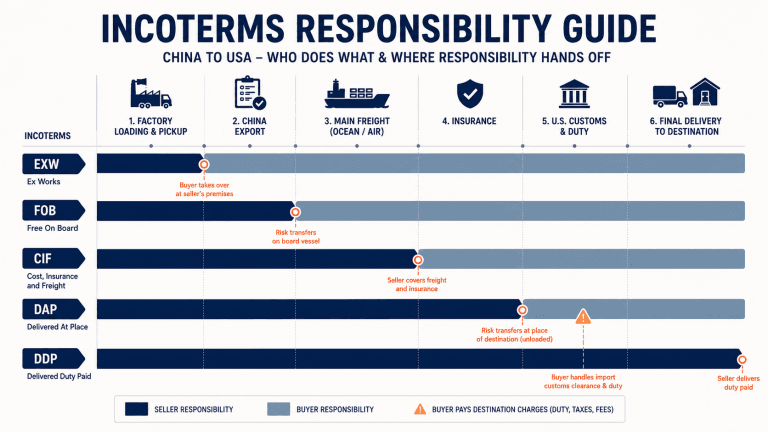
Incoterms allocate delivery tasks, costs and risk between seller and buyer. They do not set product ownership, payment terms or U.S. customs law.
| Term | What the seller generally handles | What the buyer generally handles | Common issue |
|---|---|---|---|
| EXW | Makes goods available at the named premises | Loading/pickup, export arrangement, main freight, import and delivery | Buyers underestimate China pickup and export formalities |
| FOB | Export clearance and delivery on board at the named port | Main ocean carriage, insurance if wanted, U.S. import and delivery | The named port and booking responsibilities must be clear |
| CIF | Cost, insurance and freight to the named destination port | Import clearance, destination charges and final delivery | A cheap CIF quote can leave large destination fees |
| DAP | Delivery to the named place, ready for unloading | Import clearance, duty and tax | Buyer must be ready to act as or appoint the importer |
| DDP | Delivery to the named place with import duty handled by seller | Usually unloading and buyer cooperation | Seller may lack a lawful, transparent U.S. import structure |
DDU is an older term that was replaced by DAP in the ICC rules. It still appears in supplier messages, so ask the seller to restate the current term, named place and responsibilities. Our comparison of DDP and DAP shipping terms provides a longer explanation, but the written quote for the actual shipment controls the commercial arrangement.
Documents normally needed for a China–U.S. shipment
The exact file depends on the cargo and entry type, but most commercial shipments start with:
- commercial invoice with buyer, seller, product description, quantity, unit value, currency, total value, Incoterm and country of origin;
- packing list with carton count, net/gross weight and dimensions;
- bill of lading for ocean freight or air waybill for air freight;
- HTS classification and product details supporting that classification;
- importer and customs-broker information;
- customs bond and power of attorney where required;
- ISF data for ocean shipments;
- product-specific permits, test reports, registrations or declarations where applicable;
- cargo insurance certificate if insurance is purchased.
Descriptions such as “accessories,” “sample” or “gift” are usually too vague for commercial goods. The invoice should say what the product actually is and what it is made from.
Shipping to Amazon FBA from China
Amazon is a delivery destination, not your customs broker or importer of record. Before sending inventory, create the shipment in Seller Central and confirm the current receiving, carton, pallet, label and appointment requirements.
The forwarder should know:
- the final Amazon destination or assigned routing;
- carton and pallet labels;
- whether the load is small parcel, less-than-truckload or full truckload after U.S. entry;
- appointment requirements;
- who handles import clearance and duties;
- what happens if Amazon refuses or delays delivery.
Do not send first and solve prep later. Incorrect FNSKU labels, carton data or pallet configuration can create rework after the international freight has already been paid. If needed, arrange Amazon FBA prep before export or at a controlled warehouse.
Four shipment examples
These examples are decision exercises, not price quotes.
Example 1: two sample cartons
- 18 kg actual weight
- 0.11 CBM
- ordinary non-hazardous goods
- delivery to a U.S. business address
- needed within one week
Start with express. Check the dimensional weight of both cartons and compare two courier services. Standard air freight may have lower line-haul pricing but too much minimum handling for a shipment this small.
Example 2: repeat DTC orders fulfilled from China
- about 100 consumer parcels per day
- most parcels weigh 0.4–1.5 kg
- inventory is stored at a China fulfillment warehouse
- delivery is to residential ZIP codes across the United States
- ordinary consumer products that fit the line’s restrictions
Compare at least two U.S. dedicated parcel-line products with an express account rate. Standard air freight is not an order-level delivery solution unless the inventory first moves in bulk to a U.S. warehouse. Compare the parcel-line delivery zones, dimensional-weight rule, customs and duty arrangement, last-mile carrier, tracking handoff, return address and compensation policy—not only the per-kilogram rate.
Example 3: inventory replenishment at risk of stocking out
- 180 kg actual weight
- 1.2 CBM
- established product with healthy margin
- warehouse needs inventory within two weeks
Price air freight door to door and LCL ocean. Air may cost more, but the relevant comparison includes lost sales and stockout time. A split shipment can also work: send enough by air to protect sales, then move the balance by sea.
Example 4: 14 CBM of repeat inventory
- 14 CBM
- non-urgent replenishment
- stable supplier and packaging
- delivery to a U.S. 3PL
Request both LCL and 20-foot FCL quotes. Compare destination handling, free time, customs, drayage and delivery. At this volume, FCL may be cheaper even though the container is not completely full.
How to get an accurate shipping quote
Send this information in one message:
- product name, material and intended use;
- whether the cargo contains batteries, liquids, magnets, powders, wood or other controlled materials;
- total units and carton count;
- packed carton dimensions;
- gross weight per carton and total gross weight;
- total CBM;
- pickup address or city in China;
- destination address and ZIP code in the United States;
- EXW, FOB or other supplier term;
- required delivery date;
- airport/port or door-to-door scope;
- whether duties should be separated or included;
- importer-of-record and customs-broker plan;
- Amazon, 3PL, residential, liftgate or appointment requirements;
- insurance requirement and cargo value.
Then ask each forwarder to break out:
- China pickup and export charges;
- main freight;
- fuel and security surcharges;
- customs brokerage and bond;
- estimated duties, clearly separated from freight;
- destination terminal or CFS charges;
- final-mile delivery;
- insurance;
- exclusions and possible exception charges;
- quote expiry date and planned route.
That is how you compare like with like.
Buying from several 1688 suppliers? Follow the 1688 receiving and consolidation steps to reconcile incoming orders and confirm the final packed dimensions before requesting a U.S. freight quote.
For a dedicated parcel-line quote, also provide:
- expected parcels per day or month;
- average and 90th-percentile parcel weight and dimensions;
- SKU mix and the percentage containing batteries or other sensitive goods;
- destination ZIP-code distribution;
- required delivery SLA and tracking events;
- insurance or signature requirements;
- expected return and failed-delivery process.
Ask for a sample parcel-cost calculation and a complete surcharge table. Confirm the line operator, U.S. last-mile carrier or carrier options, service limits, duty handling, return address, claims deadline and compensation cap.
How to choose China–U.S. freight forwarder
A freight forwarder arranges cargo movement for the shipper or importer. A traditional shipping or port agent usually represents the vessel or carrier at the port. In China sourcing, companies often use “shipping agent” as a loose marketing term, so verify the work rather than relying on the label. Our guide to freight forwarder and shipping agent explains the distinction.
Ask a potential forwarder:
- Which China–U.S. lanes and cargo types do you handle regularly?
- Are you quoting as a forwarder, NVOCC, courier reseller or warehouse consolidator?
- Which carrier or service will be used?
- Who handles U.S. customs brokerage?
- Who will be importer of record?
- Can I review a draft bill of lading or air waybill before departure?
- Which charges are excluded?
- What insurance is available?
- How are customs exams, storage, demurrage and failed delivery billed?
- Can you support my U.S. warehouse, 3PL or Amazon delivery requirements?
If the provider is quoting a dedicated parcel line, also ask which company operates the international line, which carrier performs the U.S. last mile, whether the last-mile carrier can change by ZIP code, how undeliverable parcels are handled and who owns a claim when the parcel is between networks.
A serious provider will ask you just as many questions. Fast, vague quotes are easy to issue because the difficult costs have not been considered yet.
Fulfillbot provides freight forwarding from China for importers, retailers and ecommerce sellers that need supplier pickup, consolidation, shipping coordination and delivery support. For an actual comparison, send the packed shipment details and destination rather than a product-page link alone.
How to track shipment from China
If it’s a sea freight container, you can track it on this website.
Air freight
you can check Air freight in this site
Express & Small Package
If you want track your express or small package then you can track in this site
Our guide to tracking a package from China covers common tracking statuses and handoffs.
Frequently asked questions
What is the cheapest way to ship from China to the USA?
Ocean freight is usually the first method to price for heavy or high-volume commercial cargo. Express can be cheaper for a small compact parcel because it avoids freight minimums and separate local handling. Air freight often sits between them. Compare complete door-to-door quotes using the same cargo details and Incoterm.
For repeat B2C orders shipped directly from a China warehouse, a dedicated parcel line may cost less than premium express while remaining faster and more trackable than a basic postal economy service.
How much does shipping from China to the USA cost per kilogram?
There is no single per-kilogram price. Air and courier rates depend on route, chargeable weight, cargo type and service. In Freightos’s June 22, 2026 public air series, Shanghai–U.S. examples ranged from about $6.73 to $11.55 per kg before the full door-to-door cost was known.
How long does shipping from China to the USA take?
Allow roughly 3–8 business days for express, about 5–12 business days for many dedicated parcel-line products, 7–14 days for standard air freight and 30–50 days for a normal door-to-door ocean shipment. LCL can take longer than FCL because cargo must be consolidated and deconsolidated. Every range depends on the start point, destination and service conditions.
What is U.S. special line from China?
U.S. special line is another name used by many Chinese logistics providers for a U.S. dedicated parcel line. The provider collects individual ecommerce parcels in China, consolidates the international movement, arranges U.S. customs processing and hands each parcel to a local carrier for final delivery.
Is a dedicated parcel line the same as air freight?
No. A dedicated parcel line is an order-level door-to-door product, usually using consolidated air line-haul and a contracted U.S. parcel carrier. Standard air freight moves consolidated commercial cargo through airport and freight-forwarder networks; it does not normally deliver each consumer order separately.
Do packages under $800 still enter the United States duty-free?
Do not assume so. Duty-free de minimis treatment for qualifying low-value commercial shipments was suspended globally effective August 29, 2025, after an earlier suspension for China and Hong Kong. The suspension continued in 2026. Applicable duty still depends on the product, origin, value and current trade rules.
What information is needed for a shipping quote?
Provide the product description, cargo restrictions, carton count, packed dimensions, gross weight, CBM, China pickup point, U.S. delivery address, Incoterm, delivery deadline and customs/duty scope. A product link and unit quantity are not enough.
Final shipping checklist
Before the cargo leaves China:
- verify the final carton dimensions, weight and CBM;
- compare the same door-to-door scope across quotes;
- confirm the Incoterm and named place;
- review the commercial invoice and packing list;
- confirm the HTS code, customs value and country of origin;
- identify the importer of record and customs broker;
- confirm ISF filing for ocean freight;
- check restricted-cargo requirements;
- for dedicated parcels, confirm the line operator, customs method, last-mile carrier, return process and claims responsibility;
- buy cargo insurance when the risk justifies it;
- obtain the route, cut-off, ETA and tracking documents in writing.
The lowest headline rate is rarely the whole answer. The better shipment is the one whose cost, documents and responsibilities still make sense when the cargo reaches U.S. customs.
Sources
- Freightos, Shipping from China to the United States, public route data and planning guidance checked June 23, 2026. Live quotes may differ.
U.S. Customs and Border Protection, E-Commerce FAQs, including the suspension of duty-free treatment for low-value shipments.
White House, Suspending Duty-Free De Minimis Treatment for All Countries and Continuing the Suspension of Duty-Free De Minimis Treatment.
U.S. International Trade Commission, Harmonized Tariff Schedule and CBP, Determining Duty Rates.
U.S. Customs and Border Protection, Section 301 Trade Remedies FAQs.
International Trade Administration, Customs Brokers and Freight Forwarders and Shipping Options.
U.S. Customs and Border Protection, Importer Security Filing (10+2).
YunExpress, Cross-Border B2C Dedicated Line and Standard Express, product structure, U.S. reference time and volumetric-weight guidance checked June 24, 2026. Product limits and service times can change.