If you are importing goods from China, you usually need a freight forwarder, not a traditional shipping agent. A freight forwarder organizes the shipment from the supplier to your final destination. A shipping agent, in formal maritime logistics, usually works for the vessel owner or carrier at the port. In China sourcing, though, many companies use “shipping agent” loosely even when they are really selling freight forwarding, consolidation, DDP, or door-to-door delivery.
That is where many buyers get the trade-off wrong: they compare labels, not responsibilities. The useful question is simple: who is actually responsible for pickup, export, freight, customs, duties, and final delivery?
This article uses the formal industry distinction from sources such as the U.S. Federal Maritime Commission, the International Trade Administration, and the International Chamber of Commerce Incoterms rules, then translates that into the messier reality of China sourcing.
Quick answer: which one do importers usually need?
For most Alibaba orders, ecommerce imports, and Amazon FBA shipments, you usually need a China freight forwarder or a company calling itself a China shipping agent that clearly performs freight-forwarding work.
Here is the short version:
| Situation | Best fit |
|---|---|
| Samples or small parcels | Courier service or a simple China shipping agent |
| Alibaba bulk order | Freight forwarder |
| Amazon FBA shipment | Freight forwarder with FBA experience |
| LCL or FCL sea freight | Freight forwarder or NVOCC |
| Port and vessel operations | Traditional shipping agent or port agent |
| DDP door-to-door shipment | Forwarder offering DDP, with compliance checks |
For a growing importer, fulfillment is not a back-office detail. It is part of the offer. If the shipment is commercial, valuable, or repeatable, you need more than a vague “we can ship it” promise.
Why the terms are confusing in China shipping
The confusion starts because the phrase shipping agent means different things in different contexts.
In formal maritime logistics, a shipping agent usually represents the shipowner, vessel, or carrier at the port. But in China sourcing, many companies use “shipping agent” as a broad marketing term because buyers search for it. The company may actually be a warehouse consolidator, freight forwarder, DDP line operator, courier reseller, or local middleman who coordinates delivery from China.
That does not automatically make the company unreliable. It just means the label tells you less than you think.
Working with a China shipping agent can be completely fine for some shipments, but only if you verify what the company actually handles.
What is a China freight forwarder?
A China freight forwarder arranges the movement of cargo from a supplier or warehouse in China to the buyer’s final destination. The forwarder usually does not own every truck, plane, container vessel, or warehouse involved. Instead, it coordinates the chain.
Typical freight forwarder services include:
- factory pickup
- receiving goods at a China warehouse
- consolidating cargo from multiple suppliers
- arranging export declaration
- booking sea freight, air freight, rail freight, truck freight, or express service
- handling LCL and FCL shipments
- reviewing shipping documents such as invoices and packing lists
- coordinating customs clearance through brokers or local agents
- arranging cargo insurance
- delivering to a home, business, 3PL, or Amazon FBA warehouse
The U.S. Federal Maritime Commission treats ocean freight forwarders as transportation intermediaries, and the International Trade Administration notes that freight forwarders can help with freight costs, packing, insurance, documentation, and booking space on vessels, aircraft, trains, or trucks. That matches how most importers use the term: not the carrier itself, but the organizer of the shipment.
A cheaper supplier is not always a cheaper supply chain. A good forwarder proves its value when something goes wrong: a delay, an inspection, a mislabeled carton, or a missing document.
What is a China shipping agent?
Traditional meaning
Traditionally, a shipping agent represents the vessel owner, carrier, or shipping line at the port. Their work is tied to port and vessel operations rather than the buyer’s whole import process.
Typical responsibilities can include:
- vessel arrival and departure coordination
- port documentation
- communication with terminal and port authorities
- arranging berth-related formalities
- handling charges and local port administration
- local carrier-side support
In that traditional sense, a shipping agent is not the same as a freight forwarder. Industry explainers from logistics providers such as Drip Capital and PGS Logistics make the same practical distinction: freight forwarders coordinate cargo movement for the shipper or importer, while shipping agents are more closely tied to vessel, carrier, and port-side operations.
China sourcing meaning
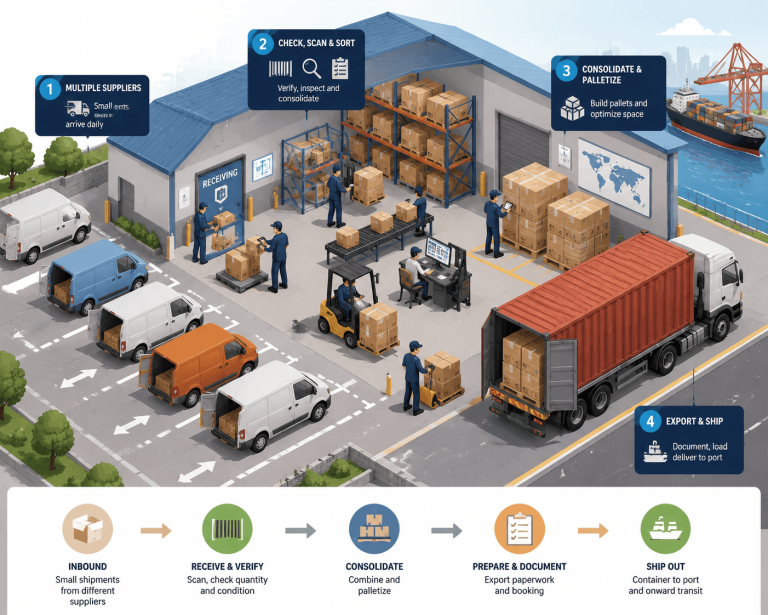
In Alibaba, 1688, and ecommerce sourcing language, a China shipping agent often means a local logistics helper. They may receive parcels, consolidate products from different suppliers, repack cartons, quote air or sea freight, and send cargo overseas.
Possible services include:
- receiving products from multiple suppliers
- warehouse storage and consolidation
- repacking and relabeling
- DDP door-to-door shipping
- courier, air, or sea quotes
- tracking and export support
This is where the market gets fuzzy. Some of these companies are effectively freight forwarders. Some are warehouse-based coordinators. Some resell other logistics lines. Some are fine for simple ecommerce shipments but not strong enough for customs-sensitive cargo.
Freight forwarder vs shipping agent: the key differences
The clearest way to compare them is by role, responsibility, and who they represent.
| Factor | China freight forwarder | China shipping agent |
|---|---|---|
| Traditional role | Arranges cargo transport for the shipper or importer | Represents the vessel owner, carrier, or shipping line at port |
| Buyer-facing role | Usually buyer-facing | Traditionally less buyer-facing; China ecommerce usage often is buyer-facing |
| Main responsibility | Moves cargo from origin to destination | Handles vessel or port-side coordination, or loosely defined logistics help |
| Transport modes | Sea, air, rail, truck, express, multimodal | Traditionally port and ocean focused; loosely used agents may offer many modes |
| Customs involvement | Often coordinates customs through brokers or overseas partners | Traditional shipping agent usually does not replace the importer’s customs process |
| Best for | Importers, FBA sellers, commercial cargo, repeat shipments | Port operations, small parcel consolidation, or simple door-to-door support |
| Main risk | Buyer assumes more is included than the quote actually covers | Buyer hires a middleman with unclear responsibility |
The more commercial your shipment becomes, the more you should care about accountability, not terminology.
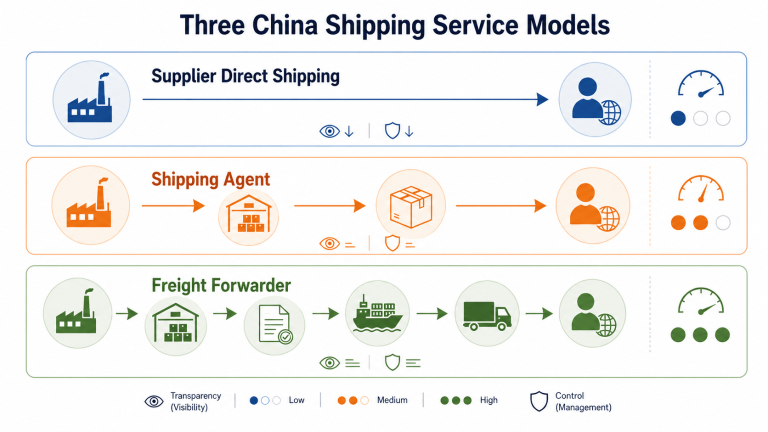
Supplier shipping vs freight forwarder vs shipping agent
This is the real buying decision behind most searches.
Supplier shipping
When the supplier arranges shipping, the process feels simple. For small or straightforward shipments, that convenience can be enough.
Pros:
- easy for first-time buyers
- less coordination for the importer
- sometimes cheaper on small shipments
- supplier may already work with a regular forwarder
Cons:
- low transparency on freight cost breakdown
- less control over routing and documents
- weak tracking or support in some cases
- higher risk that shipping becomes a hidden profit center
If you are comparing prices, our guide on Alibaba shipping costs explains why quotes that look cheap upfront can become expensive after destination charges, poor routing, or vague DDP terms.
Independent freight forwarder
An independent forwarder usually works more clearly for the importer.
Pros:
- better control over Incoterms and routing
- clearer quote structure
- easier to standardize repeat shipments
- stronger support for insurance, customs, and final delivery
- better fit for LCL, FCL, and FBA cargo
Cons:
- may look more expensive on very small shipments
- requires more shipment details before quoting
- needs proper vetting before you trust them
This is where many sellers get the trade-off wrong: they compare unit freight price, not total delivery risk.
China shipping agent
A China shipping agent can be useful when the job is simple and the provider is clear about what is included.
Pros:
- flexible for samples and ecommerce parcels
- useful for multi-supplier consolidation
- often responsive on WhatsApp or WeChat
- may offer simple DDP lines
Cons:
- role can be vague
- may be a reseller rather than the actual logistics operator
- responsibility can get blurry if cargo is delayed, inspected, damaged, or lost
Incoterms matter more than the job title
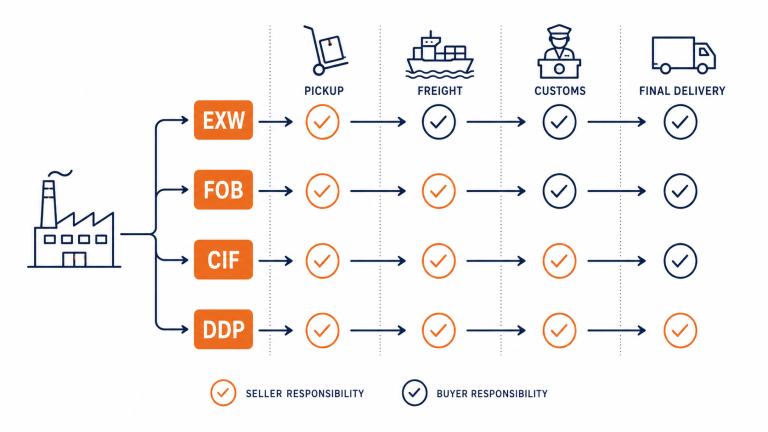
If you remember only one thing from this article, remember this: Incoterms matter more than the company label.
Two quotes can look similar while covering very different responsibilities. The International Chamber of Commerce describes Incoterms as trade terms used in business-to-business sale contracts, and they are what determine where cost, risk, and responsibility shift between seller and buyer.
EXW
Under EXW, the supplier makes the goods available at the factory or warehouse, and the buyer takes over from there. That gives the buyer maximum control, but also maximum complexity.
EXW is usually best for:
- experienced importers
- buyers using a trusted forwarder
- shipments consolidated from multiple suppliers
FOB
Under FOB, the supplier is responsible up to the agreed loading point in China. After that, the buyer’s side takes over.
FOB is often the most balanced option for sea freight because it gives the importer more control without forcing them to manage every China-side detail. For China-specific trade terms, Maersk’s Incoterms in China guide is a useful reference for understanding how terms affect customs, delivery, and buyer-seller responsibility.
CIF
CIF can make a quote look attractive because freight to the destination port is included. But the buyer may still face destination charges, customs, duties, and local delivery costs.
That is why buyers sometimes discover why Alibaba shipping can get expensive only after the cargo arrives.
DDP
DDP is the easiest to understand on paper because it promises a door-to-door price with duties and taxes included.
DDP is often best for:
- beginners
- Amazon FBA shipments
- small and medium shipments where simplicity matters
But DDP is not automatically the safest option. You still need to ask:
- Who is the importer of record?
- How are duties handled?
- What HS code is being used?
- Is the route compliant for the destination country?
- Is insurance included?
The reason this matters is that EXW and DDP sit at opposite ends of the responsibility spectrum. Under EXW, the buyer takes on much more of the logistics burden; under DDP, the seller or provider is promising to carry the shipment much further through the chain.
Who handles customs clearance?
This is one of the most misunderstood parts of China shipping.
A freight forwarder may coordinate customs clearance, but the formal customs work may still be done by a licensed customs broker or local customs agent. A traditional port-side shipping agent usually does not replace that customs role for the buyer.
Many buyers hear “shipping included” and assume customs, duties, taxes, and last-mile delivery are all covered. Sometimes they are. Sometimes they are not.
For U.S. imports, customs can involve separate legal responsibility, especially once shipment value, size, or compliance risk increases. The International Trade Administration explains that customs brokers oversee customs entry, product classification, valuation, and duty payment, while U.S. Customs and Border Protection licenses brokers to conduct customs business on behalf of others. Do not rely on casual wording in a chat thread or Alibaba message.
When should you choose a China freight forwarder?
A freight forwarder is usually the better fit when:
- you are importing commercial cargo
- the shipment is larger than courier size
- you need LCL or FCL sea freight
- you are shipping to Amazon FBA
- you want insurance and predictable documentation
- you need repeatable logistics for reorders
- you want to compare EXW, FOB, DDP, or DAP correctly
- you care about who fixes problems when the shipment stalls
If your plan is to buy from Alibaba and sell on Amazon, this is usually not the place to cut corners. Amazon-bound cargo has tighter labeling, delivery, and timing requirements than general parcel shipping.
When can a China shipping agent be enough?
A China shipping agent may be enough when:
- you are shipping low-value samples
- you are consolidating small products from 1688, Taobao, or Alibaba suppliers
- you need basic repacking and forwarding
- the shipment is simple and not customs-sensitive
- the provider gives clear quote terms, tracking, and liability rules
This can work well for lightweight ecommerce workflows. But once the cargo becomes high-value, fragile, oversized, regulated, or time-sensitive, evaluate that provider the same way you would evaluate a forwarder.
Questions to ask before hiring a China freight forwarder or shipping agent
Before you pay anyone, ask these questions in writing:
- Are you a freight forwarder, NVOCC, customs broker, courier agent, or warehouse consolidator?
- What Incoterm is your quote based on?
- Does the price include China pickup?
- Does it include export declaration?
- Does it include the international freight leg?
- Does it include destination customs clearance?
- Does it include duties and taxes?
- Who is the importer of record?
- What HS code and declared value will be used?
- Is cargo insurance included or optional?
- What happens if the shipment is delayed, inspected, damaged, or lost?
- Can you provide the bill of lading, invoice, packing list, and tracking details?
- Do you have a real warehouse address in China?
- Can you provide references or shipment examples?
- What charges are excluded from the quote?
A serious provider will not treat these questions as unreasonable. Clear answers are usually a good sign.
Red flags to watch for
There are a few warning signs that come up again and again in importer complaints and Reddit threads:
- the quote is far below every other quote
- the provider refuses to break down charges
- the DDP offer is marketed as “all included” but nothing is explained
- there is no company address or registration detail
- there are no written terms
- no insurance option is offered
- payment is requested only through a personal account
- the provider suggests declaring an unrealistically low customs value with “no risk”
- the price changes after goods arrive at the warehouse
- they cannot explain duties, HS codes, or importer responsibility
The risk is not just overpaying. The bigger problem is a shipment moving forward under a structure nobody can clearly defend once customs, damage, or delay becomes an issue.
Example scenarios
Small Alibaba sample order
If the item is low value, non-sensitive, and easy to replace, supplier shipping or a simple shipping agent may be enough.
3 CBM LCL shipment from Shenzhen to Los Angeles
Use a freight forwarder. Ask for both EXW and FOB quotes, and make sure destination charges and customs coordination are explained. This is the kind of shipment where understanding shipping from China to the USA as a full process matters more than just chasing the lowest per-kilo rate.
Amazon FBA shipment
Use a forwarder with Amazon FBA experience. They need to understand labeling, delivery appointments, pallet rules, and DDP realities. If they do not speak clearly about FBA routing, keep looking.
Full container from Ningbo to the UK
Use a freight forwarder or NVOCC with clear ocean freight documentation, destination support, and customs coordination.
Mixed products from multiple 1688 suppliers
A shipping agent with a China warehouse can be useful for receiving and repacking. But once the combined cargo becomes true commercial freight, the operational center of gravity shifts toward freight forwarding.
How to choose the right partner
For most importers, the practical answer is simple: choose the provider whose scope, documentation, and responsibility are clear, even if the title is messy.
In many real shipments, that means choosing a freight forwarder or a so-called shipping agent that clearly performs forwarder-level work.
Use these filters:
- who do they represent?
- what exactly is included?
- which Incoterm is the quote based on?
- who handles customs?
- who pays duties and taxes?
- who is responsible when something goes wrong?
The more valuable or complex your shipment is, the more you should prioritize operational clarity over headline price.
FAQ
Are freight forwarder and shipping agent the same?
No. Traditionally, a freight forwarder arranges cargo movement for the importer or shipper, while a shipping agent usually represents the vessel owner or carrier at the port. In China sourcing, the phrase “shipping agent” is often used much more loosely.
Do I need a shipping agent for Alibaba?
Not always. For small orders, supplier shipping may be enough. For commercial cargo, LCL, FCL, or Amazon FBA shipments, you usually need a freight forwarder or a shipping agent offering full forwarding services.
Is supplier shipping cheaper than a freight forwarder?
Sometimes, especially on small shipments. But the cheaper-looking quote may come with weaker transparency, less routing control, and more risk around documents, customs, and destination charges.
Who handles customs clearance when shipping from China?
It depends on the Incoterm, shipment type, and destination. A forwarder may coordinate the process, but a licensed customs broker or local customs agent may still handle the formal entry.
What is the safest shipping term for beginners?
DDP is often the simplest, but not automatically the safest. Beginners should still ask for a written breakdown covering duties, taxes, customs handling, delivery scope, and excluded charges.
Conclusion
A China freight forwarder and a China shipping agent are not the same thing in formal logistics. But in real-world sourcing from China, the terms often blur because many providers use “shipping agent” as a broad commercial label.
For most importers, the practical rule is simple: if you are shipping commercial goods from China, especially Alibaba orders or Amazon FBA cargo, focus less on the title and more on the service scope, Incoterms, customs responsibility, and written accountability.
The safest setup is usually not the one with the cheapest first quote. It is the one that still makes sense when the shipment hits its first real problem.
Sources and further reading
These are the main sources behind the definitions and recommendations in this article:
- U.S. Federal Maritime Commission: Ocean Transportation Intermediaries – useful for understanding freight forwarders and NVOCCs in regulated ocean shipping.
- International Trade Administration: Shipping Options – explains how freight forwarders help with costs, packing, insurance, documentation, and booking transport.
- International Trade Administration: Customs Brokers and Freight Forwarders – explains the customs broker role and how it differs from freight forwarding.
- U.S. Customs and Border Protection: Customs Brokers – official reference for U.S. customs broker licensing and customs business.
- International Chamber of Commerce: Incoterms rules – primary reference for trade terms such as EXW, FOB, CIF, and DDP.
- Maersk: Incoterms in China – practical explanation of common China trade terms and how they affect shipping responsibility.
- Freightos: How to Find the Best Freight Forwarder in China – buyer-focused guidance on finding and evaluating China freight forwarders.