The lowest freight quote has a habit of becoming expensive after the cargo is picked up. A destination fee was not included. The cartons were remeasured. “Door to door” stopped at a warehouse appointment nobody had arranged.
That is why choosing a China freight forwarder is less about finding the biggest company—or the smallest number in a spreadsheet—and more about operational fit. One forwarder may include pickup, export handling, destination fees, customs coordination, and final delivery. Another may quote only the main freight. The second number is lower because it describes a smaller job.
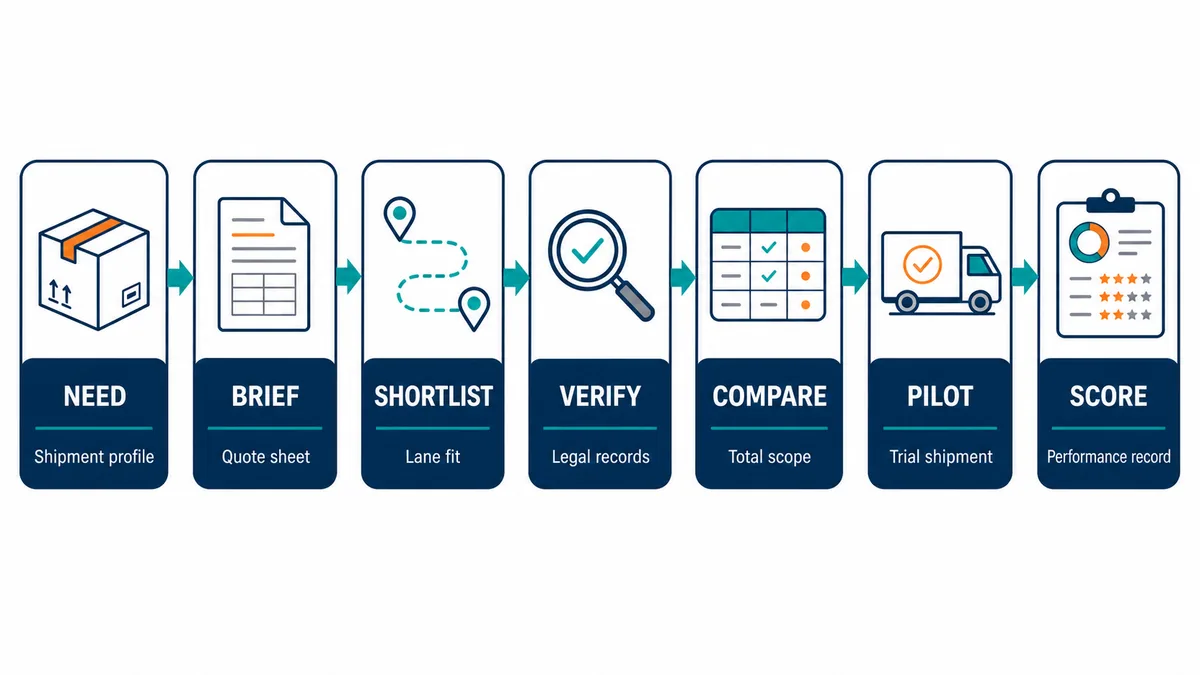
The practical method is:
Need → Brief → Shortlist → Verify → Compare → Pilot → Score
The seven-step process below turns the choice into something you can check, compare, and test. No unverifiable “best forwarder” ranking required.
The Quick Answer: Choose for Fit, Not the Lowest Headline Rate
Start with four tests. The forwarder regularly handles your origin-to-destination lane, your type of cargo, and shipments of a similar size. Its quote defines the service and exclusions in writing. Its legal identity and any authority relevant to the shipment can be independently checked. Then it performs as promised on a representative pilot shipment.
Five things must match:
- Lane: the actual pickup city, export gateway, destination port or airport, and final delivery area.
- Cargo: the product, materials, packaging, handling needs, and regulatory risk.
- Shipment profile: cartons, pallets, gross weight, dimensions, CBM, frequency, and seasonality.
- Service scope: pickup, consolidation, export handling, main transport, customs handoff, insurance, and final mile.
- Destination execution: the partner, broker, appointment process, and person responsible when a handoff fails.
FIATA’s description of freight forwarding is broad because a forwarder may coordinate carriage, consolidation, storage, handling, packing, distribution, customs-related work, insurance, and documents. That breadth is precisely why you must define what your quote covers.
If you already have a shipment brief, you can also request a freight forwarding quote from China. Send every candidate the same brief so you can compare like with like.
First Decide Whether Your Order Actually Needs a Freight Forwarder
Not every package leaving China needs a freight forwarder.
For samples or a few ordinary cartons, an express courier or a supplier-arranged parcel service may be simpler. You receive a door-to-door rate, tracking, and a familiar handoff without building a multi-party freight plan.
A forwarder becomes more useful when coordination is the hard part:
- several suppliers must deliver into one China warehouse;
- cartons need to be counted, relabeled, stored, or consolidated;
- the shipment moves as air cargo, a pallet, LCL, or FCL;
- export documents and a destination customs-broker handoff must be coordinated;
- a warehouse or Amazon FBA delivery requires an appointment;
- shipments repeat often enough that you need control over routing and records.
There is no magic weight or CBM cutoff at which a forwarder suddenly wins. Density, route, minimum charges, packaging, destination fees, and urgency all move the crossover. If your cargo is near an air-versus-sea or LCL-versus-FCL decision, price both options on the same pickup and delivery scope.
Supplier-arranged shipping can work well when the order is simple and the supplier gives you a complete written scope. Consider appointing your own forwarder when you need independent control, multiple-supplier consolidation, or consistent shipment records across vendors.
Do not confuse the roles. A forwarder coordinates transport; a customs broker handles customs entries within its licensed scope; a sourcing agent manages supplier-side purchasing work; and a 3PL stores or fulfills inventory. One provider may offer several of these services, but the responsibilities should still be named. See this deeper comparison of a freight forwarder vs. shipping agent.
For a U.S. route, use the mode and responsibility questions in this article alongside a current guide to shipping from China to the USA.
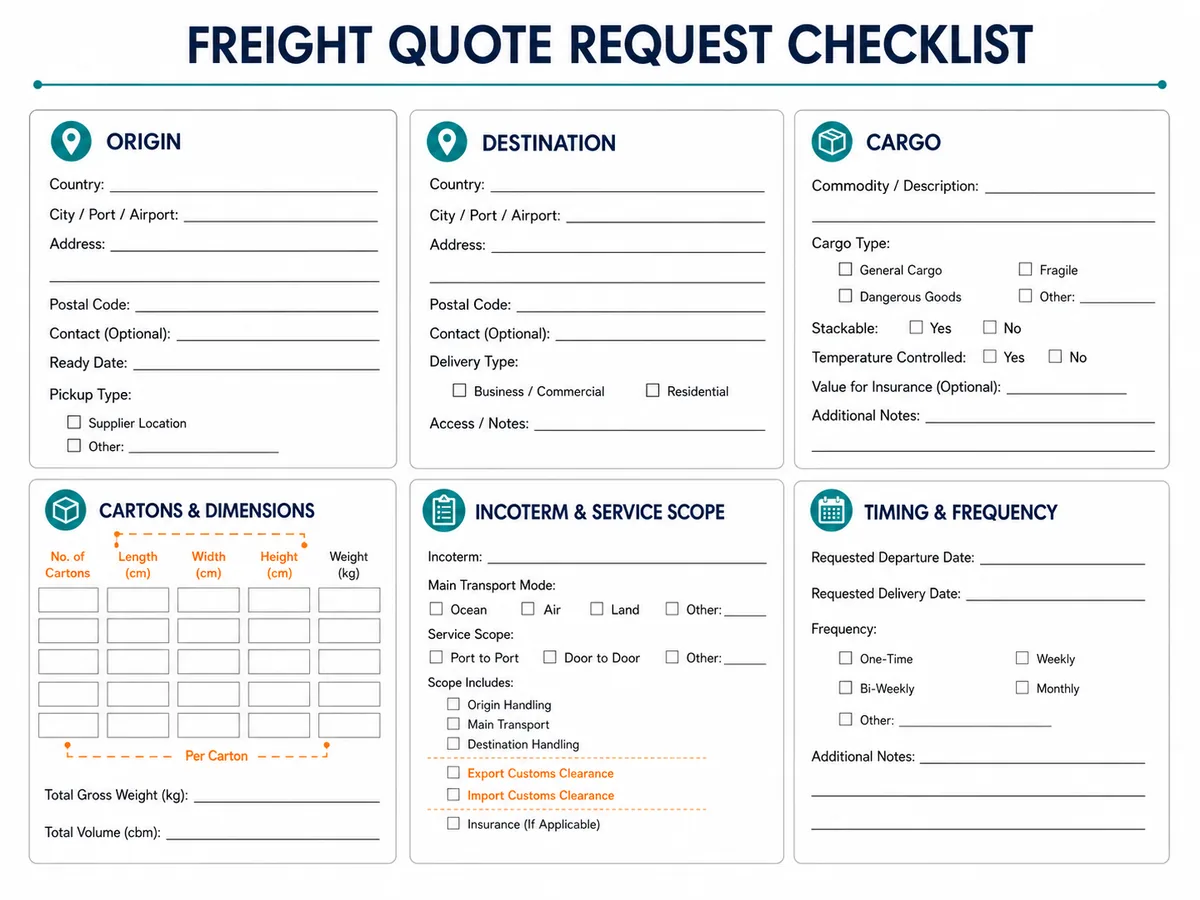
Build a Quote-Ready Shipment Brief Before Contacting Forwarders
Three quotes are not comparable merely because they sit in the same spreadsheet. If one candidate receives estimated carton sizes, another gets final packed measurements, and a third assumes port-to-port service, their totals tell you almost nothing.
Give every candidate the same information:
| Area | Information to provide |
|---|---|
| Origin | Supplier addresses, pickup cities, number of factories, cargo-ready date |
| Destination | Country, postcode, commercial or residential address, warehouse/FBA/3PL requirements, unloading limits |
| Cargo | Plain-language product name, materials, intended use, HS-code candidate, battery/liquid/magnet or other regulated attributes |
| Shipment | Carton count, outside dimensions, gross weight, pallets, total CBM, cargo value, packing method |
| Commercial terms | Agreed Incoterm, who handles export, customs scope, duty/tax scope, cargo insurance, final-mile delivery |
| Operations | Required delivery window, frequency, storage, consolidation, inspection, labeling, split delivery |
Use outside carton dimensions, not product dimensions. For many services, the billed amount is based on the greater of actual weight and a volumetric or dimensional calculation. The divisor and charging rule vary by carrier and mode, so ask each forwarder to show the basis used. If the cartons have not been packed, label the measurements as estimates and ask how remeasurement will be documented.
Copy-and-send shipment brief
Origin:
- Supplier pickup address(es):
- Number of suppliers:
- Cargo-ready date:

Destination:
- Country and postcode:
- Delivery type: commercial / residential / FBA / 3PL
- Appointment, liftgate, pallet or unloading requirements:

Cargo:
- Product and materials:
- Battery, liquid, powder, magnet, branded or regulated content:
- HS-code candidate:
- Cargo value:

Packed shipment:
- Carton count:
- Outside dimensions per carton:
- Gross weight per carton:
- Pallets and total CBM, if applicable:

Requested scope:
- Incoterm:
- Pickup:
- Export handling:
- Air / courier / LCL / FCL options requested:
- Customs-broker coordination:
- Duty/tax scope:
- Cargo insurance:
- Final delivery:

Timing and frequency:
- Required delivery window:
- One-time or recurring:
- Expected shipment frequency:
You can use a shipping cost estimator to form an initial expectation, but the booking quote still needs final packed data and a written scope. If the result is higher than the product-only estimate, this explanation of why a China shipping quote can look expensive covers dimensional weight and other common variables.
Shortlist Forwarders by Lane, Cargo, and Order Profile
Forget “Who is the biggest?” The useful question is “Who has recently handled this job?”
A smaller specialist may be excellent on one China-to-U.S. lane and weak outside it. A global network may cover more countries but be less responsive to low-volume recurring shipments. Your shipment profile decides which advantage matters.
If your destination is Canada, review the China-to-Canada shipment requirements before asking candidates how they will handle the importer arrangement, customs preparation and final delivery.
Ask candidates to describe recent shipments with the same origin region, destination area, mode, and commodity. Then assess:
- whether minimum charges fit your order pattern;
- whether a China warehouse can receive and reconcile cartons from multiple suppliers;
- whether it can quote courier, air, LCL, and FCL where relevant instead of pushing one mode;
- whether it understands the documents and handling risks for your product;
- who manages the destination agent, broker, and final-mile carrier;
- how FBA or 3PL appointments, labels, and rejected deliveries are handled;
- what backup route and escalation process exist during capacity disruptions.
If several factories feed the same order, the warehouse receiving process matters as much as the ocean or air rate. Ask how cartons are identified, counted, photographed, and reported before consolidation. If you need this operating layer, review whether the provider can consolidate inventory in a China warehouse.
Amazon inventory adds another boundary: freight delivery and FBA preparation are related, but not identical. Confirm which party handles carton labels, pallet standards, appointment data, and correction work. Here is a separate overview of how to prepare and ship inventory to Amazon FBA.
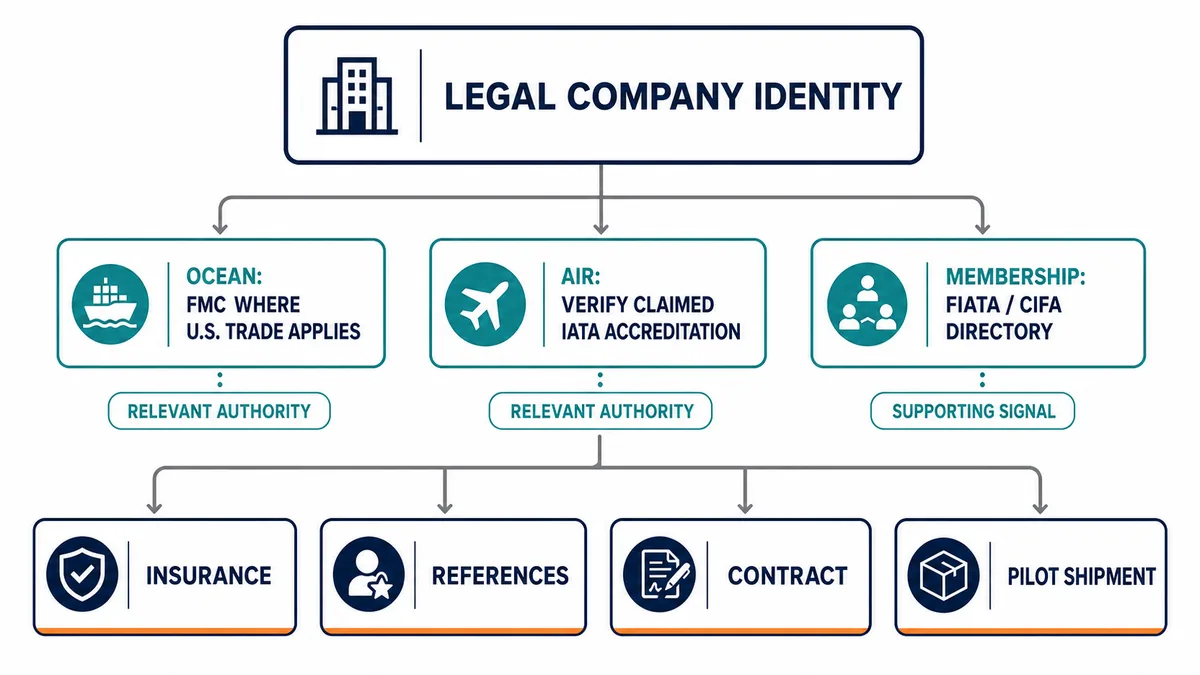
Verify the Company, Relevant Authority, and Insurance
Be wary of the phrase “licensed freight forwarder” when nobody names the license. Different records apply to different roles, modes, and jurisdictions.
Start with the legal entity:
- Obtain its full registered company name and registration details.
- Match that name across the quote, contract, invoice, and bank beneficiary.
- Confirm its office or warehouse address and your named operations contact.
- Ask which services it performs itself and which it subcontracts.
If the quote includes storage or consolidation in China, apply these China warehouse verification checks to the actual facility and the company responsible for it.
Then verify the authority relevant to the shipment. For U.S. ocean freight, search the legal name in the Federal Maritime Commission’s OTI/NVOCC list. The FMC explains that U.S.-based ocean transportation intermediaries generally require a license, while non-U.S.-based NVOCCs may operate under the applicable registration or licensing route. The exact check depends on the company’s role.
For air cargo, ask what IATA accreditation is being claimed and whether it applies in that country and role. IATA publishes country-specific accreditation requirements; this is not a universal license for every freight service.
You can also cross-check membership in the FIATA China directory, CIFA, or another relevant network. Treat membership as a supporting signal, not proof of quote accuracy, shipment performance, or claims handling.
Finally, separate three concepts that are often blurred:
- carrier liability, which is governed by the transport contract and applicable rules;
- forwarder liability, which depends on the forwarder’s role and terms;
- cargo insurance, which is a separate coverage product with declared value, exclusions, evidence requirements, and a claims process.
Ask for the policy option, coverage basis, exclusions, deductible if any, claim deadline, required documents, and the party that files the claim. “Your cargo is insured” is not enough.
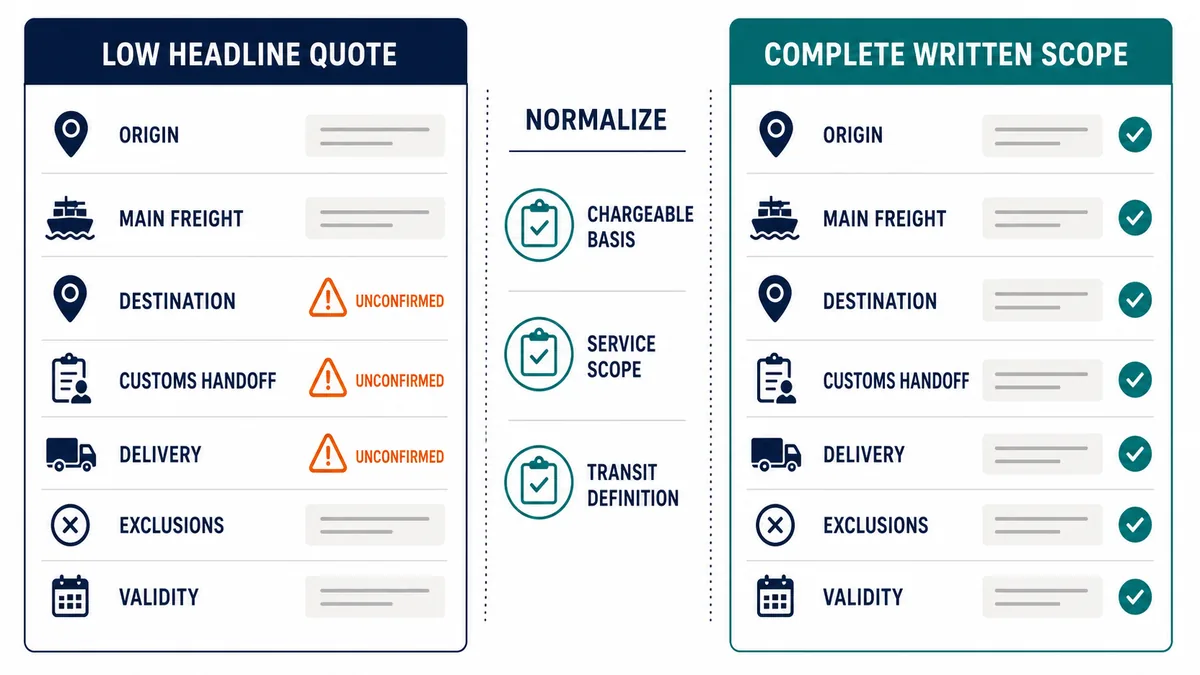
Compare Quotes Line by Line—Not by the Total at the Bottom
Put each quote into the same table. A blank cell means “unconfirmed,” not “included.”
If you are comparing an Alibaba supplier’s shipping offer with a forwarder’s quote, use the Alibaba shipping quote comparison template to record what each price includes.
| Quote area | What to normalize |
|---|---|
| Chargeable basis | Actual weight, volumetric weight, W/M, CBM, remeasurement rule, minimum charge |
| Origin | Pickup, warehouse receiving, storage, consolidation, export handling, documents |
| Main carriage | Mode, carrier or service level, route, transshipment, schedule basis |
| Destination | Terminal/CFS, customs entry, examination, duty/tax scope, appointment, delivery |
| Conditional fees | Storage, demurrage, detention, redelivery, address change, inspection, overweight handling |
| Commercial terms | Currency, validity date, payment timing, cancellation terms, evidence for pass-through costs |
| Transit definition | From cargo ready, pickup, departure, arrival, customs release, or door delivery |
“All-in” needs a definition. Ask which charges may change after pickup, what triggers the change, and what supporting measurement or third-party receipt you will receive.
Transit time also needs a start and end point. “Twelve days,” for example, could mean airport-to-airport, port-to-port, departure-to-arrival, or pickup-to-door. Do not compare those as if they were the same promise.
A practical weighted scorecard
The weights below are a starting point, not an industry standard. Adjust them for your cargo and risk.
| Category | Suggested weight | What earns a high score |
|---|---|---|
| Lane, cargo, and order fit | 25% | Recent, checkable experience with a similar route and shipment |
| Quote completeness | 20% | Written scope, line items, exclusions, validity, and conditional fees |
| Legal and compliance fit | 15% | Legal identity and applicable authority can be independently checked |
| Destination execution | 15% | Named agent, broker, and final-mile handoff with clear ownership |
| Communication and escalation | 10% | Named operations contact, milestone plan, and exception owner |
| Insurance and claims | 10% | Coverage choices, exclusions, evidence, and claim steps are clear |
| Normalized price | 5% | Competitive total after scope and risk adjustments |
Price receives only 5% here because a low incomplete quote can create a much higher landed cost. If price is the dominant constraint, increase its weight—but only after normalizing the scope.
Treat DDP, Customs, and Importer of Record as Separate Decisions
DDP can make a shipment feel simple because the seller assumes a broad delivery obligation under the sales term. It does not remove the need to understand the import setup.
For a U.S. shipment, ask:
- Who will be the Importer of Record?
- Whose importer number and bond will be used?
- Which licensed customs broker will file the entry?
- Who gives that broker Power of Attorney?
- Who is responsible for product admissibility, labeling, and other agency requirements?
- How will duties and taxes be calculated and evidenced?
- What happens if customs requests information or examines the cargo?
U.S. Customs and Border Protection states that using a customs broker does not remove the importer’s ultimate responsibility for knowing and meeting CBP requirements. Outsourcing the filing is not the same as outsourcing legal responsibility.
The ICC Incoterms® 2020 checklist also notes that DDP may appear attractive to a small importer while creating practical complications if the seller cannot complete import clearance in the destination country.
Write down four separate decisions:
- Incoterm: allocation of costs, tasks, and risk between seller and buyer.
- Transport scope: port-to-port, airport-to-airport, or door-to-door movement.
- Importer of Record: the party legally responsible for the import entry.
- Customs broker: the licensed party filing or assisting with the entry.
Once those roles are clear, use our checklist to compare DDP quotes on the same basis. Match the cargo details, delivery point, included services and adjustment conditions before comparing totals.
Reject any proposal that depends on undervaluing the cargo, changing the product description, or “guaranteeing no customs problem.” A clear DAP, FCA, or FOB arrangement with a known importer and broker can be better than a vague DDP promise. The right term depends on the transaction, so have the parties and responsibilities confirmed before pickup.
Ask These 12 Questions Before You Hand Over the Cargo
The supplier may be asking for a pickup date while the quotes are still full of gaps. Slow the booking down long enough to get these answers in writing:
- How many recent shipments have you handled on this origin-to-destination lane with this cargo type?
- Which services will your company perform, and which will be subcontracted?
- What are the legal names of the destination agent, customs broker, and final-mile provider?
- Which carrier, service level, and route is this quote based on?
- What chargeable weight or CBM did you calculate, and which minimums apply?
- Which origin, main-freight, destination, customs, and delivery charges are included?
- Which charges can change after pickup, what triggers them, and what evidence will you provide?
- Who will be the Importer of Record, and who will file the customs entry?
- Which documents must be approved before pickup and before departure?
- What cargo insurance is available, what is excluded, and how is a claim filed?
- Which milestones will you report, and who owns escalation when a handoff fails?
- Can we begin with a representative pilot shipment under the same written terms?
Watch how the candidate answers. A useful response names parties, documents, triggers, and next steps. “We handle everything” is a slogan, not an operating plan.
Run a Representative Pilot Shipment and Score What Actually Happens
The pilot should be small enough to contain the risk but similar enough to predict future performance. A sample sent by courier tells you very little about a forwarder you plan to use for recurring LCL deliveries.
Before pickup, freeze:
- the quote and its validity;
- the service scope and exclusions;
- packed dimensions, weight, and remeasurement process;
- the carrier or service level and planned route;
- required documents and approval deadlines;
- milestone updates and named contacts;
- the destination handoff and delivery requirements.
During the shipment, record what actually happens. Was pickup arranged on time? Did the warehouse count match? Were revised dimensions supported by evidence? Were document drafts accurate? Did updates arrive without repeated chasing? At destination, did the broker, appointment, and final-mile handoff work as described?
Photograph packaging and cargo condition at useful handoffs when practical. If a normal clarification occurs—an address detail, document question, or missed status update—use it to observe escalation. Do not manufacture a disruption that could create compliance or delivery risk.
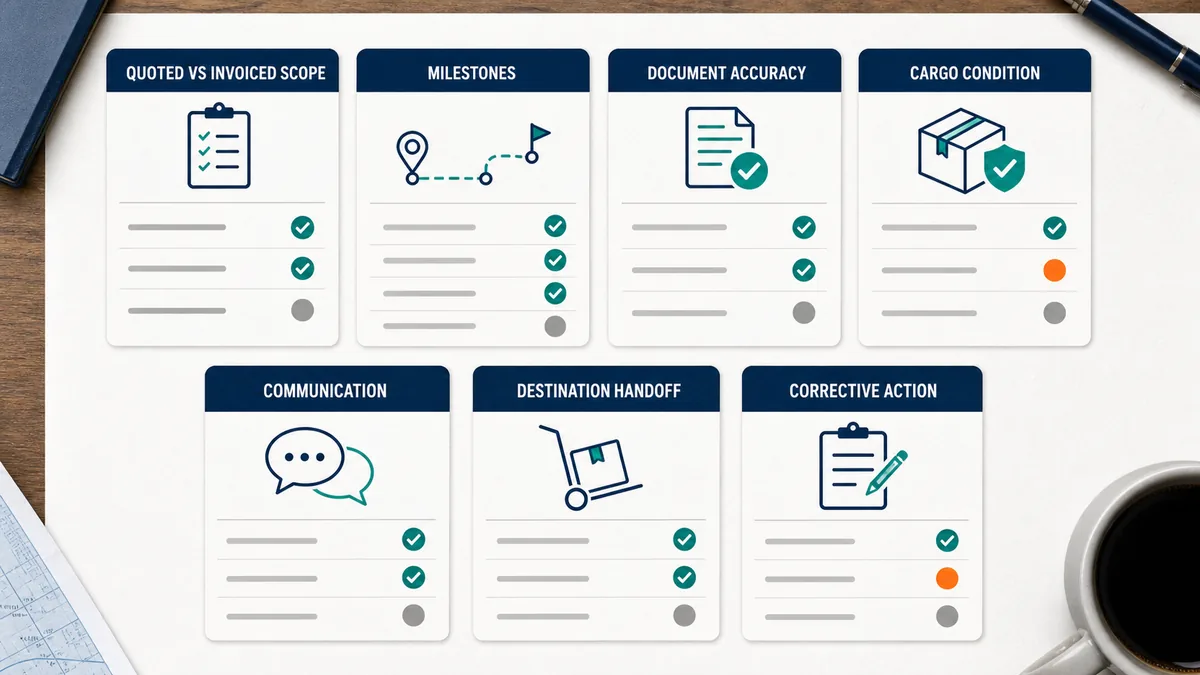
After delivery, score:
| Pilot measure | Record |
|---|---|
| Quoted vs. invoiced scope | Changes, reasons, and evidence |
| Milestone performance | Planned vs. actual event dates |
| Document accuracy | Errors, corrections, and ownership |
| Cargo handling | Count, packaging, damage, and proof |
| Communication | Response time and usefulness |
| Destination handoff | Broker, appointment, delivery, POD |
| Corrective action | Root cause, owner, and prevention step |
One clean shipment does not prove permanent reliability. It does, however, tell you more than a sales deck or star rating. Increase volume gradually and keep scoring the same things.
Red Flags That Should Stop the Booking
Some problems call for another question. These call for a stop:
- a rate far below the alternatives with no line-item scope;
- “all-in” or “DDP” with no named Importer of Record or duty explanation;
- payment requested to a personal or unrelated account;
- different legal names on the quote, contract, invoice, and bank beneficiary;
- refusal to identify the destination agent or subcontracted parties;
- pickup pressure before the scope and documents are approved;
- generic transit promises with no service level or milestone definition;
- a material price change after pickup with no measurement record or third-party evidence;
- no written insurance option, liability terms, or claims process;
- advice to undervalue, misdescribe, or split cargo to evade a rule;
- platform badges, review screenshots, or association membership offered as the only proof.
Reviews can help you find questions to ask. They cannot replace company records, a complete quote, a contract, and a pilot shipment.
Choose by Scenario: Small Parcel, Consolidated Order, LCL, FBA, or Special Cargo
Start with the capability most likely to make or break the shipment.
| Scenario | Likely starting option | Capability to prioritize | Often-missed quote item | Verification question |
|---|---|---|---|---|
| One or two urgent standard cartons | Express courier or parcel service | Pickup reliability and customs handoff | Remote-area or address-related charge | What exactly does door-to-door include? |
| Several China suppliers | Forwarder with consolidation warehouse | Receiving, counting, identification, and storage | Receiving and consolidation fees | How are cartons matched to each supplier and order? |
| Recurring air replenishment | Air-freight forwarder | Chargeable-weight control and route consistency | Screening, handling, and final delivery | Which service level and chargeable basis apply? |
| LCL with door delivery | LCL forwarder with destination coverage | CFS, brokerage, and final-mile coordination | Destination CFS and appointment charges | Who controls each destination handoff? |
| Near the LCL/FCL crossover | Quote both LCL and FCL | Complete origin and destination comparison | Minimums, local fees, and container delivery | Can you price both options on the same scope? |
| Amazon FBA or 3PL delivery | Forwarder plus prep/appointment capability | Labels, pallets, appointment, rejection recovery | Waiting, redelivery, or correction work | Who owns a rejected or rescheduled delivery? |
| Batteries, liquids, cosmetics, or regulated goods | Specialist with commodity experience | Classification, documents, packing, carrier acceptance | Testing, declarations, and special handling | Which exact documents and carrier approvals are required? |
For regulated cargo, a low rate is irrelevant if the shipment is not accepted or the documents are wrong. Ask the specialist to state the applicable requirement for your product and route in writing. Do not rely on “we ship this all the time.”
Final Checklist Before You Book
Approve the booking only when you have:
- a final shipment brief based on packed cargo;
- the forwarder’s legal entity and matching payment beneficiary;
- verification of any authority relevant to the route and role;
- named origin, destination, broker, and final-mile parties;
- a normalized quote with inclusions, exclusions, and conditional fees;
- a defined transit-time start and end point;
- written Incoterm, Importer of Record, customs, duty, and tax responsibilities;
- insurance options, liability terms, and claims instructions;
- a milestone and escalation plan;
- a representative pilot plan and scorecard.
Keep the shipment brief, quote versions, measurement records, commercial documents, customs records, milestone messages, invoices, proof of delivery, and any exception evidence in one shipment file. That record makes later disputes easier to diagnose and gives you a clean baseline for the next quote.
If the pilot performs well, increase volume in stages. If it exposes problems, require a written corrective action before the next booking—or move to the next verified candidate.
When you are ready, send the same quote-ready brief to Fulfillbot to get a freight forwarding quote from China. The final comparison is simple: which candidate can document and execute the whole job your order requires?
Frequently Asked Questions
How do I find a reliable freight forwarder in China?
Build a shortlist based on your exact lane, cargo, shipment size, and destination needs. Verify each candidate’s legal entity and relevant authority, normalize written quotes, ask for matching references, and test the finalist with a representative pilot shipment.
Do I need a freight forwarder for a small shipment from China?
Not always. An express courier or supplier-arranged parcel service may be simpler for a few ordinary cartons. A forwarder becomes more useful when you need multi-supplier consolidation, pallets, air or sea freight, export coordination, customs-broker handoff, or warehouse appointments.
Should I use my supplier’s freight forwarder or choose my own?
Compare both on the same written scope. Supplier-arranged shipping may be convenient for a simple order. Your own forwarder can give you more control over consolidation, routing, records, and recurring shipments. Neither option is automatically cheaper or safer.
How many freight quotes should I compare?
Three to five qualified candidates is usually enough to reveal scope and pricing differences without creating an unmanageable review. Send them identical packed shipment data and compare the line items, exclusions, validity, and destination responsibilities—not just the totals.
What fees should an all-in freight quote include?
The quote should state whether it includes origin pickup and handling, main carriage, destination terminal or CFS charges, customs-broker work, duties and taxes, final delivery, appointments, and conditional fees. “All-in” has no practical value unless the inclusions and exclusions are written.
How can I verify a China freight forwarder’s license?
First verify the legal company name. Then check the authority relevant to the role and route. For U.S. ocean freight, use the FMC OTI/NVOCC database. For claimed air-cargo accreditation, check the applicable IATA framework. Industry-directory membership can support the check but is not a government license or performance guarantee.
Is DDP shipping from China safe for a small importer?
It can be workable, but only when the import arrangement is transparent. Confirm the Importer of Record, customs broker, importer number or bond, duty evidence, product-compliance responsibilities, and procedure for customs questions. Avoid any DDP offer based on undervaluation or a promise of “no customs risk.”
Can a freight forwarder consolidate orders from several Chinese suppliers?
Yes, if it operates or coordinates a suitable China warehouse. Ask how each supplier delivery is identified, counted, photographed, stored, and reported; how consolidation fees are calculated; and what happens when cartons arrive late or do not match the receiving plan.