Alibaba shipping can look expensive because the quote reflects the packed shipment, the route and delivery speed, minimum charges, and the work included at each end. A low product price does not tell you what it costs to move the cartons.
If you see a $20 product on Alibaba paired with $60 shipping, treat those figures as an example to investigate, not proof of overcharging. First check what is being shipped and where the quoted service ends. Then compare another quote using the same information.
The “Item Is $20, Shipping Is $60” dilemma explained
The ratio between shipping and product price cannot tell you whether a quote is fair. An inexpensive item may need a large protective carton, while a higher-value item may fit into a small parcel. A small order can also spread fixed handling charges over very few units.
Find the issue in the table, then request the measurements or quote details needed to explain it.
| What looks wrong? | What to check | What to ask next |
|---|---|---|
| The product is light but freight is high | Sealed-carton dimensions, gross weight and the billing formula | Is the charge based on actual weight, dimensional weight, volume or a minimum? |
| A small order has a high cost per unit | Minimum charges and fixed pickup, handling or documentation fees | Which charges stay the same if the quantity changes? |
| One provider is much cheaper | Pickup point, delivery endpoint, customs scope and exclusions | Does the lower quote include the same work? |
| The price rose after packing | Estimated versus measured carton sizes and weights | Can you show the measurements and the adjustment calculation? |
| The rate changed without a packing change | Quote validity, route, service level and dated surcharges | Which item changed, when, and under which quote condition? |
| Delivery adds another bill | Terminal collection, final delivery, appointments or special unloading | What is included to the exact receiving address? |
Check the carton before arguing about the rate
A product-page weight may exclude the outer box and protective packaging. Ask for a photo of the sealed carton on a scale and its outside dimensions. Have the provider state the unit, divisor, rounding rule and any minimum charge used in the quote.
For a hypothetical example, suppose one carton measures 60 × 40 × 40 cm and weighs 8 kg. Using the 5,000 cm³/kg divisor described in FedEx’s Australia dimensional-weight guidance, its dimensional weight is 60 × 40 × 40 ÷ 5,000 = 19.2 kg. That explains a possible difference between the scale reading and the quoted billing basis. It is not a freight price; confirm the actual service’s rules before calculating a charge.
Compare transport options on the same route
Express can suit an urgent sample, while air cargo or ocean freight may suit a replenishment order. There is no universal shipment-weight cutoff that makes one mode cheapest. Ask for options that meet your delivery deadline and include the same origin and destination work. For shipping from China to USA, also check receiving requirements and which part of the journey the transit estimate covers.

Should your supplier arrange the freight?
A supplier-arranged shipment can be convenient, especially when one supplier can provide the service and documents you need. An independently appointed forwarder can be useful when you need to compare routes, combine orders from several suppliers, or coordinate a warehouse delivery.
Neither arrangement guarantees a lower price. A supplier or a forwarder may charge for coordination as well as transport. Ask either provider to identify included work, exclusions, the contracting party and the person responsible for an exception.
If the provider cannot explain the packed measurements, delivery endpoint or price-adjustment conditions, request a revised quote before booking. A quick, bundled quote can still be accurate; ask for the details behind it.
Supplier shipping vs independent forwarder
| Decision | Supplier-arranged shipping | Independently appointed forwarder | Evidence to request |
|---|---|---|---|
| Coordination | May combine order and shipping communication | Requires an agreed handoff with the supplier | Who books, collects and resolves delays? |
| Price comparison | May quote a package or separate charges | May also bundle charges or apply minimums | The same shipment brief and written inclusions |
| Transport options | Depends on the supplier’s available providers | Depends on the forwarder’s route and cargo coverage | Mode, route, delivery window and full scope |
| Customs records | Confirm who arranges clearance and shares records | Confirm its broker relationship and document access | Named parties and the records you will receive |
| Useful fit | A straightforward order with an adequate shipping offer | More routing, consolidation or receiving coordination | A scope that matches the actual order |
Separating the costs can simply mean asking the same supplier for a clearer breakdown. Keep that provider if its scope, price and records meet the order’s needs.
DDP vs DAP: check which responsibilities the price includes
Before comparing totals, write down the Incoterm, version and exact delivery point. A quote labelled “DDP service” also needs to explain how the logistics booking supports the terms agreed between buyer and seller.
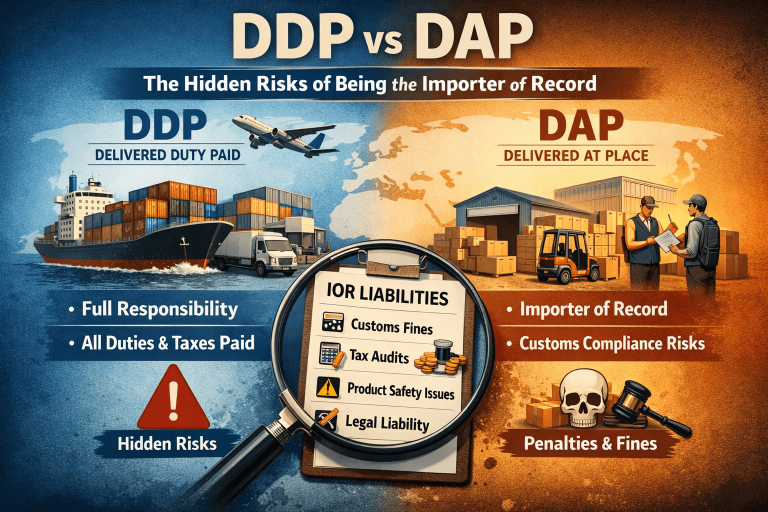
What DDP means
Under Incoterms® 2020 DDP, the seller handles import clearance and applicable import duties and taxes. Delivery is at the agreed destination, with the goods ready for unloading from the arriving vehicle. Confirm any unloading service separately.
Ask for the exact delivery point, included charges and conditions for extra costs in writing. Use our guide to review the DDP quote checklist before accepting an all-in price.
What DAP means
Under DAP, the buyer handles import clearance and its costs. The seller still arranges transport to the named destination. ICC Academy’s DAP and DDP explanation sets out this distinction and the delivery boundary.
A lower DAP total can exclude import work that a DDP total includes. Ask for those missing costs before deciding which offer is cheaper.
Confirm the import arrangement
Ask who will be named on the import entry, who will file it, and who will answer customs questions. Record how the invoice, product description, classification and value will be checked. Do not assume the letters “DDP” or “DAP” identify the registered importer for your particular shipment.
For an Amazon or other warehouse delivery, confirm the destination’s receiving requirements as well as the transport terms. Keep the agreed scope and document-access arrangements with the booking.
For U.S. imports, check the entry records as well as the freight bill
Ask the broker which entry records apply to your shipment and which copies you will receive. CBP Form 7501 is an Entry Summary. The CBP form instructions in the government archive describe fields for the importer, classification, entered value, duties and fees. Those records help you reconcile an import transaction; the archived instructions are not a current freight or tariff schedule.
Keep the commercial invoice, packing list, freight invoices and applicable entry records together. Ask the party arranging clearance to explain any mismatch between the quoted duty allowance and the recorded charge. Confirm access before booking, especially when several parties handle the shipment.
Possessing a 7501 does not by itself establish a tax deduction. IRS Publication 334 includes freight-in on merchandise purchased for resale in its discussion of cost of goods sold. The treatment depends on the business and applicable accounting method; confirm it with your accountant rather than assuming a customs form creates an immediate write-off.
Ask these questions before you ship
- Who is arranging customs clearance, and who will be named on the entry?
- Which entry type and records apply to this shipment?
- Which records will I receive, from whom, and when?
- How will duties, taxes, broker charges and freight be identified?
- Who checks and corrects a discrepancy in the shipment information?
Step by step: get a quote you can compare
Use the same brief for the supplier and any alternative provider. If you need help assessing a provider’s route coverage and handling arrangements, use our guide to choosing a China freight forwarder.
1. Confirm the shipment profile
- Product description, quantity and any battery, liquid or other handling requirements
- Carton count, outside dimensions and gross weight, marked measured or estimated
- Pickup location, cargo-ready date and exact delivery address
- Warehouse, residential, 3PL or FBA receiving requirements
- Required delivery date and acceptable transport options
- Agreed sales term, customs scope and insurance requirements
Ask the provider to calculate the charging basis from this information and show it in the quote.
2. Compare the same shipment and delivery endpoint
Get comparable offers where practical. Check that every provider has priced the same job. Separate pickup, export handling, main transport, import work, destination handling and final delivery. Mark a missing charge “unconfirmed,” not zero.
Hypothetical comparison, not a market quote: Provider A quotes $500 for a defined transport scope. Provider B quotes $420, but another $70 pickup charge and $80 destination-delivery charge are needed to match A’s scope. B’s comparable transport total is $570. Assume every other inclusion and exclusion is identical; customs duties and taxes still need separate confirmation if excluded by both.
Use this request to resolve the difference:
Please re-quote using the attached packed shipment details, pickup point and delivery address. Show the charging basis, minimum charges, included work, exclusions, currency and validity date. Identify any estimated measurements or costs, what can change the total, and what evidence will support an adjustment. Please confirm whether customs clearance, duties, taxes and final delivery are included.
3. Check whether the forwarder actually handles your use case
- labeling requirements
- appointment booking
- prepaid-duty handling
- split shipment coordination
4. Ask who handles customs brokerage
5. Ask how extra charges are approved
Have the provider list possible storage, remeasurement, special handling, address changes and delivery exceptions. Ask what triggers a charge, how it is calculated and who must approve it.
Separate charges are not automatically padding. For example, DHL Global Forwarding’s Germany surcharge page lists categories such as storage and after-hours service. That illustrates why scope matters; it is not a rate card for your China shipment. Request the current schedule and conditions for your actual route.
6. Start with one controlled shipment
7. Keep responsibilities clear even if one provider handles several tasks
Record who releases the goods, books pickup, supplies documents and resolves a delivery problem. You can retain the supplier’s shipping arrangement or appoint a separate forwarder. Choose after comparing scope, documented responsibilities and total cost.
Why consolidation warehouses like Cainiao are a game changer for small orders
- use a sourcing partner or warehouse to combine orders
- ship multiple SKUs together instead of parcel by parcel
- wait until the shipment size justifies air freight or sea freight
- reduce repeated supplier-side handling fees
Is Alibaba shipping a rip off?
How to save on Alibaba shipping costs
- Correct the packed dimensions, weight and quantity before requesting another price.
- Ask which minimums and fixed charges apply.
- Compare delivery scope, dates, customs treatment and price validity.
- Request a slower service if your stock and delivery deadline allow it.
- Compare safer, smaller packaging or consolidation with all added fees included.
- Keep a provider whose documented offer fits; change it when another comparable offer is better.
Once the freight inputs are confirmed, use the China sourcing landed cost calculator to check cost per sellable unit and margin. Count each charge once, including anything already bundled into a DDP total. Avoid buying excess stock solely to lower shipping cost per unit.
FAQ about Alibaba shipping costs
Freight depends on the packed shipment and service scope, not just the value of the goods. Check dimensions, weight, minimum charges, transport mode and delivery inclusions before judging the price.
DDP assigns import clearance and applicable import duties and taxes to the seller; under DAP, those import responsibilities fall to the buyer. Confirm the exact delivery point and unloading arrangements for either term.
A high price does not establish that. Compare written offers for the same shipment, and investigate unexplained measurements, missing charges or changes to the agreed scope.
Use measured packing data, compare suitable transport options and check the complete delivery scope. Repacking or consolidation may help, but compare their fees and timing too. There is no universally cheapest mode or provider.
Ask which entry procedure applies and what customs support you need. If you use a broker, confirm the service, fees, required information and records you will receive before shipment.
It is a U.S. customs Entry Summary with information used to reconcile an import transaction. Ask which entry records apply to your shipment. Having the form alone does not establish a tax deduction.
Assess the specific Cainiao service offered, including destination coverage, tracking, timing and claims terms. Compare it with alternatives for the same cargo; the network name alone does not establish value.
Get the missing information before paying
Identify the specific reason the quote looks high: packing, minimum charges, service speed, delivery scope or an unexplained difference. Resolve that item in writing, then compare the complete cost of options that meet your deadline.
If you need help comparing transport options, Fulfillbot’s freight forwarding from China service can help coordinate pickup, shipment planning and destination handoffs. Send the original quote, product details, carton count, outside dimensions, gross weight, pickup location, delivery address and required date. Confirm the available service, price and responsibilities for your route before booking.