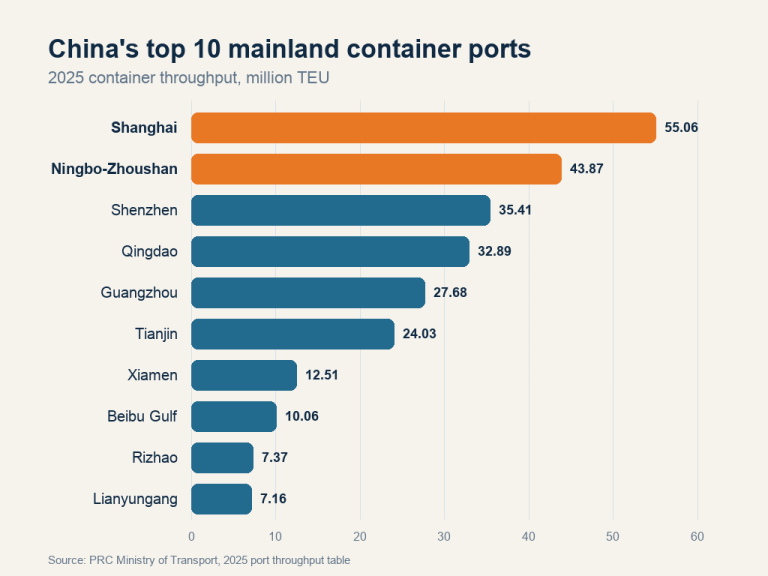
China’s biggest mainland container ports are Shanghai, Ningbo-Zhoushan, Shenzhen, Qingdao, Guangzhou, Tianjin, Xiamen, Beibu Gulf, Rizhao and Lianyungang. That ranking uses 2025 container throughput reported by China’s Ministry of Transport. Shanghai ranks first by containers, at 55.06 million TEU. Ningbo-Zhoushan ranks first by total cargo weight, at more than 1.4 billion tonnes.
Both answers can be true because they measure different things. A port can handle enormous quantities of ore, oil and other bulk cargo without moving the most containers.
There is another trap here. The biggest port is not automatically the right port for your shipment. A factory 150 kilometers from Ningbo may get a better sailing from Shanghai. A supplier in Foshan may quote Nansha while a forwarder wants to compare Yantian. The correct choice depends on the pickup address, exact terminal, carrier service, cargo, destination and complete door-to-door cost.
China’s major ports at a glance
China’s ports handled 18.338 billion tonnes of cargo and 354 million TEU of containers in 2025, according to the Ministry of Transport’s annual statistical bulletin. The container total grew 6.8% from 2024. A separate government briefing said eight of the world’s ten largest ports by cargo throughput were in China that year. The words “by cargo throughput” matter. They should not be shortened to a vague claim that China has eight of the world’s ten largest ports under every possible measure.
The table below ranks the main mainland coastal ports by containers. One TEU is the capacity of one standard 20-foot container. A 40-foot container usually counts as two TEU.
| Rank | Port | 2025 containers | Change from 2024 | Total cargo | Common geographic role |
|---|---|---|---|---|---|
| 1 | Shanghai | 55.06 million TEU | +6.9% | 811.53 million tonnes | Yangtze River Delta and national container hub |
| 2 | Ningbo-Zhoushan | 43.87 million TEU | +11.6% | 1,431.92 million tonnes | Zhejiang and the southern Yangtze River Delta |
| 3 | Shenzhen | 35.41 million TEU | +6.0% | 334.02 million tonnes | Eastern Pearl River Delta |
| 4 | Qingdao | 32.89 million TEU | +6.5% | 741.30 million tonnes | Shandong and northern/eastern China |
| 5 | Guangzhou | 27.68 million TEU | +6.2% | 669.61 million tonnes | Western Pearl River Delta |
| 6 | Tianjin | 24.03 million TEU | +3.2% | 594.85 million tonnes | Beijing-Tianjin-Hebei and North China |
| 7 | Xiamen | 12.51 million TEU | +2.1% | 211.29 million tonnes | Fujian and the Taiwan Strait |
| 8 | Beibu Gulf | 10.06 million TEU | +11.6% | 485.53 million tonnes | Guangxi, southwest China and ASEAN-facing routes |
| 9 | Rizhao | 7.37 million TEU | +9.8% | 644.52 million tonnes | Southern Shandong |
| 10 | Lianyungang | 7.16 million TEU | +7.0% | 367.53 million tonnes | Northern Jiangsu and land-sea corridors |
Source: PRC Ministry of Transport, 2025 Port Cargo and Container Throughput. The source table reports cargo in units of 10,000 tonnes and containers in units of 10,000 TEU. The values above have been converted to millions.
Where the ports sit in China’s manufacturing regions
Port selection starts inland. It begins at the factory loading dock or the warehouse where several suppliers’ goods will be combined.
The Yangtze River Delta has two obvious giants: Shanghai and Ningbo-Zhoushan. Shanghai is at the mouth of the Yangtze and connects with a broad inland network. Ningbo-Zhoushan sits south of Hangzhou Bay and is often a natural candidate for cargo from Zhejiang. Jiangsu cargo may also move through Shanghai, Ningbo or another regional port depending on the supplier location and service.
The Pearl River Delta has a similar overlap. Shenzhen Port covers several port areas on the eastern side of the delta. Guangzhou’s Nansha port area is on the western side. A supplier in Dongguan or Huizhou will often lead a forwarder to check Shenzhen services first. Guangzhou, Foshan and Zhongshan cargo often puts Nansha in the conversation. “Often” is the right word. It is not an exclusive territory map.
Qingdao, Tianjin and Rizhao are the main ports in this list for northern and northeastern sourcing. Xiamen is the major Fujian gateway in the top ten. Beibu Gulf, centered heavily on Qinzhou for container traffic, links Guangxi and parts of southwest China with maritime routes toward Southeast Asia.
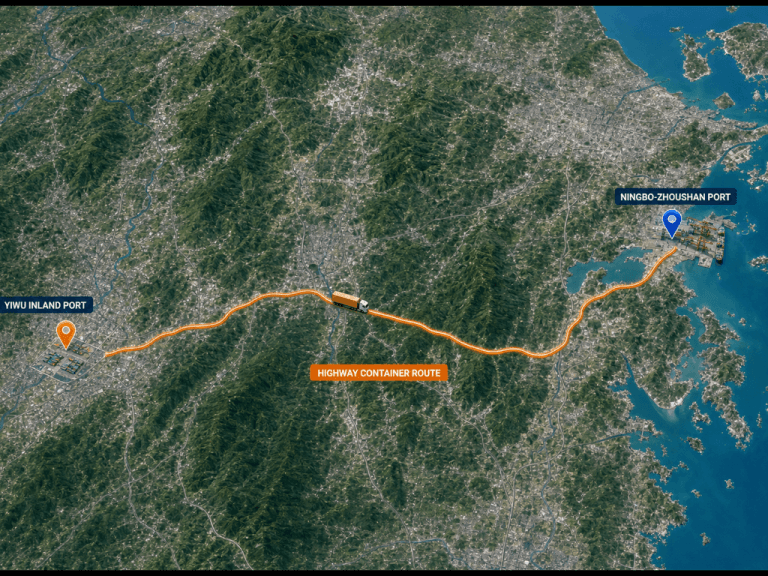
Yiwu Port: an inland customs gateway to Ningbo-Zhoushan
Yiwu needs its own category. Yiwu Port is an inland port, sometimes called a dry port, rather than a coastal terminal where ships berth. That is why it does not appear in the top-ten container ranking above. The Ministry of Transport describes it as Ningbo-Zhoushan Port’s “sixth port area.” This is not a sixth physical dock. It means port, shipping and customs services have been extended inland to Yiwu.
Under the current integrated model, export cargo can enter Yiwu Port and complete customs declaration, inspection and pre-stowage procedures there. Once the required customs and transfer formalities are complete, sealed containers can travel by rail-sea service from Yiwu, including the Suixi international hub, to Ningbo-Zhoushan Port for loading onto an ocean vessel. A General Administration of Customs report republished by Shenzhen Electronic Port describes an integrated process in which cargo departs from Yiwu, proceeds directly to the port and is handled through one connected flow.
For goods collected in Yiwu or nearby central-Zhejiang manufacturing areas such as Jinhua, Dongyang and Yongkang, ask the forwarder to quote this as a real origin option: consolidate and clear the cargo at Yiwu Port, then connect it to the named Ningbo-Zhoushan terminal. Compare that route with direct trucking to the coastal terminal. Yiwu clearance is not automatic for every shipment. The export declaration method, product controls, inspection requirements, carrier booking, terminal and cut-off still have to match the cargo. The ocean booking should identify the actual coastal port and terminal where the container will be loaded.
The ten major mainland container ports
1. Shanghai: the container leader
At 55.06 million TEU, Shanghai stayed at the top of the container ranking in 2025. The Shanghai municipal government says it ranked first worldwide for the 16th consecutive year.
“Shanghai Port” is a port system, not one gate. International container cargo may use Yangshan Deep-Water Port or terminals around Waigaoqiao, depending on the booking. That exact terminal matters to the trucker, the customs paperwork and the cut-off time.
Shanghai belongs on the shortlist for factories in Shanghai and much of Jiangsu. It can also compete for cargo from northern Zhejiang when the ocean service or total quote beats Ningbo.
2. Ningbo-Zhoushan: the cargo-tonnage leader
Ningbo-Zhoushan’s headline changes with the unit. It moved 43.87 million TEU in 2025, second to Shanghai in containers, but handled more than 1.4 billion tonnes of total cargo. The Ningbo municipal government reported that it had ranked first worldwide by total cargo throughput for 17 consecutive years.
For many Zhejiang shipments, its container network makes it a direct competitor to Shanghai. The far larger cargo-tonnage figure also reflects extensive oil, ore and other bulk operations. That mismatch is exactly why TEU and tonnes cannot be used interchangeably.
In a quote, confirm whether “Ningbo” means the intended Ningbo-Zhoushan terminal and whether the ocean service is direct or uses a transshipment hub.
3. Shenzhen: check the actual terminal
Shenzhen’s 35.41 million TEU total puts it third on the list. That city-level number is useful for ranking, but less useful when a truck is waiting for instructions: “Port of Shenzhen” is an umbrella name. The Shenzhen government identifies Yantian, Nanshan and Dachan Bay as its three main container-focused port areas. Shekou and Chiwan may also appear in shipment documents and carrier schedules within the western port group.
Yantian is a common origin name for export cargo from Shenzhen, Dongguan and Huizhou. Western Shenzhen terminals may make more sense for other factories or services. Do not send a truck based on the city name alone. The booking confirmation should name the terminal.
4. Qingdao: a large northern gateway
Qingdao’s two 2025 figures tell different parts of the same story: 32.89 million TEU of containers and 741.30 million tonnes of cargo overall. It is both a major container gateway and a very large industrial and bulk port.
For suppliers in Shandong, Qingdao is an obvious origin to price. It may also compete with Tianjin for selected northern cargo. The better choice depends on the factory location and the carrier service to the destination, not the two ports’ national rank.
5. Guangzhou: Nansha is the container name to know
Guangzhou Port recorded 27.68 million TEU in 2025. Its port system includes Nansha, Xinsha and Huangpu, though Nansha is the name most container shippers need to recognize. Guangzhou Port’s official site describes it as the core container port area and the main deep-water gateway on the western bank of the Pearl River.
For cargo from Guangzhou, Foshan, Zhongshan and nearby western-delta manufacturing areas, Nansha is often the first port to compare. Shenzhen may still win if a specific sailing, rate or destination connection is better. A bridge on the map does not settle the quote.
6. Tianjin: the Beijing-Tianjin-Hebei gateway
With 24.03 million TEU in 2025, Tianjin is the main maritime gateway on this list for Beijing, Tianjin and much of Hebei.
That does not mean every northern supplier should use Tianjin. A Shandong factory may sit closer to Qingdao. Heavy industrial cargo may require a terminal and carrier with the right equipment. Start with the pickup address, then compare the ocean service and destination leg.
7. Xiamen: Fujian’s top-ten container port
Xiamen is the highest-volume Fujian container port in the Ministry of Transport table, with 12.51 million TEU in 2025. It is a common candidate for factories around Xiamen, Quanzhou and the surrounding industrial region.
Still, Xiamen is not automatic. A supplier in northern Fujian may have another practical origin, and the carrier schedule or final delivery point can shift the answer.
8. Beibu Gulf: a fast-growing southwest option
Beibu Gulf Port crossed 10 million TEU in 2025, reaching 10.06 million, up 11.6%. Like several names in this ranking, it describes a regional port group rather than one terminal. Qinzhou is central to its container and sea-rail role.
For Guangxi and parts of southwest China, the port offers an alternative to trucking every export load toward the Pearl River Delta. It earns a place in the quote comparison only if the service frequency, destination connection and cargo-ready date line up.
9. Rizhao: bigger in tonnes than its container rank suggests
By containers, Rizhao sits ninth at 7.37 million TEU. By total cargo weight, its 644.52 million tonnes places it close to Guangzhou and above Tianjin.
Rizhao’s bulk business is a big reason. For a container importer, the lesson is not that Rizhao is “better” than a lower-tonnage container port. It is that a port’s total weight can tell a very different story from its container network.
10. Lianyungang: northern Jiangsu and land-sea links
Lianyungang closes this top ten at 7.16 million TEU. Its northern Jiangsu location can make it relevant for suppliers that sit well outside the immediate Shanghai-Ningbo orbit.
The port is also associated with rail and land-sea routes across China. Avoid choosing it from a corridor map alone. Check the actual ocean booking, terminal, cut-off and destination connection.
Shanghai vs Ningbo, Shenzhen vs Guangzhou
Port comparisons become more useful when you compare a real shipment instead of two city profiles.
For Shanghai versus Ningbo-Zhoushan, begin with the cargo-ready address. Then price the China-side truck and export handling to the named terminal. Compare the carrier, direct or transshipment service, sailing date and destination charges. A lower ocean rate can disappear after a long truck move or expensive destination handling.
For Shenzhen versus Guangzhou, get more precise. “Shenzhen” may mean Yantian, Shekou or another western terminal. “Guangzhou” often means Nansha for container exports. The factory’s side of the Pearl River matters, but so do cut-offs and the service to your destination.
Qingdao versus Tianjin follows the same logic. Shandong cargo often points toward Qingdao; Beijing-Tianjin-Hebei cargo often points toward Tianjin. Good starting point. Bad routing instruction.
For U.S. shipments, the origin port is only half the map. A cheap rate to Los Angeles may be a poor deal if the inventory must travel to an East Coast warehouse. Our guide to shipping from China to the USA explains why port-to-port transit and factory-to-warehouse time are different numbers.
How to choose the right China port
The shortlist is only the beginning. To turn it into a route, work through seven questions instead of asking only, “Which port is closest?”
- Get the factory or consolidation warehouse’s full pickup address.
- Ask the forwarder to name the exact port area and terminal, not only the city.
- Compare the actual carrier service. Check whether it is direct, how often it sails, where it transships and when cargo must arrive.
- Confirm that the carrier and terminal accept the product and equipment needed. Batteries, chemicals, refrigerated cargo and oversized freight need specific checks.
- Include the destination port and inland delivery. The cheapest ocean leg can create the most expensive total route.
- Put every quote on the same Incoterm and delivery scope. An FOB quote cannot be compared directly with a door-to-door DDP number.
- Keep a backup origin for peak season, weather disruption or a missed cut-off.
For cargo bound for Canada, use the shipping from China to Canada guide to connect the port choice with the Canadian destination, importer responsibilities and final delivery address.
To get comparable quotes, send each forwarder the same information:
- product description and any battery, liquid, chemical or other special-cargo details;
- carton or pallet count, outside dimensions, gross weight and total CBM;
- supplier pickup address and cargo-ready date;
- destination port, warehouse, Amazon facility or full delivery address;
- requested mode, Incoterm and insurance needs;
- any deadline, labeling, consolidation or handling requirement.
If one forwarder quotes “Shanghai” and another quotes “Ningbo,” ask both for the line items. Compare pickup, export handling, documentation, main freight, destination charges, customs coordination and final delivery. Our guide to why an Alibaba shipping quote can look so expensive goes deeper into quote scope.
What happens between the factory and the vessel?
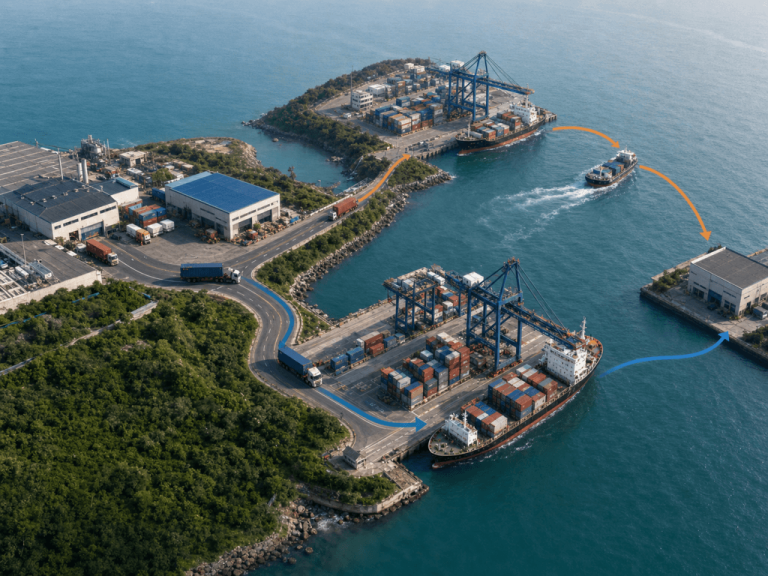
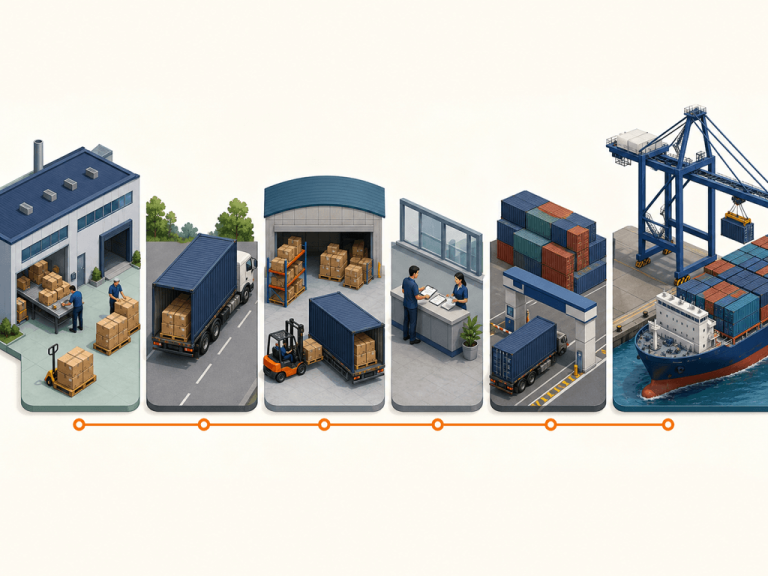
A port article can make the container appear to teleport from the factory to the ship. It does not.
For an FCL shipment, the forwarder or carrier arranges an empty container release. The container is collected, taken to the loading point, packed, sealed and moved to the terminal before the gate-in cut-off. Weight and document deadlines may sit on different clocks.
For LCL, cartons or pallets usually go to a container freight station or consolidation warehouse. The consolidator combines cargo from several shippers into one container. That adds handling and makes the origin schedule dependent on the consolidation plan.
The commercial invoice, packing list, booking details and export declaration must agree on the shipment. The bill of lading draft also needs review. A wrong consignee, quantity or port name is much easier to fix before departure than after the vessel sails.
A freight forwarder coordinates the cargo movement for the shipper or importer. A traditional port or shipping agent normally represents the vessel or carrier at the port. The names are often blurred in China sourcing conversations, so check the work being offered. This freight forwarder vs shipping agent guide explains the roles.
Is Hong Kong one of China’s major ports?
Yes, but it should be shown separately from the mainland Ministry of Transport table.
Hong Kong is part of China and is also a separate customs territory with its own port statistics. The Hong Kong Marine Department reports 12.995 million TEU in 2025, down 5.1% from 2024. If that number were silently inserted into the mainland table, Hong Kong would sit between Tianjin and Xiamen. The mixed ranking would look tidy but would hide the dataset and customs difference.
Hong Kong may still make sense for a specific shipment. That decision needs a real comparison of cross-boundary trucking, customs treatment, carrier service and destination cost. It should not be based on the port’s historic reputation.
Dalian, Yingkou and Yantai also deserve context. They remain important regional ports even though they fall outside this article’s top ten mainland container ranking. “Major” is broader than one TEU cutoff.
Frequently asked questions
What is the largest port in China?
Shanghai was China’s largest container port in 2025, with 55.06 million TEU. Ningbo-Zhoushan was the largest by total cargo throughput, with more than 1.4 billion tonnes. Always state the metric when using “largest.”
What are the top ten major ports in China?
By 2025 container throughput in the Ministry of Transport’s mainland coastal table, they are Shanghai, Ningbo-Zhoushan, Shenzhen, Qingdao, Guangzhou, Tianjin, Xiamen, Beibu Gulf, Rizhao and Lianyungang.
Which Chinese ports ship to the United States?
There is no single China-to-USA port. Shanghai, Ningbo-Zhoushan, Shenzhen/Yantian, Guangzhou/Nansha, Qingdao, Tianjin and Xiamen are common container origins. The available carrier service depends on the exact terminal and U.S. destination.
Is the nearest port always the cheapest?
No. A nearby port can have a higher ocean rate, fewer direct sailings or a worse destination connection. Compare the complete route, including China pickup and final delivery.
What is the difference between a port and a terminal?
A port can contain several port areas and terminals. Shenzhen Port, for example, includes Yantian and western port areas. The carrier booking names the exact terminal where the container must be delivered.
How many seaports does China have?
There is no useful single answer without a definition. Port counts vary depending on whether the list includes administrative ports, individual terminals, inland river ports, small coastal facilities or only major commercial gateways. For shipment planning, the exact carrier-served terminal matters more than the national count.
Can cargo clear customs at Yiwu Port and ship from Ningbo?
Yes. Under the current Yiwu-Ningbo-Zhoushan integrated model, qualifying export cargo can complete declaration, inspection and related departure procedures at the inland Yiwu Port. The sealed container then moves by rail or an approved transfer route to Ningbo-Zhoushan Port for ocean loading. Yiwu is the inland customs and logistics origin, not the seaport where the vessel loads. Ask the forwarder to confirm the declaration method, named Ningbo-Zhoushan terminal, carrier booking, cargo acceptance and cut-off for the specific shipment.
Can a buyer choose the port under FOB terms?
The named FOB port is part of the sales agreement. A buyer can negotiate the origin with the supplier, but changing it may change the supplier’s inland transport, export handling and price. Put the named port and Incoterms version in writing. The ICC Incoterms rules explain the framework; the sales contract and booking determine the actual origin.
Choose the route, not the ranking
Use the top-ten table to build a shortlist. Then forget the ranking for a moment.
Get the cargo facts, pickup address, exact terminal, carrier service, destination and Incoterm onto one page. Ask for two viable origins when the factory sits between port systems. Compare the same delivery scope. A useful quote should tell you where the cargo starts, where the price stops and what can still trigger another charge.
If you want help comparing origins, send Fulfillbot the product, carton dimensions, gross weight, supplier address, cargo-ready date and destination. The freight forwarding from China page shows the information needed for a route comparison and quote.