Yiwu Futian Market, officially the Yiwu International Trade City, is the world’s largest wholesale market for small commodities: more than 75,000 shops selling over 500,000 products across five districts, with a sixth now open. It is the right place to buy low-price general merchandise in small quantities, often 50 to 200 pieces per design. Customization is possible at the minority of stalls run by factories, and products that need safety certification usually mean arranging the testing yourself.
What is Yiwu Futian Market?
You will see three names used for the same place: Yiwu Market, Yiwu Futian Market, and Yiwu International Trade City. They all refer to one complex in Yiwu, a city in Zhejiang province about 1.5 hours from Shanghai by high-speed rail. The main building stretches roughly 5.5 kilometers and holds more than 75,000 shops.
Unlike the Canton Fair, which runs twice a year, Futian Market opens year round. Hours are 9:00 to 17:00, and most shops close on Sundays, so plan your visit Monday through Saturday. Entry is free, and you walk in the way you would walk into a shopping mall; nobody asks you to register or show an invitation letter. Yiwu’s metro line stops at International Trade City station, right at the market.
One fact shapes everything else about this place: Yiwu is a distribution hub, not a manufacturing hub. The goods come from industrial clusters in the surrounding region, and an estimated 70 to 80 percent of the stalls are run by trading companies rather than factories. That has two consequences. Prices are low but rarely the lowest possible, because there is a middleman margin built in. And a trading company stall sells what it sells; if you want changes to the product, you need one of the factory-run stalls, which do take customization work. Telling the two apart is a skill in itself, and one of the main reasons buyers bring an agent.
For the wider picture of how Yiwu fits into China sourcing, see our guide to the China Yiwu market.
The five districts, floor by floor
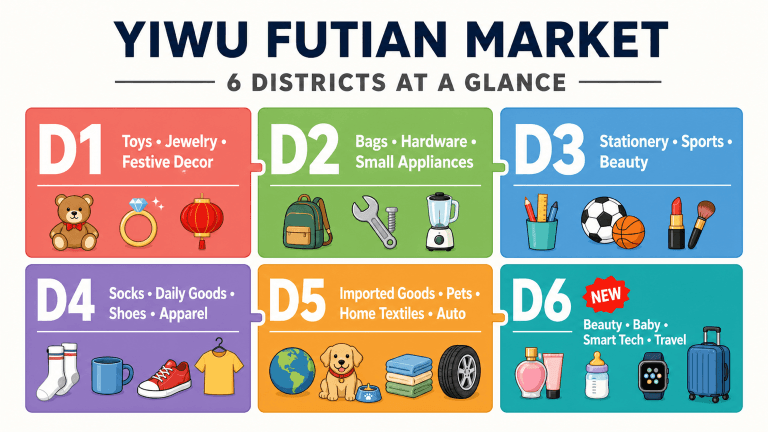
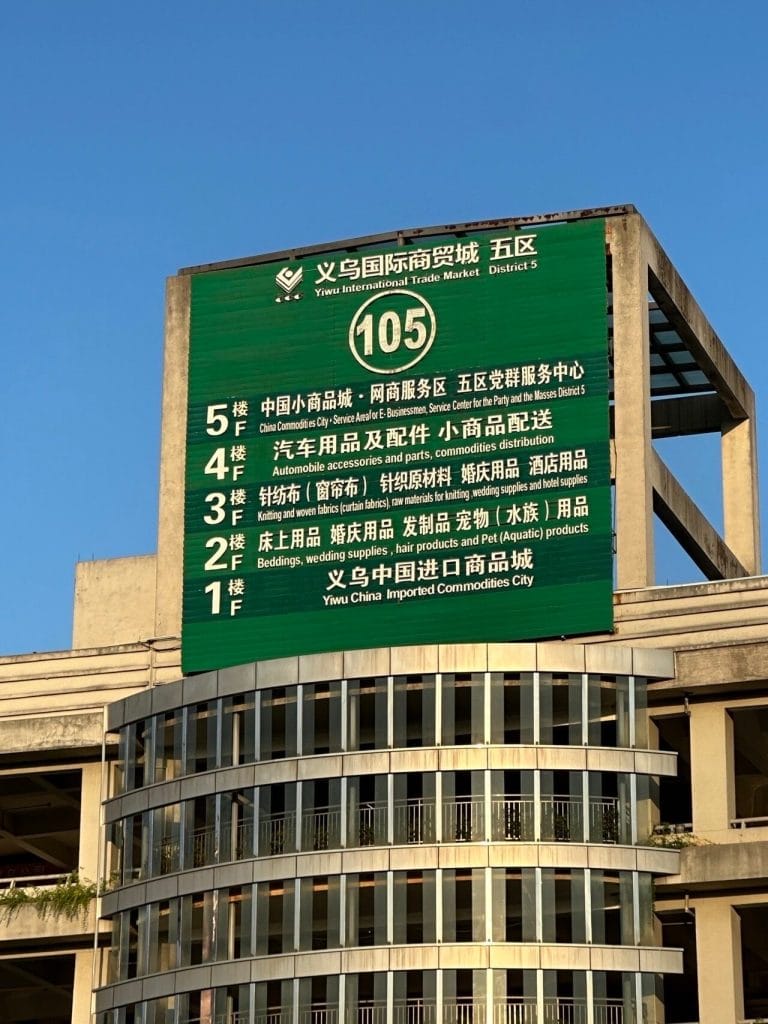
Each district specializes, and within each district, each floor specializes. Shops selling the same category sit next to each other, which sounds like chaos but is actually the market’s best feature: you can compare twenty suppliers of the same item in an afternoon without leaving the building.
| District | Floor | What you’ll find |
|---|---|---|
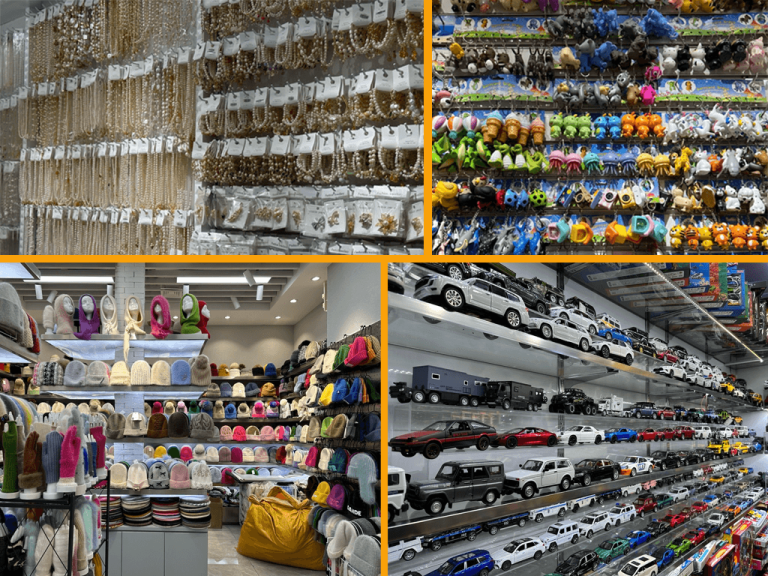
| District 1 | 1F | Artificial flowers, plush and electronic toys, toy parts |
| 2F | Hair accessories, earrings, necklaces, fashion jewelry | |
| 3F | Festive decorations, decorative paintings, ceramics, photo frames | |
| 4F | Factory outlet center, Taiwan pavilion; the east wing allows retail purchases | |
| District 2 | 1F | Bags, luggage, umbrellas, rain gear, packaging |
| 2F | Hardware tools, locks, electrical products, bikes and strollers | |
| 3F | Kitchen and bath hardware, small appliances, clocks, batteries, lighting | |
| 4F, 5F | Export pavilions and trade procurement center | |
| District 3 | B1 | New year paintings, calendars, couplets |
| 1F | Stationery, pens, eyewear, sporting goods | |
| 2F | Office supplies, outdoor gear | |
| 3F | Cosmetics, beauty tools, garment accessories | |
| District 4 | 1F | Socks, leggings, knitwear |
| 2F | Daily necessities, hats, gloves, storage products | |
| 3F | Shoes, towels, yarn | |
| 4F | Underwear, scarves, loungewear | |
| 5F | Tourist shopping center, mostly retail at low prices | |
| District 5 | 1F | Imported commodities mall (goods from outside China) |
| 2F | Pet and aquarium supplies, bedding, hair products, wedding supplies | |
| 3F | Curtain fabrics, wedding supplies, hotel supplies, knitting raw materials | |
| 4F | Auto and motorcycle accessories, goods distribution | |
| 5F | E-commerce service area | |
| District 6 | 1F | Fashion jewelry, creative and trendy toys, fashion apparel fabrics |
| 2F | Skincare and beauty products, baby and children’s products | |
| 3F | Household and health products; drones, robotics, AI equipment, AR and VR devices; travel goods | |
| 4F | Smart tech products, licensed IP merchandise |
District 6 is the newest addition, and its floor plan reads like a different market: drones, robotics, AR and VR devices, smart tech, and licensed IP merchandise sit alongside skincare and baby products. If your catalog leans toward newer product categories, it deserves a stop; for classic small-commodity buying, the five older districts remain the core of a visit.
Walking every aisle would take four days or more. Almost nobody does that. If you are a small buyer or visiting for the first time, the useful route is District 1 for toys and jewelry, District 4 for daily goods and apparel accessories, and District 5 for bedding, home textiles, and the imported goods mall. District 1 is the classic starting point; its fourth floor factory outlet center and east wing are also the most tolerant of small retail purchases, including licensed character toys.
If your product list points at Districts 2 or 3, go there instead. The point is to pick districts from your product list, not to wander.
Who should buy here, and what to check first
Futian Market fits a specific kind of buying. It works when you want inexpensive general merchandise, when your order sizes are small, and when the product is fine as it is. Typical wins: accessories, party supplies, stationery, socks, kitchen gadgets, seasonal decorations, and giveaway items that ride along with your main product. MOQs commonly start around 50 pieces per design, far below the 500 to 5,000 pieces a factory would ask for.
Three situations need a closer look before you book a flight.
First, private label and customization. Most stalls are trading companies that sell from stock, and they cannot change the product for you. The factory-run stalls can: modified designs, your packaging, your brand. So custom work is possible at Futian, but only if you identify the right stalls, and MOQs for customized orders run higher than for stock goods. For deep product development at volume, a factory relationship outside the market is still the stronger route.
Second, certified products. Children’s products going to the US need CPSIA testing, electronics need FCC, and EU markets have their own rules. Stall owners usually cannot hand you the certificates, which does not always mean the product fails the standard; it means the paperwork is your job. Budget for third-party lab testing before the goods ship, and treat any stall that promises full documents on the spot with some care.
Third, brand-name goods. Do not expect to find them. Market management prohibits the sale of counterfeit goods, so famous brands are absent from the aisles rather than lurking in them. If your business runs on licensed IP products, the east wing of District 1 has a cluster of licensed character toys; for anything else branded, Futian is simply not the channel.
How to buy from Futian Market, step by step
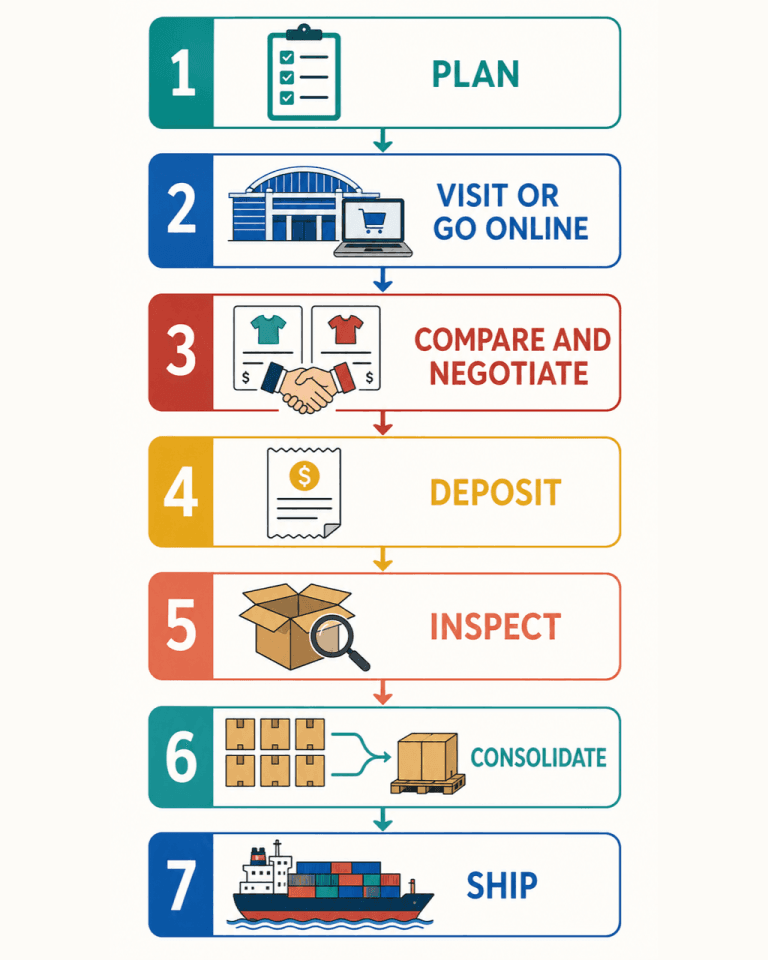
1. Prepare before you fly. Write a product list with target prices and rough quantities. Match each product to a district using the table above. Then line up a local partner before you travel: a Yiwu logistics company or a sourcing agent. This matters more than it sounds, because every stall order needs a local delivery address, and your partner’s warehouse is that address. Most will also send someone to walk the market with you, which solves translation and note-keeping at the same time. Book more days than you think you need; two focused days beats four aimless ones.
2. Get there. Fly into Shanghai or Hangzhou, then take the high-speed train to Yiwu. From Yiwu station, the metro runs straight to International Trade City station. Hours again: 9:00 to 17:00, most Sundays off.
3. Work the aisles. Compare several stalls selling the same item before negotiating. Ask for the price at your quantity, not the list price. Take photos of everything you like, and photograph the booth number and business card next to the product. After three days and two hundred stalls, your memory will not save you; your camera will.
4. Pay the deposit. The standard structure is a 10 to 30 percent deposit when you order, with the balance due after the goods arrive at your designated warehouse, meaning the warehouse of the logistics company or agent you lined up in step 1. There is no escrow here. An Alibaba order comes with Trade Assurance; a Futian order comes with a deposit slip and a relationship. The structure still protects you more than it first appears, because the balance only moves after the goods physically show up. Keep every receipt, and pay through traceable channels rather than cash where you can. For a comparison of how buyers usually pay Chinese suppliers, see our rundown of payment methods.
5. Inspect before the balance. The window between delivery and balance payment is your quality control window. Use it. At minimum, count cartons and open a sample of them. For larger orders, run a proper AQL sampling inspection at the warehouse.
6. Consolidate and ship. This is the quiet superpower of Yiwu. You can buy from thirty stalls, or a hundred, and merge everything into one container from one warehouse. Small buyers who could never fill a container from a single factory can fill one here.
Can you buy without going to China?
Yes, and this question matters to more buyers than any other. The market runs an official online platform, Yiwugo (yiwugo.com), which lists stalls with photos and contact details, and offers virtual browsing. It is genuinely useful for research, less so for transactions: listings skew Chinese-language, prices are indicative, and you still need someone to verify goods before money moves.
The practical remote setup is Yiwugo for discovery plus an agent on the ground for sampling, ordering, inspection, and consolidation. Plenty of buyers run Yiwu programs for years without visiting. The visit helps most at the start, when you are choosing categories and building supplier relationships, and matters less once reorders are running.
Do you need a Yiwu agent, and how do you vet one
You can skip the agent if your order is small, your stall speaks workable English, and you have shipping already solved. Freelance translators cost around 300 to 500 RMB for a market day if language is the only gap.
For everything else, an agent earns their fee, which typically runs 3 to 10 percent of order value. The job is not translation. It is telling factories from middlemen, negotiating at local price levels, receiving goods, inspecting them before your balance payment, consolidating thirty shipments into one, and handling export paperwork.
The catch: Yiwu has a crowded agent market, and quality varies wildly. Vet them like a supplier. Ask for a business license and export record. Ask how they charge, because an agent quoting suspiciously low commission often makes it back through hidden supplier kickbacks. Ask for references from buyers in your region. A good agent answers all three without flinching. We wrote a separate beginner’s guide to Yiwu sourcing agents that covers the vetting checklist in detail, and if you would rather hand the whole process to one team, that is what our China sourcing service does.
Shipping from Yiwu
Consolidation changes the shipping math. Once your goods from multiple stalls sit in one warehouse, you ship them as one consignment: sea freight for cost, air for speed, or rail to Europe as the middle option. Small mixed orders in the 1 to 13 cubic meter range usually go LCL (less than container load); past about 17 cubic meters, a full container usually wins on cost per unit.
Your agent or forwarder handles export declaration from Yiwu. If the goods are heading to the US, our guide to shipping from China to the USA walks through the options and timelines, and our freight forwarding service covers the Yiwu pickup itself.
Five mistakes first-time buyers make
Treating stall owners as factory owners. Negotiate with a trading company as if it had factory margins and you will hit a wall, or worse, push them to recover the discount through quality. Know which one you are talking to; the techniques in our guide to verifying Chinese suppliers apply offline too.
Paying the balance before the goods reach the warehouse. The deposit-then-balance structure only protects you if you keep the sequence; hand over the full amount early and you have given up your leverage and your inspection window in one move.
Skipping inspection because the samples looked fine. Samples are chosen; bulk is produced. The gap between them is one of the oldest problems in China sourcing, and we cover why it happens in why your bulk order differs from the sample.
Ordering certified categories without certificates. A cute kids’ product with no CPSIA paperwork is not a bargain; it is a seizure notice with extra steps.
Losing the booth number. Reorders die this way. Photograph the booth plate with every product shot.
Yiwu vs Canton Fair vs Alibaba
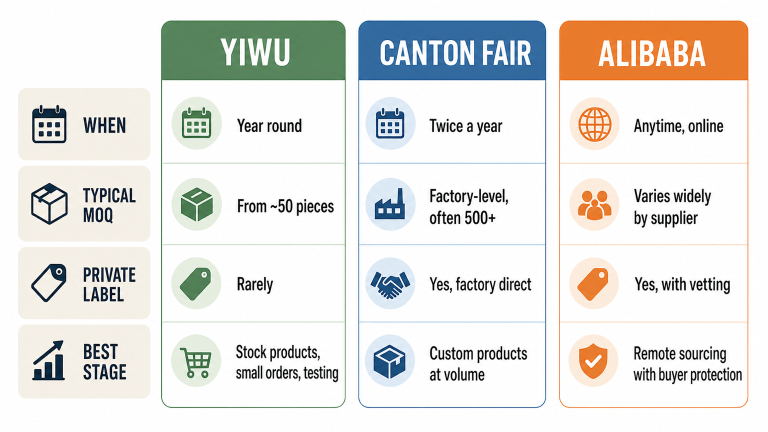
| Yiwu Futian Market | Canton Fair | Alibaba | |
|---|---|---|---|
| When | Year round | Twice a year (spring and autumn) | Anytime, online |
| Typical MOQ | From ~50 pieces | Factory-level, often 500+ | Varies widely by supplier |
| Private label | Rarely | Yes, factory direct | Yes, with vetting |
| Best stage | Stock products, small orders, testing | Custom products at volume | Remote sourcing with buyer protection |
The three channels answer different questions. Yiwu answers “where do I get small quantities of ready-made goods cheaply.” The Canton Fair answers “which factory can build my product.” Alibaba answers “how do I source without leaving my desk,” with escrow protection but higher listed prices than in-person negotiation tends to reach. Many buyers use two or all three at different stages; our comparison of China wholesale websites maps the online end of that spectrum.
FAQ
What is the Yiwu Futian Market?
It is the common name for the Yiwu International Trade City, the world’s largest small-commodity wholesale market, located in Yiwu, Zhejiang, China. Over 75,000 shops sell more than 500,000 products across five specialized districts, with a sixth district now open.
What is Yiwu Market famous for?
Small commodities at low prices with low minimum orders: toys, jewelry, stationery, socks, bags, home goods, festive decorations, and similar everyday products. It is the main export trading center for this category in China.
Is Yiwu Futian Market open on weekends?
Partly. As of 2026, the market runs 9:00 to 17:00, Saturdays included, but most shops close on Sundays. Guides that describe it as open every day are working from outdated information. Chinese New Year brings a roughly two-week closure.
Is Yiwu the biggest wholesale market in China?
Yes, for small commodities it is the biggest in China and in the world. Other Chinese markets lead specific verticals, such as the Keqiao fabric market near Shaoxing for textiles, but nothing matches Yiwu’s breadth in general merchandise.
Can I buy from Yiwu without visiting?
Yes. Use the official Yiwugo platform to research products and stalls, then work with an agent in Yiwu who samples, orders, inspects, and consolidates on your behalf. Many buyers run this fully remotely after an initial visit, and some never visit at all.
What is the minimum order quantity at Yiwu Market?
Commonly around 50 pieces per design, and often negotiable, especially if you buy several designs from one stall. That is a fraction of typical factory MOQs. If you are new to the term, here is what MOQ means in practice.
Is Yiwu cheaper than Alibaba?
Usually, for the same stock product, because you negotiate in person at local price levels. But the comparison is not clean: Alibaba includes buyer protection and remote convenience, and Yiwu stall prices carry a trading company margin that a factory-direct Alibaba order might beat at volume. Cheapest depends on your quantity and product.
How do payments work at the market?
The standard arrangement is a 10 to 30 percent deposit at order time, with the balance paid after goods arrive at your designated warehouse. There is no platform escrow, so keep receipts, use traceable payment channels, and inspect goods before releasing the balance.
Where to go from here
If your products are general merchandise and your quantities are small, Futian Market is probably the fastest sourcing route you can take: low MOQs, instant price comparison, and consolidation that turns thirty small orders into one shipment. Go in with a product list, sort factory stalls from trading companies, inspect before you pay the balance, and treat the agent decision as seriously as the supplier decision.
If you want help on the ground, from sourcing and negotiation through inspection and consolidated shipping, talk to our China sourcing team. And if you are still deciding whether Yiwu fits your product at all, start with the district table above; it usually answers the question in about a minute.