To verify Alibaba supplier before paying a deposit, confirm four things: who is legally selling, who receives the money, who controls production, and what quality the order requires. A supplier badge, Trade Assurance, or a professional-looking certificate can support that review. None of them alone proves that the supplier will make your exact product correctly or that a dispute will automatically be refunded.
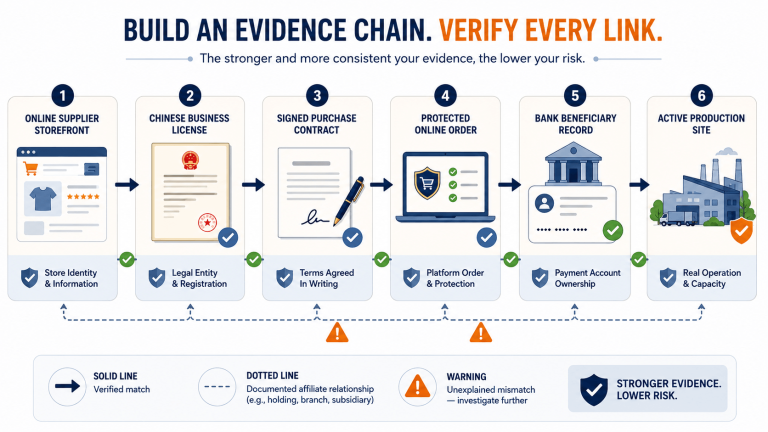
For a normal first order, match the Alibaba profile to the Chinese business registration, contract, protected order, payment beneficiary, and production site. Then approve measurable product specifications, document subcontracting and material changes, and agree on inspection before the final balance is released. If an important mismatch remains unexplained, pause the payment.
Pause before paying if: the supplier changes the payee without a documented reason, refuses to identify the legal seller or production site, cannot support a critical certificate, will not put specifications into the order, or blocks a reasonable independent audit or inspection for a substantial order.
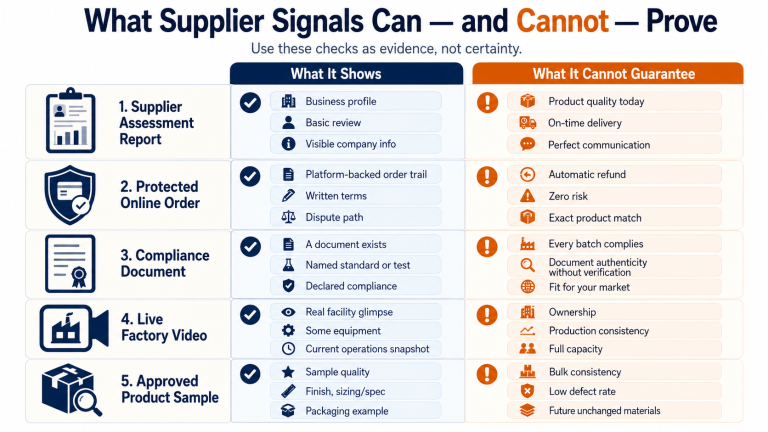
What Alibaba badges, Trade Assurance, and certificates actually prove
Buyers often see several reassuring signals on the same supplier profile and assume they add up to a guarantee. They do not. Each signal answers a different question.
| Signal | What it may establish | What it does not establish | What to do next |
|---|---|---|---|
| Alibaba supplier badge or assessment | Certain company or site information has been reviewed under the applicable supplier program | Current product quality, delivery performance, or the outcome of your order | Open the complete report and check its date, legal entity, assessed address, business type, production lines, and scope. |
| Trade Assurance or order protection | Your Alibaba order may qualify for platform dispute handling under its order terms | An automatic refund or protection for requirements that were never written into the order | Keep the transaction within the eligible Alibaba order and write measurable product and delivery requirements into it. |
| CE, FCC, or other supplier documents | A document may relate to testing or conformity for a stated product or model | Authenticity, current relevance, or applicability to the exact SKU and factory you are buying from | Verify the issuer, report number, applicant, manufacturer, product model, standard, and date. |
| Factory photos or video | The supplier has access to a production environment | Ownership, current capacity, or use of that site for your order | Use a continuous live walkthrough or an independent factory audit when the commitment justifies it. |
| Good sample | The supplier can produce at least one acceptable unit | Repeatability across the bulk run | Convert the approved sample into written specifications and inspect production before final payment. |
Alibaba’s current Verified Supplier page says that the program includes third-party onsite verification and a detailed assessment report available to buyers.1 That makes the report useful evidence, but it remains a point-in-time assessment of a company or operation. It is not a warranty for every product listed by that supplier.
Trade Assurance should be treated as an order-protection and dispute mechanism governed by the current order terms, not as a substitute for due diligence. Review Alibaba’s current buyer-protection information and the terms displayed on the actual order before paying.
Run a 10-minute desktop supplier check
The first pass is not meant to prove that the supplier is safe. Its purpose is to expose contradictions before you spend money on samples, audits, tooling, or production.
1. Open the supplier profile and assessment report
Record:
- full legal company name in English and Chinese
- company address
- stated business type
- years on Alibaba
- assessment date and assessor
- assessed site address
- main products and production lines
- whether the report describes a manufacturer, trading company, or combined operation
Do not treat a PDF sent over chat as self-authenticating. Compare it with the report linked from the supplier profile. If the assessor provides an official verification channel, confirm the report there.
2. Verify the Chinese business registration
Ask for a clear copy of the Chinese business license. Search the Chinese company name or 18-character Unified Social Credit Code in China’s National Enterprise Credit Information Publicity System, commonly called GSXT.3
Compare:
- exact Chinese company name
- Unified Social Credit Code
- registration status
- legal representative
- registered address
- establishment date
- business scope
Manufacturing or processing language in the business scope supports a factory claim, but it does not prove that the company currently operates the machinery or will make your order at that address. A legitimate factory may also use an affiliated export company, while a company registered for manufacturing may subcontract production.
Registered capital is a weak screening signal. It is not the same as paid-in cash, equipment value, revenue, or current capacity.
3. Map every company in the transaction
Write down the name attached to each role:
| Role | Company or account to verify |
|---|---|
| Alibaba storefront | Profile owner and assessed company |
| Chinese business license | Registered legal entity |
| Assessment report | Company and site that were assessed |
| Quotation and contract | Legal seller |
| Alibaba order | Supplier named in the protected transaction |
| Payment | Account beneficiary |
| Production | Company operating the actual manufacturing site |
| Export documents | Exporter or shipper |
The names do not always have to be identical. Group companies, Hong Kong sales entities, and licensed exporters are common. They do need a coherent explanation supported by documents.
If the factory and seller are different, ask who owns or controls each entity, why that structure is being used, which company is responsible for quality and delivery, and which jurisdiction applies to the contract. For a high-value order, tooling, or an unexplained cross-border payee, obtain advice from a qualified trade lawyer rather than relying only on supplier assurances.
Pause if the payee changes shortly before payment, the supplier requests an unrelated personal account, or no one can explain the relationship between the contracted seller, payment beneficiary, and factory.
4. Use import records only as supporting evidence
Shipment databases such as ImportYeti can show patterns in U.S. ocean-freight records.4 Search the legal English name, name variations, former names, related exporters, and address.
Do not treat a missing record as proof that the company has never exported. Public datasets do not cover every mode or market, and a record may name an exporter, freight forwarder, consolidator, or 3PL instead of the factory. Shipment history can support the supplier’s story; it rarely proves who manufactured the product.
Keep a supplier verification record
Use one record for each check, and copy these fields into your spreadsheet. Keep supplier-provided material separate from evidence you have checked independently.
| Field | What to record |
|---|---|
| Item being checked | The legal seller, payment beneficiary, production site, product report, or another specific item. |
| Supplier’s claim | The exact statement you need to confirm. |
| Evidence and reference | A document, official lookup, issuer response, or inspection record. Save its link or file reference and note who provided it. |
| Date and scope | When the evidence was issued and checked, and which entity, site, product model, or specification version it covers. |
| Status | Verified within the stated scope / Pending evidence / Conflicting evidence. |
| Open question and next action | What is missing or inconsistent, and how you will resolve it. |
| Owner and follow-up date | Who will obtain or check the evidence, and by when. |
| Decision record | The next sample, production, or payment step this check affects; the reviewer’s name, date, and decision under the agreed terms. |
Missing evidence belongs under “Pending evidence”; it is not proof of fraud. Mark conflicting records for clarification and retain both versions. A verified item confirms only the fact and scope recorded in that row—it does not certify the supplier or guarantee the order. Review unresolved items before the next step they affect.
Verify CE, FCC, and other supplier documents
A polished PDF is not enough. Before relying on a certificate, declaration, or test report, identify what kind of document it is and what product it covers.
Check:
- document or report number
- issuing organization and its official verification channel
- applicant and manufacturer
- factory address, if stated
- product name and exact model
- tested standard and edition
- issue date and validity, where applicable
- complete report versus selected pages
- whether the tested configuration matches the product you will buy
- whether the laboratory’s scope covers the claimed test
For FCC-related equipment, confirm which authorization requirements apply and verify a claimed FCC ID through the FCC’s official equipment-authorization resources.5 For CE-marked products, remember that CE marking is tied to applicable EU legislation and the manufacturer’s conformity responsibilities; it is not one universal certificate issued by the EU.6 Ask for the relevant EU Declaration of Conformity and supporting technical or test documents for the exact model.
If the document names a different applicant, manufacturer, model, or factory, do not immediately label it fake. Ask for the legal and production relationship, then confirm whether the document actually covers your configuration. If the product is regulated or safety-critical, use an independent compliance specialist or laboratory before production.
Factory, trading company, or hybrid?
A factory operates at least part of the production process. A trading company buys from or coordinates one or more factories. A hybrid may manufacture core products while sourcing related products from partner plants.
Those labels do not tell you whether the supplier is good. They tell you where control may sit.
| What to compare | Factory | Trading company |
|---|---|---|
| Main role | Operates at least part of production | Sources and coordinates production |
| Product range | Often centered on related materials or processes | Can combine unrelated products from several factories |
| MOQ | Often higher because production setups require minimum runs | May negotiate smaller runs or consolidate demand |
| Customization | Can provide direct engineering and process access | Depends on its influence over the producing factory |
| Production visibility | Potentially direct | Indirect unless factory access is provided |
| Multi-SKU coordination | Limited when products require unrelated processes | Often a core advantage |
| Main risk | Factory status creates false confidence about quality or delivery | Hidden or weakly controlled subcontracting reduces traceability |
| Best fit | Repeat volume, tooling, technical customization, tighter process control | Product testing, mixed SKUs, lower volume, consolidated coordination |
The problem is not paying a trading-company margin. The problem is believing that you are dealing directly with the plant when your contact cannot control materials, scheduling, subcontractors, or corrective action.
For products that share one core process, a specialized factory may be the best fit. For an order combining items such as molded products, printed packaging, stickers, and apparel, one transparent trading company or China sourcing agent may be more practical than trying to force one factory to make everything.
Verify who controls production
A business license cannot tell you what will happen on the production line. Ask the supplier to divide your product into:
- operations performed in-house
- operations routinely subcontracted
- components purchased as finished items
For each critical step, ask:
- Which operations for this exact product happen at your facility?
- Who supplies the critical material or component?
- What machinery is used for the critical process?
- What is normal daily output for this product?
- What defect appears most often, and where is it detected?
- Who can approve a material, color, tolerance, packaging, or process change?
- If production is late, who controls the revised schedule?
Use a live walkthrough as a challenge, not a factory tour
For a meaningful order, request one continuous call showing the building entrance, company name, relevant production area, machinery, raw materials, active work, QC area, and finished-goods storage. Ask the supplier to show an order-specific item, machine nameplate, current production record, or another detail that would be difficult to answer with recycled footage.
A small supplier may reasonably limit access, especially before a low-value sample order or when other customers’ confidential work is visible. The question is whether its response is proportionate to your commitment and whether it offers credible alternatives, such as an independent audit.
Know what a factory audit can and cannot do
A factory audit can examine the site, equipment, headcount, processes, capacity, quality system, subcontracting, and document consistency. It does not prove that your finished order meets its specifications. That requires product inspection and, when applicable, laboratory testing.
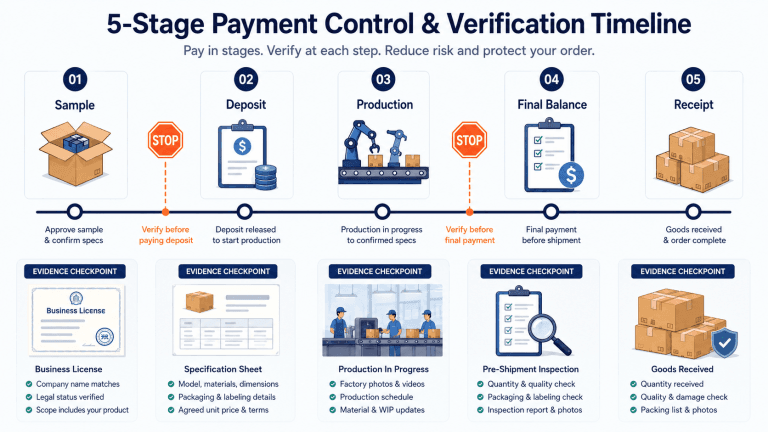
Use five payment gates instead of one supplier checklist
Supplier verification should become stronger as more money and inventory are exposed.
Gate 1: before paying for samples
- Confirm the basic legal entity and profile consistency.
- Confirm that the supplier understands the relevant product and process.
- Ask who will make the sample and at which site.
- Put the sample specifications, price, lead time, and shipping method in writing.
For a simple low-cost product, document screening and sampling can run in parallel. Do not commission a full audit for every inexpensive sample.
Gate 2: before paying the production deposit
Complete the checks that would become expensive to correct after production starts:
- match the contracted seller, Alibaba order, and payment beneficiary
- document any factory, sales-company, or exporter relationship
- verify critical certificates and reports
- approve the final sample and product specification
- define materials, components, dimensions, tolerances, color, function, packaging, labels, and allowed defect limits
- state which production steps may be subcontracted
- require written approval before material, component, supplier, or process changes
- agree on the inspection stage and the condition for releasing the final balance
Normalize competing quotes before deciding that one supplier is cheaper. Check that every quote uses the same specification, quantity, tooling, packaging, compliance work, Incoterm, lead time, inspection responsibility, and payment terms. Use the RFQ guide to compare like-for-like supplier quotes before selecting an offer.
Once you have selected an offer, check the payment route before sending a deposit. Match the beneficiary, amount, currency and payment reference to the instructions in your Alibaba order, and review the fees before authorizing payment.
Gate 3: during production
- Confirm that production started at the disclosed site.
- Approve a first production unit when product risk justifies it.
- Use during-production inspection when defects would be costly to correct after the batch is complete.
- Record all approved changes in writing and update the order specification when necessary.
Gate 4: before paying the final balance
- Complete the agreed pre-shipment inspection.
- Compare the goods with the written specification and approved sample.
- Confirm finished quantity, packaging, labels, carton marks, and shipment readiness.
- Document failed checks and corrective action.
- Do not release the balance merely because the supplier says the order is finished.
Handle inspection results under the acceptance criteria and payment conditions agreed for this order. For any failed item, keep a written record of the corrective action, any agreed reinspection, and the buyer’s approval or unresolved objection before the next payment decision. A failed check does not by itself establish a general right to withhold payment outside those terms.
Gate 5: after receipt
- Inspect promptly.
- Preserve photos, videos, carton labels, packing lists, inspection reports, and communications.
- Compare the goods with the written order rather than a general expectation of quality.
- Check the current dispute deadline and order-specific protection terms immediately if a problem appears.
Keep each reported problem with the relevant order requirement and supporting photos, inspection records, and supplier communications. Check the deadline shown on your current order as soon as a problem appears; do not wait for the supplier’s reply before checking your next required step.
Stop a good sample from becoming a bad bulk order
A sample proves that the supplier can make one acceptable unit. It does not prove that the operation can repeat it across 500, 1,000, or 5,000 units.
Keep one approved sample as the reference and convert its important characteristics into measurable specifications:
- material grade and composition
- approved critical components or component requirements
- dimensions and tolerances
- weight, thickness, or density
- color reference
- workmanship and cosmetic limits
- functional tests
- packaging and labeling
- allowed defect levels
Ask whether the sample was handmade, made in a sample room, or produced on the line planned for the bulk order. State that the supplier cannot change critical materials, components, subcontractors, or processes without written approval.
An inspection can still miss a substitution if the checklist does not cover the internal component or if the test cannot identify the material. For higher-risk items, combine visual inspection with the appropriate functional, destructive, or laboratory tests.
For the complete production-control workflow, see why an Alibaba sample can differ from the bulk order.
Factory audit vs production inspection vs product testing
These controls answer different questions.
| Control | Main question | Best timing | Key limitation |
|---|---|---|---|
| Factory audit | Is this operation real and capable of the stated process? | Before a large deposit, tooling, regulated product, or major commitment | It does not confirm that your finished batch meets specifications. |
| During-production inspection | Is the order following the approved process while correction is still possible? | After production has started but before the batch is complete | It reviews a production stage, not the entire finished shipment. |
| Pre-shipment inspection | Does a sample of the finished batch meet the written requirements? | Before final payment and shipment | Statistical sampling cannot guarantee that every unit is defect-free. |
| Container-loading or quantity check | Are the correct cartons and quantities being handed over for shipment? | During loading or shipment handoff | It does not replace detailed product inspection. |
| Laboratory testing | Does the tested sample meet defined technical or regulatory requirements? | During development, pre-production, or production depending on the risk | Results apply to the tested sample and scope, not automatically to every unit. |
Give the inspector both written specifications and the approved sample. The specifications provide measurable acceptance criteria; the sample provides a physical reference for materials, workmanship, color, and finish. Anything important that appears in neither cannot be inspected or enforced reliably.
If your inspection uses an AQL sampling plan, understand AQL sampling limits before agreeing on the plan. Define the defect categories and acceptance criteria in advance. The result supports an accept-or-reject decision for the lot under that plan; it does not establish the exact defect rate of the whole shipment.
Red flags that should stop or delay payment
No single red flag proves fraud. Several unresolved red flags are enough reason to pause.
| Pattern | Why it matters | Immediate action |
|---|---|---|
| Payee changes just before payment | Possible account compromise or entity substitution | Stop and verify through a known contact and the contracted company. |
| Personal or unrelated third-company account | Breaks the evidence chain and may change legal recourse | Require a documented relationship and correct the contract and protected order. |
| Quote is far below comparable offers | Materials, specifications, packaging, compliance, or shipping may not be comparable | Requote suppliers against the same RFQ and cost basis. |
| Supplier refuses to identify subcontracting | You cannot know who controls critical production | Require a process map and responsible production site before proceeding. |
| Critical certificate cannot be verified | The product may not meet market or customs requirements | Verify independently or commission the required testing. |
| Supplier-controlled freight is unrealistically cheap | Hidden charges, false duty assumptions, or documentation risk may appear later | Confirm the Incoterm, route, duty responsibility, and forwarder. |
| Sample is better than production | Material or process may have changed after approval | Lock specifications and change control; inspect before final payment. |
| Quantity, packing list, and shipment evidence do not reconcile | Items may be missing or only partially shipped | Stop release until the discrepancy is documented and resolved. |
| Branded goods are offered without verifiable authorization | Counterfeit and IP risk can lead to seizure or liability | Do not proceed without valid authorization and market-specific legal review. |
These risks overlap with payment fraud, fake certificates, bait-and-switch quality, and other common Alibaba scam patterns. Keep the scam check separate from the factory-versus-trader label: a real factory can still create a bad order.
Verification message you can send to the supplier
Before we approve the production deposit, please send or confirm:
- Your current Chinese business license and Unified Social Credit Code.
- The complete Alibaba assessment report linked to this profile.
- The legal company names on the quotation, contract, Alibaba order, invoice, and payment account.
- The relationship between the seller, payment company, exporter, and factory if they are different.
- The address where our sample and bulk order will be produced.
- The production steps completed in-house, subcontracted steps, and critical purchased components.
- A continuous live walkthrough of the relevant production and QC areas, or confirmation that an independent audit can be arranged.
- The report numbers and verification details for any certificates or test reports required for this product.
- The final product specification, approved sample, bulk lead time, and normal output for this product.
- Written confirmation that critical materials, components, subcontractors, or processes will not change without our approval.
- The agreed production and pre-shipment inspection stages.
- The acceptance and corrective-action process before the final balance is released.
A legitimate trading company should be able to answer these questions as clearly as a factory. The questions test transparency, traceability, and control—not the label on the storefront.
How much verification does your order need?
Due diligence should match the downside. A small, low-risk test order may need document screening, a sample, written specifications, and protected payment where applicable. A meaningful deposit or repeat order adds entity matching, change control, and pre-shipment inspection. Tooling, regulated products, and large commitments may justify a factory audit, product testing, during-production checks, and a tooling-ownership agreement.
When trading company or sourcing partner is the better choice
As the comparison above shows, a trading company or sourcing partner fits unrelated SKUs, lower quantities, consolidated shipping, and multi-plant coordination, while direct factory contact suits proprietary tooling, engineering changes, and tight material control. Compare total landed cost and execution risk rather than assuming “factory direct” is always cheaper, including when choosing between Alibaba and 1688.
If you already have a supplier but need China-side support before inventory moves overseas, Fulfillbot can review the sourcing requirements, coordinate samples and available inspection steps, receive goods, document visible issues, and prepare the order for storage, freight, FBA prep, or fulfillment based on the agreed scope. See Fulfillbot’s China sourcing support for the current service process.
For a review of your requirements, send the supplier’s profile link, target SKU and specification, quantity, current quote, sample stage, and the verification questions still unresolved. Confirm the scope and fees for document comparison, sample coordination, and any agreed checks before work begins.
FAQ
Is Alibaba Gold or Verified Supplier automatically safe?
No. A supplier badge and assessment report are useful screening evidence, but they do not guarantee the quality or delivery of your specific order. Open the complete report, match its entity and site to the transaction, and verify production and quality controls separately.
Does Trade Assurance guarantee a refund?
No. Protection depends on the current program terms, the order, the evidence, and the nature of the dispute. Keep measurable specifications and delivery terms inside the eligible Alibaba order, preserve records, and check the current deadline as soon as a problem occurs.
How do I verify CE or FCC document from supplier?
Identify the document type, issuer, report number, applicant, manufacturer, exact model, tested standard, and date. Verify the document through an official issuer or regulator channel where available, and confirm that the tested configuration matches the product you will buy.
What if mainland Chinese supplier asks me to pay Hong Kong company?
Do not assume that it is fraudulent, but do not treat it as a minor detail. Verify the relationship, contract with the correct seller, and understand which company and jurisdiction would be responsible if the order fails. Obtain legal advice when the commitment is significant.
What is the difference between factory audit and pre-shipment inspection?
A factory audit examines the operation and its capability. A pre-shipment inspection checks a statistical sample of your finished order against written requirements. Large or complex orders may need both.
How do I prevent the bulk order from being worse than the sample?
Keep an approved sample, convert it into measurable specifications, control material and component changes, identify subcontracting, and inspect the production batch before final payment. Add laboratory or destructive testing when visual inspection cannot confirm a critical requirement.
What should I check before paying the final balance?
Confirm inspection results, corrective actions, finished quantity, packaging, labels, carton marks, and shipment readiness. Compare everything with the written order and approved sample, not with informal chat promises.
Conclusion
The safest Alibaba supplier is not simply the one that looks most like a factory. It is the supplier whose legal identity, payment path, production control, product requirements, and inspection process remain traceable from the first sample through the finished shipment.
Use badges, business records, videos, and shipment history to decide what to investigate. Use a matched transaction, written specifications, change control, audits, testing, and inspections to decide when to release money.
If an important mismatch remains unexplained, pause. A delayed deposit is inconvenient. An uncontrolled bulk order is much harder to recover from.
Sources and further reading
Alibaba.com, Verified Supplier.
2: Alibaba.com, Trade Assurance Protects Your Alibaba.com Orders. Program availability and terms should be checked on the actual order before payment.
3: China’s National Enterprise Credit Information Publicity System.
4: ImportYeti, Dataset Information.
5: U.S. Federal Communications Commission, FCC ID Search and Equipment Authorization Resources.
6: European Commission, CE Marking