
Most importers get AQL 2.5 wrong the first time they see it. They assume it means “reject the shipment if more than 2.5% of the sample is defective.” That sounds logical. It is also wrong.
AQL in sampling inspection is a method for deciding whether to accept or reject a production lot after checking a random sample. It does not measure the exact defect rate in the shipment. The decision comes from the lot size, inspection level, sample-size code letter, and the acceptance and rejection numbers in the governing plan.
The current international reference is ISO 2859-1:2026. Some U.S. contracts use ANSI/ASQ Z1.4 instead. These systems are closely related, but buyers should not assume that every table, term, or procedural detail is interchangeable. The purchase order should identify the standard and version that controls the inspection.
What AQL means in a sampling inspection
AQL stands for Acceptance Quality Limit. Older documents and many search results still call it Acceptable Quality Level, but the current ISO title uses Acceptance Quality Limit.
In plain English, AQL is an indexing value used to select an acceptance sampling plan. The inspector draws a sample, classifies what was found, and compares the count with the plan’s acceptance number (Ac) and rejection number (Re).
The output is a lot decision, not a quality score:
- Accept the lot under the agreed plan.
- Reject or hold the lot under the agreed plan.
- In a double or multiple sampling plan, inspect another sample before making the final decision.
That is different from measuring the true quality of the full lot. NIST’s acceptance-sampling handbook draws a clean line: the method makes a lot decision; it does not estimate the lot’s quality with precision.
That means a passed shipment can still contain defects. A failed shipment is not proof that every unit is bad. Sampling gives you a controlled decision with known statistical risks. It does not give you X-ray vision.
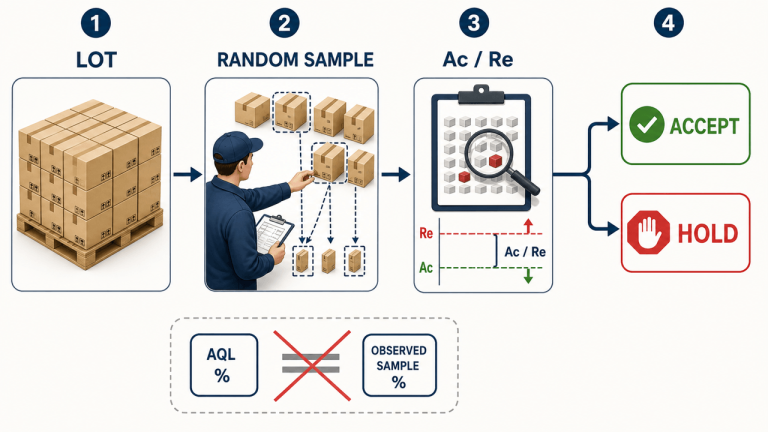
Why AQL 2.5 is not a 2.5% sample defect limit
Suppose an inspection plan calls for a sample of 200 units, with Ac 10 and Re 11 for major defects. The inspector finds nine major nonconforming units.
Nine out of 200 is 4.5%. If you compare that percentage directly with AQL 2.5, you might reject the lot. Under the specified plan, however, nine is below the acceptance number of 10, so the lot passes that major-defect criterion.
Nothing is broken in the math. AQL 2.5 indexes the sampling plan. It is not the number you compare with the raw percentage found in one sample.
Any random sample can be unusually good or unusually bad. The plan has to live with two kinds of decision error:
- Producer’s risk is the chance of rejecting a lot that is at an acceptable quality level.
- Consumer’s risk is the chance of accepting a lot that is unacceptably poor.
An operating characteristic curve shows how the probability of acceptance changes as incoming quality changes. NIST explains the risks and OC curves in its engineering statistics handbook.
For a buyer, the practical rule is blunt: read Ac and Re. Do not invent a pass/fail rule by dividing the defects found by the sample size and comparing that percentage with the AQL.
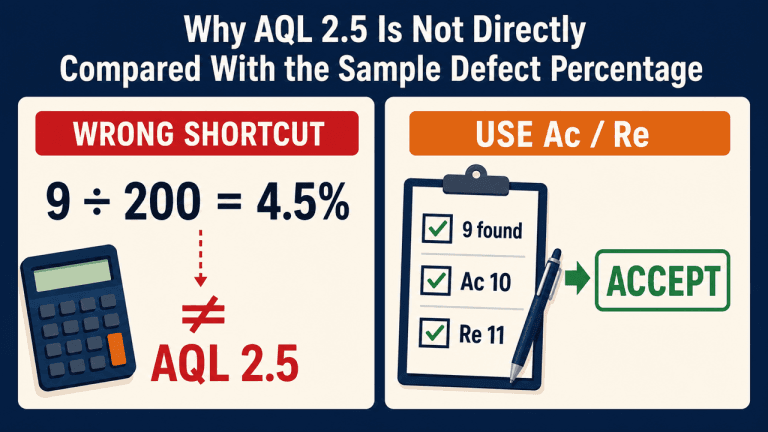
What you need before opening an AQL chart
“Use AQL 2.5” is not a complete inspection instruction. It is barely a start. Before anyone opens a chart or calculator, the buyer and inspector need to settle the following details.
Define the lot
The lot is the population from which the sample will be selected. One purchase order is not automatically one statistically sensible lot.
Different SKUs, factories, material batches, production dates, colors, or sizes may need separate lots. If 3,000 black shirts and 2,000 white shirts were produced on different lines, combining them into one 5,000-unit lot can hide a problem that affects only one color.
The inspection brief should state how the lot is divided and how many cartons and units must be selected from each part.
Name the standard and version
Write the exact reference into the purchase order or inspection booking. For example:
Single sampling, normal inspection, General Inspection Level II, under ISO 2859-1:2026.
If the contract uses ANSI/ASQ Z1.4, say so. Do not write “international AQL standard” and expect every party to use the same table.
Choose the inspection level
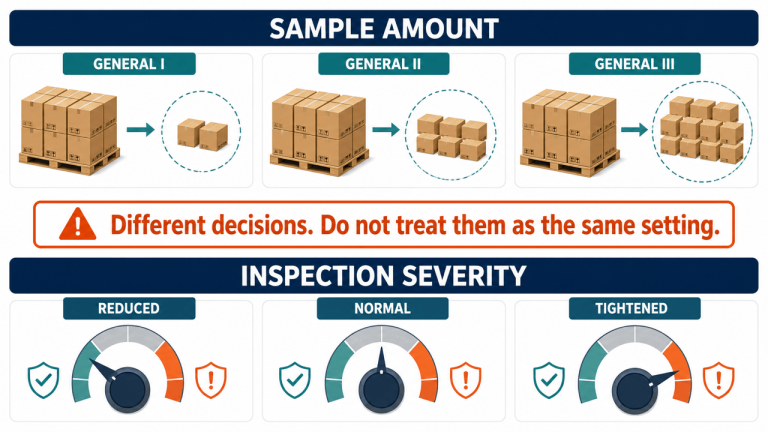
General Inspection Levels I, II, and III control the relative amount of inspection. Level I uses a smaller sample. Level III uses a larger sample. Level II is a common commercial starting point for ordinary consumer-goods inspections, but it is not a universal legal default.
Special Levels S1 through S4 usually produce much smaller samples. They are useful for checks that are expensive, slow, or destructive. A drop test, seam-strength test, or full assembly test may use a special level while workmanship checks use a general level.
Define defects and the counting method
Consumer-product inspections often separate findings into critical, major, and minor categories:
- A critical problem may create a safety, legal, or severe use risk.
- A major problem can make the product unusable, unsellable, or unacceptable to a typical customer.
- A minor problem is a smaller deviation that does not materially affect normal use.
You will often see critical/major/minor settings written as 0/2.5/4.0. Treat that as a commercial convention, not an answer you can paste into every PO. A children’s product, electrical device, cosmetic, medical item, or load-bearing component may require a different plan and product-specific compliance testing.
The brief must also say whether the inspector counts nonconforming units or individual nonconformities. One product can have several cosmetic issues. Without a counting rule, the factory and inspector may produce different totals from the same evidence.
How to read an AQL table
Most single-sampling, normal-inspection walkthroughs use two lookups.
- Find the row for the lot size.
- Move across to the chosen inspection level.
- Record the resulting sample-size code letter.
- In the applicable sampling-plan table, find that code letter.
- Read the sample size.
- Move to the selected AQL column and read Ac and Re.
- Draw the sample randomly, perform the specified checks, and count the results using the agreed rules.
Ac is the highest count that still passes. Re is the lowest count that fails. In a simple single-sampling plan, the numbers are usually adjacent. Double and multiple plans can have an intermediate zone that requires more sampling.
The order matters. Neither the lot size nor the AQL gives you the sample size by itself. The inspection level creates the code letter, and that letter connects the two lookups.
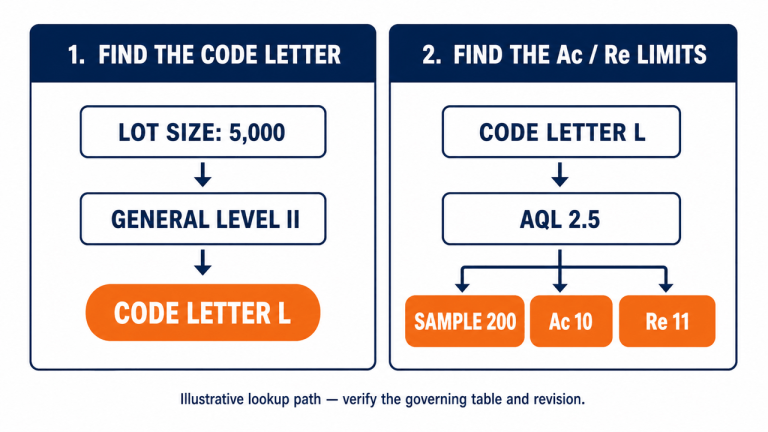
Worked example: a 5,000-unit order
Consider a lot of 5,000 units. The buyer selects General Inspection Level II and uses the public Z1.4-style example shown by QIMA, QualityInspection.org, and InTouch Quality.
The lookup produces the following teaching example:
| Input or result | Value |
|---|---|
| Lot size | 5,000 units |
| Inspection level | General II |
| Code letter | L |
| Sample size | 200 units |
| Major-defect AQL | 2.5 |
| Accept number | 10 |
| Reject number | 11 |
If the inspector finds nine major nonconforming units, the major criterion passes. If the inspector finds 11, it fails.
The AQL count does not settle every part of the inspection. If the factory made the wrong product or printed every barcode incorrectly, counting each unit as another ordinary defect misses the point. The same goes for a short quantity, the wrong packaging, or a failed safety test. These are separate checklist or specification failures.
This example explains the mechanics. It is not a substitute for the governing standard. The public QIMA table identifies ANSI/ASQ Z1.4-2008 as its basis. Before placing Ac/Re values into a binding contract, have the exact table and version checked by a qualified quality professional.
Inspection level and inspection severity are different
Two sets of labels appear in AQL discussions, and they are easy to mix up.
General Levels I, II, and III change the amount of inspection. They affect the code letter and usually the sample size.
Normal, tightened, and reduced inspection change the severity of the sampling plan based on the history of a continuing series of lots. ISO says a stable record can support reduced or skip-lot inspection, while worsening results can trigger tightened inspection or the suspension of acceptance sampling.
Level III is not another name for tightened inspection. Level I is not another name for reduced inspection. One choice controls sample coverage; the other belongs to a switching system that responds to recent lot performance.
How AQL fits into a pre-shipment inspection
AQL tells the inspector how to sample and where the acceptance boundary sits. It cannot tell the inspector what a good product looks like.
That job belongs to the product specification, approved sample, defect catalogue, and QC checklist. This is why a vague instruction such as “same as sample, AQL 2.5” is weak. The inspector still needs measurable requirements for dimensions, material, finish, color, function, labeling, packaging, and tolerances.
If your approved sample never became a written specification, read why a good Alibaba sample can still turn into a bad bulk order. The sample is a useful visual reference. The specification is what makes the inspection repeatable.
A practical inspection brief needs enough detail that the inspector does not have to guess:
- The PO, SKU list, lot definition, and production quantity.
- The standard, version, plan type, and inspection severity.
- The inspection level for each group of checks.
- AQL values and defect definitions by category.
- The counting rule for units and nonconformities.
- Drawings, tolerances, color references, and approved-sample evidence.
- Quantity, packaging, barcode, labeling, and functional checks.
- Rules for random carton and unit selection.
- Photo requirements and report format.
- What happens to payment, shipment, rework, and reinspection after a failure.
Random selection deserves more attention than it usually gets. If the supplier chooses the cartons, the sample is no longer meaningfully random. The inspector should select across warehouse locations, carton positions, production times, and relevant variants. Convenient boxes at the front of the warehouse are not a statistical method.
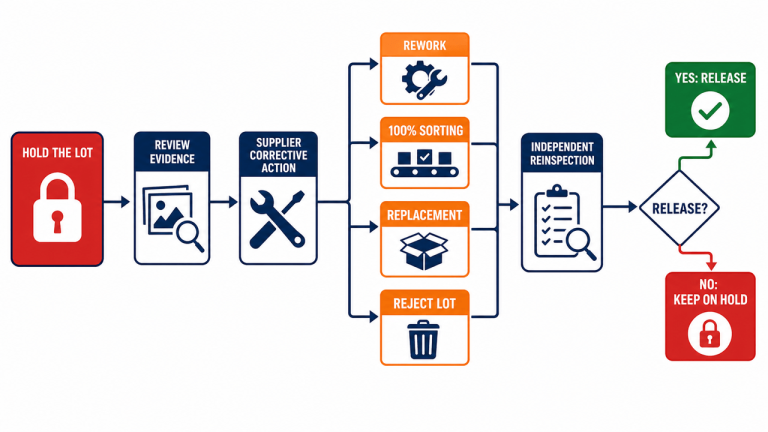
What happens when an AQL inspection fails?
A failed sample does not mean the whole order goes in a dumpster. It means the lot should be held and formally dispositioned under the purchase agreement.
Once the lot is on hold, work through it in this order:
- Stop shipment and, where the contract allows, hold the unpaid balance.
- Check the defect classification, sample selection, counts, photos, and failed tests.
- Ask the supplier for a root-cause explanation and a written rework plan.
- Decide whether the affected characteristic needs 100% sorting, repair, replacement, or additional testing.
- Reinspect using a fresh, independently selected sample.
- Release, discount, replace, return, or reject the lot according to the contract.
The inspection report is evidence. It is not a refund clause. Your right to reject, charge for reinspection, demand rework, or withhold payment depends on the purchase agreement, payment terms, and applicable law.
For an eligible Alibaba order, prepare Trade Assurance dispute evidence by matching the inspection findings to the agreed specifications and keeping the report with the order records.
This is also why supplier screening and lot inspection solve different problems. AQL does not prove that the supplier is a real factory, financially stable, or capable of repeating the process. Those checks belong in supplier due diligence. If you are still at that stage, use this guide to verify an Alibaba supplier before paying a deposit.
When AQL sampling is not enough
AQL saves time and money because you do not inspect every unit. The trade-off is obvious: it is still sampling. Some products and failure modes need more control.
| Method | Best use | Main limitation |
|---|---|---|
| AQL attribute sampling | Economic accept/reject decision for a production lot | Sampling error; does not reveal the exact lot defect rate |
| 100% inspection or sorting | Small lots, visible critical characteristics, and reworked lots | Expensive and still subject to human or test error |
| Laboratory or compliance testing | Safety, chemical, performance, and regulatory requirements | Covers defined samples and characteristics, not every workmanship issue |
| Process audit and in-process control | Preventing recurring variation before final inspection | Does not by itself accept the finished lot |
| Isolated-lot sampling | Unique or short-run lots where switching rules do not apply | Requires a different risk framework and qualified plan selection |
The isolated-lot issue is especially relevant to importers. ISO 2859-1:2026 is designed around a continuing series of lots and includes switching rules based on performance over time. A one-time shipment is often inspected with commercial AQL tables, but that does not turn it into a full continuing-lot scheme.
For a unique lot or a series too short for switching rules, ISO 2859-2:2020 provides plans indexed by Limiting Quality. If consumer-risk protection for an isolated lot matters, ask a quality engineer whether an LQ-based plan or another product-specific method is more appropriate.
Safety and compliance also need separate treatment. An Ac of zero for critical findings means no critical nonconforming unit is accepted in the sample. It does not guarantee that no critical defect exists anywhere in the lot. Products with serious safety consequences may need 100% checks on selected characteristics, laboratory testing, process controls, or a regulatory sampling method.
A buyer’s AQL inspection checklist
Before production starts, confirm these items in writing:
- The lot is defined by SKU, variant, factory, and production batch where necessary.
- The governing sampling standard and version are named.
- The plan states single, double, or multiple sampling and normal, tightened, or reduced inspection.
- General or special inspection levels are assigned by check type.
- Critical, major, and minor findings have product-specific examples.
- The counting method for nonconforming units and nonconformities is clear.
- The inspector has the approved sample, drawings, tolerances, and packaging requirements.
- The inspector controls random carton and unit selection.
- Quantity, packaging, labeling, function, and compliance checks are not hidden inside the AQL count.
- The PO explains shipment holds, rework, sorting, reinspection costs, and final disposition.
For China sourcing, basic QC, warehousing, and fulfillment coordination, send Fulfillbot’s China sourcing team the product specification before production begins. A formal ISO/ANSI AQL inspection, independent certificate, or laboratory test is a separate requirement. Confirm the standard, version, provider qualification, and report scope in writing rather than assuming a general warehouse QC check covers it.
Frequently asked questions
What does an AQL of 2.5 mean?
AQL 2.5 indexes an acceptance sampling plan. It does not mean that exactly 2.5% defective units are allowed in the sample. Use the sample size and Ac/Re numbers in the specified standard and plan to make the decision.
How is the AQL sample size determined?
Use the lot size and inspection level to find a sample-size code letter. Then use that code letter with the selected AQL, sampling-plan type, and inspection severity to find the sample size and Ac/Re numbers.
What is General Inspection Level II?
General Level II is a commonly used starting point for consumer-goods inspections. It usually produces a larger sample than Level I and a smaller sample than Level III. It is not the same thing as normal inspection severity, and it is not a universal legal requirement.
Does an AQL pass prove that the lot has fewer defects than the AQL?
No. A pass is a statistical lot-acceptance decision. The full lot may have a higher or lower defect rate than the AQL, and sampling always carries a chance of accepting a poor lot or rejecting a good one.
What is the difference between Ac and Re?
Ac is the highest observed count that still passes the applicable criterion. Re is the lowest count that fails it. A double or multiple sampling plan may require another sample when the first result is inconclusive.
Should I use ISO 2859-1 or ANSI/ASQ Z1.4?
Use the standard named in the customer requirement, contract, or quality system. They use related AQL-indexed attribute-sampling approaches, but you should not assume every table or rule is identical. Write the standard and version into the inspection instruction.
Is AQL suitable for a one-time shipment?
Commercial inspection companies often use AQL tables for one-time pre-shipment inspections. ISO 2859-1’s full switching scheme, however, is intended for a continuing series of lots. For a true isolated lot, ask whether an ISO 2859-2/LQ plan or another risk-based method is more suitable.
What should I do after an AQL inspection fails?
Hold the shipment, review the evidence, require a corrective-action and rework plan, and decide whether to sort, replace, reinspect, discount, or reject the lot. The available remedy depends on the purchase agreement; the inspection report alone does not create a refund right.
The bottom line
AQL works when the lot, standard, sample, defect rules, and commercial remedies are settled before the inspector opens a carton.
The expensive mistake is treating AQL as a magic percentage. It is a decision system. Define the product, draw the sample randomly, compare the results with Ac/Re, and make the call while the goods are still at the factory. Fixing a quality problem there is much cheaper than explaining it to hundreds of customers later.