Bundle pricing means selling two or more products or services together for one combined price. The offer often includes a discount, but the decision also concerns what customers can buy separately, which combinations are useful, and what the complete order costs to deliver.
For an ecommerce seller, a bundle succeeds when it improves the customer’s purchase and produces an acceptable contribution after the added costs. A larger basket alone does not settle that question. A heavy accessory or an extra parcel can consume the money you expected to earn from the second item.
This guide explains the main structures, walks through a price calculation, and shows what to check before offering the bundle to customers. The numerical examples are hypothetical, not market benchmarks or Fulfillbot quotes.
What is bundle pricing?
A bundle combines an offer and a price. A desk set, a meal combination, a software suite, and a service package can all use the approach. The customer pays for the combined offer instead of assembling an equivalent purchase item by item.
The physical goods do not necessarily have to be assembled beforehand. A store can price a set together while the warehouse picks its components after the order arrives. Conversely, a prepacked kit can be sold at full price. Pricing and warehouse assembly are separate decisions.
Pure bundles and mixed bundles
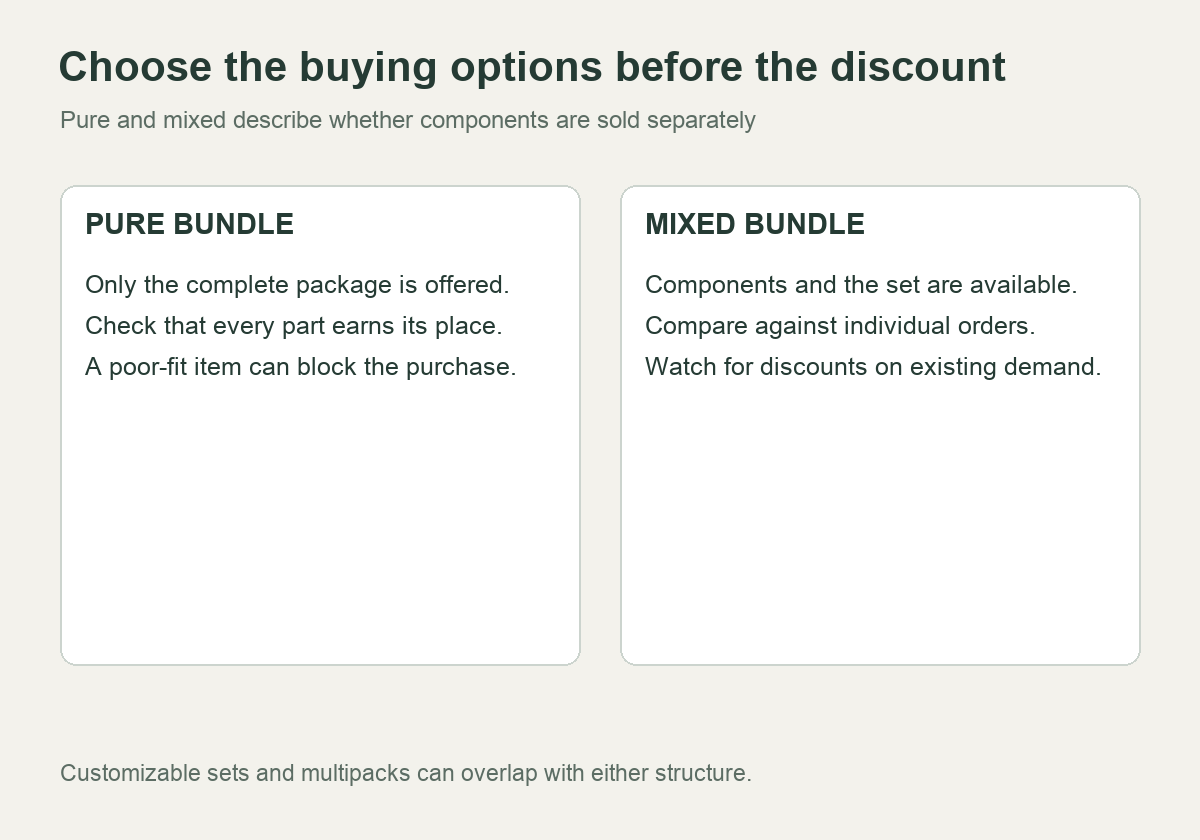
Salesforce’s bundle pricing guide distinguishes pure bundles, available only as a package, from mixed bundles, whose components can also be purchased individually. Choose the structure before choosing the discount.
| Structure | Customer choice | Practical question |
|---|---|---|
| Pure bundle | Buy the complete package | Is every included item necessary or wanted? |
| Mixed bundle | Buy individual items or the set | Does the package add enough value without giving away existing sales? |
| Customizable bundle | Choose within stated rules | Can every permitted combination meet the cost and fulfillment requirements? |
| Multipack | Buy several units of the same item | Do the unit savings cover the larger shipment and purchase commitment? |
Customizable sets and multipacks describe the contents; pure and mixed describe whether separate purchases are available. These labels can overlap. A three-pack may be a mixed offer if singles remain on sale.
Choose products that solve one purchasing problem
Start with a reason to buy the items together. A starter set might remove the need to find compatible accessories. A refill pack can suit repeat use. A gift set can offer coordinated presentation and save the buyer assembly time.
Write the use case in one sentence, then check each component against it. If one product is included only because it is sitting in the warehouse, ask whether the customer would value it. A free item still takes space and may add handling or delivery cost.
Review existing order combinations, customer questions, and return reasons. Those are inputs for an offer to test, not proof that every visitor wants the same package. Keep an unbundled alternative when customers regularly need only one part, unless there is a sound reason to sell the set exclusively.
Be specific about what the price includes: component quantities, variants, packaging, shipping charges, and any installation or support service. A photo showing optional extras can create the wrong expectation even when the price calculation is correct.
Calculate the bundle price from contribution
Use a consistent definition of revenue. In the worksheet below, price is the product amount collected after discounts and before tax collected for remittance. Customer-paid shipping is zero in the example; if you charge for shipping, include the resulting revenue and applicable fees consistently.
Group the costs into two parts:
- C: costs per bundle that do not change directly as a percentage of selling price, such as inventory, packaging, handling, delivery, and a fixed transaction fee.
- r: the combined rate of charges assessed on that selling price, expressed as a decimal.
For price P, the simplified calculation is:
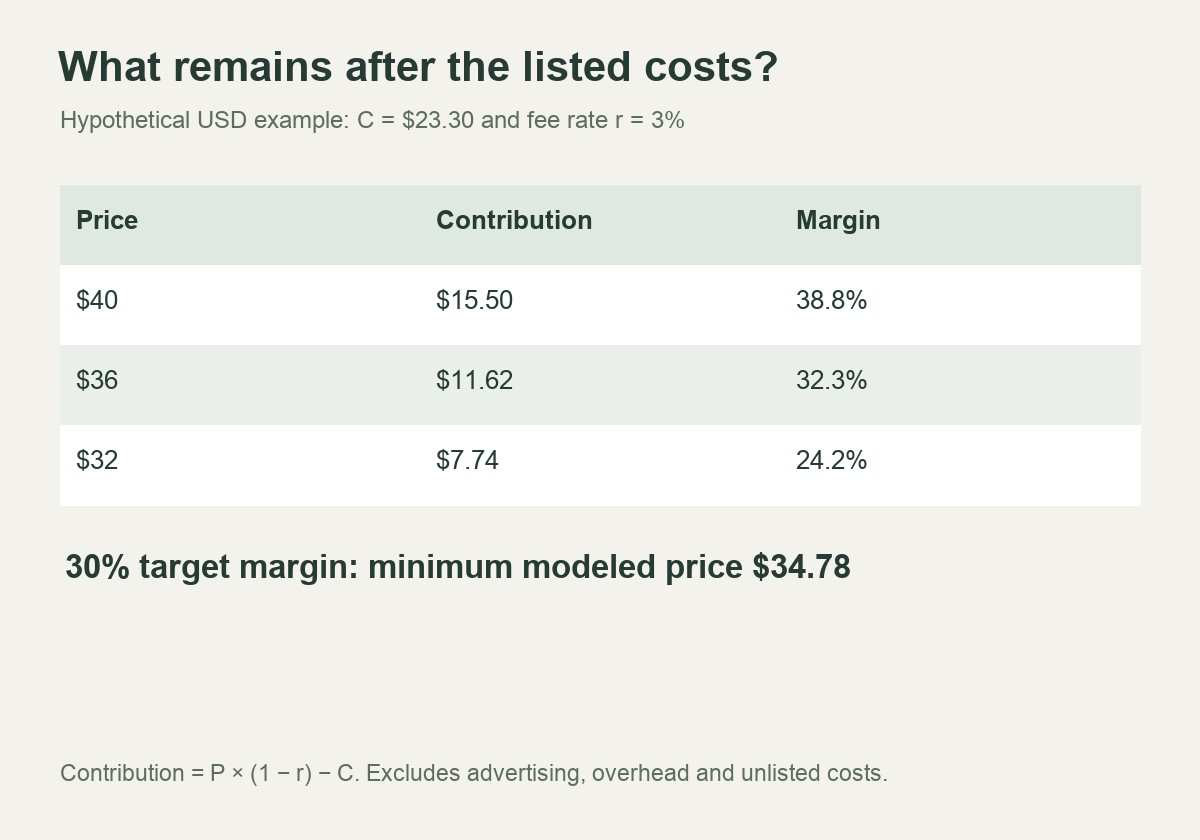
Contribution per bundle = P × (1 − r) − C
Contribution is the amount left after the costs included in this model. It is not automatically net profit. State whether customer acquisition, returns, storage, and overhead are included, excluded, or treated separately.
To reach a target contribution margin m on price:
Minimum modeled price = C ÷ (1 − r − m)
The denominator must be positive. This formula also assumes the rate applies to P and the other costs remain constant at the prices tested. Percentage fees charged on shipping or tax, tiered commissions, minimum fees, and price-dependent demand require a more detailed model.
A worked example for a two-product set
Suppose the regular individual prices are $25 and $20, a total of $45. Your illustrative per-bundle costs are:
| Cost input | USD |
|---|---|
| Landed cost of both products | $14.00 |
| Packaging | $1.20 |
| Picking and packing | $1.80 |
| Delivery paid by the seller | $5.00 |
| Expected incremental returns/support cost | $1.00 |
| Fixed transaction charge | $0.30 |
| C: total listed fixed-dollar costs per bundle | $23.30 |
Assume a further 3% charge on P. The $1 allowance here covers extra handling/support rather than refunds already deducted from revenue. Avoid counting the same return twice. Advertising, overhead, tax treatment, and unlisted costs are excluded from this example.
| Bundle price | Discount from $45 | Contribution | Contribution / price |
|---|---|---|---|
| $40 | 11.1% | $15.50 | 38.8% |
| $36 | 20.0% | $11.62 | 32.3% |
| $32 | 28.9% | $7.74 | 24.2% |
At $36, the calculation is $36 × 0.97 − $23.30 = $11.62. For a 30% target margin, the modeled price floor is $23.30 ÷ 0.67 = $34.776…, or $34.78 rounded up to cents.
A $32 offer falls below that particular target. It is not universally wrong: a seller could deliberately accept a lower contribution for a justified purpose. Write down that exception before launching, including how much contribution you are willing to give up.
Build the inventory cost from a named receiving location. Our landed cost worksheet helps separate that cost from the subsequent customer-order expenses. Recalculate when packaging, freight, or the composition changes.
Compare the bundle with what customers would otherwise buy
The relevant alternative is often a normal single-item order, not zero revenue. Some buyers would have bought both products at their individual prices. Others would have bought only the main item. A bundle can create additional demand or simply discount demand you already had.
Suppose the existing order normally contributes $10 and the $36 bundle contributes $11.62 under comparable cost definitions. The difference is $1.62 per such converted order, not the bundle’s entire $11.62. This comparison is still incomplete if conversion rate, acquisition cost, or returns change.
Track total contribution for a consistent traffic or customer group, alongside contribution per order and conversion. Average order value helps describe basket size but cannot show whether the extra revenue paid for itself.
If you run a controlled test, decide eligibility, the primary metric, and the duration before looking at results. Avoid comparing a holiday promotion with a quiet week and attributing the whole difference to the bundle. With small volumes, treat the result as directional rather than claiming a statistically established uplift.
Check the packed order before finalizing the discount
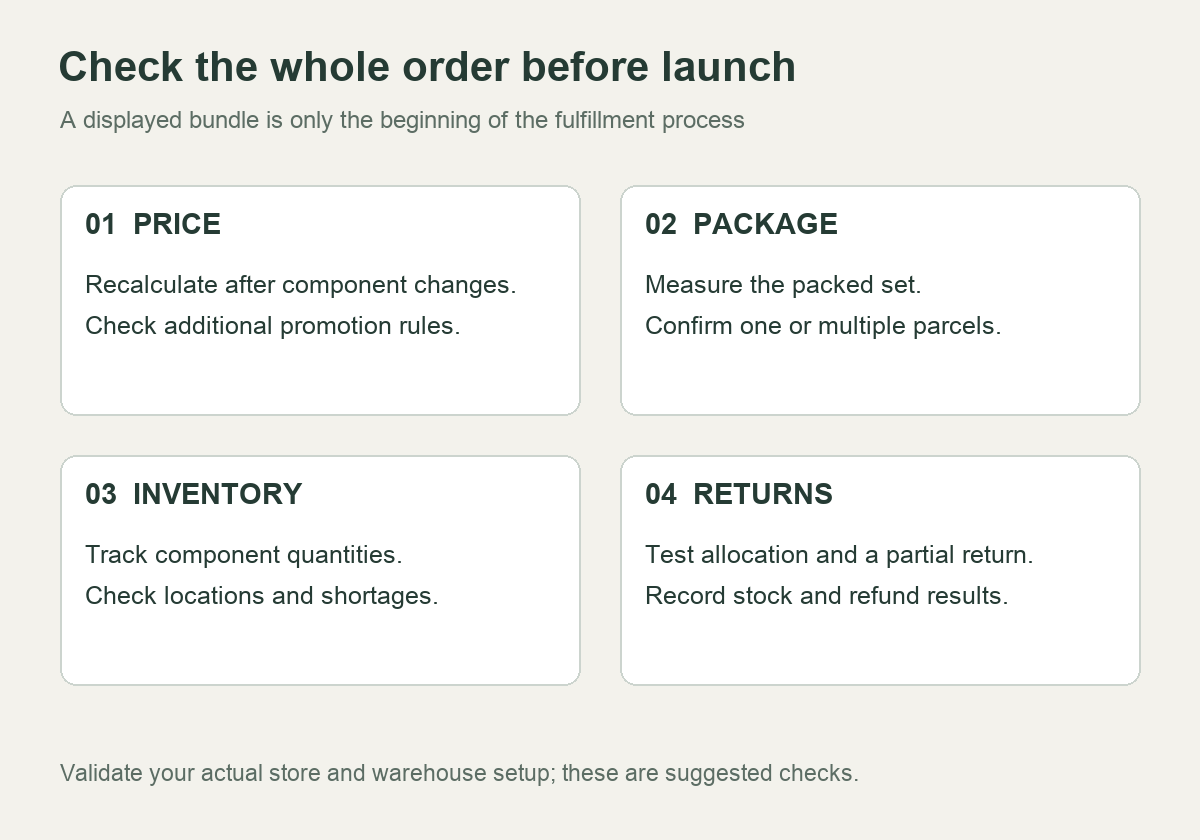
Put the intended components in the intended package. Confirm the packed dimensions and weight, protective materials, assembly work, and destination coverage. Two products that fit one box individually may require a different box when shipped together.
Ask the fulfillment provider to quote the actual configuration. Include extra picks, inserts, special wrapping, fragile handling, and any split shipment. Check whether inventory is in the same location and whether the order system sends clear component instructions.
For returns, decide how a partial return affects the refund, inventory, and the rest of the offer. The customer policy and the platform’s actual allocation must agree. Do not assume the returned component receives its full standalone price if the customer paid a discounted bundle total.
Fulfillbot’s pick-and-pack service describes combining multiple products into one package. To evaluate a specific bundle, provide the component list, quantities, variant rules, packaging specification, destinations, and expected order volume. Request confirmation of the actual handling and shipment scope before setting the discount.
Shopify checks before launch
If you use Shopify Bundles, review its current official documentation. It states that changing a component price does not automatically update the bundle price. Maintain a review trigger when component prices or costs change.
The documentation also describes component SKUs appearing in orders, shipping weight derived from component weights, and discounts allocated to components by weighted price. Product-specific discounts must target the parent bundle. Verify the resulting order, refund, and warehouse instructions in your own setup; app documentation is not a test of your integrations.
Run a trial order that covers the selected variants, a discount, and the actual destination. Check the inventory changes and a partial-return scenario. Confirm what happens when one component runs out, when stock sits across locations, and when another promotion applies. A displayed bundle quantity should not be treated as proof that all parts can ship together from the intended warehouse.
A practical bundle pricing worksheet
Record the following for each proposed offer. Keep the assumptions beside the number rather than hiding them in a separate conversation.
| Worksheet field | What to enter |
|---|---|
| Offer | Component SKUs, quantities, variant choices, separate-purchase options |
| Revenue | Bundle price, shipping charged, discount rules, refund treatment |
| Inventory cost | Cost of all included units at the same location boundary |
| Fulfillment | Materials, picking, assembly, delivery and split-parcel assumptions |
| Other variable costs | Fixed fees, percentage fees with their base, support and return allowance |
| Target | Contribution dollars and/or contribution margin, with exclusions stated |
| Comparison | Normal order contribution and how buyer behavior might change |
| Review trigger | Cost change, component shortage, return pattern, or test end date |
Once the trial is complete, replace estimates with the actual package measurements and charges. If the margin fails, change the price, contents, packaging, or shipping promise. If the revised offer still cannot cover the costs you intend it to cover, keep the products separate.
Bundle pricing FAQ
Does a bundle always need a discount?
No. Convenience, compatibility, presentation, or an included service may justify the package at its combined price. If you claim savings against separate purchases, use a truthful, relevant comparison and keep the included items consistent.
What is a good bundle discount?
There is no universal percentage. Start with the customer value, modeled contribution, and realistic alternative purchase. Then test demand at a price your operation can support.
Is bundle pricing the same as kitting?
Bundle pricing defines the commercial offer. Kitting is the operational work of bringing components together. One can exist without the other, so both the pricing setup and the physical process need their own checks.