Alibaba RFQ lets buyers describe a purchasing requirement and receive quotes from interested suppliers. A useful request gives those suppliers the same specification, quantities and delivery requirements to price.
This guide includes a sourcing brief you can copy, a supplier quote comparison table, and a message for following up on missing information.
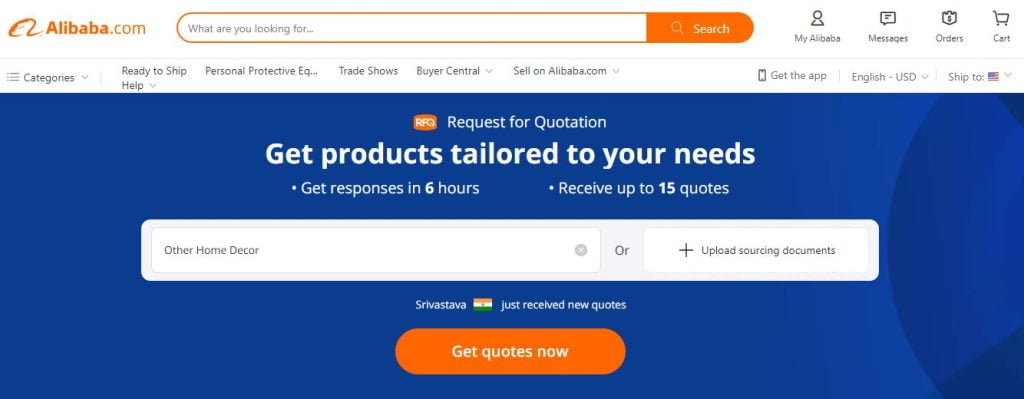
Alibaba RFQ – What Is it?
The Request for Quotation (RFQ) is an Alibaba feature that improves procurement. Here, we will examine its definition and functions. We will also dispel a few myths in more detail.
An Alibaba RFQ is a sourcing request posted to Alibaba.com so suppliers can respond with quotations. Alibaba describes this buyer-request and supplier-response process in its official RFQ overview. A reply is a starting point for checking the offer and supplier; it does not establish that the quoted goods meet your requirements.
The Role of Alibaba RFQ on the Alibaba Platform
Alibaba RFQ has overturned how buyers and sellers relate overnight on Alibaba. This section explores the essential function of the Alibaba RFQ in the ecosystem. Let’s start:
1) Increased Efficiency
Alibaba’s RFQ can save buyers a lot of time and effort. It eliminates the hassle of sorting through unnecessary solutions. Hence, you find a suitable supplier faster than ever.
2) Promotes Targeted Sourcing
RFQs enable buyers to express their needs adequately. This way, they draw in a range of qualified suppliers who can meet their demands.
3) Encouraged Competition
RFQ promotes healthy competition amongst vendors. Suppliers have to offer their best and most competitive pricing. This way, they can secure the best deal from the buyer.
4) Promotes Clarity
RFQ offers a simple framework for contrasting various supplier offers. Buyers can make well-informed judgments by examining costs, quality certifications, and delivery schedules.
What Are the Widespread Myths About Alibaba’s RFQ?
A few myths can make it challenging to comprehend Alibaba RFQs. Below is a closer look at a few of the common ones:
Myth 1: You Can’t Use RFQ with Other Sourcing Options
You don’t have to use RFQ alone. Using it while using Alibaba’s other sourcing options is best. You can use a combination of strategies. You can use RFQs, look through product listings, or contact suppliers directly.
Myth 2: Setting Up RFQ is Challenging
Start with a written brief, then complete the fields shown in the current submission form. Check the supplier’s reply against your requirements and follow up on missing details.
Myth 3: RFQ Has A Limited Reach
Some buyers think RFQ has a limited reach. However, nothing is farther from the truth. Eligible vendors watch the RFQ market for fresh chances. You can locate a broader range of possible partners by using RFQs.
Moreover, there’s an increased chance to find the ideal match for your requirements. Hence, it has a broad reach and is highly specific.
What Is the Importance of RFQ?
Alibaba’s RFQ is a potent instrument. It enables companies to optimize their purchasing procedures and get the best offers. Here are the reasons Alibaba’s RFQ should be part of your sourcing strategy:
1) It Offers Results
RFQ conserves time. You can do more in less time when you set up a proposal request. You can put the saved time into other aspects of the company.
2) It Eliminates Information Overload
RFQs are specific. You communicate your demands to relevant suppliers to meet your objectives. By doing this, you can stop wasting time on options analysis that isn’t relevant to your project.
3) It Simplifies Communication
The Alibaba platform makes it easier to communicate and negotiate. This feature makes it unnecessary to have drawn-out phone conversations or email exchanges. Hence, you can quickly engage with possible suppliers and speed up the process.
4) It Offers Competitive Pricing
Suppliers compete with one another through the RFQ process. So, it forces them to give you the best terms and pricing to earn your business. Ultimately, you gain from getting the most excellent bargain for your requirements.
5) It Provides Transparency in Negotiations
The site offers a simple way to contrast supplier offers. You can quickly check the payment conditions, delivery schedules, and prices. Hence, you can negotiate with a thorough grasp of the competitive environment.
How Does RFQ Promote Making Informed Decisions As A Buyer?
Outside the conventional benefits, RFQ enables better decision-making. This technique ensures you have a lot of information about a potential seller. This way, you are able to make better decisions based on what you know. This section takes a closer look at how RFQ promotes knowledge-based decisions:
1) Comprehensive Supplier Data
You can get comprehensive data about possible suppliers. The information includes their production capacities, certifications, and historical performance evaluations. This openness promotes well-informed choices after carefully examining each supplier’s credentials.
2) Standardized Communication
Ask suppliers to reply against the same specification, quantities and delivery basis. Use a consistent format for price and terms so you can identify differences and unanswered questions.
How Does Alibaba’s RFQ Compare to Other Sourcing Techniques?
RFQ is one of the sourcing techniques you can use on Alibaba. But is the method in any way the superior choice? Here, we compare Alibaba’s RFQ with other contemporary methods. We also want to see how well it performs:
1) Global Reach
Alibaba provides access to a vast network of certified suppliers. It improves your chances of discovering the ideal partner for your particular requirements. Using traditional approaches could force you to work only with local vendors.
2) Reduced Risk
Alibaba’s RFQ reduces the risks of international trade. However, you may have to do further research to determine the reliability of your source. Yet, the method is safer than the typical sourcing techniques in several leagues.
3) Convenience and Efficiency
The Alibaba platform can handle all aspects of the RFQ process. From creation to supplier interactions, they hold the wheels. Hence, simplifying the procurement process eliminates the need for several communication channels.
Unlike other options, you don’t have to be actively involved. You can take your hands off the rows and leave the platform to steer the boat. There is a wide range of potential when you use Alibaba’s RFQ in your sourcing strategy. You can:
- Establish connections with capable suppliers,
- Negotiate the best terms, and
- Increase the effectiveness and performance of your international procurement operations
How Does Alibaba’s RFQ Perform In a Global Market?
Alibaba’s RFQ creates a special place in the vast B2B e-commerce network. It goes beyond the conventional idea of looking through a product catalog. It becomes a focused way to find what you need. Here is an in-depth explanation of Alibaba’s RFQ idea and how it differs from other methods:
1) Use the Alibaba RFQ as a Targeted Sourcing Tool
As a buyer, picture yourself in a situation where you need a specific widget with exact specs. You can create a document specifying these precise requirements using Alibaba’s RFQ. This document serves as a beacon.
It draws eligible exporters/suppliers to the platform who can meet your requirements. These vendors can then provide estimates in a structured format. The format helps make comparisons easy. It contains delivery conditions, specs, and pricing.
2) Differences Between Other Alibaba Sourcing Options and RFQs
Product Listings: Alibaba is a vast online marketplace. Many vendors list goods and services for sale on the platform. You can browse an extensive inventory and contact suitable vendors. This method can take a long time and a lot of work to find appropriate providers to fulfill your demands.
Direct Supplier Inquiry: Contact an Alibaba supplier using their product listings/profile. Although it works well for focused outreach, it could restrict your alternatives. Moreover, it can prevent you from finding other suppliers that are more capable.
Specificity is Key: RFQs let you express your needs in detail. This method saves more time than browsing generic listings. It draws in a group of pertinent suppliers ideal for your undertaking.
Simplified Communication: The Alibaba platform makes it easier to communicate and negotiate. This way, it simplifies the sourcing process. It removes needing to reach out to one too many vendors.
More Value: RFQ encourages suppliers to compete by offering the best terms and prices to win. This sourcing technique motivates suppliers to provide more value to be preferred.
Alibaba’s RFQ fills the gap between browsing and contacting suppliers directly. The technique allows you to attract qualified providers with the skills you need. As a result, the procurement process is more effective and successful.
What Should an Alibaba RFQ Template Include?
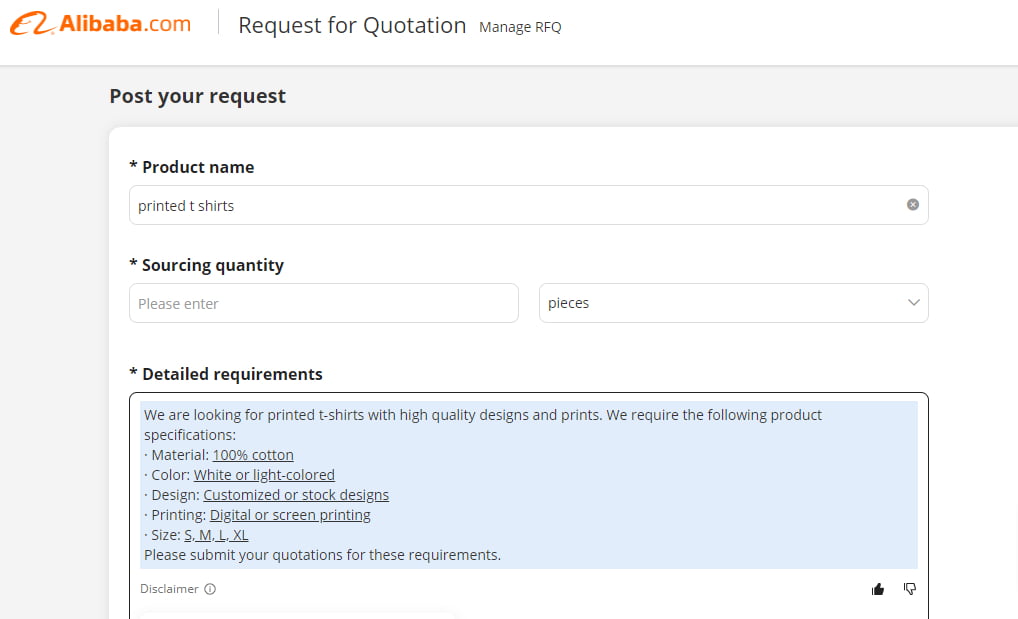
The five categories below are a buyer-side checklist for preparing a request. They are recommendations for your sourcing brief, not a fixed list of fields in Alibaba’s current form. Clear requirements also help when sourcing suitable suppliers.
1) Product Description
Pay close attention to this part. Here, you describe in great detail the product you need. The information includes its requirements, materials, and features that it must have. Potential vendors can comprehend your wants better and adjust their responses. When dealing with Alibaba’s RFQ, it pays to be specific.
2) Quantity
State the total quantity and how it is split across SKUs, colors and sizes. If a supplier’s minimum is above your trial-order needs, use these steps to negotiate MOQ with Chinese suppliers. Ask for alternative quantities with the same specification, and have any changes to packaging, unit price or separate fees listed clearly.
3) Delivery Requirements
Please specify the location and preferred delivery timeframe. So, suppliers can account for logistics and provide accurate delivery estimates. Neglecting location and expected delivery time can be problematic.
4) Payment Terms
State your proposed payment method and deposit and balance milestones, including any agreed inspection or acceptance condition before payment. Ask the supplier to confirm its proposed terms in writing. Treat them as terms to agree, not conditions already accepted by either party.
When turning the agreed quote into an order, compare Alibaba payment methods and fees using the options available at checkout. Confirm the total payment cost before sending the deposit.
5) Extra Details
Mention any particular specifications or queries you may have. You can use this area to go deeper into topics not addressed in the other parts. You can talk about customization or obtaining the particular quality certifications you need.
A sourcing brief you can copy
This is our suggested buyer brief. Replace the labels with your requirements and remove fields that do not apply. Do not invent a compliance standard or tolerance to fill a blank; identify what still needs confirmation.
Product and intended use:
Specification or drawing file name, revision and date:
Materials, dimensions, tolerances and required functions:
Quantity options and allocation by SKU, color and size:
Packaging, labels, carton requirements and customization:
Sample quantity, sample cost, lead time and approval requirements:
Acceptance criteria, defect definitions and proposed inspection stage:
Target market and required compliance documents or tests:
Destination country, postal code and exact delivery point:
Requested Incoterm, named place and version:
Required production completion date and delivery timing:
Proposed payment method and deposit/balance milestones:
Quote currency and unit price for each quantity option:
Separate tooling, setup, packaging, sample and inspection charges:
Freight, duties, taxes and other charges included or excluded:
Quotation validity date, reference and revision:
Exceptions, substitutions or unanswered questions:
Supplier legal name and contact:For the sample and acceptance fields, see how to turn sample approval into bulk-order specifications. Give suppliers the same approved version when requesting comparable quotes.
When you select a supplier and create an eligible Alibaba order, turn order requirements into Trade Assurance evidence by attaching the agreed specification and recording the acceptance and delivery terms in the order.
Adapt the brief to the product and attach the relevant drawing or specification version. Ask each supplier to identify any requirement it cannot meet or any alternative it has priced.
Tips to Create a Compelling Alibaba RFQ
It is a comprehensive section for creating and submitting a successful RFQ. It ensures you draw in the proper suppliers and help your company get the best possible deal. Let’s dive right into it:
1) Ensure Your Needs Are Definable
Avoid Any Misunderstandings. In the description of your goods, be as detailed as you can. Describe the product’s features, components, and any necessary technical requirements. It will be more straightforward for qualified vendors to comprehend your needs. Plus, it provides pertinent rates if you are more specific.
2) Establish Realistic Timelines
Consider variables like production and customs clearance lead periods. Unrealistic timeframes have the potential to discourage capable vendors from submitting an RFQ.
3) Attach Related Files
Never undervalue the importance of visual aids. Include technical specifications and comprehensive drawings to define your needs better. The extras help vendors better comprehend your idea and adjust their quotes.
4) Proofread Your RFQ
Ensure your proposal request is clear and free of ambiguities. Grammar or spelling mistakes can be confusing. They can result in irrelevant quotes. Before submitting, take the time to edit your request for proposals.
How to Submit RFQ on Alibaba?
Prepare your brief before opening Alibaba’s RFQ submission page. Follow the fields and account instructions shown there; the steps below describe the working process rather than a fixed button-by-button path.
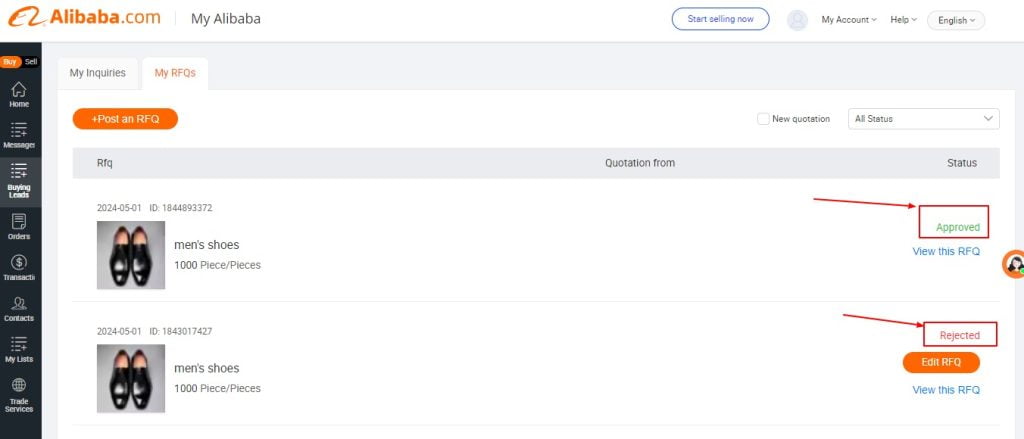
1) Submission and Acceptance
Sign in through the official submission page and check the available product category and required fields for your request.
Enter the requirements from your brief and attach the relevant specifications where the form allows. Review the current posting rules and the information you are about to share before submitting.
After submission, check the status and any requests for clarification in your account. Follow the instructions displayed for that request.
Allow time for any platform review and for suppliers to prepare replies. Do not schedule a deposit or production start around an assumed 24-hour approval or response time.
2) Get Reactions
Suppliers can respond to requests in the RFQ marketplace. The relevance of those replies depends on the requirements you provide, including:
- Product specification and quantity.
- Delivery requirements and any stated budget.
- Required customization, documents or tests.
Remember to be patient. Suppliers need time to study your request, perform internal reviews, and produce quotes.
3) Watch Reactions and Find Partners
Use the RFQ management and messaging options available in your account to keep track of responses. Keep your own record of:
- Supplier name, contact and quotation reference.
- Response date, specification version and unanswered questions.
- Revised offer, exceptions and next follow-up date.
Check each responding supplier against your requirements before treating it as a shortlist candidate. A reply alone does not establish production capability or suitability.
4) Communication
You can communicate with potential vendors after obtaining quotations. Discuss to get more information about their suggestions. Ask questions or get clarification on particular details.
Never be afraid to bargain! RFQ process encourages competition. Suppliers may be open to modifying their payment conditions, delivery schedules, or prices.
Keep the supplier’s messages, attachments and revised quotes together, with dates and specification references.
Before moving to samples or an order, resolve missing information and keep the selected supplier’s complete written offer.

How to Communicate With Suppliers With RFQ?
Now that your Alibaba RFQ has yielded a pool of supplier quotations, what’s next? It’s essential to dig deeper and develop communication to make well-informed judgments. Here’s how to use Alibaba’s platform to get your company the best possible deal:
1) Start a Proactive Conversation
Don’t wait for vendors to get in touch! Use Alibaba’s secure messaging system to start conversations with your identified vendors. It shows that you are interested in and serious about their suggestions.
2) Be explicit
Communicate clearly to avoid confusion by including the following:
Product Specifications: Ask questions! What materials were used? What are the provided features? Also, please inquire about changes made to your original specifications.
Pricing: Request a thorough explanation of the pricing structure. Take into account any extra expenses for things like freight or customs charges.
Delivery Schedules: Verify the approximate delivery time. Ask about any possible hold-ups or unanticipated events.
Payment Terms: Talk about the available credit terms, payment options, and others
3) Use Requests for Further Information
Never hesitate to request further details. This information might be:
Sample Requests: Requesting samples is essential before you close deals. This way, you can gauge the quality of the supplier’s products.
Company Certifications: Find any applicable industry certifications or quality control procedures. This information ensures the supplier satisfies your quality standards.
Previous Performance Reviews: Alibaba grants access to last customer evaluations for specific vendors. Use the data to check their reputation and dependability.
4) Develop Transparency
Always keep the communication lines open and honest. Explain your assessment standards and selection procedure to establish credibility with possible partners. This bit motivates providers to address your problems proactively. Also, it creates a more collaborative atmosphere.
5) Use Bargaining Skills
There is an inherent competitiveness to the RFQ process. Make the most of this method to your benefit! Haggle about price, delivery schedules, payment terms, and minimum order amounts!
Be Respectful: Throughout the negotiation, act formally. It’s beneficial to have a solid working connection. It doesn’t matter, even if you decide not to follow through with the supplier.
Justify Your Requests: When bargaining, be sure your requests are well-founded. Describe your market research to aid your argument for the best deals.
Be Ready to Leave: Never feel pressured to take a quote that doesn’t fit your needs. Be ready to leave talks if they come to a standstill and look into other solutions.
You can efficiently communicate with suppliers on Alibaba. Establish trust, get insightful information, and close a deal that suits your needs! Just use strategic bargaining, proactive thinking, and unambiguous communication.
This way, you maximize the benefits of the Alibaba RFQ process. This section covers all you need to know to communicate effectively.
How to Evaluate Quotations Received After Sending RFQ?
Evaluate each quotation against the same written requirements. Check the following five areas before comparing the offers side by side.
1) Price: Compare offers for the same product specification, quantity and delivery endpoint, using one currency. Confirm which packaging, inspection, freight and import charges are included, and request any missing amounts in writing. Then compare supplier offers by landed cost per expected sellable unit, rather than factory unit price alone. Record bundled charges only once and keep estimates clearly labeled. Use that cost comparison alongside the quality, delivery and payment checks below.
2) Quality: Always consider quality when you are evaluating quotations. You can gauge quality by researching the supplier’s customer reviews and ratings.
Before choosing a quote, verify shortlisted Alibaba suppliers. Record what you have confirmed about the company, production site and relevant product reports alongside the quote.
3) Delivery Terms: Confirm the production lead time, shipping estimate, Incoterm and named delivery point. Ask which transport charges are included and which remain to be quoted. Use the Alibaba shipping cost breakdown to identify the charges that need clarification.
4) Payment Terms: Examine the credit terms and payment options various vendors provide. After considering your cash flow, choose the option that best fits your demands.
5) Finalization & Negotiation: Finally, you negotiate with the potential seller. After you and the supplier have agreed, you strike the deal. Never shy from haggling with suppliers to get the best deals.
The RFQ process’s competitive nature gives you leverage to negotiate the best price. Alibaba’s platform makes communicating easier during the negotiating process. Hence, you can discuss your needs and create a win-win solution. Remember, you can always walk away when it is not favorable.
Compare supplier quotes on one sheet
Use one sheet for each specification and quantity combination. Copy the supplier’s answer and its quote reference into each column. The cells below are blank for you to fill.
| Comparison field | Supplier A | Supplier B | Supplier C |
|---|---|---|---|
| Supplier legal name and quote reference | |||
| Quote date, revision and validity | |||
| Specification/drawing version and listed exceptions | |||
| Quantity tier and allocation by SKU/color/size | |||
| Currency and unit price for that quantity | |||
| Tooling and setup charges: included or separate | |||
| Packaging and labeling scope and charges | |||
| Sample cost, sample freight and approval timing | |||
| Inspection/testing scope and charges | |||
| Incoterm, version and named delivery point | |||
| Freight mode, route and cargo basis | |||
| Freight/import charges included and excluded | |||
| Production lead time and starting conditions | |||
| Shipping estimate and delivery assumptions | |||
| Payment method and deposit/balance conditions | |||
| Compliance documents and unresolved requirements | |||
| Other exclusions or one-time charges | |||
| Open items, owner and confirmation date |
Write “Pending” for an unknown amount or term, not zero. Use “Included” only when the supplier confirms it, and record where a bundled charge is already counted. Keep offers with different specifications or delivery scopes separate until those differences are resolved.
This sheet organizes the supplier offers; use the landed-cost guide linked in the Price section for the cost calculation. A lower quoted unit price is not enough to rank offers with unresolved costs or requirements.
Ask for the missing information in one message
Please revise quotation [reference/date] against specification [file/revision].
Confirm the quantity and allocation: [quantity/SKU breakdown].
Complete these missing items: [list].
State whether packaging, tooling/setup, inspection, freight, duties and taxes are included, excluded or separately charged. Identify any bundled charges so we do not count them twice.
Confirm the Incoterm and named delivery point, lead-time starting conditions, payment milestones and quotation validity date.
List any proposed specification changes separately.
Return one complete revised quotation with its reference, date and revision, rather than only changes in chat.Keep the revised quote with the comparison sheet. Carry unresolved items into supplier verification before committing to the next payment or production step.
How to Enhance RFQ Response Rate?
The key to a successful Alibaba RFQ experience is drawing in a large group of capable supplies. Consider the following insights for quick response rates and top quality:
1) The RFQ should be crystal clear since clarity is king
Easy-to-read Language: Steer clear of language that is too technical. Aim to use language that is easy to read and understand and is evident throughout your RFQ. Remember, they have to understand what you want to be able to deliver.
Well-defined Needs: Carefully outline your unique requirements. Describe the desired features, components, standards of quality, and any applicable technical information. If you are more straightforward, eligible vendors can tell if they fit your project well.
Visual Helps Promote Understanding: Never undervalue the influence of images! You can use reference pictures and technical drawings to clarify your requirements.
2) Go for Precision to Draw the Ideal Partner
Go Above and Beyond. Don’t stop with the standard product descriptions. Give a clear description of the features, functions, and performance requirements you need. Rather than just saying “metal housing,” specify the material and thickness you want.
- Quality Matters: State what standards you have for quality. Do you demand adherence to worldwide quality standards or specific industry certifications? These points draw in vendors who can meet your quality requirements with proof.
- Quantify Whenever Possible: Throughout your RFQ, include exact measures and amounts. Show the desired order volume and applicable weight or dimension restrictions.
3) Establish Reasonable Expectations
Market research is essential. Find average prices for comparable goods and services by conducting in-depth market research. Inappropriate pricing expectations can discourage competent providers. It does matter if it’s too high or too low.
When setting delivery schedules, be reasonable. Consider production lead times, custom clearance, and any delays in logistics. Unreasonable deadlines can deter suppliers or cause hurried production, which could lower quality.
State your readiness to compromise on specific issues. This move shows adaptability and motivates vendors to take part in the procedure.
4) Seek Competitive Market Prices
Find average market prices before establishing pricing assumptions. This way, you set realistic yet competitive prices that draw in capable vendors.
Remember that the lowest price isn’t always the best choice. Consider aspects like quality, dependability, and supplier reputation when assessing proposals. It might be justified if more cost results in better quality.
Explain the value you bring if you can’t offer a competitive price. This process could involve enduring collaborations, recurring business, or fast payment conditions.
What Are the Possible Pitfalls of RFQ and How to Avoid Them?
While RFQ offers a seamless sourcing experience, there are potential pitfalls. Several traps can prevent a successful RFQ process. Here’s how to get around them and ensure everything goes smoothly:
1) Uncertain Requirements
Suppliers frowned upon a vague RFQ. Ensure you craft an RFQ that expresses your needs in-depth and is clear and precise. This way, you attract suitable suppliers and maximize your response rate.
2) Unrealistic Expectations
Qualified suppliers don’t respond to unreasonable pricing or delivery terms. Conduct in-depth market research to determine reasonable pricing expectations and potential delivery schedules.
3) Limited Contact
Building trust is a benefit of active contact with suppliers. Feel free to express concerns, seek clarification, and maintain open communication lines. When you refuse to engage, you lose a lot from the potential partnership.
4) Neglecting to Negotiate
Negotiating is necessary to get the best bargain possible. Don’t hesitate to haggle about price, delivery conditions, or payment terms. Negotiating ensures you get the best offers.
RFQ Case Studies to Gain Knowledge from Actual Situations!
1) Achievement
A furniture manufacturer used Alibaba’s RFQ to find premium wooden table legs. Their well-written RFQ included details about their desired materials, dimensions, and weight capacity. Based on their market analysis, they also set expectations for competitive pricing.
Many capable providers responded to this clear and concise request for proposals. They collaborated with a reputable manufacturer for outstanding quality at a competitive price. They were able to do so with efficient communication and negotiation.
2) Warning
A device maker made the error of sending out an ambiguous request for bids with high-cost demands. The RFQ was devoid of precise information regarding the intended features and components. Furthermore, they established ridiculously low pricing.
There were a few responses. However, most came from unfit vendors. Then, they adjusted the price after comparing it to market realities. After, they reopened the process. This time, they had more replies from capable vendors. And it gave birth to a fruitful collaboration.
Final Thoughts!
A useful RFQ gives suppliers a clear specification and gives you comparable replies. Keep the brief, quote comparison and supplier verification record connected, and ask for a complete revised offer when requirements or prices change.
If you need help comparing supplier offers and coordinating samples, use Fulfillbot’s China sourcing support. Send your product photos or specifications, quantity options, existing supplier quotes, target market and required timing. Confirm the sourcing scope and fees before work begins.
FAQ for Alibaba RFQ
1) What Is the Cost of Utilizing Alibaba RFQ?
Check the current RFQ submission page for any charge applicable to your buyer account or selected service. A supplier’s membership fee is not evidence of a buyer fee for posting an RFQ. Budget separately for samples, tooling, inspections, freight and the eventual purchase; request written quotes for those costs.
2) Is Using an RFQ Subject to a Minimum Order Quantity Requirement?
Posting a sourcing request and meeting a supplier’s product MOQ are separate questions. State the quantity you actually need, including the split by SKU, and ask each supplier to confirm its minimum and any alternative pricing. Follow any quantity or category requirements shown in the current posting form.
3) How Much Time Does It Usually Take to Complete an RFQ?
Preparing a request, receiving quotations and agreeing an order are different stages. Timing depends on the specification, any platform review and the suppliers’ work. Set a requested quotation deadline and follow up on missing information; do not treat a response-time promotion as a promise that a suitable supplier or final order will be ready by then.
4) Can I Source Services and Products Using Alibaba RFQ?
Check whether the current form supports the category you need. Do not assume that every service can be requested through the product RFQ workflow. For an additional service such as inspection or freight, define the scope and obtain a separate written quote from the provider.