
Ask a supplier how much a product weighs and you may get three different answers. One is for the product itself, another includes the retail packaging, and a third is for the sealed master carton. None is necessarily wrong. The problem is that the label on the number is often missing.
The math behind net weight vs gross weight is simple:
Gross weight = Net weight + Tare weight
Net weight is the product or contents alone. Tare is the empty packaging or transport equipment being excluded. Gross weight is the two added together within a stated boundary.
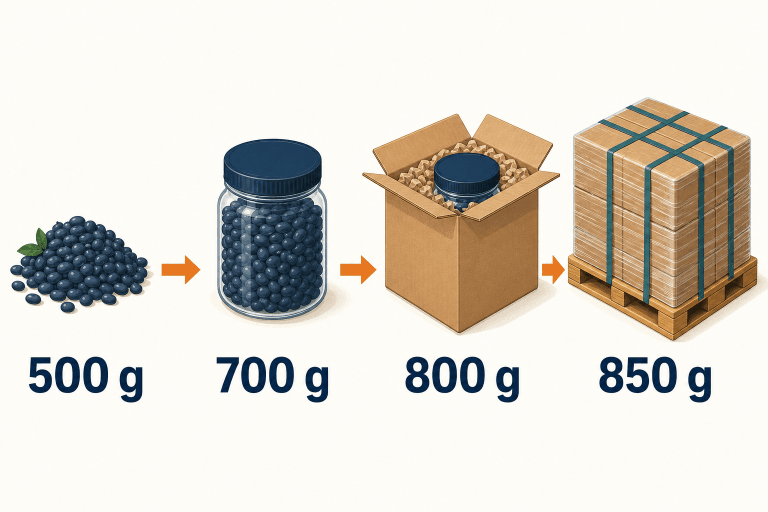
So a 500 g product in 200 g of packaging has a 500 g net weight and a 700 g gross weight at the retail-package level. Put it in a shipping carton and the gross weight changes. Put that carton on a pallet and it changes again.
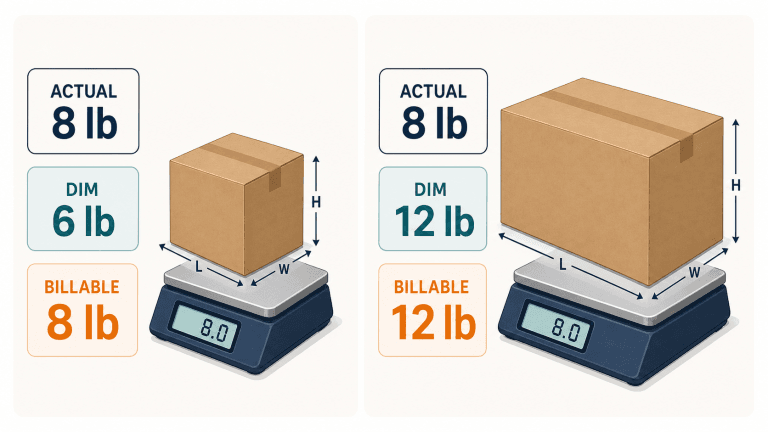
One more wrinkle: a parcel or air carrier may charge by dimensional weight even when the scale shows a lower number. Actual weight and billable weight are related, but they are not interchangeable.
Net Weight vs Gross Weight at a Glance
| Term | What it means | Usually includes | Common use |
|---|---|---|---|
| Net weight | Weight of the goods or contents alone | Product or usable contents | Labels, inventory, unit costs |
| Tare weight | Empty packaging or equipment within the stated boundary | Jar, box, pallet, container, or empty vehicle—as defined | Calculating net or gross weight |
| Gross weight | Net weight plus the relevant tare | Goods and packaging within the boundary | Handling, shipment records, load limits |
| Dimensional weight | A calculated weight based on package size | Length, width, and height through a carrier formula | Parcel and air pricing |
| Billable weight | The weight used to calculate the freight charge | Often the greater of actual and dimensional weight | Carrier quote or invoice |
Here is the question worth writing at the top of any packing sheet: What exactly was on the scale?
What net weight means
Net weight is the weight of the goods without the packaging used to contain or protect them. You may also see it written as net mass or simply N.W.
For identical units:
Unit net weight × Number of units = Total net weight
If 1,000 products weigh 250 g each before packaging, their total net weight is 250 kg.
That sounds unambiguous until you buy a kit. Does its charger count as product? What about the cable, manual, or fitted case? The buyer and supplier need to agree on what belongs to the sellable SKU. If they do not, two factories can quote different net weights for the same item and each can defend its number.
Net weight on a product label
For packaged food in the United States, net quantity tells the customer how much food is inside. The FDA Food Labeling Guide excludes the container, lid, wrappers, and packing materials from net weight.
Net quantity may be stated by weight, fluid measure, or count, depending on the product. A figure from a freight quote does not belong on a retail label.
The NIST Handbook 130 contains the model Uniform Packaging and Labeling Regulation used by many states. Other rules may apply to meat, poultry, cosmetics, drugs, and similar regulated products.
Does packing liquid count?
Usually, yes. A liquid packing medium is generally part of the net quantity, although drained-weight rules can apply when that liquid is normally thrown away. Check the rule for the product instead of subtracting every liquid by default.
What gross weight means
Gross weight is what the goods and the relevant packaging weigh together. The phrase “relevant packaging” matters more than it looks.
A retail gross weight may include a jar and lid. A parcel gross weight can add the mailer, cushioning, inserts, and tape. A palletized gross weight can add the pallet, stretch wrap, straps, and dunnage.
That is why “Does gross weight include the container?” is a frustrating question. Which container: the bottle, the master carton, or the ocean container?
| Measurement level | Gross weight may include | Usually does not include |
|---|---|---|
| Retail package | Contents, jar or bottle, lid, retail box | Master carton or pallet |
| Parcel | Sellable unit, outer carton, filler, tape | Delivery truck |
| Palletized freight | Goods, cartons, pallet, wrap, straps, dunnage | Tractor and trailer |
| Ocean-container VGM | Cargo, all packing and securing materials, container tare | Truck or chassis after the correct weighbridge subtraction |
Gross weight is an actual measurement. Dimensional weight is different: the carrier calculates it from the space a package takes up.
Is shipping weight the same thing?
Sometimes. In ecommerce, “shipping weight” often means the sealed parcel’s actual weight. On one platform it may be a seller’s estimate; on another it may be a warehouse measurement or a carrier’s billable figure. Check the field definition before using it in a purchase order or freight budget.
Tare weight, without the jargon
Tare is the empty part you subtract from a gross measurement. It might be a jar, carton, pallet, ocean container, truck, trailer, or railcar. In each case, it means the empty part of the weighed combination.
Companies may measure the actual tare of each package or use an average based on similar packaging. An average saves time, but it can drift when carton thickness, moisture, inserts, or suppliers change. For a regulated label or an expensive shipment, “we have always used this number” is not much of a control.
The formulas, with real examples
All three formulas are versions of the same relationship:
Gross weight = Net weight + Tare weight
Net weight = Gross weight − Tare weight
Tare weight = Gross weight − Net weight
Keep the units and the boundary consistent. Subtracting a pallet tare from a retail-package gross weight will produce a number, but not a useful one.
Example 1: A packaged food product
The FDA guide uses this structure:
- Filled container: 18 oz
- Empty container: 2 oz
- Wrapper and packing: 1 oz
- Net weight:
18 − 2 − 1 = 15 oz
That 15 oz is the food for label purposes. It is not the weight of the parcel after someone puts the product in a shipping box.
Example 2: One product through four packaging layers
| Layer | Added weight | Running total |
|---|---|---|
| Product contents | 500 g | 500 g net weight |
| Jar and lid | 200 g | 700 g retail-package gross weight |
| Outer carton and filler | 100 g | 800 g parcel actual weight |
| Allocated pallet, wrap, and straps | 50 g | 850 g palletized gross weight per unit |
All four figures are correct. They just answer different questions.
Example 3: Cargo gross weight and container VGM
Now take a full-container shipment:
- Product net weight: 10,000 kg
- Cartons, pallets, dunnage, and securing materials: 800 kg
- Ocean container tare: 2,280 kg
The cargo gross weight, before adding the ocean container, is:
10,000 + 800 = 10,800 kg
The packed-container Verified Gross Mass is:
10,000 + 800 + 2,280 = 13,080 kg VGM
These numbers are often confused on shipping documents. They should not be.
Which Weight Should You Use?
| Task or document | Weight to start with | What to confirm |
|---|---|---|
| Consumer product label | Net quantity or net weight, where applicable | Product regulator, units, and presentation rules |
| Supplier quote | Unit net and packed weight | Per unit, carton, pallet, or total shipment |
| Packing list | Net and gross fields requested | Buyer, forwarder, destination, and commodity requirements |
| Commercial invoice | Quantity and weight data required for the transaction | Broker and destination-country instructions |
| Parcel rate quote | Actual packed weight and dimensions | Carrier divisor, rounding, minimums, and surcharges |
| Air freight quote | Actual gross weight and shipment dimensions | Volumetric and chargeable weight rules |
| Ocean cargo documents | The cargo weight specified by the form | Whether the field is net, cargo gross, or another value |
| SOLAS VGM | Packed-container verified gross mass | Container tare, shipper responsibility, and cutoff |
Product labels
Use the net quantity required for the product. Do not substitute the parcel’s gross weight. Labeling rules are product-specific, so this article is a guide to the terms, not legal advice for a particular SKU.
Commercial invoices and packing lists
International trade documents commonly show N.W. and G.W.. That does not make one template universal.
Under 19 CFR 141.86, a U.S. import invoice must state merchandise quantities and disclose weight or measure when it is needed to determine duties. The commodity, destination, carrier, and customs process can change what is required. Have the supplier, customs broker, and freight forwarder or shipping agent agree on the fields before the cargo leaves the factory.
Bill of lading and VGM
Do not assume the weight on a bill of lading is the VGM. CBP’s bill of lading overview includes weight and packaging type among the cargo details, but the document and carrier determine the exact fields.
For ocean containers covered by the rule, the International Maritime Organization requires the shipper to provide VGM before loading. The shipper can weigh the packed container or use an approved method that totals the cargo, packing, securing materials, and container tare. Without VGM, the packed container cannot be loaded under the rule.
How carriers use weight
Parcels and ecommerce orders
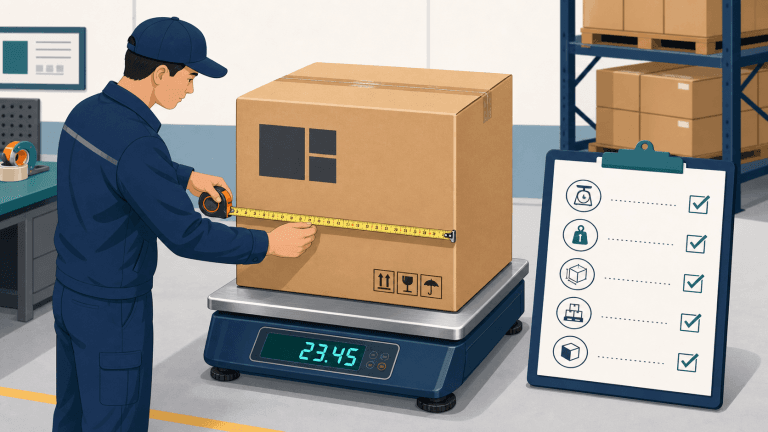
Weigh the sealed parcel, then measure its outside dimensions. Skipping the second step is how a light, oversized box blows up a shipping estimate.
FedEx’s dimensional-weight guide says the bill is based on dimensional or actual weight, whichever is higher. Its current U.S. example uses:
Length × Width × Height in inches ÷ 139
The 139 divisor comes from FedEx’s current U.S. example. Another carrier or service may use a different divisor, rounding method, minimum weight, or surcharge rule.
If the parcel weighs 8 lb but its dimensions produce 12 lb, the carrier may bill 12 lb. Its actual weight remains 8 lb; the 12 lb figure is only the billing basis.
Air freight
Air cargo has the same basic split between actual and volumetric weight. IATA’s air cargo guidance says carriers can price by either one and use the higher figure.
The factor is not universal. Airline rules, minimum charges, rate breaks, rounding, and accessorial fees can all affect the quote.
Ocean freight
For LCL cargo, weight and volume can both matter. For FCL, keep three figures separate: product net weight, cargo gross weight, and packed-container VGM.
If you are shipping from China to the USA, send your forwarder the carton count, outside dimensions, total net weight, cargo gross weight, and CBM before booking. For a full container, settle who calculates and submits VGM before the cutoff.
A note on vehicles
Vehicle terms use another boundary. Actual gross vehicle weight is a current loaded measurement. GVWR is the manufacturer’s loaded weight rating for one vehicle, according to NHTSA. Check the vehicle label, manual, axle ratings, and transport rules. A parcel formula has nothing useful to say about a truck’s safe limit.
Where bad weight data costs you
An understated weight or size can lead to a remeasurement and a larger carrier bill. Oversized packaging can raise dimensional weight even when the product is light. This is one reason international shipping gets expensive: the product may be cheap and light, but the logistics provider is moving cartons, pallets, filler, and empty space too.
Documents create another kind of trouble. A packing list may use kilograms per carton while a booking record uses pounds for the full shipment. Or a supplier may copy cargo gross weight into the VGM field. These errors can trigger questions, corrections, reweighing, extra charges, or delays. The outcome depends on the route and authority, so blanket claims about automatic penalties are not helpful.
Labels have their own stakes. Net quantity tells a customer how much usable product is in the package. Counting the jar or pouch overstates what the buyer receives. A manufacturer also needs to account for package variation, moisture, and filling tolerances; one tidy tare measurement from last year’s packaging run is not enough.
Warehouses and carriers also use weight data to plan racks, forklifts, vehicles, aircraft balance, and vessel stowage. The IMO links misdeclared container mass to bad stowage decisions, collapsed stacks, and containers lost overboard. Estimates that are good enough for an early quote may not be good enough for loading.
What to request from a supplier
I would not build a freight budget from a product-page weight. Ask what the number includes, then request:
- unit product net weight
- unit retail-packed weight
- units per master carton
- carton net weight and gross weight
- sealed outer-carton dimensions
- pallet tare and palletized gross weight, if used
- shipment carton count, total net weight, cargo gross weight, and CBM
- container tare and the proposed VGM method for FCL cargo
Also ask whether the figures were measured or estimated. Packaging often changes between the sample and the production run, which is exactly when an early freight estimate stops being trustworthy.
To verify a supplier’s production data, request a photo or continuous video with the sealed carton, SKU or carton mark, and scale reading in the same frame. For a bulk order, check several cartons. Measure the outside, including any bulge.
This message is ready to send:
Please confirm the unit net weight, unit packed weight, units per master carton, carton net weight, carton gross weight, outer carton dimensions, and palletized gross weight. State whether each figure is measured or estimated, and send a photo of one sealed production carton on a calibrated scale.
Common Weight Mistakes to Avoid
- Entering product net weight as the carrier’s package weight
- Forgetting inner boxes, manuals, filler, tape, pallets, and straps
- Confusing per-carton weight with the shipment total
- Converting kilograms and pounds inconsistently
- Using sample packaging data for the production shipment
- Treating cargo gross weight as ocean-container VGM
- Treating actual gross weight as the final billable weight
- Comparing two suppliers’ gross weights without asking what each includes
Mistakes worth checking before shipment
- Using product net weight as the carrier’s package weight
- Leaving inner boxes, filler, tape, pallets, or straps out of gross weight
- Mixing per-carton weight with the shipment total
- Converting pounds and kilograms inconsistently
- Reusing sample-package data after production packaging has changed
- Copying cargo gross weight into the VGM field
- Treating actual weight as the final billable weight
- Comparing supplier figures before defining what each one includes
FAQ
What is the difference between net weight and gross weight?
Net weight is the goods or contents alone. Gross weight adds the packaging and other tare inside the stated boundary.
Is gross weight always greater than net weight?
Usually. If the tare is zero, net and gross weight can be equal.
Does net weight include the container?
Normally, no. Gross weight includes the packaging inside the chosen boundary, whether that is a retail package, shipping carton, pallet, or packed ocean container.
Is tare weight the same as net weight?
No. Tare is the empty packaging or equipment. Net weight is the product or cargo inside it.
Which weight should I use for shipping?
Give the carrier the sealed package’s actual weight and outside dimensions. The carrier may compare actual and dimensional weight to set the billable weight.
What is VGM in ocean shipping?
Verified Gross Mass is the total verified mass of a packed ocean container. It includes the cargo, packaging, pallets, dunnage, securing materials, and container tare.
The Bottom Line
Whenever a supplier, warehouse, or carrier gives you a weight, write down the boundary beside it. Is it for one bare product, one retail package, a sealed carton, a pallet, or a loaded container?
Then list the tare and check whether the carrier will bill actual or dimensional weight. This catches the common mistake of comparing two correct numbers that were measured at different stages.
When two weight figures disagree, do not start by asking which one is “real.” Ask what each one includes.