USPS Flat Rate boxes solve one problem very well: they make Priority Mail postage predictable. If your item fits safely in the right USPS-produced container, the domestic price is tied to that container—not the package weight or shipping zone—up to 70 lb.
That does not make Flat Rate the automatic low-cost choice. A light package traveling nearby may cost less with USPS Ground Advantage. A compact package may qualify for Priority Mail Cubic. Even ordinary Priority Mail can beat Flat Rate on some routes. The winning service depends on the parcel in front of you.
This guide gives you the current published prices, usable dimensions, packaging rules, and a repeatable way to compare your options. Prices were checked on September 10, 2026, against USPS Notice 123, effective July 12, 2026, and the current USPS Priority Mail page.
USPS Flat Rate prices and sizes at a glance
Here is the useful part first. “Commercial” below means USPS-published Commercial Pricing. It does not mean every seller will see exactly that price in every label platform; some platforms offer account- or channel-specific merchant rates.
Current USPS Flat Rate box prices
| Flat Rate packaging | USPS published Commercial Pricing | Retail / Post Office price | Outside dimensions | Inside dimensions |
|---|---|---|---|---|
| Small Flat Rate Box | $12.10 | $13.65 | 8 11/16 × 5 7/16 × 1 3/4 in | 8 5/8 × 5 3/8 × 1 5/8 in |
| Medium Flat Rate Box 1, top-loading | $21.17 | $24.80 | 11 1/4 × 8 3/4 × 6 in | 11 × 8 1/2 × 5 1/2 in |
| Medium Flat Rate Box 2, side-loading | $21.17 | $24.80 | 14 × 12 × 3 1/2 in | 13 5/8 × 11 7/8 × 3 3/8 in |
| Large Flat Rate Box | $31.00 | $34.00 | 12 1/4 × 12 × 6 in | 12 × 11 3/4 × 5 1/2 in |
| APO/FPO/DPO Flat Rate Box | $29.59 | $32.55 | 12 1/4 × 12 × 6 in | 12 × 11 3/4 × 5 1/2 in |
Current USPS Flat Rate envelope prices
| Flat Rate packaging | USPS published Commercial Pricing | Retail / Post Office price | Listed dimensions |
|---|---|---|---|
| Flat Rate Envelope | $11.12 | $12.90 | 12 1/2 × 9 1/2 in |
| Legal Flat Rate Envelope | $11.66 | $13.25 | 15 × 9 1/2 in |
| Padded Flat Rate Envelope | $11.99 | $14.00 | 12 1/2 × 9 1/2 in |
The two Medium boxes cost the same but behave very differently. Medium 1 is deeper and top-loading; Medium 2 is wider and flatter. Look at the inside measurements, not just the product photo or outside dimensions. Your merchandise, padding, inserts, and paperwork all need room.

Retail, Commercial Pricing, and platform rates are not the same thing
This distinction is the source of a lot of bad shipping advice.
- Retail price is the counter rate shown for a Post Office purchase.
- Commercial Pricing is the business tier USPS publishes and makes available through qualifying online channels such as Click-N-Ship.
- Platform or merchant rates are discounts offered through a particular shipping platform, marketplace, or negotiated account. They can be lower, but they are not universal.
When you compare services, use prices available through the same buying channel. Putting a retail Flat Rate price beside a discounted Ground Advantage rate will tell you which screenshot is lower, not which service is genuinely better for your business.
How USPS Priority Mail Flat Rate works
Flat Rate is a packaging-based option within Priority Mail. For a domestic shipment, the rules are straightforward:
- Use the matching USPS-produced Flat Rate box or envelope.
- Keep the total weight at or below 70 lb.
- Close the container within its normal folds.
- Buy postage for that exact Flat Rate packaging type.
The destination zone does not change the domestic Flat Rate price. That predictability is the product’s real advantage. If your catalog contains dense items going to many parts of the country, a fixed container price can simplify quoting and reduce surprises.
USPS says Priority Mail typically arrives in 2–3 days. Treat that as an estimate, not a delivery guarantee. Most eligible Priority Mail shipments include tracking and up to $100 of insurance, but restrictions and exclusions apply. Free Package Pickup is available, and USPS does not add separate fuel, residential, rural-delivery, or normal Saturday-delivery surcharges to Priority Mail.
There is another important boundary: your own box is not a Flat Rate box. If you pack an order in generic packaging, ordinary Priority Mail is priced by weight and zone, with dimensional or nonstandard fees possible for some parcels.
Are USPS Flat Rate boxes free?
Yes—the standard empty boxes and envelopes are free. The postage is not.
You can order supplies through the USPS Postal Store or ask at a local Post Office. Online supplies are typically delivered with regular mail; USPS says this usually takes 7–10 days. Local inventory varies, so order ahead if a box is part of your regular fulfillment rule.
Do not confuse free shipping supplies with Prepaid Forever Priority Mail Flat Rate packaging. The prepaid version includes postage in its purchase price, which is why the packaging itself is not a $0 supply.
Free packaging has operational value even when another service has slightly lower postage. It removes a carton purchase from the order, gives staff a recognizable format, and can simplify storage. Still, “free box” is not a reason to overpay by several dollars on every shipment. Count packaging cost as one line in the comparison, not the whole decision.
When is USPS Flat Rate cheaper?
Flat Rate tends to become more competitive as a parcel gets denser and travels farther. That is a useful direction, not a universal formula.
You will sometimes see advice such as “use Flat Rate above X pounds.” Ignore any threshold that does not also name the origin ZIP, destination ZIP, outside dimensions, price tier, and competing service. A five-pound package moving across town and a five-pound package crossing the country are not the same rate problem.
Flat Rate vs. standard Priority Mail
Regular Priority Mail in your own packaging is priced by weight and zone. It can be cheaper for lighter parcels or nearby destinations. Flat Rate removes the zone variable, so it often improves relative to standard Priority Mail on longer routes or for heavier contents that still fit safely.
There is no substitute for a live quote. Use the same shipment inputs in the USPS price calculator or your label platform, then compare the final amount.
Flat Rate vs. Priority Mail Cubic
Priority Mail Cubic prices qualifying compact parcels by size tier and zone rather than conventional weight steps. That makes it especially relevant to sellers shipping small, dense products. Eligibility and available rates depend on the package and buying channel.
If a product fits a small mailer or carton, do not assume a Small Flat Rate Box wins just because the contents are heavy. Check Cubic with the sealed outside dimensions first. Understanding the difference between actual, gross, dimensional, and billable weight also helps prevent messy comparisons; this guide to net, gross, and chargeable weight covers the underlying terms.
Flat Rate vs. USPS Ground Advantage
USPS Ground Advantage handles domestic packages from 1 oz through 70 lb and generally has a 2–5 business-day delivery estimate, with exceptions. For a light, non-urgent parcel, it should usually be one of the first quotes you check.
Ground Advantage is not automatically cheaper either. Distance, dimensions, weight, and possible nonstandard charges still matter. Flat Rate also has the advantage of faster expected service in many cases and exemption from USPS nonstandard fees. Compare the actual total, not the service names.
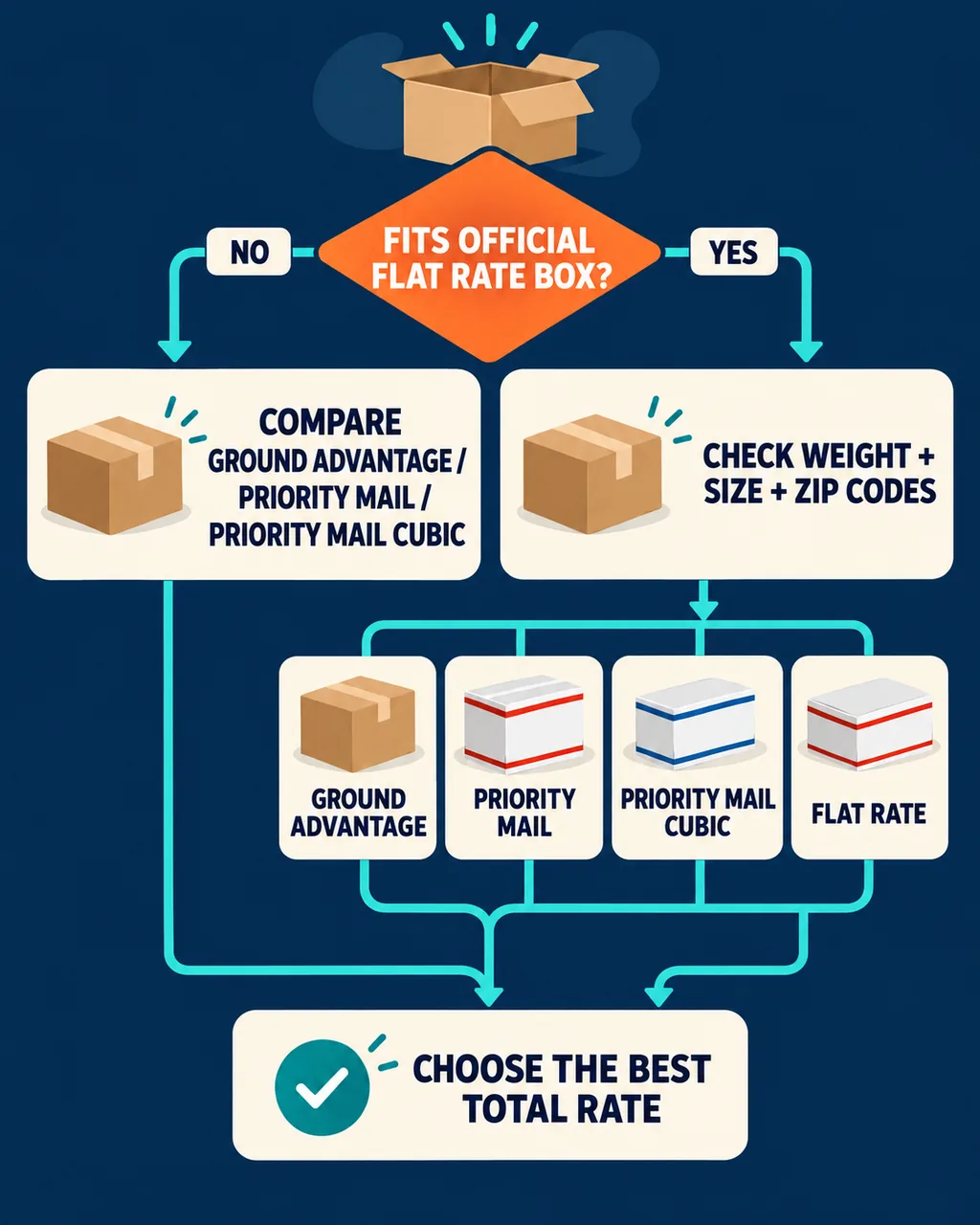
A five-input rate-shopping check
Collect these before deciding:
- Origin ZIP Code
- Destination ZIP Code
- Sealed outside dimensions
- Actual packed weight
- Required delivery window
Then compare Ground Advantage, regular Priority Mail, Priority Mail Cubic if eligible, Flat Rate, and any other carrier that makes sense for the order. Use the same insurance and signature requirements across quotes. A low base rate with missing services is not an apples-to-apples result.
Which Flat Rate box should you use?
Choose a box around the protected shipment, not the bare product.
Small Flat Rate Box
The Small box is genuinely small and shallow. It works for compact electronics, parts, hardware, or other dense items that fit with enough protection. It is a poor choice when the product only fits after you remove padding or press against the walls.
Medium Flat Rate Box 1: top-loading
Medium 1 offers 5 1/2 inches of internal depth. It suits objects that stack or need a more conventional carton shape. Shoes and bundled small goods are common examples, but product category alone never proves fit—measure the packed order.
Medium Flat Rate Box 2: side-loading
Medium 2 trades depth for a wider, flatter footprint. It can work for boxed products, documents with protection, apparel bundles, or items that would waste vertical space in Medium 1. Because both Medium formats have the same postage, the shape decision is about protection and packing efficiency.
Large and APO/FPO/DPO Flat Rate Boxes
The Large box provides more volume, but its fixed price is high enough that comparison becomes even more important. The APO/FPO/DPO version has the same listed dimensions and a lower published rate for eligible military and diplomatic addresses. Those destinations require a customs form and have their own restrictions.
Whichever container you choose, make it part of a documented order fulfillment process. A rate rule that ignores picking, padding, damage, storage space, and packing time is only half a rule.
How to ship a USPS Flat Rate box
The physical work is simple. The label selection is where mistakes tend to happen.
- Get the correct official container. Check the printed packaging name against the service you plan to buy.
- Confirm the item is mailable. Hazardous, restricted, perishable, and international contents can trigger separate rules or fees.
- Pack for protection. Use enough cushioning to stop movement without deforming the container.
- Close on the original folds. Reinforce normal seams with tape if needed; do not add extensions or rebuild the box.
- Select the exact package preset. In Click-N-Ship or a label platform, choose Small, Medium 1, Medium 2, Large, or the correct envelope—not a generic “Priority Mail package.”
- Enter accurate shipment information. Domestic postage is flat, but weight still matters because the limit is 70 lb. Correct addresses also affect deliverability and eligibility.
- Attach and tender the package. Keep the label clear of folds and seams, schedule pickup or take the parcel to USPS, and retain the acceptance receipt or tracking record.
If the Flat Rate option does not appear in a marketplace or label tool, check the package-type selector before changing the dimensions. Interfaces differ, so follow the current instructions for the platform you are actually using.
Flat Rate rules that prevent expensive mistakes
USPS requires the container flaps to close within their normal folds. Tape may reinforce the seams. What you cannot do is cut, enlarge, or reconstruct the packaging to create extra capacity.

Other avoidable errors are less dramatic but more common:
- Putting a Flat Rate label on your own box
- Using Flat Rate packaging with Ground Advantage or another incompatible service
- Assuming the $0 supply price includes postage
- Building shipping rules from an old USPS rate table
- Quoting a 2–3 day estimate to a customer as a guarantee
- Skipping restrictions or assuming included insurance covers every item and every claim
- Sending every order by Flat Rate without checking a lower-cost eligible service
Old packaging creates another trap. The current USPS Priority Mail information page lists a Large Flat Rate Board Game Box, but current supply availability is not equally clear across USPS channels. Do not build a permanent packing rule around that format until you have confirmed you can order or obtain it.
Domestic, international, and military Flat Rate are different
The domestic 70 lb rule does not carry over to Priority Mail International Flat Rate.
For international Flat Rate shipments, envelopes and Small Flat Rate Boxes generally have a 4 lb maximum. Medium and Large Flat Rate Boxes generally have a 20 lb maximum. Destination price groups, customs forms, country restrictions, and size rules also apply. Check the destination in the current USPS international rules before accepting an order or quoting delivery.
APO/FPO/DPO mail uses domestic pricing but military postal routing. A customs form is required, and destination restrictions can differ. The dedicated APO/FPO/DPO Flat Rate Box is priced below the regular Large box for eligible addresses.
If your inventory is arriving from overseas, keep that movement separate from domestic parcel fulfillment. Importing stock, clearing customs, and moving freight into a U.S. warehouse is a different cost problem from the USPS label used for the final customer order. This overview of shipping from China to the USA explains the upstream side.
How ecommerce teams can turn this into a shipping rule
Checking every order by hand is fine at five shipments a week. It becomes a bottleneck at fifty a day.
Start with representative packed orders—not catalog dimensions. Record the final weight and outside dimensions for each common SKU or bundle in each viable package. Then sample the destinations that matter to your business: nearby zones, the middle of the country, and the longest routes you routinely serve.
Build a matrix with one row per packed order and columns for:
- Packaging cost
- Packing time
- Ground Advantage rate and estimated timing
- Regular Priority Mail rate
- Priority Mail Cubic rate, when eligible
- Flat Rate container and rate
- Any relevant carrier alternative
- Insurance or signature cost
- Damage or exception notes
Only automate after the matrix has produced sensible results on real orders. Keep an exception path for unusually valuable, fragile, oversized, restricted, or time-sensitive products. Review postage adjustments and damage reports; the cheapest label is not cheap if it creates avoidable reships.
USPS prices can change more than once in a year. In 2026, a transportation-related temporary adjustment began April 26 and is scheduled to run through January 17, 2027; the current July 12 Notice 123 reflects the latest table used in this guide. Put a rate-review date on the calendar instead of treating the matrix as permanent.
USPS Flat Rate boxes FAQ
How much does a USPS Flat Rate box cost in 2026?
As of the July 12, 2026 USPS price list, retail prices are $13.65 for Small, $24.80 for either Medium format, and $34.00 for Large. USPS-published Commercial Pricing is $12.10, $21.17, and $31.00 respectively. Platform-specific rates may differ.
Are USPS Flat Rate boxes really free?
The standard empty supplies are free from USPS. You still pay postage when shipping. Prepaid Forever Flat Rate packaging is not a free supply because it already includes postage.
What is the USPS Flat Rate weight limit?
The domestic maximum is 70 lb. For Priority Mail International Flat Rate, the usual maximum is 4 lb for envelopes and Small boxes, and 20 lb for Medium and Large boxes, subject to destination rules.
Can I use my own box for USPS Flat Rate shipping?
No. Flat Rate pricing requires the corresponding USPS-produced Flat Rate packaging. You may use your own box with ordinary Priority Mail, Ground Advantage, or another service for which it qualifies.
Is Flat Rate cheaper than using my own box?
Sometimes. Your own box may be cheaper with regular Priority Mail for a light or nearby shipment, while Flat Rate may improve for a dense parcel traveling farther. Compare current quotes using identical shipment details and include the cost of your own packaging.
Is USPS Flat Rate cheaper than Ground Advantage?
There is no universal answer. Ground Advantage is often attractive for lighter, non-urgent parcels. Flat Rate may win for some dense or long-distance shipments and carries a faster typical delivery estimate. Quote both.
Do Flat Rate boxes include tracking and insurance?
USPS Tracking is included. Most eligible Priority Mail shipments also include up to $100 of insurance, but exclusions and claim rules apply. Buy additional coverage when the contents and eligibility justify it.
How long does USPS Flat Rate shipping take?
USPS generally estimates 2–3 days for Priority Mail. That estimate depends on origin, destination, and acceptance time and is not a money-back guarantee.
Can USPS Flat Rate boxes be used internationally?
Certain Flat Rate packaging can be used with Priority Mail International Flat Rate, but the price, weight limit, customs requirements, and destination restrictions are different from domestic shipping.
The practical answer
Flat Rate buys predictability. It does not promise the lowest postage.
For a single shipment, measure the sealed parcel and compare live rates with the same ZIPs, weight, timing, and extras. For a growing store, turn those comparisons into a SKU-by-package-by-zone matrix and refresh it whenever rates change. That small piece of discipline is worth more than any universal “if it fits, it ships” shortcut.
If packaging and carrier decisions are taking over your operation, look at the whole fulfillment flow—inventory, picking, packing, rate shopping, handoff, and exceptions—rather than optimizing one label at a time.