A third-party logistics provider (3PL) handles logistics work such as warehousing, fulfillment, transportation, or returns. A fourth-party logistics provider (4PL) sits above a broader network. It may coordinate several 3PLs, combine their data, and take responsibility for how the network performs.
Neither model is automatically better. If your problem is getting orders out accurately and on time, you probably need a 3PL. If managing several warehouses, carriers, systems, and contracts has become the harder job, a 4PL may help.
One warning before getting into the details: there is no universal industry definition of either term. Read the contract. The acronym on the sales deck tells you less than you might think.
3PL vs 4PL at a glance
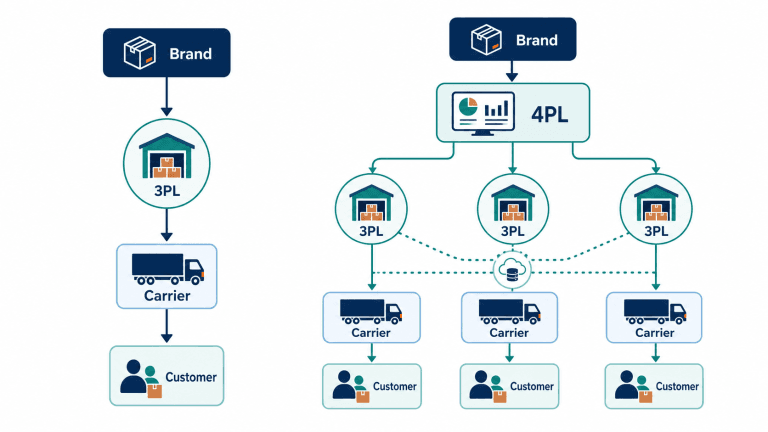
The quickest useful distinction is execution versus orchestration. A 3PL usually does or manages logistics work. A 4PL manages the network of companies doing that work.
The 2025 Third-Party Logistics Study from CSCMP uses a similar working definition. A 3PL provides or manages one or more logistics services for customers. A 4PL may manage multiple providers or orchestrate broader parts of a customer’s supply chain.
| Question | 3PL | 4PL |
|---|---|---|
| Main job | Execute or manage logistics functions | Orchestrate the wider supply chain |
| Typical work | Receiving, storage, pick and pack, shipping, freight, returns | Network design, provider management, data integration, performance governance |
| Provider relationships | The client often manages the 3PL directly | The 4PL may manage several 3PLs and carriers |
| Strategy | Usually stays with the client | May be partly outsourced |
| Technology | WMS, TMS, inventory, and shipment tools | A control layer combining data from several systems |
| Physical assets | May own, lease, or arrange assets | Often asset-light, but not always |
| Best fit | A business with an execution problem | A business with a coordination problem |
| Main risk | Poor execution, weak integration, or limited capacity | Weak incentives, extra fees, loss of visibility, or lock-in |
What is a 3PL?
A 3PL is an outside company that takes over one or more logistics activities. For an ecommerce brand, that often includes receiving stock, storing it, processing orders, picking and packing products, arranging shipment, and handling returns.
The range can be much narrower or wider. One 3PL may run a fulfillment center. Another may manage transportation without owning a warehouse. A larger provider may combine freight, customs brokerage, warehousing, and fulfillment.
For a closer look at the warehouse side, see how a 3PL fulfillment workflow works. Fulfillbot’s separate order fulfillment process guide covers receiving, storage, picking, packing, shipping, and returns.
What a 3PL usually handles
The contract may cover inbound receiving, inventory checks, storage, order processing, picking, packing, labeling, kitting, shipping, FBA preparation, exchanges, or returns. Most ecommerce 3PLs also connect to store or marketplace orders and return tracking data to the seller.
Technology is not a 4PL-only feature. A 3PL may provide a warehouse management system, shipping tools, inventory reports, and order integrations. The difference is usually the scope. A 3PL portal tends to show what is happening within that provider’s operation. A 4PL platform tries to combine information from several providers and locations.
What the client still manages
Hiring a 3PL does not remove the brand’s supply chain responsibility. The client still decides where to hold inventory, which markets to serve, what delivery promise to make, and how much risk to accept. Someone also has to review invoices, watch service levels, plan capacity, and resolve disputes.
That is manageable when the network is simple enough to understand. One main fulfillment provider and a few carriers do not necessarily need another company sitting above them.
Does a 3PL have to own warehouses or trucks?
No. Some 3PLs own physical assets. Others lease facilities or arrange services through partners. CSCMP describes both asset-based and non-asset-based 3PLs. Maersk’s discussion of 3PL and 4PL models also describes several kinds of 3PL, including providers that arrange transportation or warehousing through other companies.
Ask what the provider owns, leases, subcontracts, and controls. Then ask who is accountable when a subcontractor misses the service level. Those answers are more useful than a tidy definition.
What is a 4PL?
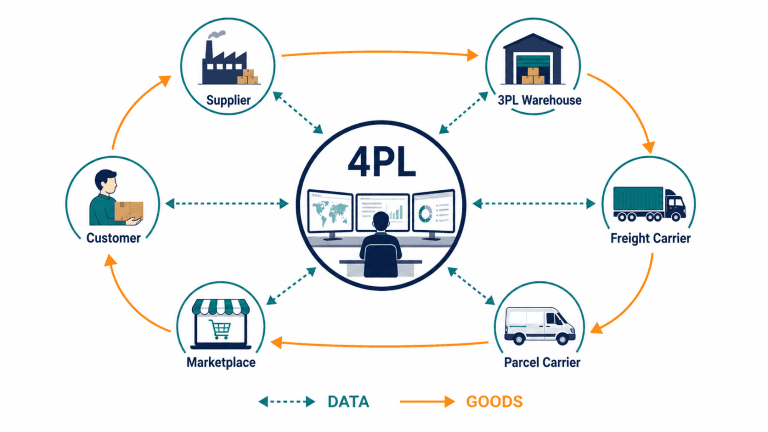
A 4PL is an outside partner that manages a broader logistics network for the client. It may select and oversee 3PLs, combine data from different systems, design distribution networks, coordinate inbound and outbound flows, and report performance through one point of contact.
The term overlaps with “lead logistics provider” and “control tower.” DHL’s comparison of 3PL and 4PL services describes a 4PL as the single contact for the customer and the providers it manages. Penske lists supplier coordination, technology integration, transportation optimization, and distribution-network management among common responsibilities.
The physical work still happens in warehouses and carrier networks. A 4PL coordinates those companies; it does not make the boxes disappear.
What the client still owns
Outsourcing coordination does not outsource legal responsibility, customer promises, or business judgment. The client has to set service targets, approve incentives, protect sensitive data, and check that the 4PL is acting in its interest.
There is a slightly awkward conflict to address. Some companies sell both 3PL and 4PL services. Penske’s explanation discusses information barriers and checks used when a 4PL compares its own operating business with competitors. A buyer should ask how bids are compared, whether affiliated services receive preference, and how conflicts are disclosed.
Nine contract differences that actually matter
The sales page is a starting point. The contract tells you what you are buying.
1. Scope
A 3PL agreement usually covers named functions, facilities, lanes, channels, or regions. A 4PL agreement may cover the network connecting those functions, including the management of other providers.
2. Execution and orchestration
A 3PL is commonly measured on receiving speed, inventory accuracy, order accuracy, dispatch, damage, and returns. A 4PL should also answer for cross-network results such as total logistics cost, service consistency, capacity, and exception resolution.
3. Provider management
With a 3PL, your team normally manages the relationship. A 4PL may run sourcing events, negotiate with carriers and 3PLs, monitor their performance, and handle escalation.
4. Decision rights
“End-to-end management” is too vague for a contract. List the decisions the provider can make without approval. Can it change a carrier, move inventory between warehouses, authorize an expedite, or alter a delivery method? Put the answer in writing.
5. Technology and visibility
A 3PL may provide inventory data, order integration, tracking, and a WMS portal. A 4PL may add a layer that combines data from warehouses, carriers, suppliers, and enterprise systems.
The dashboard is the easy part. The real work is getting consistent data from every source and deciding which record wins when the systems disagree.
6. Data ownership and portability
The contract should state who owns shipment, cost, inventory, forecast, and performance data. It should cover export formats, API access, retention, security, and the treatment of historical data after termination.
7. Pricing and incentives
Comparing management fees alone misses the point. A 4PL may add fees while reducing internal coordination work, expedites, fragmented purchasing, or excess inventory. It may also add another margin and deliver very little.
Require a baseline. Define which savings count, how they are calculated, who audits them, and whether the provider earns more by choosing an affiliated service.
8. KPIs and exceptions
Every KPI needs one owner and one calculation method. If the warehouse says an order shipped on time but the carrier says it was tendered late, who settles the record? Set the source of truth, escalation timing, corrective-action process, and any service credits before launch.
9. Transition and exit
Buyers spend months planning onboarding and a few minutes thinking about exit. Do the opposite for an hour. Ask how data, carrier accounts, procedures, open claims, inventory records, and supplier contacts will be transferred. A system that works only while the incumbent controls it is costly to leave.
3PL vs 4PL examples
The same brand can use either model. What changes is who manages the network.
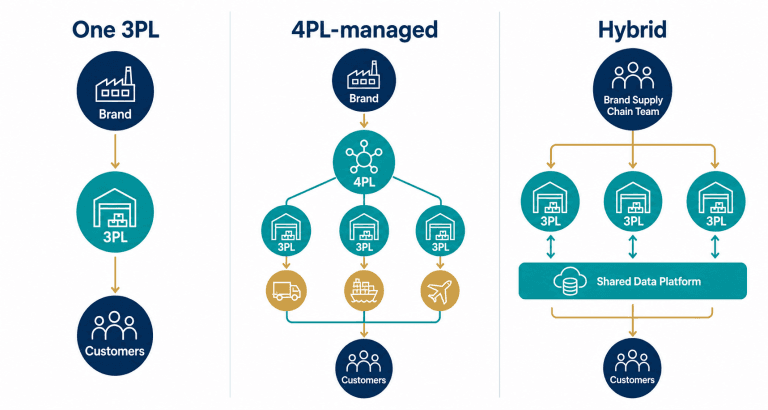
One main 3PL
A US ecommerce brand sources products from China and sends bulk inventory to one US fulfillment center. The 3PL receives stock, stores it, fulfills store and marketplace orders, and handles returns. The brand’s operations manager reviews inventory, carrier performance, costs, and forecasts.
The main problem is execution. One capable 3PL may be enough.
A 4PL managing a regional network
Now the brand expands into North America, Europe, and Australia. It uses several fulfillment providers, ocean and air forwarders, parcel carriers, and separate technology connections. No internal team has a dependable view of total cost or service across the network.
A 4PL could manage provider selection, data integration, reporting, and exceptions. The regional 3PLs would still store and ship the inventory.
A hybrid model
The brand keeps a supply chain director in-house and uses specialist 3PLs in each region. The internal team controls network design and commercial decisions. A technology provider combines the data, while each 3PL remains responsible for execution.
That is not a half-finished 4PL arrangement. It may be the better choice when the company has strong internal expertise and wants direct provider relationships.
Benefits and trade-offs
A 3PL can remove the daily burden of running a warehouse or arranging transportation. The brand gets facilities, labor, processes, and systems without building everything in-house. It also keeps a direct relationship with the company doing the work.
The brand still has to manage that relationship. With several 3PLs, it must compare data, enforce standards, and solve problems across providers. Weak integrations can leave uncomfortable gaps around inventory and order status.
A 4PL gives one team responsibility for that fragmented network. Done well, it can simplify communication and provide a wider view of cost, inventory, and performance. It may also bring skills in sourcing, network design, and systems integration that the client does not have internally.
The trade-off is dependence. The buyer may lose direct control of provider relationships and become tied to the 4PL’s systems. Fees, transition costs, and biased incentives are real concerns. They are manageable only when the agreement is specific and the results are measurable.
A poor 4PL does not become strategic because it built a dashboard. A strong 3PL does not become unsophisticated because it focuses on execution. Choose the provider that solves the management problem you have now.
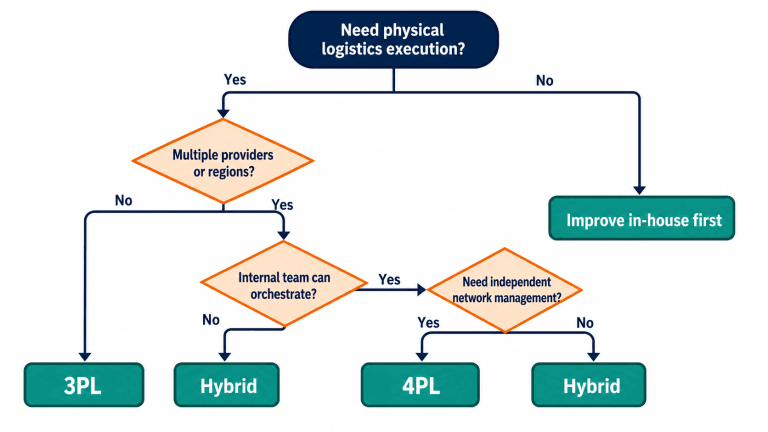
Should you choose a 3PL, a 4PL, or a hybrid?
Choose a 3PL when you need someone to receive, store, fulfill, or move goods and your team can still manage logistics strategy. Consider a 4PL when cross-provider coordination has become its own operation. Keep orchestration in-house when your team has the expertise, systems, and time to do it well.
A 3PL is usually the better fit when one or two providers cover most of the network, your team can set inventory and service strategy, and the main failures happen inside a facility or transport service.
A 4PL may be worth considering when you manage several providers, modes, or regions; costs and KPIs are inconsistent; systems do not provide one reliable view; or exceptions bounce between companies without an owner.
A hybrid model can work when the business wants shared technology but intends to keep supply chain strategy and direct commercial control. It is also useful when different regions genuinely need different operating partners.
Run through these questions before requesting proposals:
- How many providers, transport modes, and regions are we managing?
- Can one person see total logistics cost and end-to-end performance?
- Which system is the source of truth for inventory and shipment status?
- Who owns a problem that crosses a warehouse, carrier, and customs broker?
- Do we need network redesign, or simply more reliable execution?
- Can we audit provider selection and claimed savings?
- Which data, decisions, and relationships must stay under our control?
Questions to ask before hiring a provider
Put the answers in the proposal, implementation plan, or contract. Verbal reassurance is hard to audit later.
Start with scope. Which activities, facilities, lanes, channels, and regions are included? Which work is subcontracted? Who is liable for loss, inventory errors, damage, or missed cutoffs? How is peak capacity reserved?
Then get specific about systems. Ask which tools will connect, who pays for integration, which record is authoritative when systems conflict, and whether you can export raw cost and operational data without another fee.
Pricing needs the same treatment. Separate fixed charges, variable charges, pass-through costs, and markups. Define how savings will be calculated and checked. If the provider can award work to an affiliated warehouse or carrier, ask how that decision is reviewed.
For performance, agree on the formula behind every KPI and SLA. Name the owner of cross-provider exceptions. Set escalation times, corrective-action rules, and service credits where appropriate.
Finally, discuss the breakup before the relationship starts. How will inventory, open orders, claims, data, procedures, and carrier accounts be transferred? How much transition help is included? Can a replacement provider access historical records before the agreement ends?
The bottom line
Use a 3PL when the work itself is the problem. Consider a 4PL when managing the companies doing the work has become the bigger problem.
For many growing ecommerce brands, a capable 3PL and a clear internal owner are enough. A 4PL becomes useful when the network has outgrown that structure and the value of coordination can be measured. A hybrid is often sensible when the business wants shared data but is not ready to hand over strategy.
If your immediate need is China-side receiving, warehousing, pick and pack, ecommerce fulfillment, or cross-border shipping, review Fulfillbot’s China warehousing and fulfillment services. If you need an independent party to govern several 3PLs across a global network, look for proven 4PL contracts, integrations, and governance controls.
Frequently asked questions
Is a 4PL always non-asset-based?
No. Many 4PLs are asset-light, but that is not a universal definition. Some companies provide both 3PL and 4PL services. Judge the contract by its scope, independence, decision rights, and accountability.
Can a company use both a 3PL and a 4PL?
Yes. A 4PL often manages one or more 3PLs. The 3PLs perform warehousing, fulfillment, or transportation while the 4PL coordinates the wider network.
Is a 4PL more expensive than a 3PL?
A 4PL adds a management layer and may add fees. That does not prove total logistics cost will rise. Compare provider fees, internal labor, inventory, expedites, errors, technology, transition costs, and independently verified savings.
When should a company move from a 3PL to a 4PL?
Consider a 4PL when coordination across several providers, regions, and systems has become harder than the physical logistics work, and when the expected value can be measured against a reliable baseline.
Are Amazon, DHL, or FedEx 3PLs or 4PLs?
Large logistics companies can provide different service levels under different contracts. Classify the service being purchased rather than assigning one permanent label to the entire company.
What is the difference between 1PL, 2PL, 3PL, 4PL, and 5PL?
In a simplified model, 1PL handles logistics in-house, 2PL provides an asset-based transport service, 3PL manages logistics functions, and 4PL coordinates a wider provider network. “5PL” is used inconsistently, often for technology-led management of broader supply-chain networks. Read the service scope before relying on the number.