A vendor list is a lead list. That is all.
It does not prove that a supplier owns the inventory, can provide usable invoices, will ship the grade shown in its photos, or leaves you enough margin after freight and returns. Those checks still belong to you.
If you want a practical starting point, compare these sourcing routes:
- Faire for independent stores and boutique wholesale
- Wholesale Central for free US supplier discovery
- SaleHoo or Worldwide Brands for paid directory research
- Alibaba or Global Sources for international wholesale and custom products
- 1688 with China-side support when you can manage a domestic-market workflow
- CJdropshipping for store-connected sourcing and fulfillment
- B-Stock for returned and excess inventory auctions
- Direct distributors, trade shows, and local wholesalers for category-specific supply
There is no single “best” reselling vendor for every seller. The right source depends on what you sell, where you sell it, the documents your marketplace may ask for, the order size you can safely test, and the final cost of getting sellable units into your hands.
This guide compares ten useful options, then gives you a scorecard and first-order process you can use with any supplier. Inclusion is not an endorsement of every seller on a platform. Fees, eligibility, minimums, shipping, return terms, and inventory condition can change, so confirm the current terms before paying.
What is a reselling vendor?
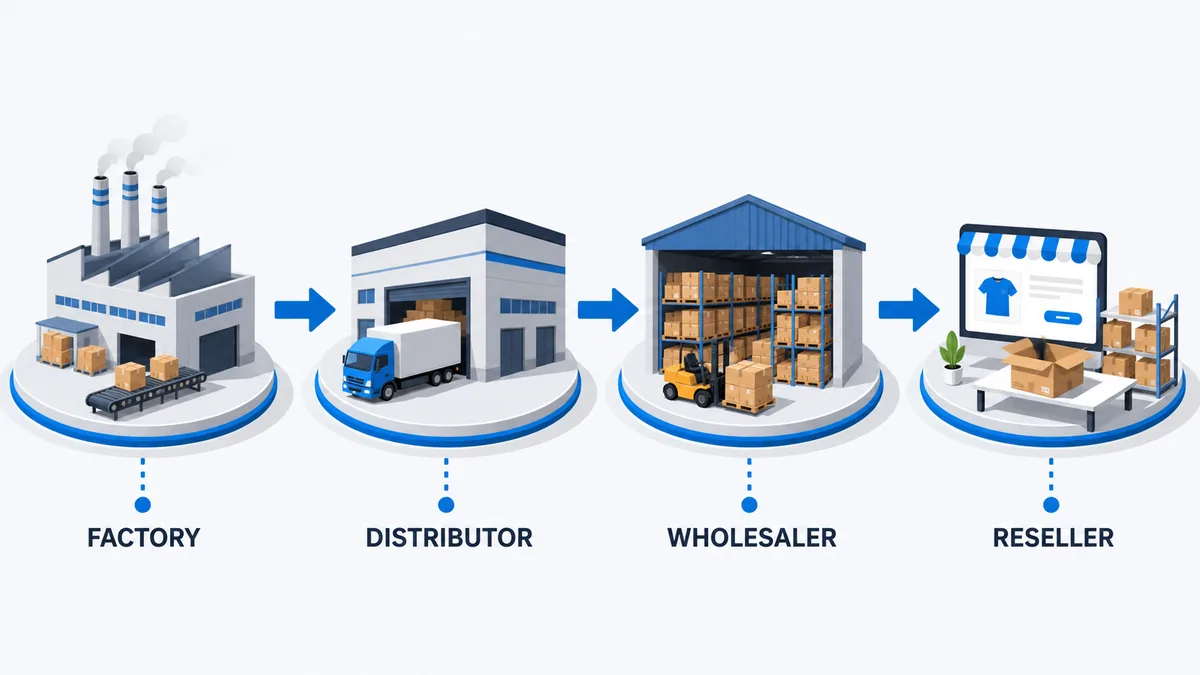
A reselling vendor is a business or source that supplies inventory you plan to sell to someone else. The source might be a brand, manufacturer, authorized distributor, wholesaler, liquidation marketplace, dropshipping supplier, or recurring local seller.
These labels describe different roles:
- A manufacturer makes the product.
- A distributor may have a formal relationship with the manufacturer or brand and sells into a territory or channel.
- A wholesaler buys and resells inventory in business quantities.
- A sourcing marketplace helps buyers discover suppliers but is not necessarily the seller of record.
- A liquidation source sells returns, overstock, trade-ins, or other secondary-market inventory.
- A dropshipping supplier holds stock and ships an order after your customer buys.
The distinction matters. A factory may offer customization but require a larger order. A wholesaler may be easier to test but add markup. A liquidation lot can look cheap per unit while containing damaged, incomplete, or slow-moving stock. A marketplace can make discovery easier without removing the need to assess the individual seller.
Quick comparison: match the vendor type to your resale model
Start with the inventory model, not a famous platform name. This table narrows the field.
| Sourcing model | Useful when | Main tradeoff | What to verify first |
|---|---|---|---|
| Boutique wholesale marketplace | You run an independent online or physical store and want finished goods from multiple brands | Lower buying friction can come with higher unit costs or channel restrictions | Retailer eligibility, opening-order terms, brand resale restrictions |
| Supplier directory | You want a searchable shortlist across categories | Membership or directory screening does not verify each future order | Supplier identity, current inventory, authorization, references |
| International B2B marketplace | You want bulk, private-label, packaging, or product customization | More control usually means more work on specifications, samples, QC, and import logistics | Legal entity, payee, sample, contract terms, production capability |
| Dropshipping supplier | You want to test demand without receiving a bulk order first | Less inventory exposure, but weaker control over stock, packing, and delivery | Live stock, handling time, tracking, returns, product consistency |
| Liquidation marketplace | You can process returns, overstock, or mixed-condition inventory | Low acquisition cost can hide freight, missing units, testing labor, and unsellable stock | Manifest, condition codes, lot terms, freight, final-sale rules |
| Direct distributor or local wholesaler | You know the category and want repeatable supply or local inspection | Discovery takes more work and account approval may be stricter | Brand relationship, territory/channel rules, invoice quality, reorder capacity |
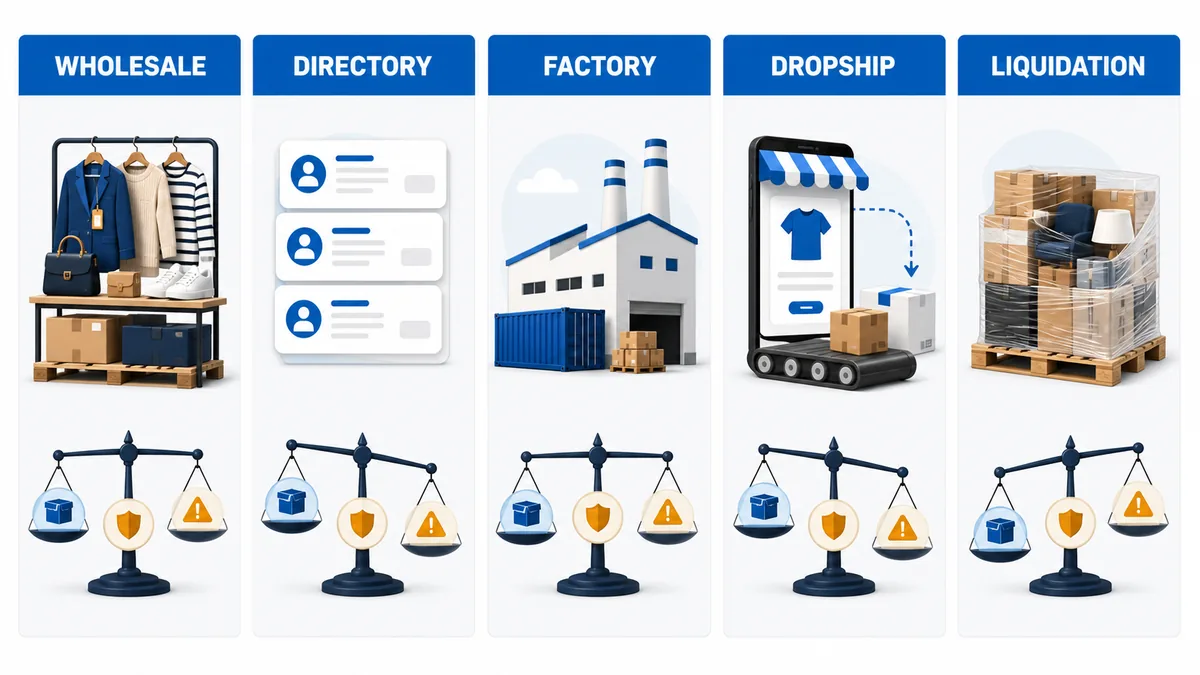
10 reselling vendor platforms and sourcing options to compare
This is a comparison of sourcing routes, not a universal ranking. A platform can be a sensible place to search while a particular seller on it is still a bad fit.
1. Faire for boutiques and independent shops
Faire connects independent brands with retailers. Buyers can search across brands, place wholesale orders, and, when eligible, use opening-order returns or payment terms described by Faire. Those terms can vary by account and market, so treat the current help center as the source of truth.
Faire makes the most sense for boutiques, gift shops, specialty retailers, and independent ecommerce stores looking for finished branded goods. Marketplace-only sellers need to check eligibility carefully. Faire’s current retailer eligibility guidance says it may not support businesses whose primary channels are marketplaces such as Amazon, eBay, Etsy, Poshmark, Whatnot, or TikTok.
Use Faire when you run an eligible independent store and want to test several brands without opening accounts one by one. Before placing an order, check the brand minimum, shipping cost, channel restrictions, and whether the advertised return terms apply to that specific purchase.
2. Wholesale Central for free US supplier discovery
Wholesale Central is a B2B directory for finding wholesalers, importers, distributors, manufacturers, and products. It can be a useful first stop when you want US-focused supplier leads without paying for a directory membership.
The directory is the beginning of the check, not the end. Open the supplier’s own site, verify the legal business name and contact details, ask what documents come with an order, and confirm that the products shown are currently available. A listing in a directory does not establish authorization for branded goods.
It suits sellers who already know the category and are willing to research several US wholesalers. Before ordering, match the business identity to a physical address, confirm the current stock and terms, ask what the invoice will show, and start with a small trial.
3. SaleHoo for a structured paid directory
SaleHoo sells access to a supplier directory and research tools. SaleHoo says its directory contains more than 8,000 pre-vetted suppliers. That is the platform’s description of its screening, not a promise that every product or transaction will suit your business.
The value is organization. A paid directory can save time when it helps you filter by product, location, order requirements, or sourcing model. It cannot tell you whether your real landed cost works or whether today’s batch matches last month’s sample.
SaleHoo is most useful when a structured search saves you more time than the membership costs. Check the current membership terms and category coverage first. Once you find a supplier, confirm where it ships, what documents come with an order, and whether a test quantity is available.
4. Worldwide Brands for long-term directory access
Worldwide Brands markets a lifetime-access directory of suppliers it describes as certified wholesalers. As with any directory, use that language as a platform claim. Do not turn it into an unqualified statement that every listed company, listing, or order has been independently authenticated for your intended sales channel.
This route can suit a seller who expects to research several niches over time and prefers a one-time membership model. Before paying, compare the current directory scope with the categories and countries you actually need.
The lifetime model is more relevant to someone doing ongoing supplier research than to a seller looking for one secret contact. For every lead, recheck the supplier’s legal details, brand relationships, resale restrictions, minimums, shipping, returns, and invoice contents.
5. Alibaba for international bulk and private-label sourcing
Alibaba.com Buyer Central lets buyers search for manufacturers, wholesalers, and distributors, request quotations, discuss customization, and place international B2B orders. It is especially useful when you need a defined specification, packaging, or a product made to order.
Alibaba’s Trade Assurance can cover eligible shipping or quality disputes when the platform order, payment, and agreed contract terms meet the program’s rules. It is not a blanket guarantee that a supplier is capable or that an informal promise made in a chat will be enforced. Put the measurable specification, quantity, packaging, inspection standard, and shipping terms into the order record. Keep material communication and payment within the protected workflow.
Alibaba works best when you have a clear brief and can manage the unglamorous parts: samples, specifications, QC, and import logistics. Check the legal entity and payee, business type, production capability, written specification, inspection plan, incoterm, shipping quote, and Trade Assurance eligibility. The detailed Alibaba supplier verification guide covers those checks step by step.
6. Global Sources for export-focused discovery and trade shows
Global Sources combines online supplier discovery with trade shows and sourcing events. Its exhibition site provides product and exhibitor discovery tools for buyers attending shows, which can help when you want to compare suppliers in person instead of relying on storefront pages alone.
Face-to-face access is useful, but a polished booth is still sales material. Ask who owns the factory, which processes happen on-site, whether the exhibitor is a manufacturer or trading company, and what documents will name the seller of record. Take the same product brief to every meeting so the quotes are comparable.
This route is better suited to buyers who can arrive with a detailed brief and compare export-ready suppliers in person. Confirm the exhibitor’s identity and factory relationship, then check applicable product certificates, sample consistency, written terms, QC access, and shipping responsibility.
7. 1688 plus China-side support for domestic-market access
1688 primarily serves China’s domestic wholesale market. It can expose buyers to a broad local supplier base and product pricing that differs from export-focused platforms. The listing price is not the savings. Domestic freight, payment, sourcing support, inspection, consolidation, international shipping, duties, and rejects can narrow or erase the gap.
Some overseas buyers can purchase directly, depending on their account, payment access, language ability, and location. Others use a China warehouse, forwarder, or sourcing partner to communicate with sellers, receive parcels, inspect goods, consolidate shipments, and arrange export. The right setup depends on the order, not a blanket rule.
1688 makes more sense after you know the product and want domestic wholesale listings, components, packaging, or standard goods. Before ordering, settle how payment and domestic delivery work, what happens if the received item is wrong, and who handles inspection and export. This Alibaba vs. 1688 comparison explains the workflow differences in more detail.
8. B-Stock for returns and overstock auctions
B-Stock hosts B2B liquidation marketplaces for returned, excess, and trade-in inventory. Lots are sold through auctions and may range from smaller lots to pallets or truckloads. Requirements and terms vary by storefront; US buyers are often asked for a valid resale certificate.
Liquidation inventory demands a different margin model. Review the manifest when one is provided, condition codes, lot size, buyer’s premium, shipping method, unloading needs, and final-sale terms. B-Stock’s buying guidance tells buyers to review the manifest, expanded condition description, and shipping information before bidding. Some lots are unmanifested, so do not assign a full retail value to units you have not identified or tested.
B-Stock is for operators with space, testing or repair capacity, and a sales plan for mixed-condition stock. Before bidding, price the resale-certificate requirement, manifest quality, condition mix, freight, buyer fees, missing-unit risk, testing labor, storage, disposal, and final-sale terms. A pallet that blocks the garage for three months is not cheap inventory.
9. Direct distributors, trade shows, and local sources
The least glamorous route is often the most durable: search by product category plus “authorized distributor,” contact brands for their distributor list, attend a trade show, visit a cash-and-carry wholesaler, or build a recurring relationship with a local closeout source.
Direct sourcing takes longer because there is no universal catalog. In return, you may get clearer channel permission, stronger invoices, better category knowledge, and a person who can discuss reorders. Local sources can also let you inspect stock before paying and avoid international freight on a test order.
This is the route for category-focused sellers who care more about repeatability than a secret vendor link. Ask about authorization or the upstream source, permitted sales channels, territory rules, invoice details, reorder cadence, returns, and quantities. A solid vendor can still be wrong for your cash position if the opening order is too large.
Which reselling vendor is best for your sales channel?
The source has to fit the channel where you plan to sell. A vendor can be legitimate and still be unusable for your store.
eBay, Poshmark, Mercari, Vinted, and similar marketplaces
Start with goods you can accurately identify, photograph, grade, and document. Local wholesalers, direct distributors, vintage wholesalers, liquidation sources, and recurring local sellers can work. The condition and authenticity burden sits with you when you create the listing.
For used clothing or mixed apparel, a low price per pound tells you almost nothing by itself. Grade, season, size mix, brands, damage, cleaning, photography labor, and sell-through determine whether the lot works. The Vinted supplier guide goes deeper into trial lots and grading risk.
Amazon
Prioritize sources that can provide clean commercial invoices, consistent products, and clear authorization where a brand or category requires it. Direct brands and authorized distributors are usually easier to document than anonymous social-media vendors. Before buying, check the current seller requirements for your category and product; account, brand, and marketplace rules change.
Shopify and private-label stores
Alibaba, Global Sources, direct manufacturers, and 1688 with China-side support become more useful when you own the product brief and want packaging or white-label products. The workload also grows. Samples, specifications, inspections, compliance, packaging, inventory planning, and customer support are now part of your system.
Independent boutiques and specialty retail
Faire, direct brands, category distributors, trade shows, and local wholesalers are natural starting points. Confirm that your store and primary sales channel meet each supplier’s eligibility rules. Test several small opening orders rather than filling the store around one unproven brand.
Are reselling vendors legal?
Using a vendor to buy inventory for resale is not inherently illegal. The risk comes from the product, the supplier’s rights, how the goods entered the market, your records, your marketing claims, and the rules of the channel where you list them.
This section is general business information, not legal advice. US resale, trademark, copyright, parallel-import, tax, product-safety, and state requirements can be fact-specific. Get qualified advice for branded goods, regulated products, or a sourcing model with unclear ownership.
At minimum, separate five questions:
- Is the product genuine, and can the supplier support that claim?
- Does the supplier have the right to sell the inventory into your market or channel?
- Is the product lawful and compliant for sale in the destination?
- Can you describe its brand, condition, origin, and compatibility accurately?
- Can you keep the records needed for tax, platform, and customer disputes?
eBay’s counterfeit-item policy prohibits counterfeit, fake, or unauthorized replica items and tells sellers to be sure an item is genuine before listing it. It also recommends keeping documentation such as invoices or receipts. Other marketplaces have their own rules, so check the policy for the channel you use.
The phrase “1:1 vendor” is not evidence of authenticity. It is used loosely in social-media resale content and often appears in replica marketing. Treat it as a high-risk signal that requires more proof, not as a recognized product grade. If the seller cannot identify the legal business, upstream source, and document trail for branded goods, stop.
How to verify a reselling vendor before you pay
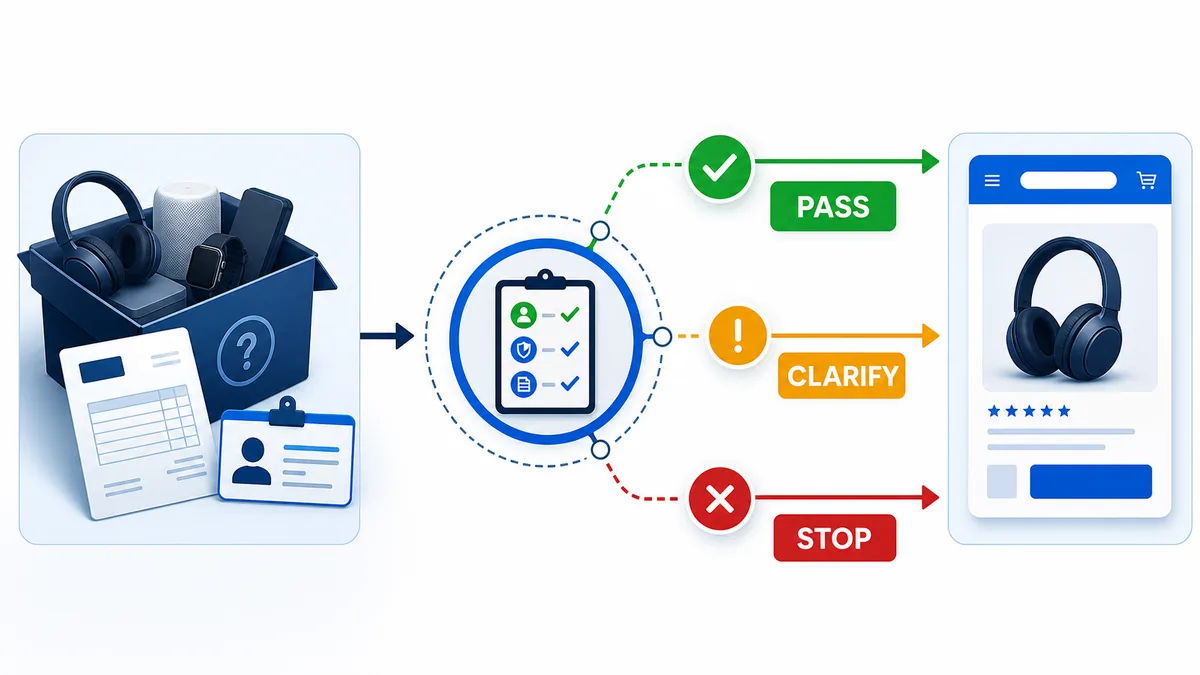
Verification is not one badge or reverse-image search. It is a chain of checks that should connect the business, payee, product, documents, and trial-order result.
Use three outcomes for each check:
- Pass: the evidence is consistent and usable.
- Clarify: something is incomplete, but the supplier can reasonably resolve it before payment.
- Stop: the identity, payee, goods, or documents conflict, or the seller pressures you to ignore the gap.
1. Define what you are buying
Write a one-page product brief before contacting suppliers. Include the model or material, dimensions, color, packaging, quantity, acceptable defects, labeling, destination, target delivery window, and any documents or testing you need.
Without a fixed brief, two quotes are rarely comparable. One may exclude packaging, another may use a different material, and a third may quote a smaller or lower-grade item.
2. Match the legal business to the payee
Ask for the legal company name, registered address, business registration information, website, company email, and invoice or pro forma invoice. Check whether the bank or platform payee makes sense for that entity.
A different name is not automatic proof of fraud. Trading groups and payment providers can create legitimate variations. It does require an explanation you can document. A sudden request to pay a personal account, an unrelated company, gift card, cryptocurrency wallet, or new beneficiary should pause the order.
3. Verify the product and the right to sell it
For generic goods, compare the sample against the written specification. For branded goods, ask how the supplier obtained the inventory and what evidence supports authenticity and resale rights. A product photo, barcode lookup, or matching marketplace listing cannot establish the full chain by itself.
Do not buy fake receipts or invoice templates. A fabricated document does not turn counterfeit or diverted stock into authorized inventory. It adds another problem.
4. Check the current inventory, not the marketing page
Ask for a current sample, timestamped photos, or a live video walkthrough when the order is large enough to justify it. For liquidation, review the actual manifest and condition language. For a factory order, confirm whether the sample came from the proposed production process or from existing stock.
The goal is modest: prove that the supplier has access to the product you are discussing today. It does not prove that the bulk order will match. That is why the written specification and inspection plan still matter.
5. Put the agreement in a usable order record
The document should identify the seller and buyer, product, specification, quantity, unit price, total, packaging, shipping term, delivery expectation, and dispute or remedy terms. For Alibaba Trade Assurance, keep the protected order and material communication on the platform and make the measurable requirements part of the contract.
6. Order a sample or controlled trial lot
A sample checks the item. A trial order checks more: communication, production or pick accuracy, packing, paperwork, handling time, shipping, and after-sales response.
Keep the first order small enough that a failure is survivable, but large enough to resemble the real workflow. One perfect sample does not prove repeatability. Record the result and repeat the test before a major increase in volume.
7. Keep the records
The IRS recordkeeping guidance says supporting documents for business purchases should identify the payee, amount paid, proof of payment, date, and a description of the item. It lists invoices, receipts, and payment records among the documents businesses may need to keep.
For sourcing, also retain the specification, supplier messages, sample approval, inspection report, shipping documents, lot or batch details, and authorization evidence when relevant. Those files help with more than tax. They let you calculate supplier performance and respond to a platform or customer dispute.
Calculate the real cost before calling a vendor cheap
The unit price is one line in the cost model. The number that matters is the cost of a sellable unit ready for your sales channel.
Start with this structure:
Landed inventory cost = goods + domestic freight + international freight + duties/taxes + payment and sourcing fees + inspection + packaging/prep + inbound handling
Then account for units that are missing, damaged, noncompliant, wrong, or otherwise unsellable:
Effective cost per sellable unit = total landed inventory cost / sellable units received
Finally, model the channel:
Contribution before overhead = selling price - effective product cost - marketplace/payment fees - outbound fulfillment - expected returns/allowances
Not every cost applies to every order, and the formula is not a profit forecast. It is a way to stop comparing a US delivered wholesale price with an overseas factory price that excludes freight, inspection, duty, and rejects.
For liquidation lots, add testing labor, missing parts, disposal, storage, and final-sale risk. For dropshipping, add per-order fulfillment, shipping, payment fees, refunds, and the cost of resending failures. For private label, include samples, packaging setup, testing, creative work, and inventory holding.
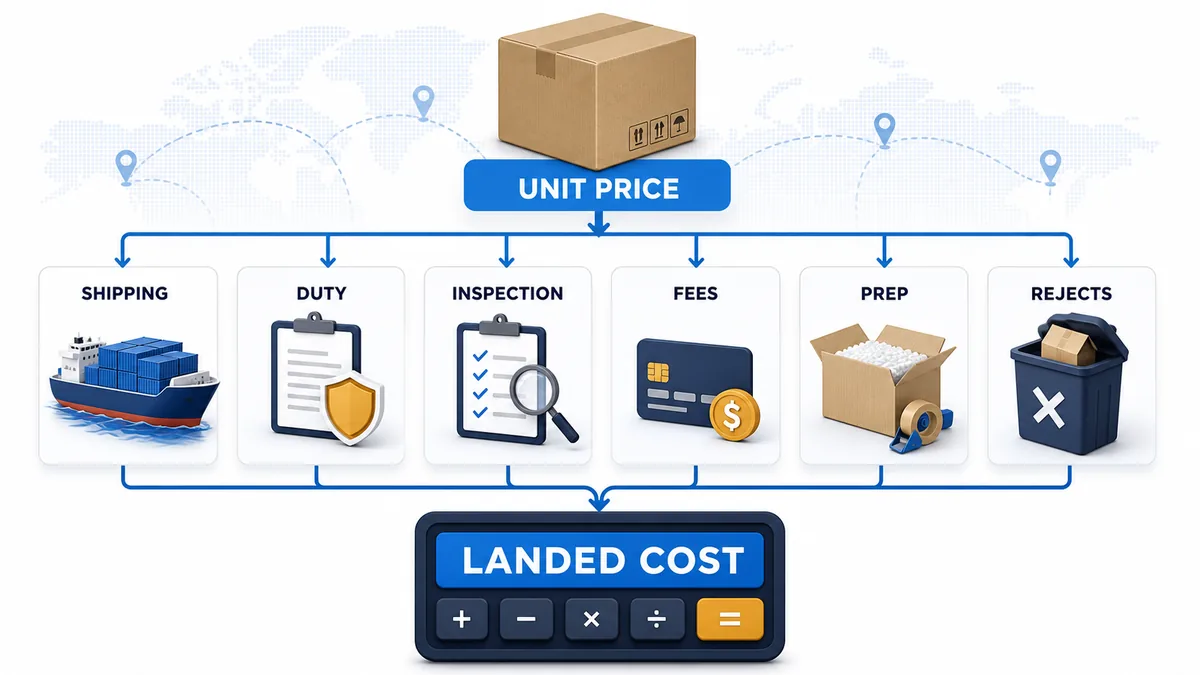
If you are comparing China routes, the broader guide to buying wholesale from China provides additional context. Recheck any time-sensitive figures on that older page before using them in a purchasing decision.
Red flags in vendor lists, DMs, Discords, and “1:1” offers
Social channels can surface real suppliers. They also make it easy to hide the actual business behind screenshots, private groups, disposable accounts, and borrowed product videos.
None of the signals below proves a scam by itself. Several together, especially around identity or payment, are enough to walk away.
- The seller will not provide a legal business name, address, or usable invoice.
- The payment recipient is unrelated and the explanation changes.
- Branded products are offered far below normal wholesale logic with no authorization or inventory trail.
- The seller uses “1:1,” “mirror,” or “same factory” as a substitute for authenticity evidence.
- The offer includes fake receipts, invoice templates, store documents, or advice for bypassing marketplace checks.
- You are pushed to move immediately from a public platform to a private payment method.
- Product photos appear in many unrelated stores, while the seller cannot provide current stock evidence.
- The seller promises guaranteed profit, sell-through, resale value, or platform approval.
- A paid vendor list reveals only another Telegram, WhatsApp, or Discord contact with no business details.
- Liquidation stock has no condition explanation, manifest, freight detail, or return terms.
- Wire instructions change close to payment without an independent confirmation through a known contact.
Wire transfer itself is not proof of fraud. It is common in B2B trade. The risk rises when the beneficiary does not match the documented transaction, the supplier refuses protected options for a first order, or pressure replaces a clear contract.
Free vendor lists are not automatically safer or worse than paid lists. Price and secrecy do not validate the supplier. Use any list as a set of leads, then run the same verification process.
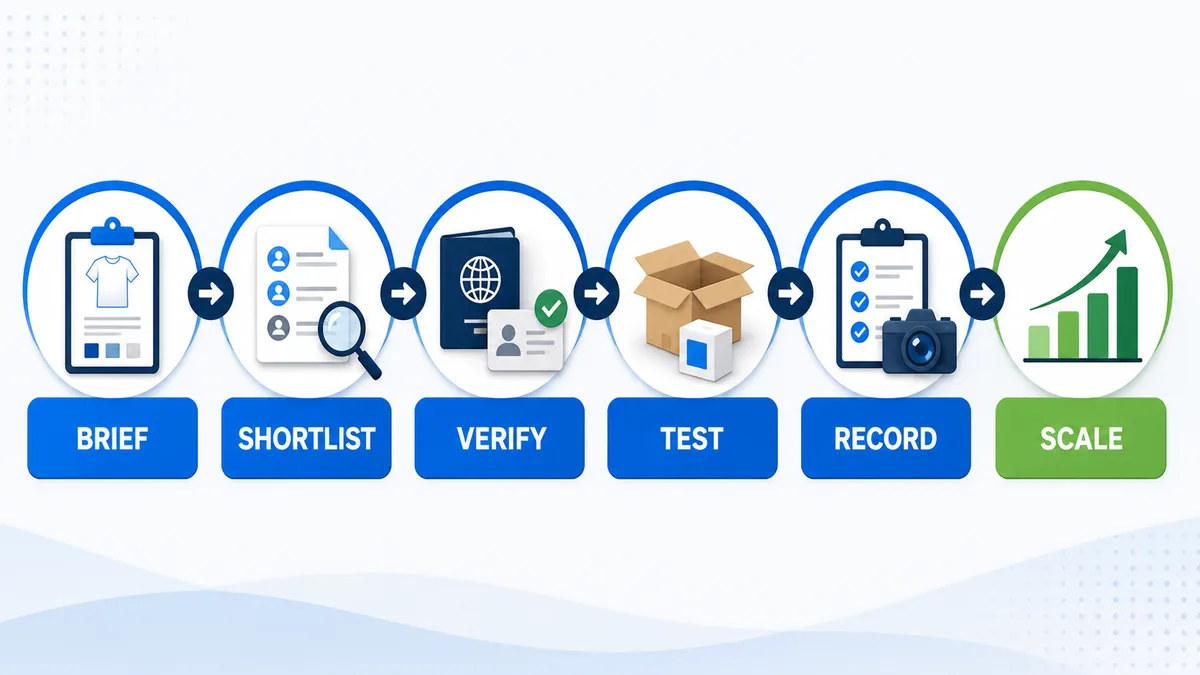
A safer first-order workflow
You do not need twenty vendor links. You need a small number of candidates you can compare under the same conditions.
Step 1: write the brief
Define the product, grade, quantity, packaging, destination, sales channel, required records, and target landed cost. If you cannot describe the order, you cannot assess the quote.
Step 2: shortlist across two sourcing routes
Choose two or three candidates from no more than two models. For example, compare a US wholesaler with a Faire brand, or an Alibaba supplier with a 1688 listing managed through China-side support. This shows whether a low quote comes from the supplier or simply from a different scope.
Step 3: verify identity, product, and documents
Use the Pass, Clarify, Stop scorecard. Resolve the legal entity, payee, inventory evidence, brand rights, sample, written terms, and expected invoice before money moves.
Step 4: test the item and the operation
Order a sample or small trial lot. Inspect the product, count, packaging, paperwork, handling, tracking, and response to any problem. For dropshipping, place a real order to the customer market. For liquidation, test the condition assumptions and processing time.
Step 5: record the result
Calculate effective cost per sellable unit. Record defects, missing units, delivery time, communication, and the work required to make the inventory listable. Memory is generous to a cheap order; a spreadsheet is less forgiving.
Step 6: repeat before scaling
One good shipment can be luck. Increase volume only after the supplier repeats the result and the larger order still fits your cash flow, storage, quality-control, and sales capacity.
When a China sourcing partner makes more sense than another vendor list
A sourcing partner is useful when you have a defined product or supplier lead but lack the China-side access to verify, receive, inspect, consolidate, or export the order. It is less useful when the product itself is still a guess.
Consider support when:
- the supplier mainly operates in Chinese or sells through a domestic platform such as 1688;
- you need comparable quotes against one specification;
- samples or goods must be received and checked in China;
- several domestic parcels need consolidation;
- the order needs custom packaging, labeling, or a pre-shipment inspection;
- the shipping plan depends on actual packed weight, dimensions, destination, and product restrictions.
Fulfillbot’s China sourcing service can help with supplier options, quote comparison, MOQ clarification, samples, quality-control planning, China warehouse receiving, consolidation, and shipping or fulfillment handoff. The scope depends on the product and order. It does not guarantee supplier legitimacy, product compliance, sales, or profit, and Fulfillbot does not help source counterfeit, replica, or IP-infringing products.
If you already know the product and quantity, the China wholesale and bulk-buying service is the more relevant next step. If inventory is already purchased and the problem is storage and order dispatch, review order fulfillment instead.
Choose one route, then prove it
The useful question is not “Who has the secret vendor?” It is “Which sourcing route gives me inventory I can document, afford, inspect, and reorder?”
Pick one or two routes from this guide. Send every candidate the same brief. Verify the company, payee, product, records, and order terms. Test small, calculate the cost of sellable units, and scale only when the result repeats.
If the product, quantity, destination, packaging, and sales channel are already defined, send Fulfillbot a sourcing request. The team can review the China-side sourcing, sample, QC, consolidation, shipping, and fulfillment needs before you commit to a larger order.