Buying wholesale jewelry from China can give you access to broad product ranges, custom manufacturing, private labeling, and flexible supply options. It can also leave you with the wrong alloy, weak clasps, inconsistent plating, or a shipment that costs far more than the unit quote suggested.
The difference is rarely luck. It comes down to the product definition, the supplier checks, and what happens before the balance payment. Most expensive mistakes are already visible by then, if someone has written down what to look for.
This guide shows boutique owners, online sellers, importers, and jewelry brands how to source from China without treating every supplier or material as interchangeable.
Wholesale jewelry from China: the short answer
There is no single “China jewelry wholesale” channel that works for every buyer.
Use a marketplace or stock wholesaler when you need a broad catalog, low commitment, and fast product testing. Use a manufacturer when you have a stable specification, meaningful order volume, and a reason to customize the product. Use a sourcing partner when the order involves multiple suppliers, private packaging, inspections, consolidation, or communication you do not want to manage alone.
The route changes. The order of work does not:
- Define the product and target market.
- Send the same request for quotation, or RFQ, to several qualified suppliers.
- Verify the business and production claims.
- Order samples and score them against written criteria.
- Confirm compliance, labeling, packaging, and import requirements.
- Place a controlled trial order.
- Inspect the production batch before final payment or shipment.
The cheapest quote is useful only if the underlying product is the same. In jewelry, it often is not.
Define the jewelry before you look for a supplier
A weak sourcing request starts with a photo and the sentence, “How much for 500 pieces?” A useful request defines what the jewelry is made of, how it should be finished, and what variation you will accept.
Before you open a marketplace or ask an agent for names, settle the points below.
1. Product category
Specify the exact item: hoop earring, chain necklace, signet ring, charm bracelet, stud set, anklet, brooch, hair accessory, loose charm, or another product. Add dimensions, weight range, closure type, stone size, chain length, and available sizes.
2. Base material
“Metal” is not a specification. Name the grade or composition you expect, such as 304 stainless steel, 316L stainless steel, sterling silver, brass, zinc alloy, titanium, or another defined base.
A supplier’s “925” stamp is not proof of silver content. In the United States, a product described as “Sterling Silver” or “Sterling” should be at least 925 parts per thousand pure silver under the FTC Jewelry Guides. Your purchase specification and verification plan should reflect the claim you intend to make to customers.
3. Surface finish
For plated jewelry, state the plating color, process if known, target thickness, underlayer, protective coating, and restricted-substance requirements. “18K gold plated” describes a color and gold-quality claim, but it does not by itself tell you how thick the layer is or how the product will wear.
Do not use “vermeil” as a loose synonym for gold-plated jewelry. The FTC guide ties the term to a sterling-silver base, gold or gold alloy of at least 10 karat, and a minimum thickness equivalent to 2.5 microns of fine gold.
4. Stones, pearls, and decorative parts
Name whether a stone is natural, laboratory-grown, synthetic, simulated, glass, or cubic zirconia. For pearls, define the type, approximate size, shape, color, surface expectations, drilling, and matching standard. Include glue, prong, bezel, and setting requirements where relevant.
5. Customer-facing claims
List every claim you plan to put on a product page or package: metal grade, nickel-free, hypoallergenic, waterproof, non-tarnish, lead-free, cadmium-free, recycled content, gemstone identity, or country of origin.
Then ask a hard question: what evidence would make that claim defensible for this SKU and this production batch? A generic certificate in a supplier profile is not an answer.
Choose the right sourcing channel
The usual options are a marketplace, a stock wholesaler, a manufacturer, or a sourcing company. Their catalogs can overlap, but their operating models are different.
| Channel | Best fit | Main advantage | Main risk to manage |
|---|---|---|---|
| B2B marketplace | Early product search and supplier discovery | Large selection and easy comparison | Listings, company types, and quality levels vary widely |
| Stock wholesaler or trading company | Small mixed orders and quick assortment tests | Low commitment and many ready-made styles | Less control over production and possible batch changes |
| Manufacturer | Repeat orders, custom specifications, OEM or ODM | Better process control and deeper customization | Higher development effort, MOQs, tooling, and longer setup |
| Sourcing partner | Multi-supplier projects, remote buyers, QC and consolidation | One coordination layer across sourcing, samples, inspection, packaging, and freight | Service scope, fees, and decision rights must be clear |
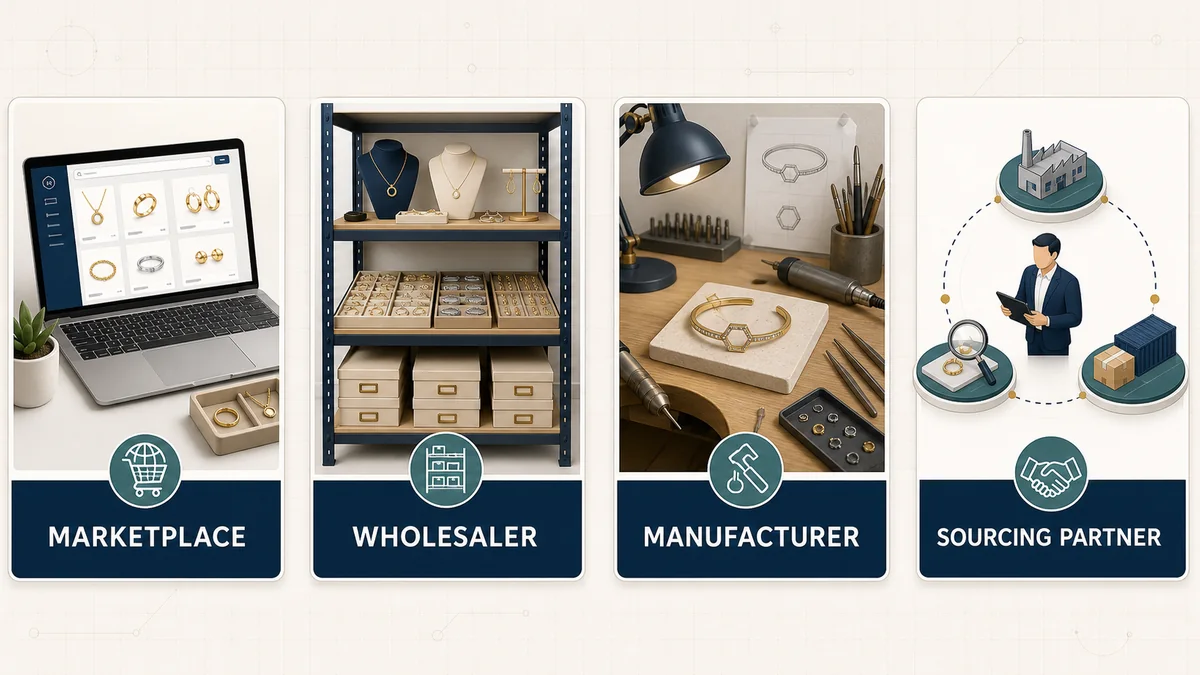
If you are testing ten styles in small quantities, a catalog wholesaler may be more sensible than persuading a factory to customize ten tiny production runs. If one style already sells steadily, a manufacturer may give you better control over dimensions, components, polishing, plating, and packaging.
For a project that spans several factories, you can use a China sourcing and supplier coordination service to collect quotes, arrange samples, coordinate quality checks, and prepare a shipping handoff. Keep the product specification and acceptance decision under your control, even when someone else manages the communication.
If branding matters, separate the product decision from the packaging decision. Private label jewelry and product branding may cover the product, while a custom jewelry packaging brief should define the box, pouch, insert, barcode, warning, care card, and outer-carton marks.
Understand the main jewelry sourcing hubs
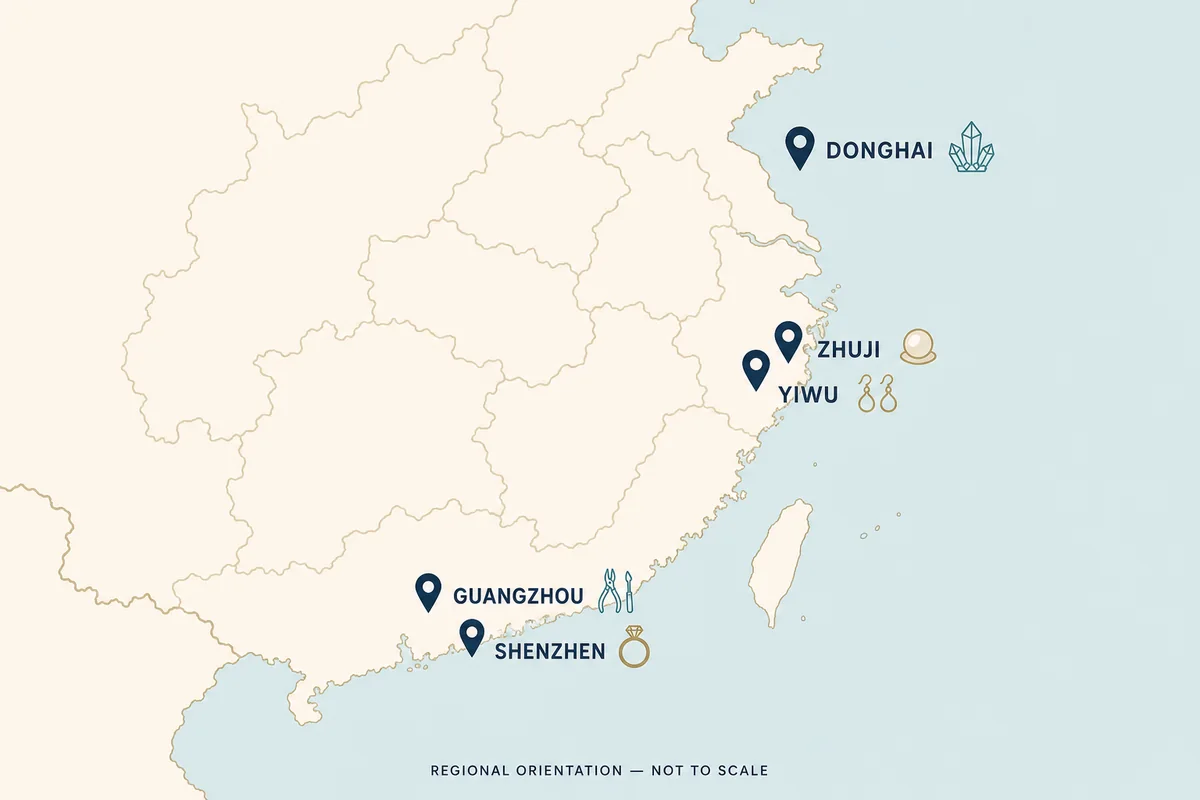
China’s jewelry supply chain is spread across specialized clusters. Location is a useful clue, not a guarantee of capability.
- Yiwu is commonly used for broad fashion-accessory assortments, ready-made products, components, and small mixed orders.
- Guangzhou and the wider Pearl River Delta offer dense manufacturing and wholesale networks across fashion jewelry, stainless steel, plated items, components, and packaging.
- Shenzhen is associated with fine-jewelry production, precious-metal processing, design, and technology-intensive manufacturing.
- Zhuji is well known for freshwater pearls and related processing and trading.
- Donghai is associated with crystals and gemstone trading.
These descriptions are directional. They should help you decide where to search, not persuade you that every supplier in a cluster is qualified. A third-party overview such as the JingSourcing China jewelry market guide can help with orientation, but hard numbers and supplier claims still need independent checking.
Vet a China jewelry supplier before you pay
A polished catalog tells you what a supplier wants to sell. That is all. It does not prove who will make the goods or whether the next batch will match the sample.
Start with business identity. Ask for the supplier’s registered Chinese company name, unified social credit code, registered address, invoice entity, bank beneficiary, and business license. The company on the contract, the company receiving payment, and the company that supposedly operates the factory should make sense together.
Then verify operating role:
- Does the company own a factory, subcontract production, or trade products from several factories?
- Which steps happen in-house: casting, stamping, machining, polishing, stone setting, plating, assembly, packing?
- Which material grades and product categories are routine for that facility?
- Can the supplier show recent, unedited production video connected to your product?
- Can it trace raw materials, plating batches, and inspection records to an order?
- Will it accept a sample approval standard and pre-shipment inspection?
Being a trading company is not automatically bad. A good trading company may offer wider selection, lower mixed-order friction, and stronger coordination. The problem is a company pretending to control a process it does not control.
Check documents at the SKU level
When a supplier sends a test report, read it instead of counting logos on the first page. Confirm:
- the tested product or material matches your SKU;
- the report names the relevant material and color;
- the test method and limits match your destination market and claim;
- the laboratory, report number, and date can be verified;
- the applicant is connected to the supplier or factory;
- the report covers the component that creates the risk;
- the evidence is recent enough for the process and can be related to the production batch.
A report for one silver-colored earring does not automatically cover every gold-colored necklace in a catalog.
Protect the commercial basics
Use a written purchase order or contract that identifies the product revision, approved sample, acceptable tolerances, inspection method, packaging, delivery term, payment milestones, defect remedy, intellectual-property responsibilities, and governing terms.
Avoid copying branded logos, recognizable protected designs, or “inspired” emblems. A supplier’s willingness to make an item does not give you the right to import or sell it.
Send an RFQ suppliers can actually quote
Send the same structured RFQ to three to five plausible suppliers. If each supplier receives different information, the quotes will not be comparable.
Include:
| RFQ field | What to specify |
|---|---|
| Product | Drawing, photos, dimensions, sizes, weight range, closure, components |
| Material | Exact base metal, stone or pearl description, prohibited substitutions |
| Finish | Color, plating process, target thickness if required, coating, polish |
| Quantity | Units per SKU, number of SKUs, reorder scenario |
| Branding | Logo location, method, artwork, private label requirements |
| Packaging | Unit pouch or box, insert, barcode, warning, carton marks |
| Quality | Critical dimensions, workmanship limits, defect categories, AQL or another sampling plan |
| Compliance | Destination market, intended age group, claims, required tests and documents |
| Commercial | EXW/FOB or other requested term, tooling, sample fee, MOQ, lead time, payment terms |
| Shipping data | Unit weight, packed dimensions, units per carton, carton weight and dimensions |
Ask suppliers to separate one-time charges from unit costs. Tooling, molds, artwork plates, sample fees, testing, packaging setup, and domestic transport can distort the apparent unit price.
Also ask for quote validity and a breakdown of optional features. If a thicker chain, better clasp, longer plating cycle, or branded box changes the price, you want to see that before the sample, not after approving the order.
Compare landed cost, not the quoted unit price
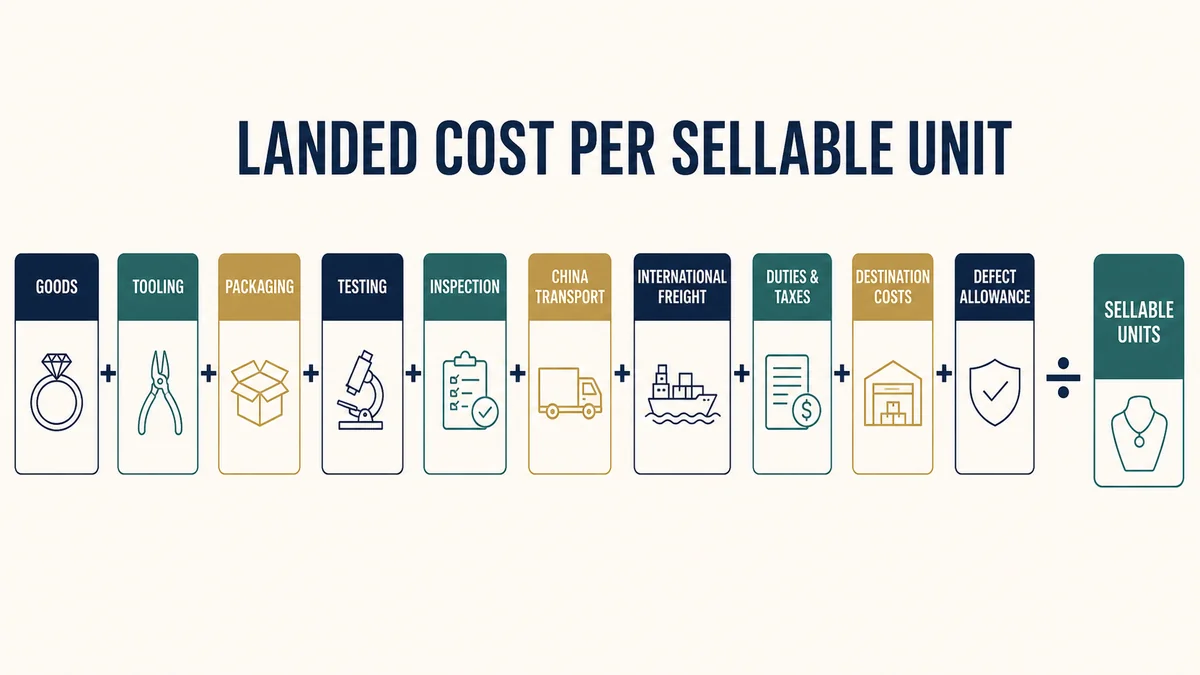
The lowest EXW price can still produce the highest landed cost. Heavy packaging, scattered suppliers, rework, testing, defects, and destination handling have an annoying habit of appearing after a buyer has mentally committed to the cheap quote.
Use this working formula:
Landed cost per sellable unit = (goods + tooling + packaging + testing + inspection + China transport + international freight + insurance + duties/taxes + brokerage + destination handling + expected rework/defects) ÷ sellable units
Build three scenarios instead of one:
- Expected: the most likely quantity, freight mode, and defect allowance.
- Best case: smooth production, efficient consolidation, and full sellable yield.
- Stress case: a delay, extra inspection, higher freight, or a realistic portion of unsellable units.
For U.S. imports, classification depends on the article’s material and construction. Fine jewelry, imitation jewelry, precious metal, base metal, stones, and combinations can fall under different headings. Check the current U.S. Harmonized Tariff Schedule and ask a licensed customs broker when the classification or additional duties are uncertain. Do not use a single “jewelry duty rate” copied from a blog.
Order samples, then inspect the batch
One perfect sample proves that one acceptable sample can be made. Nothing more.
Order samples from more than one supplier when the product is commercially important. If possible, request examples from normal production rather than a specially hand-finished showpiece. Record the sample cost, revision, date, and supplier.
Score each sample on the same sheet:
- dimensions and weight;
- base-material evidence;
- color and finish consistency;
- plating appearance and specified thickness evidence;
- edges, burrs, solder, polishing, and scratches;
- clasp, hinge, pin, chain, and connection function;
- stone or pearl matching and setting security;
- logo position and legibility;
- packaging fit and transit protection;
- odor, residue, sharp points, or other obvious safety issues;
- test results required for the destination market and intended user.
Keep one signed or sealed approved sample as the golden sample. Photograph it under controlled light and record key dimensions. Your purchase order should refer to the approved revision.
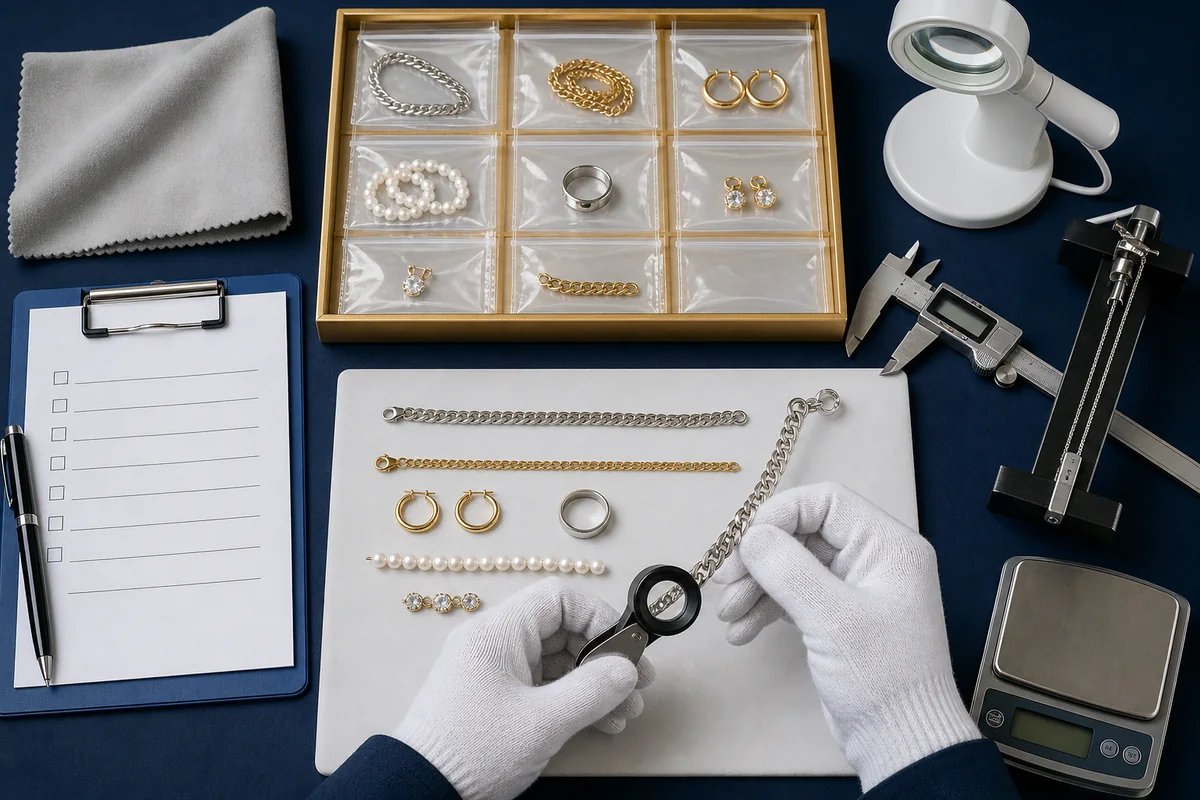
Before final payment or shipment, inspect the production batch. The checklist should match the purchase specification, not a generic jewelry form. Define critical, major, and minor defects before the inspector opens a carton.
Typical checks include:
- SKU, quantity, color, size, and assortment;
- unit dimensions, weight, and tolerances;
- workmanship under suitable lighting and magnification;
- clasp and connection function;
- stones, pearls, settings, glue, solder, and symmetry;
- markings, labels, barcodes, warnings, and inserts;
- unit packaging and carton strength;
- comparison with the approved sample;
- selected performance or laboratory tests where risk justifies them.
Visual inspection cannot confirm a metal grade, plating thickness, lead content, nickel release, or gemstone identity. Use an appropriate laboratory and sampling plan when those facts support a legal requirement or customer-facing claim.
Handle U.S. compliance before production
Compliance is not a document you request after the goods are packed. It begins with the intended customer, product claim, material, and destination.
Marketing and material claims
The FTC Jewelry Guides apply to representations about jewelry at different levels of trade. Claims about metal content, gemstone identity, treatment, durability, origin, and other material attributes should not be deceptive. Make sure the product, product page, invoice, hangtag, and packaging use consistent language.
Adult and children’s jewelry
The CPSC Jewelry FAQ explains that there is no single mandatory federal requirement written specifically for all adult jewelry, while also pointing to voluntary standards for adult and children’s jewelry. That is not the same as saying adult jewelry is unregulated. Other federal and state rules, marketplace policies, material claims, and general consumer-product obligations can still apply.
Children’s jewelry requires a separate risk review. Accessible components in children’s products are generally subject to a 100 ppm total-lead limit, while paint and similar surface coatings are subject to a 90 ppm lead limit, according to the CPSC Total Lead Content FAQ. Applicable children’s products generally require testing by a CPSC-accepted third-party laboratory and a Children’s Product Certificate.
CPSC’s current import guidance also says that, from July 8, 2026, importers of most regulated consumer products must electronically file certificate data. Scope depends on the product and rule, so confirm the current testing, certification, and eFiling requirements for your shipment.
Country of origin and import records
Imported goods generally need clear English country-of-origin marking that reaches the ultimate purchaser, subject to product-specific exceptions and rules. A recent CBP ruling on jewelry origin marking shows why the product, packaging, legibility, and specific facts matter.
Keep the commercial invoice, packing list, purchase order, material and test records, country-of-origin information, and customs classification aligned. If a product or claim creates doubt, speak with a qualified laboratory, customs broker, or attorney before production.
This section is educational information, not legal or customs advice.
Move from trial order to bulk production
Your first commercial order should test the operating system as much as the product. Choose a quantity you can afford to inspect, rework, delay, or replace without damaging the business.
Before production begins:
- Freeze the product specification and artwork revision.
- Approve and retain the golden sample.
- Confirm the bill of materials and allowed substitutions.
- Approve packaging, labels, barcodes, and carton marks.
- Confirm test and inspection responsibilities.
- Set production milestones and the final inspection window.
- Tie the remaining payment to agreed commercial terms and evidence.
For repeat orders, review change control. Ask whether any component supplier, material, plating factory, process, color standard, packaging, or production site has changed. “Same as last order” is not a specification.
If you are ready to buy wholesale inventory from China, keep all product revisions and acceptance criteria attached to the order rather than scattered through chat messages.
Plan shipping, consolidation, and inventory
Jewelry is small, but it is not automatically simple to ship. Dense metal items can be heavy for their carton size. Gift boxes can create far more volume than the products. Batteries in lighted packaging, magnets, liquids, treated wood, or unusual materials can add restrictions.
Ask each supplier for packed unit dimensions, units per carton, carton dimensions, gross weight, pickup address, ready date, and export capability. Use those numbers to compare shipping options.
If several suppliers are involved, consolidation can reduce duplicated international shipments and give you one point for carton checks, relabeling, kitting, or packaging completion. It can also add handling time, storage fees, and another handoff, so model it honestly.
A freight-forwarding plan for shipments from China should identify the pickup terms, export party, consolidation location, freight mode, insurance, customs responsibilities, destination charges, and delivery point.
After arrival, decide whether the stock moves to your own location, a fulfillment center, a marketplace warehouse, or a third-party facility. If you need to store and distribute wholesale inventory, prepare SKU labels, carton data, receiving requirements, and replenishment rules before the shipment lands.
Watch for these supplier red flags
Walk away or slow down when several of these appear together:
- the beneficiary account changes without a documented reason;
- the registered company, contract entity, and payment recipient do not match;
- every technical question receives “no problem” but no measurable answer;
- the supplier refuses samples, batch inspection, or reasonable product identification;
- material claims change between the listing, quote, invoice, and report;
- a certificate cannot be traced to the SKU, laboratory, date, or applicant;
- the quote omits tooling, packaging, testing, domestic freight, or other known charges;
- the supplier pressures you to pay in full before basic verification;
- product photos appear copied or the company cannot show the quoted item in current video;
- the supplier offers branded copies or encourages false declarations;
- a very low quote depends on an unspecified material substitution;
- defects are discussed only after production, with no written remedy.
A single messy email does not prove fraud. A pattern of unverifiable identity, vague specifications, hidden cost, and resistance to inspection is a business signal.
A practical sourcing workflow
Put it all together and the order of work looks like this:
- Choose the product category and destination market.
- Write the material, finish, construction, packaging, and claim specification.
- Select the right sourcing channel.
- Shortlist several suppliers and verify their identities and roles.
- Send a controlled RFQ and compare like with like.
- Order and score samples.
- Confirm testing, labeling, classification, and import requirements.
- Calculate landed cost per sellable unit.
- Place a manageable trial order.
- Inspect the batch against the approved sample and specification.
- Arrange freight, customs, receiving, and inventory.
- Record changes before every reorder.
China has a broad jewelry supply base. That is useful, but it also makes “find a cheap supplier” a poor objective. Write a product definition that a capable supplier can follow, then build the checks that tell you whether the factory followed it. The supplier search gets much easier once those two things exist.
Frequently asked questions
Where can I buy wholesale jewelry in China?
You can buy through B2B marketplaces, wholesale markets, catalog wholesalers, trading companies, specialized manufacturers, or sourcing companies. Pick the channel based on order size, customization, number of SKUs, quality-control needs, and how much coordination you can manage.
Is jewelry from China good quality?
It can range from disposable fashion jewelry to well-made fine jewelry. Country of manufacture does not settle the question. Material specification, process control, sample approval, testing, and batch inspection do.
How can I verify 316L stainless steel or 925 silver?
Do not rely only on a stamp, listing, or supplier statement. Define the grade in the purchase specification, review traceable material or test documentation, and use an appropriate laboratory method when the grade supports a legal or marketing claim.
What is a normal MOQ for wholesale jewelry from China?
There is no useful universal MOQ. Ready-stock products may allow small mixed orders, while custom casting, molds, plating colors, stone settings, or branded packaging may require higher quantities. Ask for the MOQ by SKU, color, size, and customization level.
Should I choose Yiwu or Guangzhou for jewelry sourcing?
Yiwu is often practical for broad ready-made fashion assortments and mixed purchasing. Guangzhou and the surrounding manufacturing network can suit deeper factory sourcing and customization across several jewelry categories. The right choice depends on the product and supplier, not the city name alone.
Do I need a sourcing agent?
Not for every order. Direct sourcing may work when you have one clear product, a capable supplier, and enough time to manage verification and logistics. A sourcing partner can be useful when you need supplier discovery, multi-factory coordination, samples, QC, consolidation, private packaging, or a local communication layer.
How much import duty will I pay on jewelry from China?
It depends on the product’s current tariff classification, material, construction, country of origin, and any applicable additional duties or trade measures. Check the current HTS and confirm uncertain classifications with a customs broker before relying on a landed-cost estimate.
What should I inspect before paying the final balance?
Check quantity, assortment, dimensions, weight, workmanship, clasps and connections, stones and settings, markings, barcodes, packaging, carton condition, and conformity with the approved sample. Add material, chemical, or performance testing when visual inspection cannot verify a required fact.