The cheapest party-supply quote can produce the most expensive order.
That sounds backward until a “matching” collection arrives in three shades of blue, half the favor kits are missing a component, or a seasonal shipment lands after the event has passed. Add an invalid test report, emergency air freight, relabeling, and unsold stock, and the low unit price stops looking clever.
This guide is for retailers, ecommerce sellers, brands, importers, and event-supply businesses buying for resale or repeat use. It is not a shopping list for one birthday party. The goal is to help you define a sellable assortment, choose the right sourcing route, compare like-for-like quotations, approve samples, check compliance evidence, and calculate the real landed cost of bulk party supplies.
The short version: define the order before you hunt for a supplier. A supplier cannot quote accurately when the request is little more than a product photo and “best price?”
Wholesale Party Supplies Are Not One Product Category
“Party supplies” is a retail shelf, not a manufacturing category. A single collection can contain latex balloons, coated paper plates, printed napkins, foil banners, small plastic toys, battery-operated lights, and custom packaging. Those items use different materials, production lines, quality checks, and regulatory paths.
Treating them as one product creates two problems. First, you may assume one supplier makes everything when it actually outsources most of the order. Second, you may ask for one generic certificate even though the evidence required for a toy, a food-contact cup, and an LED accessory is not the same.
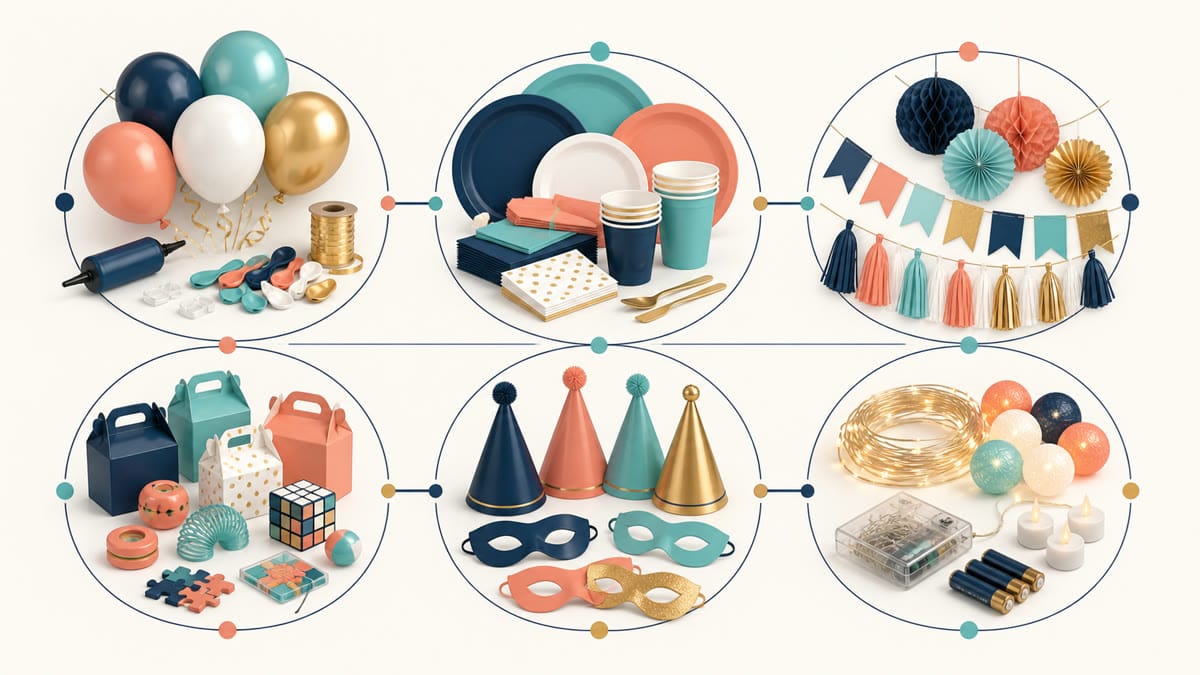
Balloons and balloon accessories
For latex and foil balloons, specify material, inflated and uninflated size, finish, color reference, print method, print position, valve type, inflation method, pack count, and packaging. Quality checks may include inflation, leakage, valve performance, print alignment, color consistency, and pack accuracy. Pumps, weights, ribbons, and garland strips should be listed as separate SKUs or clearly defined kit components.
Disposable tableware and food-contact items
Paper plates, cups, napkins, straws, cutlery, and table covers need more than a diameter and a color. Define substrate, weight or thickness, coating, print coverage, intended use, pack count, and performance expectations. A supplier saying “food grade” is not a substitute for identifying the materials, substances, and intended food-contact use that apply to the actual product.
Decorations, favors, wearables, and lights
Banners, backdrops, tissue decorations, confetti, and photo props need finished dimensions, assembly instructions, hanging methods, adhesives, and color tolerances. Party favors and games may raise age-grading, small-parts, coating, and toy-safety questions. Hats, masks, wigs, and other wearables add fit, skin-contact, sharp-edge, and labeling concerns. LED strings and battery products require their own functional, battery-compartment, instruction, transport, and market-specific review.
The awkward category is the coordinated party kit. It looks like one SKU to the customer, but it may be ten products from several factories. Your specification must cover both individual components and the finished kit: color match, quantities, warnings, packaging order, and what happens if one component fails inspection.
Choose the Buying Route Before You Choose a Supplier
There is no universally best place to buy wholesale party supplies. The right route depends on how many SKUs you need, how much customization you want, how quickly you need stock, what evidence the products require, and how much coordination you can handle.
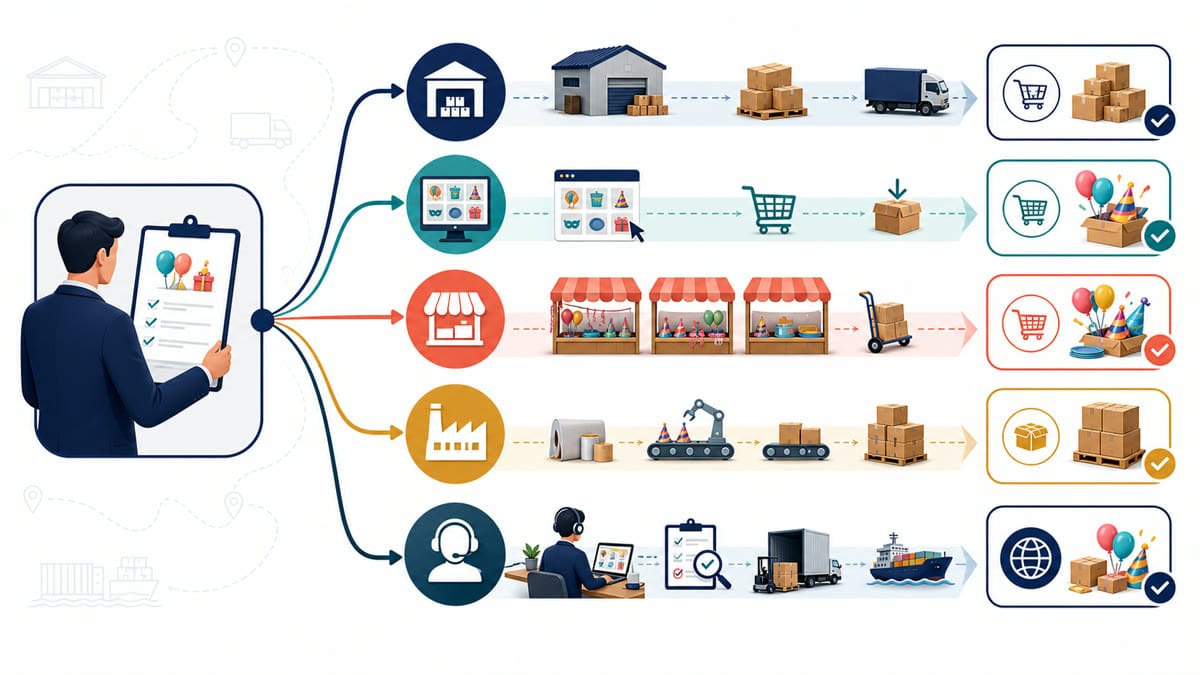
Domestic distributors
Domestic distributors make sense when speed, low operational burden, and easy replenishment matter more than deep customization. You may pay more per unit, but you avoid much of the overseas supplier, testing, freight, customs, and consolidation work. This can be the sensible choice for small test orders or last-minute replenishment.
B2B marketplaces and Yiwu wholesalers
Marketplaces are useful for discovery and quote comparison. They are not a substitute for verification. Two listings that look identical may represent different materials, pack counts, factories, or levels of quality control.
Yiwu wholesalers are useful when the order contains many small-commodity SKUs and no single factory covers the full assortment. The tradeoff is coordination: more suppliers, more samples, more minimums, more color-matching risk, and more work consolidating cartons.
Direct factories and sourcing agents
A direct factory can be the right choice when volume, specifications, and customization justify a production relationship. But “direct” does not automatically mean cheaper after setup, testing, inspection, freight, and management time.
A sourcing agent becomes useful when the order spans several product families or when you want help with supplier discovery, quotation comparison, samples, private-label packaging, inspection, consolidation, and the handoff to freight or fulfillment. Fulfillbot’s China sourcing service follows that broader coordination model. The decision should still be based on the work you need, not the job title on a website.
Build a Sellable Assortment Before Requesting Quotes
Do not copy a wholesaler’s entire catalog into your first purchase order. A wide catalog looks impressive until your cash is trapped in twenty shades, twelve themes, and products that customers admire but do not buy.
Start with three buckets:
- Evergreen basics: solid-color balloons, neutral tableware, generic banners, candles, serving items, and practical event supplies that can sell across occasions.
- Seasonal or event-driven stock: graduation, Halloween, New Year, baby shower, wedding, or birthday collections with a fixed shelf window.
- Controlled tests: a small number of new themes, formats, or price points with a clear reorder or stop rule.
Then look at the customer’s full job. Party planners repeatedly mention unglamorous essentials such as extra cups, plates, water, ice, waste bags, and cleanup supplies. A catalog built only for photographs can miss the items that solve problems during the event.
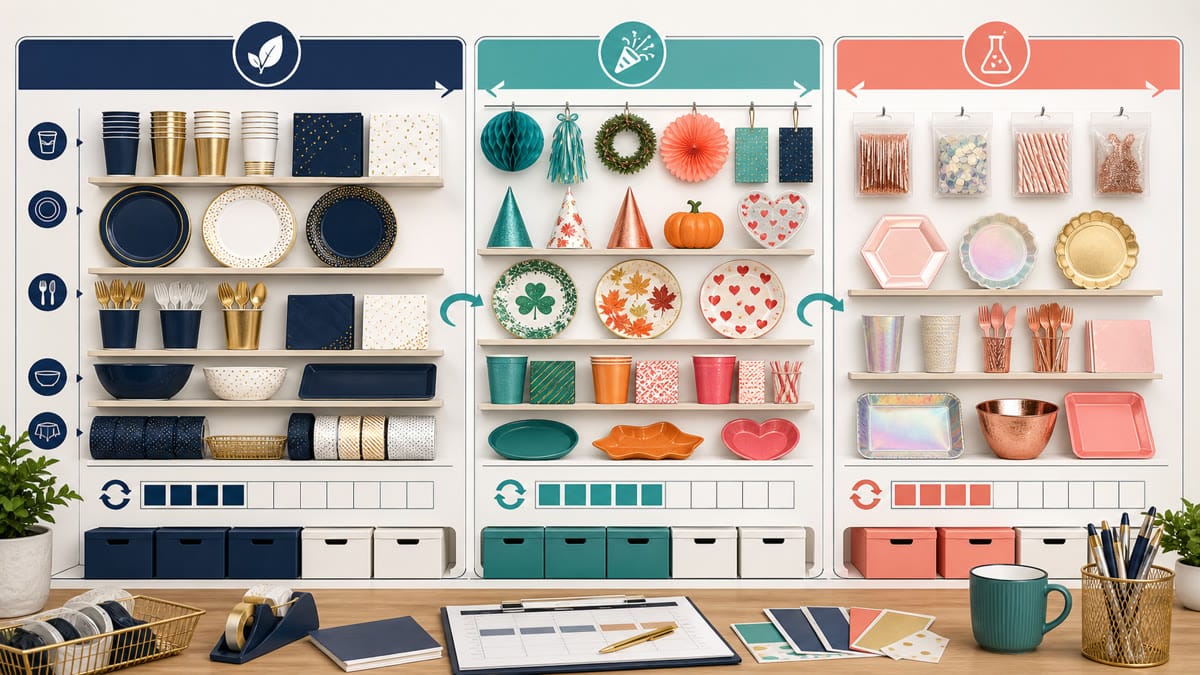
Organize the range by occasion, theme, color, and product family, but do not confuse a popular character with artwork you are free to reproduce. Generic themes such as stars, rainbows, sports shapes, or color stories are different from protected names, logos, and characters. Check ownership and authorization before requesting artwork or approving samples.
Once the assortment is limited and intentional, you can plan a bulk purchase from China without turning the first shipment into a warehouse full of guesses.
Create a Party Supplies RFQ That Produces Comparable Quotes
A usable request for quotation gives every supplier the same target. If Supplier A quotes a thin plate in a 10-pack and Supplier B quotes a heavier plate in a 20-pack, their unit prices tell you almost nothing.
For every SKU, include:
- Product name and unique SKU code
- Reference photo or drawing, marked as visual reference only
- Finished dimensions and acceptable tolerance
- Material, grade, weight, thickness, coating, or finish
- Color standard, such as a Pantone reference or approved physical swatch
- Print method, artwork file, print area, and number of colors
- Units per retail pack, packs per carton, and required kit components
- Barcode, insert, warning, language, country-of-origin, and carton-mark space
- Quantity scenarios, not just one target quantity
- Sales market and intended user or age group
- Required evidence, sample type, and acceptance tests
- Ship-to location, trade term to be quoted, and required shelf date
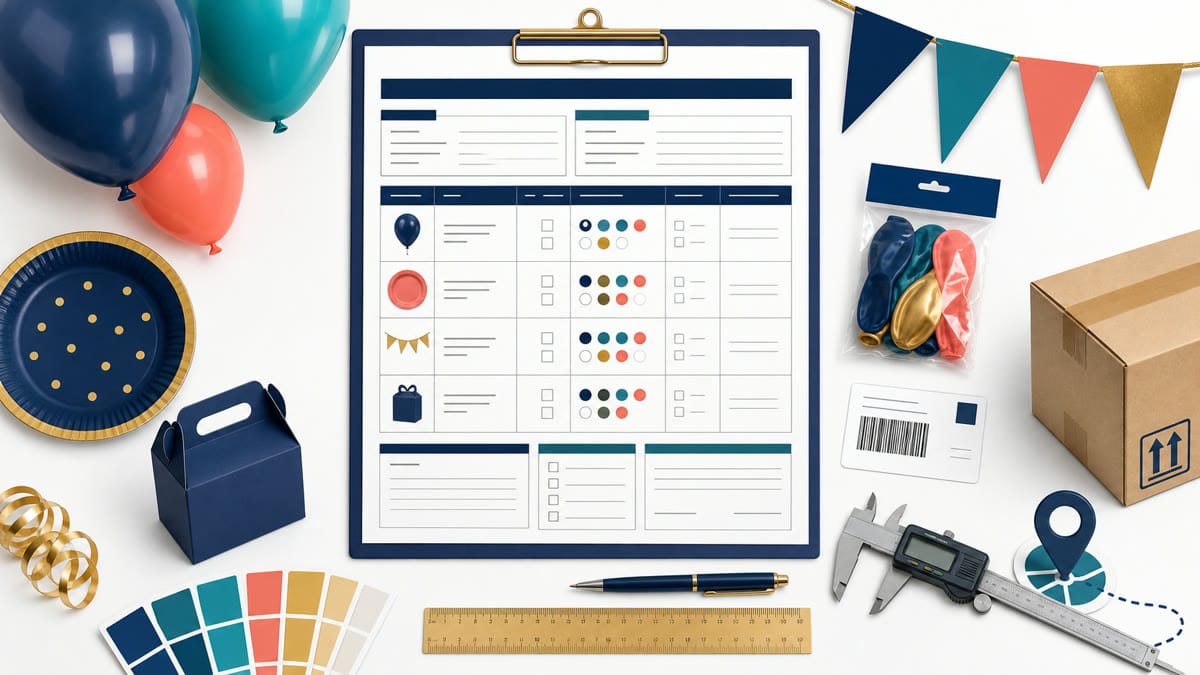
Category details matter. For balloons, define size before and after inflation, finish, valve, and leakage test. For tableware, state substrate, thickness, coating, print, and intended food use. For decorations, include finished size, assembly, hanging method, adhesives, and every component in the pack. For favors or toys, include age grading, materials, small parts, functions, battery access, labels, and test-report needs.
If the order needs branded boxes, inserts, tags, or printed retail packs, freeze the dieline, artwork version, print colors, barcode data, and warning space. A private-label packaging request should be tied to the exact SKU and revision, not sent as a separate “add our logo” message after production starts.
Verify What the Supplier Actually Makes and Controls
A party-supply collection can make a trading company look like a factory because the showroom contains hundreds of products. That is not proof that the company makes them.
Ask which categories and processes are in-house. Which are subcontracted? Who owns the printing equipment? Where will final assembly and packing occur? Which company appears on the quotation, purchase order, invoice, test report, and business license? If those names or addresses differ, get the relationship explained in writing.
Export experience is helpful, but it is not compliance proof. Neither is a folder full of old certificates. Match every report to the exact product, material, tested sample, standard version, laboratory, applicant, factory, and date. A report for a plain paper cup may not support a differently coated, differently printed cup. A test for one toy does not automatically cover every favor in a kit.
Keep specifications, revisions, approvals, subcontracting responsibilities, and deadlines in one controlled record. Messaging history is useful evidence, but it is a terrible bill of materials.
Approve Samples With a Category-Specific Scorecard
“Sample approved” is too vague. Approved against what?
A useful scorecard lists the characteristic, test method, tolerance, result, photo reference, and disposition. Start with universal checks: dimensions, count, color, print, odor, workmanship, labels, retail packaging, and carton information. Then add category-specific checks.
For balloons, check inflation, leakage, valve performance, print placement, color, breakage, and pack count. For tableware, check size, stiffness, print rub, odor, pack hygiene, and performance under the intended use. For decorations, assemble and hang the product rather than inspecting it flat on a table. For toys and favors, check function, accessible parts, edges, age labels, and battery access where relevant. For a collection, lay every SKU together and inspect color matching and kit completeness.
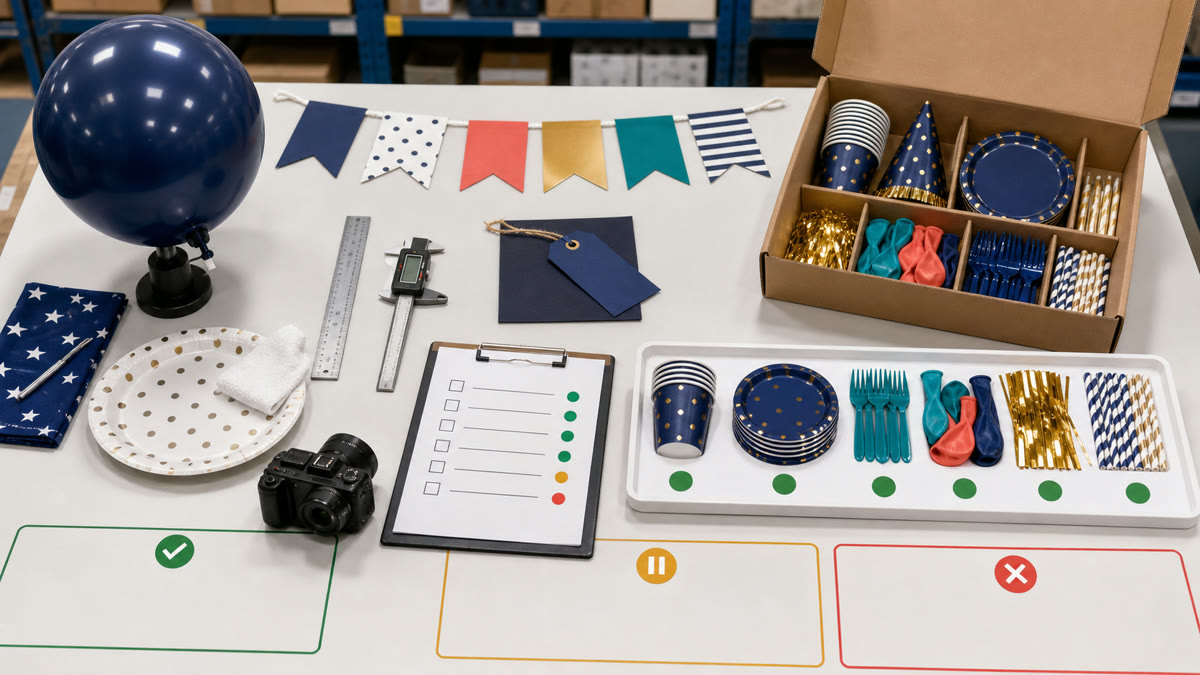
Label and retain the approved sample. Record its revision and use it as the physical production reference. Photos help, but they cannot reliably show thickness, odor, stiffness, color under different light, or whether a component feels flimsy.
Match Compliance Evidence to Each Product and Target Market
There is no universal “party supplies certificate” for the United States. Classification depends on what the product is, who it is intended for, how it functions, what it touches, and how it is marketed.
For children’s toys intended primarily for ages 12 and under, the U.S. Consumer Product Safety Commission says the applicable requirements must be identified, third-party testing must be performed by a CPSC-accepted laboratory where required, and the domestic manufacturer or importer must certify the product in a Children’s Product Certificate. The current mandatory toy standard is ASTM F963 as incorporated into 16 CFR part 1250, but different parts of the standard apply to different toys. There is no one-size-fits-all test plan. See the CPSC toy-safety guidance.
The CPC must identify the covered product and applicable rules, along with the certifier, record contact, manufacture information, testing information, and accepted laboratory where applicable. For overseas production, the U.S. importer carries the certification responsibility. Since July 8, 2026, importers of most regulated consumer products must also electronically file certificate data with U.S. Customs and Border Protection under the CPSC’s eFiling rules. Check the current CPSC CPC guidance for the exact process.
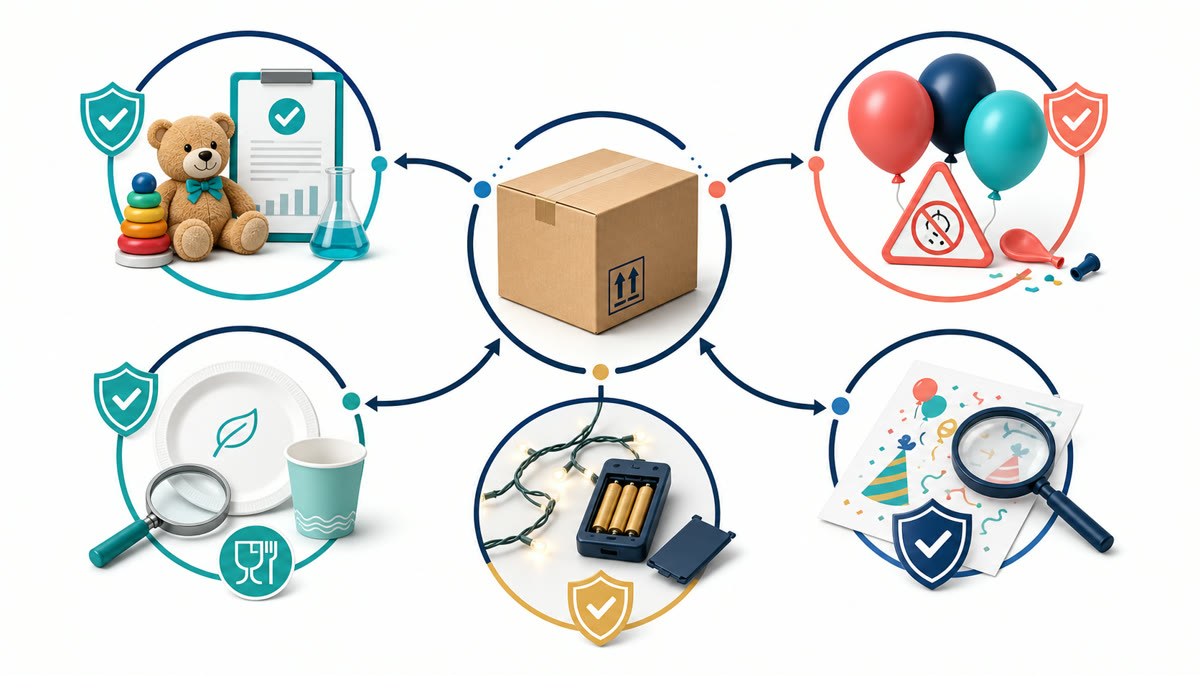
Small-parts rules also depend on age and product characteristics. CPSC notes that certain toys and games containing small parts, latex balloons, small balls, or marbles require choking-hazard labeling. Marketing and stated age matter; changing the age label does not magically change how a product is recognized or used. Review the CPSC small-parts and labeling FAQ.
Disposable plates, cups, coatings, inks, and adhesives raise a different question. FDA treats substances that come into contact with food as food-contact substances, and a use may require a specific authorization. Do not accept “food grade” as the entire evidence file. Identify each material and intended use, then check the relevant FDA food-contact information.
Battery and LED items need product-specific review before you order testing. Bundled kits need review as marketed, not merely as isolated components. Finally, verify your right to use brand names, logos, characters, and protected artwork. The USPTO trademark basics are a starting point, not a replacement for legal advice.
Compare Total Landed Cost, Not Just Unit Price
The factory price is only one line in the calculation. Build a landed-cost model that includes:
Product cost + setup or tooling + printing + packaging + testing + inspection + inland transport + international freight + insurance + duty and fees + brokerage + receiving + storage + damage or defect allowance + fulfillment.
Separate one-time costs from per-unit costs. Run more than one quantity scenario. A larger order may reduce the factory price while increasing storage, cash exposure, and the risk of missing the season with leftover stock.
Carton dimensions deserve attention. Party decorations and tableware can be light but bulky, so dimensional weight and container space can matter more than net product weight. If several SKUs share a shipment or test, allocate those costs consistently rather than burying them in a convenient product.
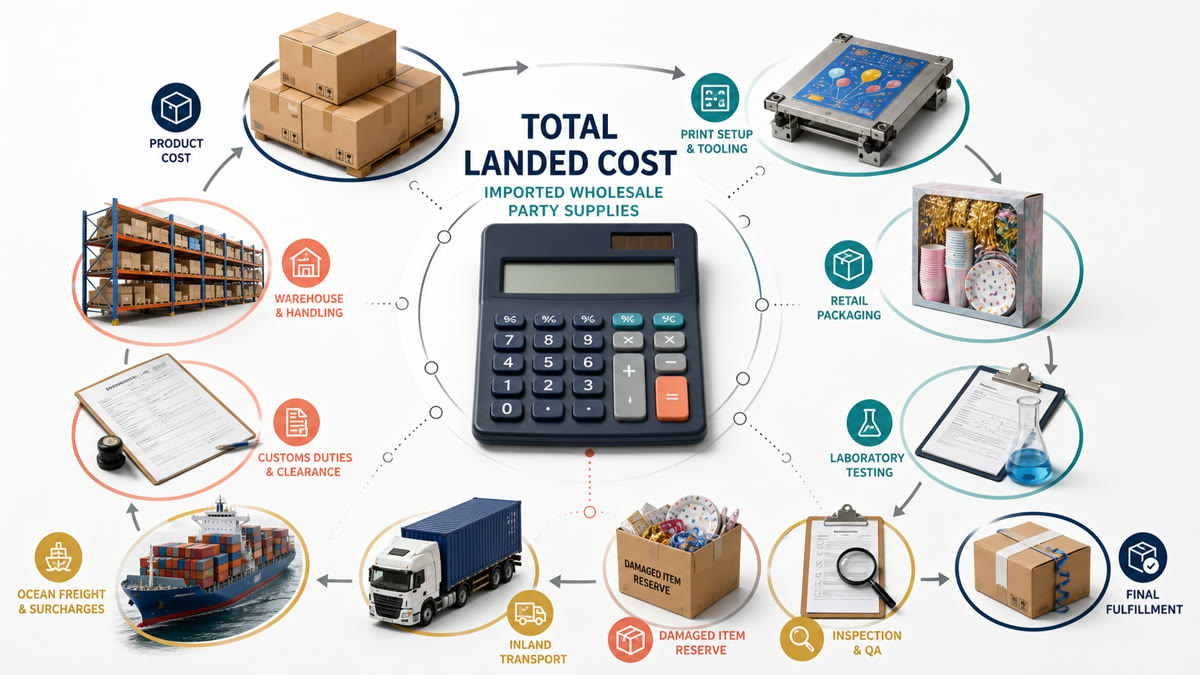
Import classification and duty depend on the specific SKU, material, construction, and use. There is no single tariff rate for party supplies. Search the current U.S. Harmonized Tariff Schedule and confirm uncertain classifications with a customs broker. For transport scenarios, compare current freight-forwarding options from China using actual carton data.
The most honest comparison may be hybrid: import stable, repeatable products in bulk and buy uncertain or urgent products domestically. A slightly higher purchase price can be cheaper than air-freighting the wrong inventory to rescue a missed date.
Plan Backward From the Shelf Date
Seasonal inventory has two delivery dates. The first is the day cartons arrive. The second is the day the stock is received, checked, labeled, distributed, listed, and ready to sell. The second date is the one that matters.
Start there and plan backward through receiving, customs, freight, inspection, production, pre-production approval, artwork, samples, quotation, and supplier selection. Use the lead times quoted for your actual products and route. Do not borrow a generic online timeline and pretend it applies to every factory, holiday, port, or test plan.
Build decision gates into the calendar:
- Last date to approve a sample without changing the shelf date
- Last date to ship by sea
- Point at which a split sea-and-air shipment is still economical
- Stop date after which the order should be reduced, changed, or cancelled
- Reorder point for evergreen stock
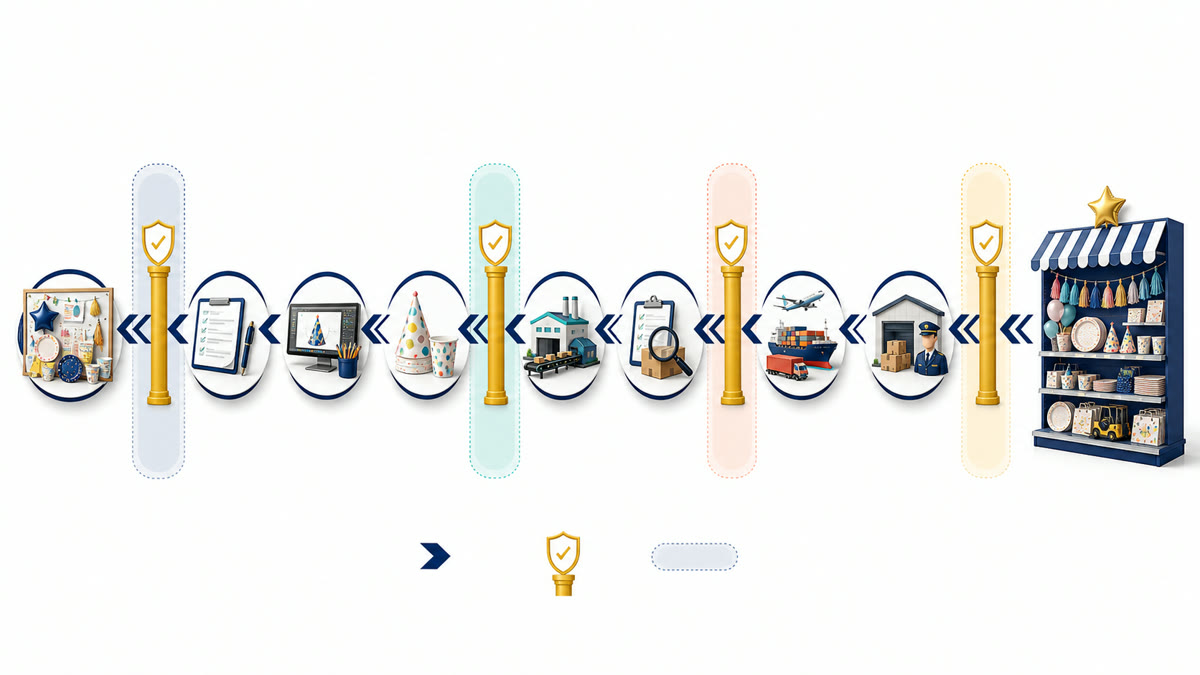
For evergreen products, staged inventory can reduce the temptation to overbuy. Warehousing and scheduled replenishment may help if the sales channel needs smaller releases rather than one large delivery. Fulfillbot offers warehousing and distribution as part of that post-production flow.
Control Production, Inspection, Consolidation, and Delivery
After sample approval, turn the specification into a controlled purchase order. Freeze the artwork version, bill of materials, pack count, tolerances, quantities, warning copy, carton marks, and approved-sample reference. Any change should have an owner, a date, and written approval.
Use checkpoints in proportion to risk. A simple repeat order may need less intervention than a first production run involving custom print, several factories, children’s products, or a fixed seasonal launch. Pre-shipment inspection should compare the finished goods with the purchase order, approved sample, and scorecard—not with a product listing that may have changed months earlier.
If an inspection fails, document the affected quantity, defect type, evidence, proposed rework, resampling plan, and commercial decision. “Supplier will improve” is not a disposition. Decide whether the goods are reworked, replaced, accepted with a concession, held, or rejected.
Consolidate only after the release decision. Verify carton count, carton marks, packing list, dimensions, weights, and the SKU mix inside each carton. From there, inventory can move to a store, marketplace warehouse, 3PL, or an ecommerce order-fulfillment operation.
Common Wholesale Party Supplies Mistakes
The expensive mistakes are usually boring, which is why buyers keep repeating them:
- Buying a huge catalog before testing demand
- Assuming one supplier directly manufactures every product shown
- Approving a photo instead of a labeled physical sample and specification
- Treating a generic or expired report as proof for every SKU
- Using characters, logos, or artwork without confirming authorization
- Ignoring carton dimensions, testing, duty, storage, and fulfillment costs
- Ordering late and expecting emergency air freight to protect the margin
- Treating adult products, children’s favors, food-contact items, and electronics as one compliance category
- Letting a supplier substitute material, color, packaging, or components without written approval
The pattern is simple: buyers spend too much time negotiating pennies and too little time defining what must arrive. Price negotiation matters, but only after the products, evidence, dates, and delivery terms are comparable.
Bottom Line: Buy the System, Not the Cheapest SKU
Before requesting quotes, finish seven things: product list, specifications, quantities, target market, packaging, compliance questions, and shelf date. Add the final destination and carton assumptions as early as possible.
Then compare suppliers against the same brief. Keep the approved sample, freeze revisions, inspect against written criteria, and calculate total landed cost. That is how a low price becomes a usable order instead of an expensive surprise.
If your assortment spans several suppliers or needs custom packaging, inspection, consolidation, freight, warehousing, and fulfillment, send the complete brief to Fulfillbot’s China sourcing team. If the product and supplier are already defined, the Buy in Bulk service is the more direct route.
Wholesale Party Supplies FAQ
What is the best way to source wholesale party supplies?
Use a domestic distributor for speed and easy replenishment, a marketplace for discovery, a Yiwu wholesaler for mixed small-commodity orders, a direct factory for volume and deeper customization, or a sourcing agent when the order needs multi-supplier coordination, samples, inspection, consolidation, and logistics. The right route depends on the order rather than a universal ranking.
What should be included in a party-supplies RFQ?
Include a unique SKU, dimensions, material, color reference, print method, packaging, pack count, quantities, target market, intended user or age, evidence requirements, sample tests, delivery term, destination, and required shelf date. Add category-specific fields for balloons, tableware, decorations, toys, or electronic items.
Do all party supplies need the same certificate?
No. There is no universal party-supplies certificate. Requirements vary with product classification, intended age, food contact, electrical features, materials, labeling, bundling, and destination market. Verify evidence for the exact SKU and intended use.
How do I calculate the landed cost of bulk party supplies?
Add product, setup, print, packaging, testing, inspection, inland transport, freight, insurance, duties and fees, brokerage, receiving, storage, defect allowance, and fulfillment. Separate one-time and per-unit costs, then compare several quantity and shipping scenarios.
Can one factory make a complete custom party collection?
Sometimes, but many collections combine products made by different factories. Verify which processes are in-house, which are subcontracted, who controls final assembly and packing, and who is responsible for quality and evidence across every component.
Compliance note: This article provides a procurement framework, not legal, laboratory, or customs advice. Requirements change and depend on the actual product, market, claims, age grading, materials, and use. Confirm the current rules with qualified professionals before production or import.