A container can have plenty of theoretical volume and still be useless for one tall crate that will not pass through the door. That is why the right choice starts with the cargo, not with a list of container capacities.
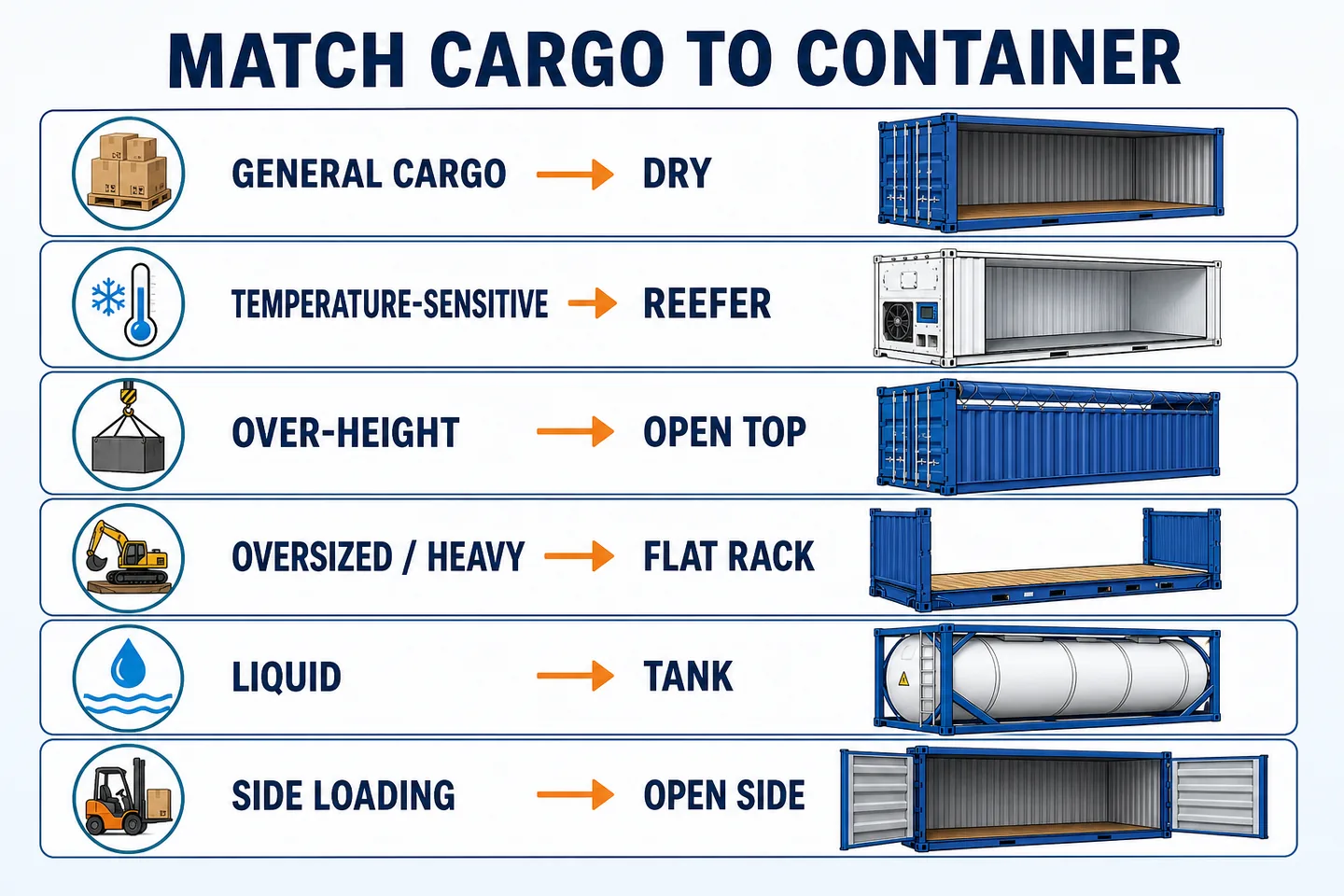
For ordinary boxed or palletized goods, start with a dry container. Move to a reefer when the cargo needs managed temperature conditions, an open top when it must be lowered in from above, a flat rack when it is oversized or unusually heavy, and a tank when the cargo is a compatible bulk liquid or gas. An open-side unit solves a different problem: access along the length of the container.
Those are starting points, not booking instructions. Final packed dimensions, gross weight, load distribution, handling method, inland limits, route availability, and compliance requirements still decide whether the equipment will work.
Shipping container types at a glance
| Container type | What makes it different | Common sizes | Typical cargo | Check before booking |
|---|---|---|---|---|
| Dry or general purpose | Enclosed steel box with end doors | 20GP, 40GP, 40HC | Cartons, pallets, furniture, consumer goods | Door fit, packed layout, gross weight |
| High cube | About one foot taller than standard height | Usually 40HC; some 45HC | Light, bulky cargo | Usable height, route availability |
| Reefer | Insulated body and refrigeration machinery | 20RF, 40RF/HC | Food, produce, pharmaceuticals, sensitive products | Commodity settings, power, ventilation |
| Open top | Removable roof covering and top access | 20OT, 40OT | Tall machinery, stone, large crates | Lifting plan, weather cover, over-height approval |
| Flat rack | Strong platform, end walls, no fixed sides or roof | 20FR, 40FR | Machinery, vehicles, boats, project cargo | Point loads, lashing, out-of-gauge dimensions |
| Tank | Pressure vessel secured inside an ISO frame | Commonly a 20-foot frame | Compatible bulk liquids and gases | Product compatibility, regulations, tank history |
| Open side | A large section of the side can open | Often 20 or 40 feet | Long items, side-loaded cargo, event equipment | Side clearance and equipment availability |
Type, size, and load mode answer different questions
Shipping terminology gets muddy because three separate choices are often discussed as though they were one.
- Container type describes the equipment’s function or construction: dry, reefer, open top, flat rack, tank, and so on.
- Container size describes nominal length and height: 20-foot, 40-foot, 40-foot high cube, or another size.
- Load mode describes how the space is purchased: full container load (FCL) or less-than-container load (LCL).
A 40HC is usually a high-cube version of a dry container. It is a size variant, not a different cargo function in the way that a reefer or tank is. FCL does not automatically mean 40-foot equipment, either. A shipper can book a 20-foot FCL, while small dry shipments may move as LCL without the shipper controlling a whole container.
Two ISO references are also easy to confuse. ISO 668 covers the classification, dimensions, and ratings of Series 1 freight containers. ISO 6346 covers identification, coding, and marking. If you are reading the four-character size/type code on a container, you are dealing with the latter system.
The main container families
Dry containers: the normal starting point
A general-purpose dry container is an enclosed box with cargo doors at one end. It suits goods that can travel at ambient conditions: cartons, palletized products, textiles, furniture, appliances, components, and many other manufactured items.
Dry does not mean waterproof in every real-world circumstance, nor does it remove the need for packaging. Cargo may still face condensation, movement, vibration, and temperature swings. Moisture protection, bracing, dunnage, and sensible weight distribution remain part of the packing plan.
The trap is choosing by cubic meters alone. A shipment can fit on a spreadsheet but fail in the yard because the tallest case is wider than the door opening, the last pallet cannot turn, or one machine puts too much weight on a small section of floor.
High cube: extra room, not extra payload
A high-cube container is nominally 9 feet 6 inches high, one foot taller than a standard-height unit. The extra headroom is useful for goods that are bulky rather than dense, such as furniture, insulation, or lightweight consumer products.
It does not follow that a 40HC can carry more weight than every 40GP. Tare and payload ratings vary, and inland road or rail limits may become the controlling factor first. Treat the additional height as volume, not as permission to add weight.
Reefers: the cargo protocol comes first
A refrigerated container combines an insulated body with machinery that circulates conditioned air. Food, produce, pharmaceutical products, and other temperature-sensitive goods may require one, but “use a reefer” is only the beginning of the specification.
The shipper needs a commodity-specific plan. Depending on the product, that can cover set point, ventilation, humidity, fresh-air exchange, controlled atmosphere, pre-cooling, packaging, probe placement, and allowable time without power. No single temperature range is safe for every cargo.
The Digital Container Shipping Association’s overview makes the broader point well: cargo weight, density, form, and temperature needs all influence equipment choice. For a reefer booking, operating instructions should be confirmed with the carrier and qualified specialists before loading.
Open tops: when the door is the problem
An open-top container uses a removable roof covering, allowing cargo to be lowered in by crane. That makes it a logical candidate for a tall crate, stone block, or machine that cannot travel through standard end doors.
Top access solves only one part of the job. The lifting arrangement, over-height dimensions, weather protection, terminal handling, lashing points, and carrier acceptance all need review. Cargo that projects above the top rails is usually treated as out of gauge, which can affect slot use and cost.
Flat racks: open space with strict load control
A flat rack is a heavy platform with end walls but no fixed roof or side walls. It can carry industrial equipment, vehicles, boats, and other cargo that is too wide, too tall, or too awkward for an enclosed container.
This is where “total weight is under the limit” becomes a dangerous shortcut. A machine can remain below the overall payload while placing an excessive point load on the floor. Center of gravity, support footprint, blocking, bracing, lashing design, lifting points, and projection beyond the frame all matter.
The UNECE CTU Code documents the safety risks created by poor packing, overload, and inadequate securing. Heavy and project cargo should be reviewed by people qualified for the specific loading and securing plan.
Tank containers: a specialist equipment decision
A tank container places a vessel inside an ISO frame so compatible liquids or gases can move through intermodal systems. Depending on the tank specification, cargo may include food-grade liquids, chemicals, or regulated products.
Do not select one from a generic chart. Product compatibility, filling limits, tank type, previous cargo, cleaning certificate, inspection status, dangerous-goods classification, route rules, and operator acceptance can all change the answer. Tank suitability should be confirmed by the tank operator and relevant compliance specialists.
Open-side containers: access along the length
An open-side container has doors or panels along a substantial part of one side. It helps when an item is too long for practical end loading, a forklift needs side access, or event and display equipment must be reached quickly.
These units are not as widely available as ordinary dry containers. Check the origin depot, route, return conditions, and loading-site clearance before designing a packing plan around one.
Common container sizes
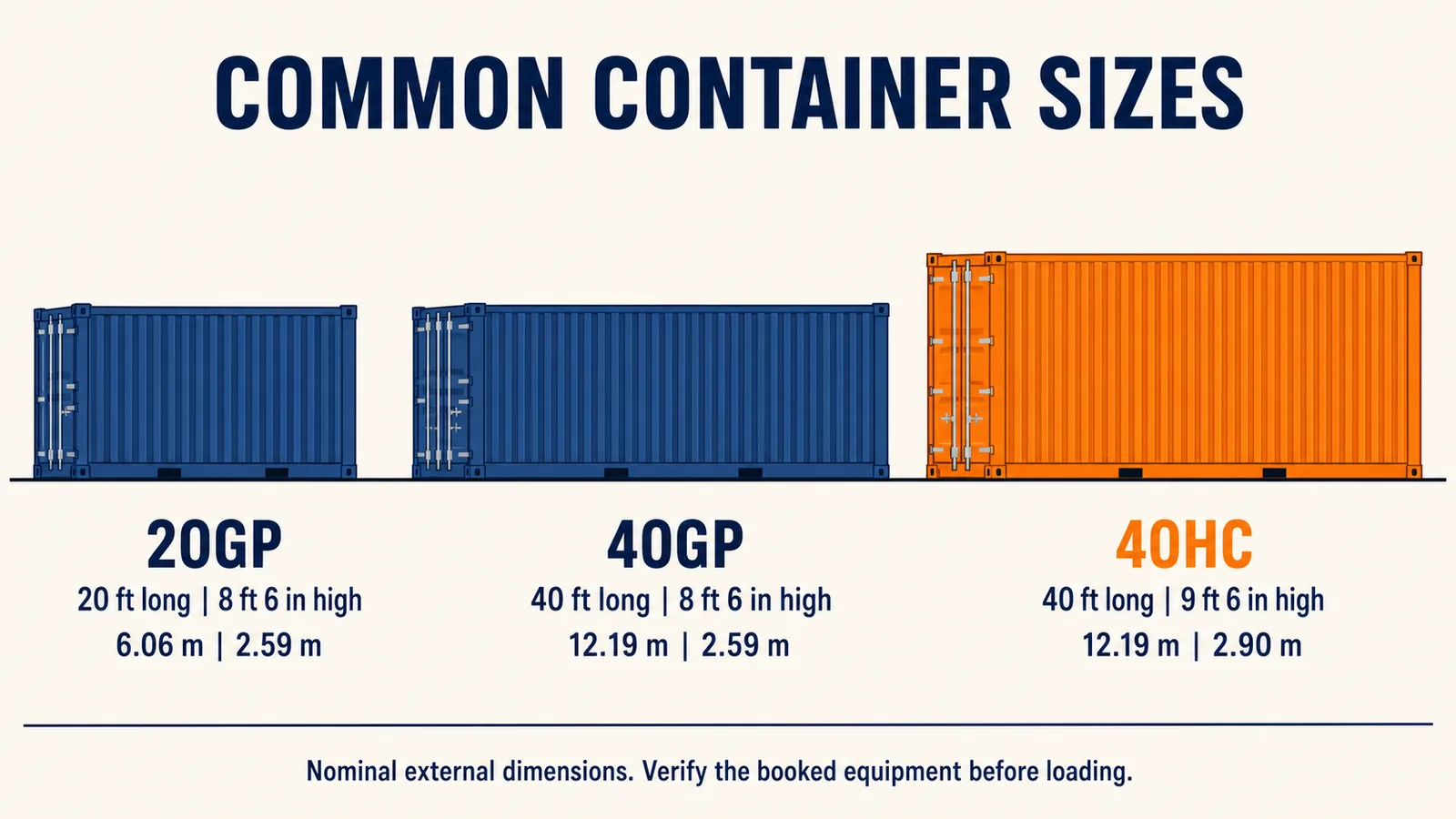
The familiar names refer to nominal external dimensions. Actual internal length, door opening, tare, payload, and cubic capacity vary by manufacturer and fleet.
| Size | Nominal exterior, L × W × H | Representative interior, L × W × H | Representative door, W × H | Approx. volume |
|---|---|---|---|---|
| 20GP | 6.06 × 2.44 × 2.59 m | 5.90 × 2.35 × 2.39 m | 2.34 × 2.29 m | 33 m³ |
| 40GP | 12.19 × 2.44 × 2.59 m | 12.03 × 2.35 × 2.39 m | 2.34 × 2.29 m | 67.7 m³ |
| 40HC | 12.19 × 2.44 × 2.90 m | 12.03 × 2.35 × 2.70 m | 2.34 × 2.60 m | 76.4 m³ |
The figures above are rounded planning values drawn from current carrier specifications, including the Hapag-Lloyd container specification. They are not a promise about the next empty unit released from a depot. Verify the offered equipment before loading.
Payload is deliberately absent from the table. It changes with the unit’s tare and rating, and a legal inland weight can be lower than the marked container capacity. For a real shipment, check the booking, equipment plate, size/type code, road and rail limits, and any terminal restrictions.
How to choose a container without guessing
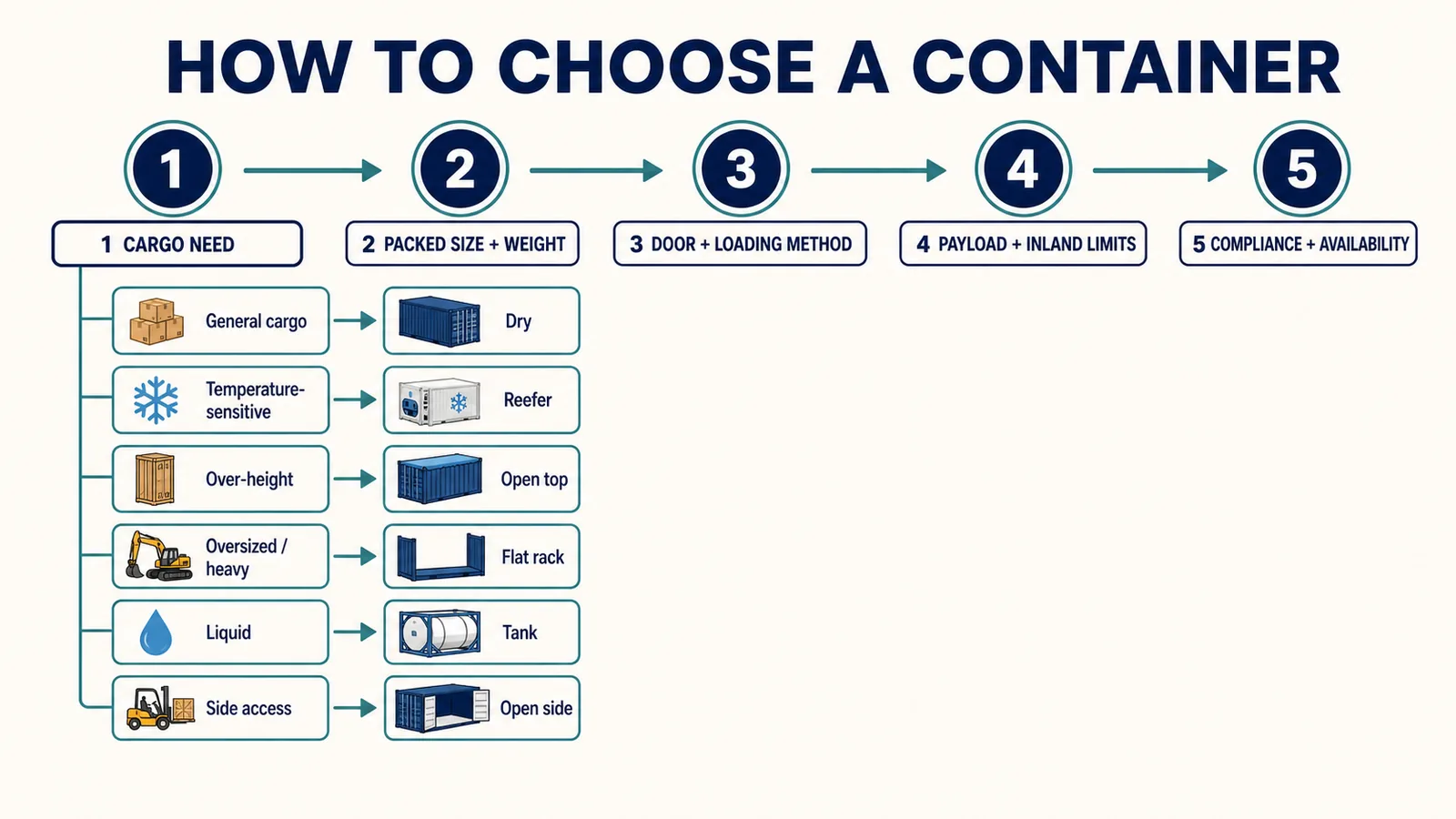
1. Name the cargo’s hardest requirement
Start with the condition that ordinary equipment cannot satisfy. Does the product need managed temperature? Is one crate over height? Does the cargo need a crane, side access, or a heavy-duty platform? Is it a regulated liquid?
If none of those applies, a dry container remains the sensible first candidate.
2. Measure the packed shipment
Measure the cargo after pallets, crates, skids, insulation, frames, and protective material are added. Record:
- The length, width, and height of every package type
- The gross weight of each package and the total
- The footprint and center of gravity of heavy pieces
- Whether packages may be stacked or rotated
- Any protrusions, lifting points, or orientation limits
Factory product dimensions are not enough. The packed shape is what must pass through the door and survive the loading sequence.
3. Rehearse the way it will enter
Compare the largest package with the door opening, then think through its path. Can it turn after entering? Is there enough overhead room for the forklift mast? Does a crane need access from above? Will a ramp or loading dock change the angle?
This mental rehearsal catches failures that a CBM calculation cannot.
4. Check the weight beyond the ocean leg
Look at the container’s actual rating and the whole inland route. Truck axle rules, road permits, chassis limits, rail restrictions, terminal equipment, and local enforcement can impose a lower usable weight.
For concentrated loads, ask for a floor-load and distribution review. The difference between net weight and gross weight also needs to be clear across the invoice, packing list, booking data, and verified gross mass.
5. Confirm the exact equipment and acceptance conditions
Special equipment may be available at one port and scarce at another. Confirm type, size, quantity, depot, sailing, free time, return location, handling requirements, and carrier approval before production or crating becomes difficult to change.
The shipper is responsible for providing the verified gross mass of a packed container under SOLAS. The International Maritime Organization explains that VGM includes cargo, packing and securing materials, plus the container tare mass. A container without VGM cannot be loaded onto the ship under those rules.
What the choice looks like in practice
| Shipment | Sensible first option | Why it fits | What could change it |
|---|---|---|---|
| Palletized consumer goods | 20GP, 40GP, or 40HC dry | Enclosed, straightforward equipment | Density, pallet layout, inland weight |
| Lightweight furniture | 40HC dry | Extra height helps use cubic space | Door fit, stackability, damage protection |
| Chilled or frozen food | Reefer | Managed temperature conditions | Commodity protocol, ventilation, pre-cooling |
| A tall crated machine | Open top | Crane loading bypasses the door height | Weather cover, lifting plan, over-height approval |
| Wide construction equipment | Flat rack | Sides and roof do not restrict the cargo envelope | Lashing, point loads, permits, route |
| Food-grade bulk liquid | Suitable tank | Purpose-built containment | Tank history, cleaning, compatibility, regulations |
| Long equipment loaded by forklift | Open side | Access along the container length | Depot availability and site clearance |
The fourth column is the one that prevents expensive surprises. A broad cargo label never captures the whole shipment.
Mistakes worth catching before the booking
Using CBM as a fit test. Cubic volume says nothing about whether rigid packages fit through a door, can rotate inside, or leave room for safe loading.
Copying a payload from an online chart. Tare and rating vary. Inland restrictions may be lower. Use the actual equipment and route.
Measuring the product instead of the package. A skid, export crate, insulation layer, or lifting frame can be the difference between standard and special equipment.
Leaving special equipment until the last minute. Open tops, flat racks, tanks, and open-side units can be scarce. A late request may change the depot, sailing, rate, or packing plan.
Assuming a reefer fixes every cold-chain problem. The container cannot correct a warm product, blocked airflow, unsuitable packaging, or the wrong operating instructions.
Treating regulated cargo like ordinary freight. Dangerous goods, batteries, chemicals, food products, pharmaceuticals, and some machinery can trigger documentation, packaging, declaration, inspection, or acceptance requirements.
What to send for a useful quote
“One container of machinery” is not enough detail for a reliable recommendation. Send the forwarder:
- Commodity description and HS code, if known
- Number and type of packages
- Final packed dimensions for each package type
- Gross weight per package and in total
- Photos and dimensioned drawings for machinery or unusual shapes
- Stackability and orientation restrictions
- Available loading equipment at origin
- Temperature, ventilation, or humidity instructions
- Dangerous-goods status and supporting documents
- Pickup address, port pair, destination, and target schedule
Route context matters as much as the container itself. Fulfillbot’s guides to shipping from China to the USA and the major ports in China are useful starting points when you are mapping the origin and destination legs.
Where FCL and LCL fit
Choose the equipment family first, then compare how to buy the space. Small, ordinary dry shipments often move as LCL. Larger shipments, fragile cargo, or loads that benefit from fewer handling events may favor FCL.
There is no universal CBM threshold at which FCL suddenly becomes the correct answer. Freight rates, origin and destination charges, cargo density, handling risk, schedule, and space conditions move the crossover point. If the shipment sits near that point, request both options on the same assumptions.
A forwarder coordinates more than ocean space, while an agent’s role can be narrower. The comparison of a China freight forwarder and a China shipping agent explains the distinction.
Frequently asked questions
What is the most common type of shipping container?
The general-purpose dry container is the normal starting point for packaged cargo that does not need managed temperature conditions. Common size variants include 20GP, 40GP, and 40HC.
What is the difference between 40GP and 40HC?
Both are nominally 40 feet long and 8 feet wide. A 40GP is nominally 8 feet 6 inches high; a 40HC is 9 feet 6 inches high. The high cube offers more internal height and volume, but not automatically more usable payload.
Is a 20-foot container better for heavy cargo?
It can be a good candidate for dense cargo because the weight sits within a shorter footprint, but this is not a rule. Actual payload, floor loading, weight distribution, inland law, chassis limits, and carrier acceptance determine whether it works.
Can dry cargo move in a reefer?
Sometimes, subject to carrier acceptance and equipment conditions. Reefers have different internal dimensions, machinery, floor design, availability, and cost. An ordinary dry container remains the first option for ordinary dry cargo.
How many shipping container types are there?
There is no single useful total. Some lists count only broad functional families, while others count every size variant and specialized design separately. Importers get more value from identifying the cargo constraint and then confirming the exact size/type code.
What do codes such as 22G1 and 45G1 mean?
The BIC size/type coding guide explains the four characters. The first indicates length, the second describes height and width characteristics, and the last two describe the type. Common endings include G1 for general purpose, R1 for refrigerated, U1 for open top, P1 for platform, and T1 for tank.
One rule to keep
Choose around the cargo’s hardest constraint, not the largest number in a capacity table. Temperature control, door access, concentrated weight, over-height dimensions, loading method, and compliance can each override theoretical volume.
Send the final packed measurements, gross weights, photos, loading method, commodity details, and route before asking for a recommendation. Then get the exact equipment specification and availability confirmed in writing.