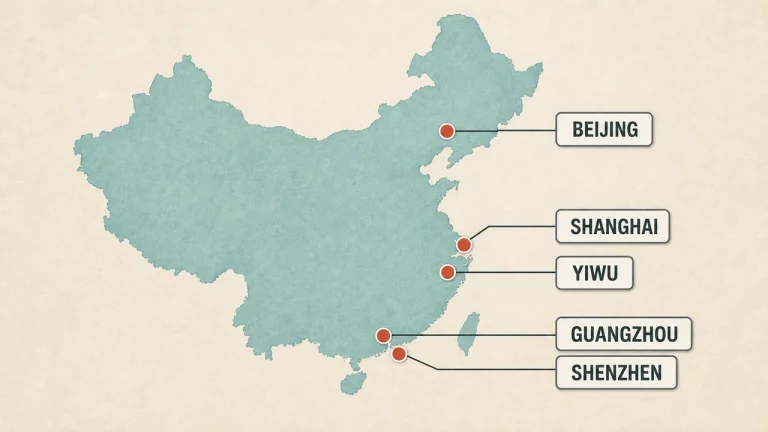
“China fake market” is an informal traveler term for a mixed shopping complex where legitimate products may appear alongside goods suspected of using brands without permission. Shanghai, Guangzhou, Shenzhen, Beijing, and Yiwu appear in current traveler searches. Selling infringing goods is not a legal gray area, market conditions change quickly, and the customs rules of your destination still apply.
That answer is less exciting than a “secret market” video. It is also more likely to survive contact with reality. A building may be open even though the stalls, stock, and way goods are sold have changed. Inside, ordinary tailoring, pearls, souvenirs, food, generic accessories, and legitimate electronics may sit next to products of doubtful origin. So treat permanent online lists, precise late-night schedules, and promises of a hidden room as perishable claims, not travel facts.
What is a “China fake market”?
It is not an official Chinese market category. It is traveler shorthand for tourist or wholesale markets where some sellers have been reported to offer unauthorized branded goods. The problem with the phrase is its reach: a label attached to one building can make every tailor, pearl seller, repair shop, and snack counter sound suspect.
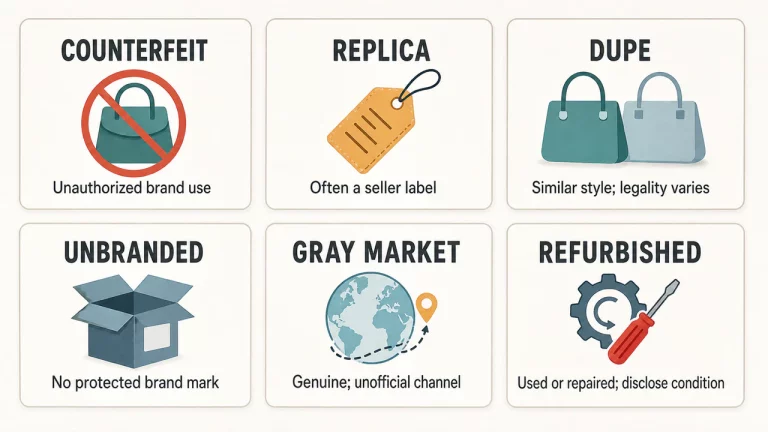
The words used by sellers and travel guides also blur several different things:
- Counterfeit or fake: a product that uses a protected trademark, logo, packaging, or source claim without authorization and creates the impression that it is connected with the brand.
- Replica: often a softer sales term. If the product carries an unauthorized mark, calling it a replica does not change the underlying trademark issue.
- Dupe: a product with a similar look, function, or trend reference but no copied brand mark. A dupe is not automatically lawful; the design, packaging, advertising claims, and destination law still matter.
- Unbranded or generic: a product sold without another company’s protected brand identity. It may still have safety or quality problems, but it should not automatically be called counterfeit.
- Gray-market goods: genuine products sold through an unofficial distribution channel. They are not the same as fakes, although warranty and import restrictions can still apply.
- Refurbished goods: used or repaired products. Their condition, replaced parts, battery health, warranty, and seller disclosure matter more than the word “refurbished.”
Seller labels such as “A,” “AAA,” “1:1,” “superfake,” “original quality,” and “same factory” are not recognized quality standards. There is no shared test, materials specification, or independent grading body behind them. One seller’s “AAA” can be another seller’s bottom shelf. The label tells you how the item is being pitched. It tells you nothing reliable about authorization, safety, durability, or customs treatment.
Are fake markets legal in China?
Selling counterfeit goods is not legal merely because the market is visible or busy. Article 57 of China’s Trademark Law includes unauthorized use of registered marks and the sale of goods that infringe registered trademark rights. Article 60 provides for stopping the infringement, confiscating and destroying infringing goods, and imposing penalties in qualifying cases.
Enforcement is not theoretical. In an April 2026 report, China’s State Administration for Market Regulation said authorities had handled cases involving physical markets, trademark violations, patent counterfeiting, and suspected infringing imports and exports during 2025. The figures cover different enforcement categories, so they should not be added together as one counterfeit total. They do show why “the shop is open” is not proof that the goods are authorized. See the SAMR enforcement summary.
The wider trade is substantial, but avoid viral claims about what percentage of all Chinese goods are fake. The OECD and EUIPO estimated that counterfeit and pirated goods accounted for up to 2.3% of global trade in 2021. That is a global customs-based estimate, not a measurement of Chinese tourist markets. The date and scope matter. See Mapping Global Trade in Fakes 2025.
What about hidden shops and late-night markets?
Some secondary reports describe off-menu catalogues, goods kept out of sight, invitations to another room, or pop-up late-night selling. Secrecy can feel like access to something special. In practice, it usually means weaker traceability and fewer options when the item is wrong.
Exact routes and night hours age quickly. Locations move, close, or disappear, and current official confirmation is usually absent. A confident “go here at midnight” instruction may lead to an outdated address or straight into an infringing sale. Here, hidden-room claims and late-night schedules are warning signs, not directions.
China fake markets by city: a current, cautious snapshot
The table below separates current market identity from reported counterfeit concerns. “Reported” does not mean that every shop or vendor is involved.
| City | Market or district | What is currently documented | Counterfeit context | Evidence checked |
|---|---|---|---|---|
| Shanghai | A.P. Plaza | An underground market inside the Shanghai Science & Technology Museum metro complex | A current local directory still categorizes it as a “fake market” | SmartShanghai, summer 2026 |
| Guangzhou | Baiyun Leather Trading Center, Kindo Garment Market, Zhanxi-area markets | Large leather, garment, shoe, and watch wholesale clusters | USTR’s 2024 review records right-holder reports about counterfeit sales at named markets | USTR report published in 2025 |
| Shenzhen | Luohu Commercial City and named Huaqiangbei electronics malls | Luohu is a mixed mall near the Hong Kong border; Huaqiangbei is a much broader electronics ecosystem | USTR records right-holder reports involving watches and electronics | EyeShenzhen 2023; USTR 2024 review |
| Beijing | Silk Street and Hongqiao Market | Established tourist markets for silk, tailoring, pearls, jewelry, gifts, and souvenirs | Older guides shaped their fake-market reputation, but current official positioning is broader | Beijing official pages, including 2026 list |
| Yiwu | Binwang Night Market / Santing Road Night Market | Active mixed night market with general merchandise, clothing, food, and small commodities | Shoes are documented; 2025 visitor reviews report bags and shoes believed to be replicas, but authenticity is unverified | Official 2025–2026 sources plus qualified visitor reports |
Shanghai: A.P. Plaza is the clearest current search match
For the search “fake market Shanghai,” A.P. Plaza is the clearest currently documented match. SmartShanghai listed it inside Metro Line 2 at Shanghai Science & Technology Museum and described it as Pudong’s biggest “fake market” as of summer 2026. That is a current local-directory description, not a guarantee about any specific stall or product. See the SmartShanghai market listing.
Qipu Road and Hongqiao New World Pearl Market also appear in market guides, but both are mixed shopping areas. Do not assume that a pearl, tailored garment, generic bag, or souvenir is counterfeit because of the building it came from. Likewise, do not assume a branded item is genuine because it has a tag or a confident sales story.
Guangzhou: leather, garment, shoe, and watch clusters
Guangzhou has one of China’s largest legitimate wholesale ecosystems. The same scale can make careless labeling especially unfair. The U.S. Trade Representative’s 2024 Notorious Markets review named Baiyun Leather Trading Center, Kindo Garment Market, and Zhanxi-area markets based on reports from rights holders. That wording matters: it is not a neutral census of every storefront.
Use the report to understand risk, not to plot a shopping route. Specific floors, concealed stock methods, runners, and late-night schedules change fast. Publishing them would also turn a consumer guide into an infringement playbook. If a seller will not put the business name, product description, condition, and price on a receipt, walk away.
Shenzhen: Luohu and the counterfeit-electronics risk
Shenzhen’s municipal English portal describes Luohu Commercial City as a mixed mall near Luohu Checkpoint with small shops selling handbags, watches, clothing, shoes, souvenirs, and other services. USTR’s 2024 review separately records right-holder reports that counterfeit watches remained available there.
Huaqiangbei needs even more care. It is not simply a “fake electronics market.” It is a vast electronics district serving legitimate component, repair, device, and product-development businesses. USTR named several malls within the district in relation to reported counterfeit electronics, but the report cannot be stretched into a judgment on the whole ecosystem.
Old posts also describe a movable “ghost market” operating after midnight. Its current location and schedule are disputed and lack reliable official confirmation. More importantly, a late hour does not solve the risks that matter: unknown battery cells, altered storage capacity, replaced components, no usable warranty, and no accountable seller after you leave.
Beijing: Silk Street and Hongqiao have changed
Silk Street and Hongqiao Market are still active tourist-shopping names, but their public identity is broader than old fake-market lists suggest. Beijing’s 2026 “Must-Buy” list identifies Silk Street with silk scarves and Chinese-style shawls, and Hongqiao with natural pearl jewelry. See the Beijing Must-Buy List.
Official promotion is not proof that every product is genuine. It does, however, make sweeping labels unfair. The most defensible description is “mixed tourist markets with a historical counterfeit association,” not a promise that hidden branded goods will be available on request.
Yiwu: Binwang Night Market mixes street food with low-cost retail
Travel guides often call it Binwang Night Market, but current government pages list Santing Road Night Market (三挺路夜市). It sits in Yiwu’s Binwang commercial area. A Zhejiang commerce report recorded active trade in February 2026, with general-merchandise stalls and a temporary food section. Yiwu’s government also documented clothing and daily-goods stalls in 2025. See the 2026 Zhejiang commerce report and the Yiwu government market feature.
A 2024 Jinhua Daily report republished by People’s Daily confirms that shoes are part of the market mix. Branded bags are harder to pin down. Two Ctrip reviewers in 2025 said they saw bags and shoes they believed were replicas. Treat that as a warning, not a stall-by-stall inventory. A familiar logo, branded box, or confident sales pitch still does not prove authenticity or authorization.
Keep the night market separate from Yiwu International Trade City. A night-market stall is not a verified supplier. Business buyers still need a legal entity, documented product rights, specifications, quality checks, and shipping records. Fulfillbot’s guide to Yiwu’s wholesale market explains how the legitimate wholesale ecosystem works.
What might you actually find?
Depending on the market, you may find legitimate souvenirs, tailoring, fabrics, pearls, costume jewelry, generic bags, phone accessories, food, used devices, repaired devices, and products whose origin is unclear. “Is this a fake market?” is too broad to help at the counter. Ask instead: “What exactly is this item, and what supports the seller’s claim?”
That distinction is especially important for electronics. A device can be genuine but used, genuine with third-party parts, assembled from salvaged components, unbranded, falsely branded, or simply defective. A familiar-looking interface proves little. For cosmetics, toys, chargers, batteries, helmets, and other safety-sensitive products, uncertain origin should carry more weight than a low price.
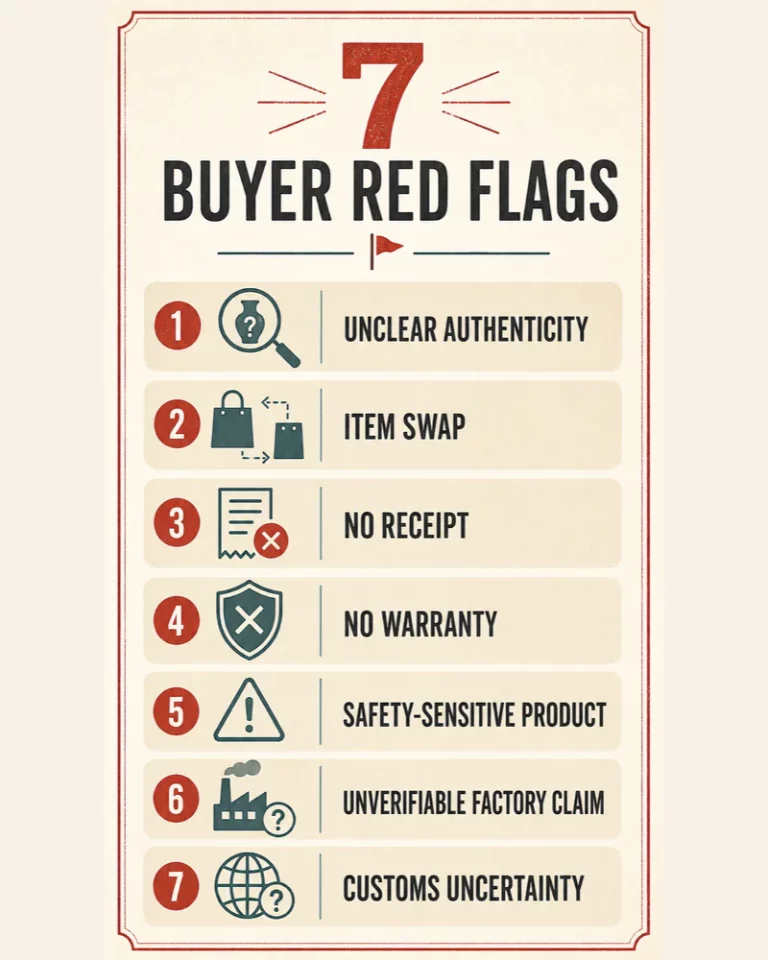
Seven risks travelers often miss
- A fake may be sold as genuine. A box, serial sticker, dust bag, or receipt-like slip can also be copied.
- The packed item may not be the inspected item. Check the exact unit before payment and again before leaving.
- There may be no usable return path. A verbal promise is hard to enforce after a flight home.
- Safety claims may be unverifiable. This matters for batteries, chargers, cosmetics, toys, protective products, and anything used on the body.
- Factory stories are not documents. “Same factory,” “overrun,” and “export surplus” do not establish permission from a brand or control over production.
- Destination customs may act. Seizure, fines, or other consequences depend on the country, item, quantity, purpose, and current rules.
- Several identical items can look commercial. Resale creates a different risk profile from one personal purchase.
What to check before buying anything
Start by deciding what you need from the purchase. If authenticity, a manufacturer warranty, safety certification, or destination compatibility matters, require evidence for that exact point. If the purchase is just an inexpensive souvenir, avoid unauthorized branding and still check the materials and condition.
Use this short check:
- Ask whether the item is branded, unbranded, used, repaired, or refurbished.
- Inspect the exact unit rather than a display sample or phone photo.
- Request an itemized receipt with the seller’s business name, the product, condition, and price.
- For electronics, check the actual model, storage, battery health, voltage, plug, network bands, serial status, and warranty coverage.
- Use a traceable payment method where possible and keep the payment record.
- Do not follow an unsolicited guide to an isolated room or transfer money to an unrelated personal account.
- Walk away when an authenticity claim cannot be documented.
This is plain buyer protection, not a way to “grade” counterfeits. A visual checklist cannot turn an unauthorized product into an authorized one.
Can you bring counterfeit goods home?
There is no useful worldwide yes-or-no answer. The destination country, type of intellectual-property right, product, quantity, purpose, and method of import all matter. Buying an item in China and importing it elsewhere are separate legal events.
The United States provides a narrow example. CBP says a traveler may be granted a personal-use exemption for one article of a type bearing a protected mark when it accompanies the traveler, is for personal use rather than sale, and the traveler has not received the same type of exemption during the previous 30 days. Read the current CBP personal-use exemption before relying on it.
That rule is not a blanket promise. It is specific to U.S. arrivals, uses “may be granted,” and does not authorize resale or repeated imports. CBP also states that it targets and seizes imports that violate intellectual-property law and that individual consumers can face consequences. See The Truth Behind Counterfeits.
Shipping the item does not make the problem disappear. A mailed or express parcel is an import shipment, not accompanied traveler baggage, so the traveler exemption does not simply transfer to it. Splitting a shipment, removing labels, concealing goods, using false descriptions, or asking a seller to misdeclare value or contents can create additional violations. None of those is a legitimate workaround.
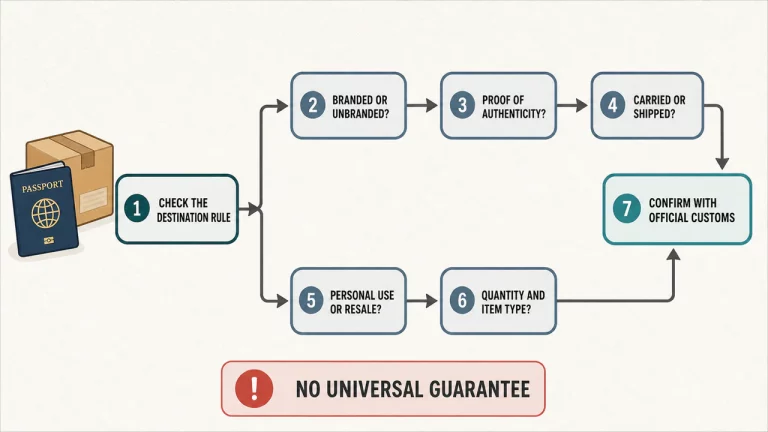
For another destination, begin with that country’s official customs website. Search the agency’s rules for counterfeit or pirated goods, trademark restrictions, traveler baggage, prohibited and restricted goods, and postal imports. If the wording is unclear or the item is expensive, ask the agency or a qualified customs professional before buying.
Safer, legal alternatives to counterfeit shopping
Most people are not really looking for a trademark violation. They want an interesting shopping experience, distinctive design, acceptable quality, customization, or a good price. Those goals have better routes:
- Buy from Chinese independent brands or an authorized retailer.
- Choose traditional crafts, silk, pearls, tea ware, stationery, or locally designed souvenirs from sellers that disclose materials and origin.
- Order tailored clothing without copied labels or protected patterns.
- Buy unbranded products with clear specifications.
- For wholesale research, compare legitimate China wholesale websites.
- If visiting a physical wholesale hub is part of the trip, learn how Yiwu’s legitimate wholesale market works.
- For a business product, build your own private-label product rather than attaching someone else’s brand.
These alternatives are not automatically risk-free. Materials, safety, supplier identity, and destination rules still need checking. The difference is that they can be documented and improved instead of hidden.
Why fake markets are not a business sourcing channel
A physical sample and a low price do not establish trademark authorization, ownership of the design, factory identity, production control, batch consistency, product compliance, or customs admissibility. A retail stall may be a retailer, a trader, a temporary sales point, or a contact for an unrelated warehouse.
Before a business pays a supplier, it should verify the legal entity, beneficiary account, product rights, specifications, samples, compliance documents, inspection method, and shipping records. Fulfillbot’s guide to how to verify a China supplier before paying explains the basic checks. The principles matter beyond Alibaba.
For a legal product brief, legitimate China sourcing can include supplier comparison, samples, quality checks, and shipping preparation. Fulfillbot does not source replicas or counterfeit goods.
Are China’s fake markets worth visiting?
A documented market can be interesting as a piece of the city’s retail culture. It is a poor place to assume that a branded bargain is authentic, safe, warrantied, or legally importable. Go for the atmosphere if it fits your itinerary. Buy only what you can identify, use safely, document honestly, and bring home under the rules of your destination.
Here is the awkward part. The most clickable advice is often the first to rot: a secret room, a midnight address, a universal bargaining percentage, a “best grade.” Market conditions move faster than those articles do. A receipt, a clear product identity, and an official customs rule are less thrilling. They are much more useful.
For business buyers: Need legitimate, non-infringing products from China? Send Fulfillbot a product brief for supplier options, samples, quality checks, and shipping preparation.
Frequently asked questions
What is the most famous fake market in Shanghai?
A.P. Plaza, inside the Shanghai Science & Technology Museum metro complex, is the clearest current search match. SmartShanghai still categorized it as a fake market in summer 2026. Its presence does not prove that every stall or item is counterfeit.
Are China’s fake markets still open in 2026?
Some markets and shopping complexes remain open, but the product mix and selling methods change. A.P. Plaza, Luohu Commercial City, Silk Street, Hongqiao, and Yiwu’s Santing Road Night Market have current public evidence of operation. Confirm the market name, entrance, and normal business hours shortly before visiting.
Is Binwang Night Market the same as Santing Road Night Market?
Yes. Travelers often call it Binwang Night Market because it sits in Yiwu’s Binwang commercial area. Current government and commerce sources generally list it as Santing Road Night Market.
Are the branded bags and shoes at Binwang Night Market authentic?
Do not assume so. Two 2025 visitor reviews described bags and shoes they believed were replicas, but neither a review nor a logo can authenticate the item in front of you. If authenticity matters, use an authorized retailer that issues a verifiable receipt.
Is it illegal to buy replicas in China?
“Replica” is only a label. When a product uses a protected mark without authorization, Chinese trademark law can treat its manufacture or sale as infringement. The buyer’s own liability depends on the facts and jurisdiction, while taking the item abroad raises a separate import question.
What do A, AAA, 1:1, and superfake mean?
They are seller-created marketing terms, not independent grades. They do not prove materials, factory origin, trademark authorization, safety, durability, or the ability to pass customs.
Where are the hidden shops and night markets?
Secondary reports describe concealed stock and movable late-night selling, but routes and times change and lack reliable current verification. Publishing those details would also help infringing sales. Treat secrecy, off-menu catalogues, and pressure to move elsewhere as risk signals.
Can I bring one counterfeit item into the United States?
CBP describes a narrow personal-use exemption that may apply to one article of a type under specific conditions. It is not guaranteed, does not cover resale, and cannot be generalized to other countries. Check the current CBP rule before buying.
Is everything at Silk Street, Hongqiao, A.P. Plaza, Luohu, or Binwang Night Market fake?
No. These are mixed markets. Depending on the location, they also sell tailoring, pearls, souvenirs, generic accessories, clothing, food, and services. Evaluate the actual product and seller claim.
Are counterfeit electronics riskier than clothing?
They can create extra safety and compatibility concerns because batteries, chargers, storage, radio components, and replacement parts may be unknown. Cosmetics, toys, protective products, and other safety-sensitive categories deserve similar caution.
Can a business resell replica goods?
A “replica” carrying an unauthorized trademark can create infringement, platform, customs, and consumer-protection exposure. A business should use original, licensed, unbranded, OEM/ODM, or private-label products with documented rights and compliance.