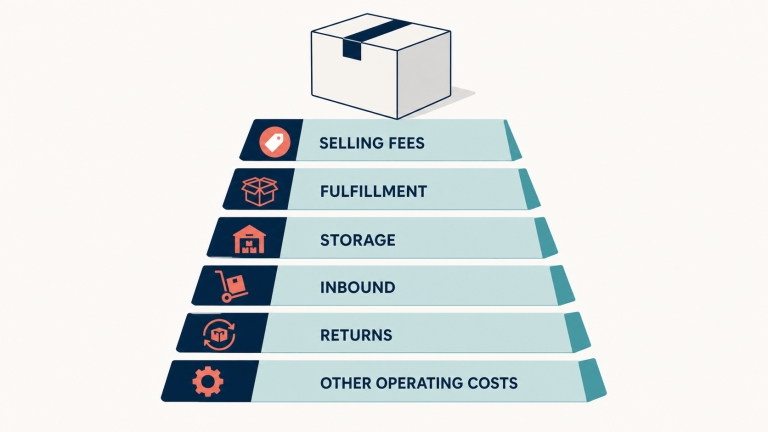
Amazon FBA fees are not one charge. They are a stack of selling fees, fulfillment fees, storage charges, inbound costs, and conditional surcharges. In 2026, US sellers also need to account for the 3.5% fuel and logistics-related surcharge that Amazon began applying to FBA fulfillment fees on April 17.
That is the short answer. The useful answer is knowing which costs apply to your SKU, when they appear, and what Amazon’s calculator leaves outside the estimate.
This guide maps the complete US fee stack and shows how to turn monthly, shipment-level, and per-order charges into a true cost per unit. Amazon can change rates and program rules, so confirm your SKU in the Revenue Calculator and Seller Central reports before making a pricing or inventory decision.
Quick answer: how much does Amazon FBA cost in 2026?
There is no universal FBA percentage. A seller may pay:
- a selling plan fee;
- a referral fee based on category and total sales price;
- an FBA fulfillment fee based mainly on price eligibility, size tier, and shipping weight;
- monthly storage based on inventory volume and season;
- inbound transportation, placement, prep, and labeling costs;
- conditional charges for low inventory, aged inventory, returns, removals, disposal, or noncompliance; and
- a temporary 3.5% fuel and logistics-related surcharge applied to the FBA fulfillment fee, not the product’s sale price.
Amazon’s current US selling plans are $0.99 per item sold for the Individual plan and $39.99 per month for the Professional plan. Referral fees vary by category. FBA then adds fulfillment and inventory-related costs.
For most sellers, the right question is not “What percentage does Amazon take?” It is “What is the contribution profit of this SKU after every cost required to make the sale?”
What changed in Amazon FBA fees in 2026?
Two separate events matter for US FBA sellers. Treating them as one increase understates the cost.
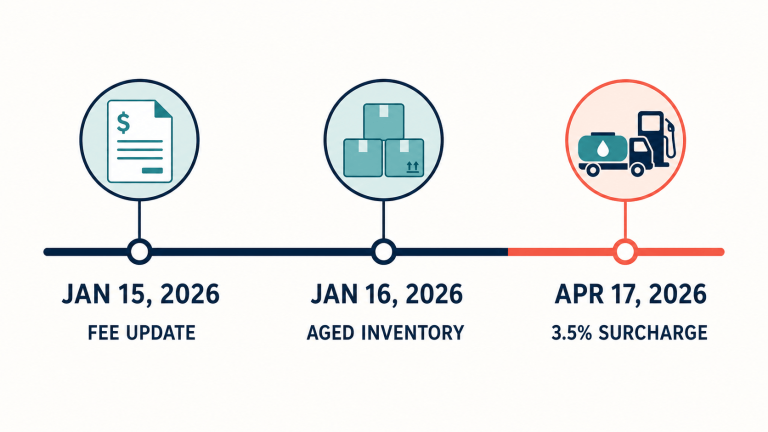
January 15 fee adjustments
Amazon announced that its 2026 US FBA fees would rise by an average of $0.08 per unit sold, with most changes effective January 15, 2026. That average is not a rate you can paste into a spreadsheet. The actual change depends on the product’s fee category, price, size, and weight.
Amazon also said there would be no new FBA fee types in the January fee package. That statement was accurate for the package announced at the time. It did not mean the fee environment could not change later in the year.
April 17 fuel and logistics-related surcharge
Amazon later introduced a temporary 3.5% fuel and logistics-related surcharge for US and Canadian FBA fulfillment fees, effective April 17, 2026. Amazon says the average US FBA impact is about $0.17 per unit, but your amount depends on the underlying fulfillment fee.
The calculation is straightforward:
Fuel surcharge = FBA fulfillment fee × 3.5%
If the fulfillment fee is $4.50, the surcharge is $0.1575, normally modeled as about $0.16 per unit. It is not 3.5% of a $25 sale price.
Low-inventory fee changes
For 2026, Amazon moved low-inventory-level fee measurement to the FNSKU level and exempted Grocery products. For an otherwise eligible standard-size product, the fee applies only when both the long-term historical days of supply, based on the previous 90 days, and the short-term historical days of supply, based on the previous 30 days, are below 28 days.
That distinction matters. A temporary stock dip does not automatically mean the fee applies if one of the two historical measures remains at or above 28 days.
Do not mix US fees with other marketplaces
Amazon fees are marketplace-specific. A UK, EU, Canadian, or Japanese fee table is not a substitute for a US calculation. Even a current article can be wrong for your account if it uses another marketplace’s dimensions, tax treatment, or program rules.
The complete Amazon FBA fee stack
The cleanest way to understand Amazon FBA fees is to separate them into three groups.
Fees almost every Amazon seller pays
Selling plan. The Individual plan charges $0.99 for each item sold. The Professional plan costs $39.99 per month. The simple break-even is about 41 units a month, though Professional also includes operational and advertising features that may matter before you reach that volume.
Referral fee. Amazon charges a percentage of the total price or a category minimum, whichever is greater. Many categories use 15%, but the official category table includes lower, higher, and tiered rates. Do not use 15% as a blanket assumption across a catalog.
These are Amazon selling fees. They still apply when you fulfill orders yourself.
Core FBA costs
Per-unit fulfillment fee. This pays for picking, packing, shipping the order to the customer, customer service, and handling returns at the fulfillment-service level. The rate depends on the applicable fee schedule and the SKU’s characteristics.
Monthly inventory storage. Amazon charges for the space your inventory occupies in its fulfillment network. Storage is based on daily average volume in cubic feet, and peak-season rates are higher. Oversize products can follow a different schedule from standard-size inventory.
This is why a small packaging change can affect two lines at once: the per-order fulfillment fee and the monthly storage allocation.
Conditional and operational fees
These charges do not hit every seller on every order, but they are often where a thin-margin SKU breaks:
- Inbound placement service fee: may apply when Amazon distributes inventory across its network. Options and charges appear during shipment creation.
- Low-inventory-level fee: can apply to eligible standard-size products with persistently low historical days of supply.
- Aged inventory surcharge: applies when eligible units have remained in the fulfillment network for 181 days or longer.
- Storage utilization surcharge: can apply when storage volume is high relative to recent sales volume.
- Returns processing fee: can apply to products with return rates above Amazon’s category thresholds.
- Removal, disposal, and liquidation fees: apply when inventory leaves FBA without a customer sale.
- Inbound defect and noncompliance costs: can arise from labeling, packaging, carton-content, appointment, or shipment-preparation problems.
The general order fulfillment process may look simple from the customer side. The fee triggers sit at several different stages behind that order.
How FBA fulfillment fees are calculated
FBA fulfillment fees are not a fixed share of revenue. A $15 compact product and a $15 bulky product can have very different fees.
Product price and Low-Price FBA
Eligible products priced below $10 automatically receive Low-Price FBA rates. Products priced at $10 or above use standard FBA rates. That creates a real pricing boundary.
Do not assume moving a price from $9.99 to $10.00 adds one cent of revenue and leaves everything else unchanged. Model both prices in the Revenue Calculator. The higher selling price may coincide with a higher fulfillment fee, while category referral rates can also have their own price thresholds.
Size tiers
Amazon assigns products to size tiers using packaged dimensions and unit weight. A fraction of an inch can matter if it pushes a product across a tier boundary. Packaging should protect the product and satisfy Amazon’s requirements, but excess empty space has a recurring cost.
Measure the final sellable unit, not an unboxed sample. Include the retail box, poly bag, inserts, protective material, and anything else that ships to the customer.
Unit weight and dimensional weight
Depending on the fee tier, Amazon may use unit weight or dimensional weight when determining shipping weight. Dimensional weight reflects how much space a package occupies, not just what it weighs.
If your actual charge is higher than expected, compare the dimensions and weight Amazon recorded with your own measurements. A remeasurement request can be appropriate when the catalog data is wrong, but it is not a substitute for measuring the packaged product correctly before launch.
Apparel, dangerous goods, and special handling
Apparel and dangerous goods can have separate fee schedules or handling rules. A rate copied from an ordinary non-apparel standard-size product may not apply. Confirm the SKU’s category and dangerous-goods status before you approve a margin forecast.
Apply the 3.5% surcharge last
First determine the correct FBA fulfillment fee. Then multiply that fee by 3.5%. Keep the surcharge on a separate spreadsheet line so you can remove or adjust it cleanly if Amazon changes the temporary program.
Reliable prep data matters here. An Amazon FBA prep service can help verify packaging, labeling, and shipment readiness before inventory reaches Amazon, but it cannot change Amazon’s fee schedule or guarantee how Amazon classifies a product.
FBA storage and inventory fees
Inventory fees punish two opposite problems: sending too much stock and running too lean for too long.
Monthly storage and Q4 seasonality
Monthly storage is charged by cubic foot using Amazon’s measured product volume. Rates change by season and size classification. Instead of hard-coding a storage rate from a blog post, pull the current rate from Seller Central and calculate:
Monthly storage per unit = monthly storage charge for the SKU ÷ average units stored
For forecasting, a more detailed model multiplies packaged cubic feet by the current monthly rate and then adjusts for expected average inventory. Build a separate Q4 scenario because October through December storage is materially more expensive than January through September.
Storage utilization surcharge
Amazon may add a storage utilization surcharge when the space occupied by inventory is high relative to recent shipped sales. It is different from aged inventory. A catalog can have poor storage utilization even when not every unit is old.
Watch the ratio and the effective surcharge in the FBA dashboard rather than trying to infer the charge from total storage alone.
Aged inventory surcharge after 181 days
Amazon assesses aged inventory surcharges in addition to ordinary monthly storage. Under the 2026 schedule shared through Amazon Seller Forums, eligible inventory reaches the first tier at 181 days. The per-cubic-foot rate climbs across later age bands, and inventory at 366 days or more is also subject to a per-unit minimum test.
Amazon uses an inventory snapshot on the 15th of each month. That date should be on your operating calendar. Review inventory approaching 181 days early enough to discount it, return it, liquidate it, or move it before the charge becomes unavoidable.
Low-inventory-level fee below 28 days
The low-inventory-level fee addresses the other side of the problem. It can apply when both the 30-day and 90-day historical days-of-supply measures remain below 28 days for an eligible FNSKU.
The goal is not to hold exactly 28 days of inventory at all times. Demand volatility, lead time, check-in delays, and seasonality require a buffer. The practical target is a replenishment policy that avoids chronic low supply without building a pile of slow stock.
This is where external inventory can help. Holding part of a purchase order at a China fulfillment center or another external warehouse and replenishing FBA in smaller batches may reduce FBA storage exposure. It also adds transfer cost and lead time, so compare the complete scenario.
Inbound, prep, and placement costs before a product sells
Amazon’s per-unit fulfillment fee starts after inventory is available for sale. Your cash outlay starts much earlier.
Shipping inventory to Amazon
Inbound freight is not included in the FBA fulfillment fee. If the product is manufactured overseas, your landed cost may include origin transport, export handling, international freight, insurance, duties, customs clearance, destination charges, and delivery to a prep center or Amazon fulfillment center.
Allocate shipment costs by the method that reflects the cost driver. Weight may work for dense products. Cubic volume is usually better for light, bulky cartons. A flat per-unit split can make one SKU look profitable by shifting its freight burden to another SKU.
If you source in China, use a current China-to-US shipping cost model rather than a stale per-kilogram estimate.
Inbound placement options
Amazon can offer different inbound placement options when you create a shipment. One option may send inventory to fewer locations with a placement charge. Another may require split shipments and more transportation work.
Compare the total, not just the line labeled “placement fee”:
Total inbound option cost = Amazon placement fee + carrier cost + prep/handling + split-shipment complexity
The cheapest Amazon fee can produce the highest end-to-end cost if it creates several small, expensive deliveries.
FNSKU labeling and packaging
FNSKU labels must be scannable and correctly matched. Poly bags, suffocation warnings, sold-as-set labels, box strength, and product-specific prep rules may apply. Amazon can provide some prep services for a fee, but not every product or problem is eligible.
Fulfillbot’s FBA prep scope includes inspection, FNSKU labeling, repackaging, photo documentation, and shipment coordination. Those services reduce preventable prep errors. They do not remove inbound placement, storage, or fulfillment charges imposed by Amazon.
Costs the calculator may not show
The public Revenue Calculator is valuable, but its result is still an estimate. It does not know your negotiated factory price, actual freight invoice, duty rate, inspection plan, prep contract, advertising spend, financing cost, or future return rate. Enter those costs yourself.
Returns, removals, and other easily missed costs
The sale is not financially complete when Amazon ships the parcel.
Returns processing fees. Amazon may charge a returns processing fee when a product’s return rate exceeds the threshold for its category. The fee and the economic loss from the return are different things.
Refund-related losses. A returned unit may be resellable, damaged, incomplete, or unsellable. Model the expected loss using your own return and recovery data. A category average is only a launch assumption.
Removal and disposal. Moving unsold units out of FBA costs money. So does disposal. Compare removal cost, external storage, liquidation recovery, and the aged-inventory charge you are trying to avoid.
Unsellable inventory. Inspection failures, transit damage, customer damage, and labeling mistakes can turn sellable stock into a write-off. Track both the number of units and the lost landed cost.
Advertising, duties, and COGS. These are not Amazon FBA fees, but excluding them from a profit calculation produces a useless answer. When sourcing products for Amazon, record samples, inspection, tooling, packaging, and defect allowances as well as the factory unit price.
How to calculate your true Amazon FBA cost per unit
Use contribution profit, not revenue minus a single “Amazon fee” estimate.
The complete formula
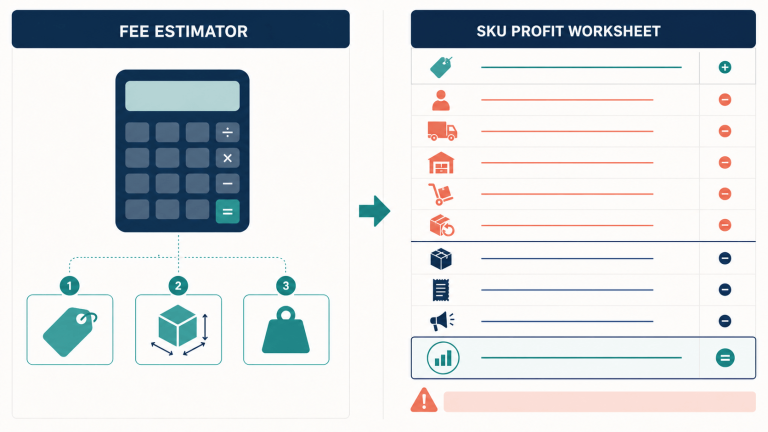
Contribution profit per unit = selling price − referral fee − fulfillment fee − fuel surcharge − selling-plan allocation − storage allocation − inbound and placement allocation − expected return loss − COGS − freight and duties − advertising − other variable costs
Convert every batch, monthly, or annual cost into a per-unit amount. Keep fixed overhead separate if you want contribution profit, or allocate it afterward to estimate operating profit.
Worked example for a standard-size product
The figures below are illustrative assumptions, not a quote from Amazon. They show the method.
| Line item | Per-unit amount | How it was modeled |
|---|---|---|
| Selling price | $25.00 | Assumed sale price |
| Referral fee | -$3.75 | Assumed 15% category rate |
| FBA fulfillment fee | -$4.50 | Assumed calculator result |
| 3.5% surcharge | -$0.16 | $4.50 × 3.5%, rounded |
| Professional plan allocation | -$0.04 | $39.99 ÷ 1,000 monthly units |
| Storage allocation | -$0.15 | Assumed monthly average |
| Inbound and placement | -$0.80 | Shipment cost divided by units |
| Expected return loss | -$0.50 | Assumed return reserve |
| Product cost | -$6.00 | Assumed COGS |
| Advertising | -$4.00 | Assumed per-order ad spend |
| Contribution profit | $5.10 | 20.4% of sale price |
The product appears to keep $16.75 after only the referral and fulfillment fees. The full model leaves $5.10. That gap is why sellers can have healthy sales and weak cash flow at the same time.
Compare prices around the $10 threshold
For a Low-Price FBA candidate, calculate at least two cases: $9.99 and $10.00. Update the fulfillment fee, referral fee, conversion assumption, and advertising efficiency for each case. A one-cent price increase can change fee eligibility, while a larger increase can still improve profit if demand holds.
There is no universal “best” side of the threshold. Run the SKU.
Use Amazon’s calculator, then complete the model
Amazon’s Revenue Calculator lets you define a product by dimensions, weight, category, price, and shipping charges, then compare FBA with your own fulfillment. Amazon explicitly describes the results as estimates.
Use it in this order:
- Confirm the US marketplace, category, price, packaged dimensions, and weight.
- Record the referral fee and FBA fulfillment estimate.
- Confirm that the 2026 surcharge appears in the current estimate or add it separately.
- Add storage under a normal and peak-season inventory scenario.
- Add landed cost, placement, prep, returns, advertising, and other variable costs outside the calculator.
- Compare the result with the fees actually charged after the SKU begins selling.
How to reduce Amazon FBA fees without creating new problems
The best fee reduction is the one that lowers total cost without causing defects, stockouts, or lost sales.
Reduce packaged dimensions and chargeable weight
Review packaging before mass production. Remove empty space, unnecessary inserts, and oversized retail boxes while preserving product protection and compliance. Recalculate both fulfillment and storage after any change.
Do not make packaging so lean that damage and return rates rise. Saving $0.30 on fulfillment and losing $2.00 in expected damage is not optimization.
Model price thresholds before repricing
Test prices around Low-Price FBA and category referral thresholds. Include expected conversion changes. A fee-efficient price that reduces unit sales sharply may lower total profit.
Balance inventory instead of minimizing it
Track lead time, demand variability, 30-day and 90-day historical supply, and units approaching 181 days. The objective is neither maximum inventory nor minimum inventory. It is enough sellable stock to protect availability without paying Amazon to hold months of slow supply.
Compare inbound placement options
When building each shipment, export or record the available placement choices. Add Amazon’s placement charge to carrier, prep, appointment, and split-shipment costs. Repeat the exercise when carton count, origin, or product mix changes.
Use external storage and smaller replenishments
An external warehouse can act as a buffer for large factory orders. It can lower Amazon storage exposure and give you more control over replenishment. It also adds receiving, storage, pick, transfer, and time costs.
Use a hybrid only when those added costs are lower than the FBA fees and risks avoided.
Audit dimensions and request remeasurement
Keep dated photos of the packaged unit on a calibrated scale and beside a measuring tool. Compare your record with Amazon’s product measurements. If the difference changes the fee tier, follow Seller Central’s remeasurement process and retain the case record.
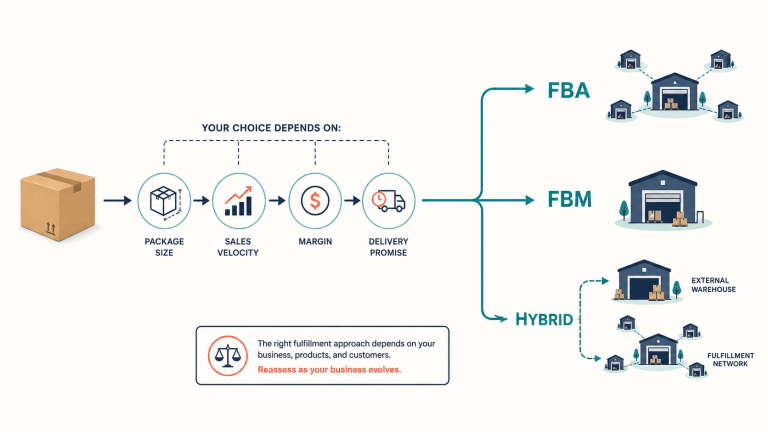
Choose FBA, FBM, or hybrid by SKU
FBA can suit compact, fast-moving products where delivery speed and outsourced operations justify the fee. FBM may work better for slow, oversized, customized, or locally stocked products when you can meet delivery and service requirements economically. A hybrid can preserve FBA availability while reducing the amount stored in Amazon’s network.
Monthly Amazon fee audit checklist
Run this audit by SKU, not only at the account level.
- Download fee data. Review Fee Preview, Payments, transaction, and relevant FBA inventory reports.
- Compare expected and charged fees. Flag changes in fulfillment fee, referral fee, surcharge, and net proceeds.
- Check dimensions and weight. Investigate SKUs that moved tiers or differ from your packaging record.
- Review inventory exposure. Identify units nearing 181 days, low historical supply, poor utilization, and peak-season storage risk.
- Allocate inbound costs. Assign placement, freight, duty, prep, and transfer costs to the SKUs that caused them.
- Update returns. Replace launch assumptions with actual return rate, recovery value, and unsellable-unit data.
- Recalculate advertising limits. Break-even ACoS should use contribution margin before advertising, not gross margin before Amazon and logistics costs.
- Choose an action. Reprice, resize packaging, change replenishment, remove stock, dispute a measurement, or change fulfillment mode.
A monthly audit will not make every SKU profitable. It will tell you which problem you actually need to solve.
Is Amazon FBA still worth it in 2026?
FBA is still worth considering when its operational and conversion value exceeds the complete alternative cost. That is a SKU-level decision.
Products that often fit FBA are compact, consistently selling, adequately margined, operationally simple, and expensive enough to absorb fulfillment and advertising. Products that need extra caution are oversized, low-priced with thin absolute margin, highly seasonal, slow-moving, fragile, frequently returned, or subject to special handling.
FBM is not free. Include warehouse labor, packaging, postage, software, customer service, returns, delivery-performance risk, and the working capital required to operate it. The Revenue Calculator can compare Amazon fulfillment with your fulfillment inputs, but the quality of the answer still depends on the quality of your numbers.
When demand is uncertain or factory minimums are large, a hybrid model can be the practical middle ground. Store reserve stock outside Amazon, replenish in smaller batches, and keep an FBM or alternative channel available where it makes economic sense.
Frequently asked questions
How much are Amazon FBA fees usually?
There is no reliable universal percentage. Add the selling plan, category referral fee, SKU-specific fulfillment fee, 3.5% surcharge, storage, inbound costs, and any conditional fees. Then add non-Amazon costs to calculate profit.
How much does Amazon take from a $100 sale?
It depends on category, fulfillment method, product size and weight, storage, and other services. A 15% referral category would create a $15 referral fee on a $100 total sales price before FBA and other costs, but not every category uses 15%.
What is the 3.5% Amazon FBA surcharge in 2026?
Starting April 17, 2026, Amazon applies a temporary 3.5% fuel and logistics-related surcharge to US FBA fulfillment fees. It is calculated on the fulfillment fee, not the sale price.
Why is my actual FBA fee higher than the calculator estimate?
Common causes include different Amazon-measured dimensions or weight, a changed fee schedule, the 3.5% surcharge, storage, placement, low-inventory or aged-inventory charges, returns, and costs that the calculator does not include.
When does Amazon charge aged inventory fees?
Eligible inventory can incur the surcharge beginning at 181 days. Amazon assesses it monthly using an inventory snapshot on the 15th, in addition to ordinary storage fees.
Is FBA cheaper than FBM?
Sometimes. FBA can be cheaper for compact, fast-moving products, while FBM can work better for other SKUs. Compare every fulfillment, storage, labor, postage, service, and return cost.
The bottom line
Amazon FBA fees become manageable when every charge has a trigger, an owner, and a per-unit value. Start with Amazon’s current calculator, but finish the model with storage, inbound placement, freight, prep, returns, product cost, and advertising. Then compare the forecast with actual Seller Central charges each month.