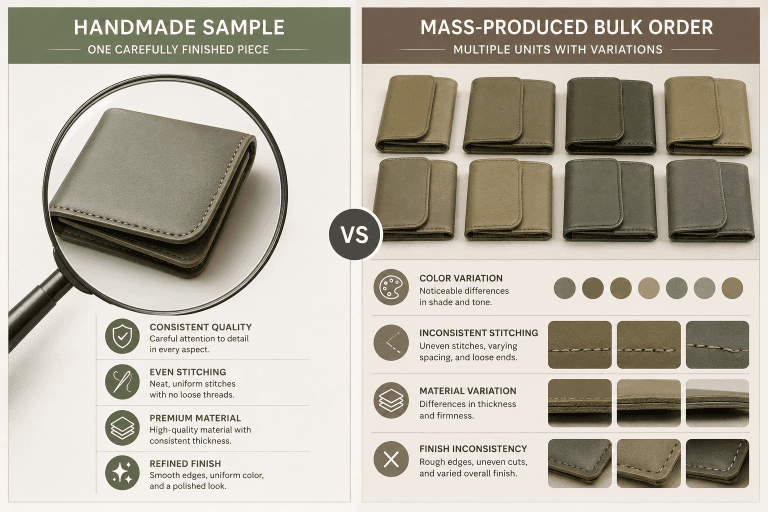
A great sample does not guarantee a great bulk order. On Alibaba, samples are often made with extra care, better materials, or manual finishing, while bulk production is where shortcuts, communication gaps, and weak quality control show up.
If you want sample quality to carry into mass production, the fix is not just “order a sample first.” You need a production-ready specification, a sample that reflects the real production process, and inspection before the final balance is released.
The sample-bulk mismatch: why it happens
This is one of the oldest sourcing problems on Alibaba, and it still catches first-time buyers. The basic issue is simple: a sample proves that a supplier can make one good unit. It does not prove they can repeat that standard across 500, 1,000, or 5,000 units.
In many cases, the sample is made by hand or assembled with extra attention because the supplier knows the sample is the sales tool. Bulk production is different. Different workers may handle it, cheaper substitute materials may appear, and the factory may start optimizing for speed or margin instead of consistency.
That is why “sample looked great, bulk was poor” shows up so often in Alibaba discussions. In the wiki, this is already flagged as one of the most common Alibaba risk patterns: suppliers may send a strong sample to win the order, then let quality slip in production if the buyer has weak controls.1
This is also where many importers get the trade-off wrong. They think the risk is choosing the wrong platform. Usually, the bigger risk is weak production control after the order is placed.
If you are still learning the basics, our guide on buying from Alibaba is a useful starting point. But once real money is on the line, supplier management matters more than platform familiarity.
Common reasons the bulk order is worse than the sample
- The sample was hand-finished, but the bulk run was line-produced.
- The supplier swapped to a lower-grade material after pricing pressure.
- The factory understood the sample visually, but not the exact tolerances.
- The bulk order was subcontracted to another workshop.
- The buyer approved a sample, but never turned that sample into a written QC standard.
A supplier is not just a quote. It is a communication system, a quality-control risk, and a delivery promise. If any one of those breaks, the bulk order starts drifting away from the sample.
How to order samples that actually reflect bulk production
The most useful sample is not always the first sample. A showroom sample or hand-made sample can help you check design direction, but it is often too optimistic.
What you really want before full production is a sample that reflects the actual manufacturing process, materials, and finish standards that will be used for the order. In sourcing language, many buyers ask for a production sample or pre-shipment reference sample rather than relying only on an early development sample.
What to ask the supplier before approving the sample
Ask direct questions in writing:
- Was this sample made by hand or on the same production line planned for the bulk order?
- Are the materials, hardware, fabric weight, color process, and packaging exactly the same as bulk production?
- Will the same factory make the bulk order, or will any part be subcontracted?
- Can you confirm the production timeline and inspection stage before shipping?
- If I approve this sample, will it be used as the golden sample for QC comparison?
This part matters because Trade Assurance is much stronger when the product requirements are clearly documented.2 If the only agreement is “same as sample,” disputes become fuzzy. If the agreement includes material specs, dimensions, finishing standards, color tolerance, packaging method, and defect rules, your position is much stronger.
For many products, the best move is to convert the approved sample into a simple quality specification sheet. That document can include:
- dimensions and tolerance range
- material type or weight
- color reference
- finish requirements
- logo placement
- packaging method
- unacceptable defects
The sample is the visual reference. The QC sheet is the enforcement tool.
If you are comparing multiple suppliers, using Alibaba RFQ to compare suppliers can make the early quote stage faster. But RFQ helps you source faster, not control production better. Those are different problems.
The role of third-party inspection
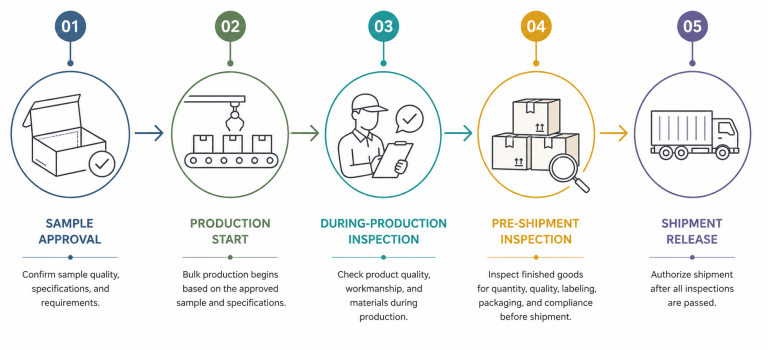
If you only check quality after the goods arrive in your country, you are already in the expensive stage of the problem. The better time to catch defects is before the final payment is released and before the shipment leaves the factory.
That is why third-party inspection matters. In the wiki, third-party inspection is treated as one of the strongest defenses in Alibaba sourcing because it gives the buyer an independent quality check before shipment.3
Typical inspection options include:
- During production inspection (DUPRO): catches problems while the order is still being made
- Pre-shipment inspection (PSI): checks the finished batch before the goods leave the factory
- Golden sample comparison: uses the approved sample and QC checklist as the benchmark
The cost is usually small compared with the cost of receiving a bad shipment. The wiki notes that a typical inspection visit is often around $200 to $300 and takes about one working day.3 For most meaningful bulk orders, that is cheap insurance.
This is the real point: inspection does not only find defects. It changes supplier behavior. Once a factory knows an outside inspector will compare the batch against your checklist and approved sample, they are less likely to cut corners.
If you already know you will need more hands-on coordination, working with a China sourcing agent can help because an agent can follow up on sample confirmation, production status, packaging details, and rework requests between the factory and the buyer.
Negotiate sample cost the smart way
Sample pricing frustrates a lot of first-time buyers because the unit cost often looks irrational. A product that will cost a few dollars in bulk may cost far more as a sample.
That is normal to a point. The wiki notes that sample prices are often much higher than bulk unit pricing because the factory is setting up a small run, handling custom work, and shipping one-off units.4 But that does not mean you should accept every sample fee without discussion.
A better approach is to negotiate the terms, not just the sticker price.
Better ways to negotiate sample fees
- Ask whether the sample fee is refundable against the first bulk order.
- Ask whether the supplier can waive the sample fee if your order passes a certain quantity threshold.
- Ask for two prices: a standard sample and a production-level sample.
- Confirm whether expedited sample shipping is necessary, or if slower shipping is acceptable for early evaluation.
One caution here: experienced buyers often avoid aggressive haggling on the very first sample because it can push the supplier to recover margin later in the process. That is one reason common Alibaba scam patterns often include quality reduction after pricing pressure. A cheaper supplier is not always a cheaper supply chain.
So yes, negotiate. But negotiate with a full view of the trade-off. Saving $30 on the sample means very little if it weakens your leverage or encourages material substitution in a $5,000 order.
Red flags that usually show up before the quality problem does
In many bad Alibaba orders, the final quality issue was not the first warning sign. The warning signs appeared earlier, during the sample and communication stage.
This is what makes the Reddit-reported case later in this article feel familiar rather than unusual. By the time buyers say “the bulk order was worse than the sample,” there were often already clues in the sample timeline, the supplier’s answers, and the way approvals were documented.
Watch for these red flags:
1. The sample takes far longer than promised
A delay by itself is not proof of fraud. But if the supplier cannot manage a simple sample timeline, that tells you something about future production discipline.
2. The supplier avoids direct answers about production timing
If they can quote a price but cannot explain lead time, production stages, or inspection timing, that is a control problem waiting to happen.
3. They resist written specifications
If a supplier prefers vague approval like “same as before” instead of documented standards, that weakens your protection in any later dispute.
4. The supplier is eager to move payment off-platform
Trade Assurance only works if the transaction stays on Alibaba. Once the supplier pushes you toward direct wire payment too early, your protection shrinks fast.2
5. Their responsiveness drops after you approve the sample
This is an underrated signal. Many suppliers are highly attentive before winning the order. What matters is how they communicate once money and deadlines are involved.
A verified supplier badge can help with initial filtering, but it is not a quality guarantee.5 Supplier verification checks business legitimacy and some production capability. It does not guarantee that your batch will match your sample.
Case study: a Reddit-reported sample that looked right, then bulk quality slipped
One buyer-reported Reddit discussion captures the problem in a way many importers immediately recognize. The buyer said they paid about $200 for a sample, waited roughly a month for it to arrive, approved what looked like a strong sample, and then felt the bulk order did not match that standard.
Taken on its own, that is still just one buyer report. But it lines up with the same warning pattern covered above: an expensive sample, a long and loosely managed timeline, and not enough proof that the approved sample had been translated into a controlled production standard.
That is the part many beginners miss. They think the sample is the proof. In reality, the sample is only the reference point. The real question is whether the supplier can reproduce it at scale, with the same materials, the same finish, and the same process discipline.
So the value of this Reddit-reported case is not that it proves exactly what happened inside one factory. Its value is that it shows how fast an approved sample can lose meaning once mass production starts without written specs, timeline control, and inspection. A good sample is not the finish line. It is the point where control needs to begin.
What to do if your bulk order is worse than the sample
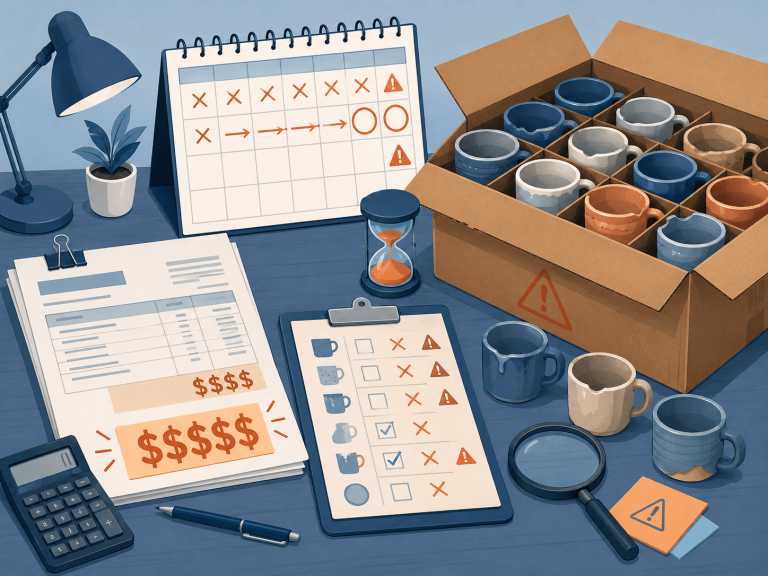
If the goods have already arrived and the quality is worse than the sample, move fast and stay organized.
Step 1: document the differences
Take clear photos and videos that show:
- the approved sample
- the bulk items
- side-by-side material or finish differences
- packaging issues
- measurement differences
- defect counts across multiple units
Step 2: compare against written specs
If you documented the sample properly, your case is much stronger. If you only approved the product informally, the dispute becomes harder to prove.
Step 3: raise the issue through Alibaba Trade Assurance
Trade Assurance is not perfect, but it is still better than having no platform protection at all.2 The clearer your documented agreement, the stronger your position.
Step 4: use inspection reports if you have them
A third-party inspection report can make a major difference because it gives independent evidence instead of just buyer dissatisfaction.3
Step 5: decide whether to salvage, rework, or replace the supplier
Sometimes the cheapest answer is partial refund and local rework. Sometimes the right answer is to stop using that supplier. The key question is not only whether this shipment can be fixed. It is whether the supplier can be trusted in the next production cycle.
How to make sample quality match the bulk order more often
If you want a simple operating rule, use this:
Do not approve a sample unless you can also enforce it.
That usually means five things:
- approve a sample that reflects actual production conditions
- turn the sample into a written QC standard
- keep payment under Trade Assurance where possible
- schedule inspection before releasing the final balance
- treat poor communication during sampling as a serious sourcing signal
For a growing ecommerce business, fulfillment is not a back-office detail. It is part of the offer. If your product sells but your quality slips in bulk production, the real damage shows up later through refunds, chargebacks, low reviews, and repeat-purchase loss.
Conclusion
The reason your Alibaba sample looked perfect while the bulk order failed is usually not mysterious. The sample sold the promise. The bulk order exposed the process.
The fix is not blind trust and it is not paranoia either. It is better control: better sample questions, better written standards, better inspection timing, and better supplier discipline. If the product is already moving, start buying control.