ETL Listed and UL Listed are both third-party product safety certification marks used in North America. Intertek issues the ETL Mark, while UL Solutions issues UL certification marks. Both Intertek Testing Services NA and UL LLC appear on OSHA’s current list of Nationally Recognized Testing Laboratories (NRTLs). OSHA does not prefer one NRTL over another when both are recognized for the same product safety standard.
That does not make every ETL and UL certification interchangeable. The product, test standard, NRTL scope, country marking, listing status, and any requirement from the local authority, customer, retailer, or project specification still need to match.
This is where most comparisons go wrong: they turn a compliance decision into a logo contest. For a buyer or manufacturer, the useful question is, “Is this exact model properly certified for its intended market, and will the party approving it accept that mark?”
ETL Listed vs UL Listed at a glance
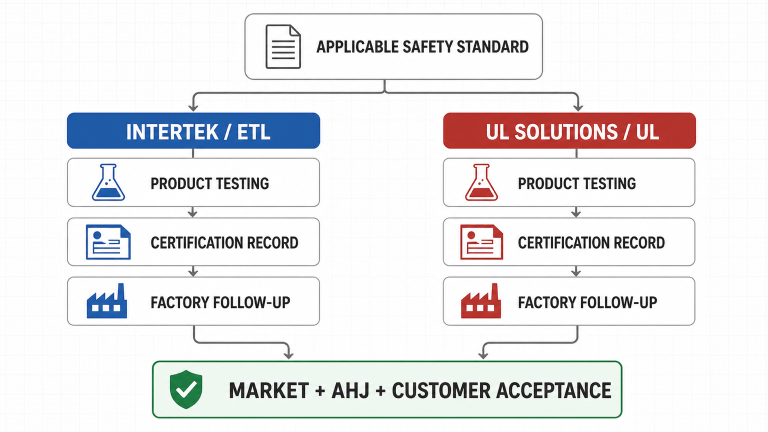
The practical difference is the certification body. ETL is Intertek’s mark; UL marks are issued by UL Solutions. The underlying safety standard may be the same, including a standard bearing the UL name. UL Standards & Engagement says UL standards are open to testing by any NRTL, including UL Solutions, Intertek, and CSA.
| Question | ETL Listed | UL Listed |
|---|---|---|
| Certification body | Intertek | UL Solutions |
| OSHA NRTL status | Intertek Testing Services NA is a current NRTL | UL LLC is a current NRTL |
| Standards used | Applicable standards may include UL, ANSI, CSA, and others | Applicable UL and other consensus safety standards |
| U.S. acceptance | Accepted under OSHA’s NRTL framework when properly certified within scope | Accepted under OSHA’s NRTL framework when properly certified within scope |
| Canada | Requires the appropriate Canadian indication and applicable certification scope | Requires the appropriate Canadian indication and applicable certification scope |
| Production control | Certification includes follow-up controls over listed production | Certification includes follow-up controls over listed production |
| Official lookup | Intertek Directory of Listed Products | UL Product iQ |
| Cost and timeline | Product-specific quote required | Product-specific quote required |
| Best choice | The mark accepted by the relevant gatekeeper, backed by the right standard and scope | The mark accepted by the relevant gatekeeper, backed by the right standard and scope |
The OSHA NRTL FAQ provides the neutral baseline. A properly certified product bears the NRTL’s registered mark, is covered by a standard in that NRTL’s recognized scope, and is certified from a recognized site. OSHA also considers NRTLs recognized for the same standard capable of testing and certifying under that standard.
What does ETL Listed mean?
An ETL Listed mark means Intertek has evaluated and certified a product to applicable safety requirements under its certification program. Intertek’s official ETL page says its program can use standards published by organizations such as UL, ANSI, and CSA, depending on the product and market. It also states that certified production is subject to regular factory inspections.
ETL is a registered certification mark administered by Intertek. It is not a separate electrical code or a less demanding version of a UL standard.
Read the whole mark. Intertek’s North American certification guidance distinguishes U.S., Canadian, and combined indications. A U.S.-only certification does not automatically cover Canada, and a Canada-only certification does not automatically cover the United States.
An ETL mark also does not prove that a product is durable, high-performing, energy efficient, secure, or suitable for every installation. It shows conformity to the safety requirements and scope named in its certification record.
What does UL Listed mean?
UL Listed generally means UL Solutions has evaluated a finished product against applicable safety requirements and authorized the corresponding certification mark. The precise mark and record matter because “UL” is often used loosely in supplier documents.
Several UL terms are easy to mix up:
- UL Listed or Certified: commonly used for finished products evaluated for an intended use.
- UL Classified: certification limited to specified properties, hazards, conditions, or uses.
- UL Recognized Component: a component or subassembly intended for use within a larger end product, subject to stated conditions of acceptability.
A recognized power supply, cable, switch, or plastic material does not make the assembled finished product UL Listed. The finished product may still need its own evaluation. UL Solutions explains this distinction in its guidance on UL Component Recognition and Classification.
“UL Approved” is another phrase to treat carefully. It is not a universal formal designation that replaces the actual certification category. Ask for the mark, file number, model coverage, and directory record rather than relying on a sales claim.
There is one more source of confusion: the UL name now spans separate organizations. UL Standards & Engagement develops standards, UL Research Institutes conducts research, and UL Solutions provides commercial testing, inspection, and certification. A product can therefore be tested to a UL standard by Intertek or another NRTL recognized for that standard.
Are ETL and UL the same safety certification?
No. They are different certification programs and different marks. They can, however, demonstrate conformity to the same applicable product safety standard when the scope and market match.
Use four filters before calling two certifications equivalent:
- Standard: Are both products evaluated to the correct current standard for this product and use?
- Scope: Is the certification body recognized and authorized for that standard, site, and program?
- Market: Does the mark cover the United States, Canada, or both as required?
- Gatekeeper: Will the AHJ, customer, retailer, insurer, or written project specification accept the mark?
OSHA’s position is specific. It considers recognized NRTLs capable under the same recognized standard and says it does not prefer one NRTL. OSHA also notes that local governments may decide the nature and extent of acceptance during local-code enforcement. Therefore, “equivalent under the applicable NRTL requirement” may be accurate, while “accepted everywhere” is not.
Does ETL test products to UL standards?
Yes, Intertek can test and certify products to UL standards when the standard is appropriate and falls within its recognized scope. UL Standards & Engagement states that UL standards are open to testing by any NRTL, including Intertek. In that case, the standard may carry the UL name, but the certification mark on the product is ETL.
Suppose a supplier says a device was “tested to UL 62368-1.” That sentence alone does not prove an active product certification. Ask which NRTL issued it, which models it covers, and where the record can be verified.
ETL vs UL: the differences that matter in a real project
Issuer, mark, and directory
The issuer determines which certification mark appears on the product and which official database holds the record. Verify ETL Listed products through Intertek’s Directory of Listed Products. Verify UL certifications through UL Product iQ.
A certificate PDF is a starting point, not the finish line. Even a genuine document can belong to another company, another model, a component, or an obsolete construction. Fulfillbot’s supplier verification guide explains how to match certificates and reports with the legal seller, factory, model, and production arrangement before paying a deposit.
Product-category scope and technical fit
NRTL recognition is not a blanket permission to certify every product. OSHA defines scope by standards, recognized sites, and supplemental programs. A lab with engineers and facilities experienced in your product category may produce fewer surprises than a lab chosen only by name.
Before requesting a quote, identify the likely product standard and send a clear product description, schematics, critical component list, ratings, intended environment, markets, and manufacturing sites. If the product is still changing, discuss pre-compliance work before freezing the design.
Customer, project, and AHJ requirements
A code may allow certification by a recognized NRTL while a procurement document says “UL Listed.” That wording can become a commercial gate even when another NRTL mark could satisfy the underlying safety rule. Get written confirmation before paying for testing.
This is especially important for building equipment, workplace machinery, public projects, retailer onboarding, and products reviewed by an inspector. The final decision may involve an Authority Having Jurisdiction, not only the test lab.
Cost and certification time
There is no reliable universal rule that ETL is always cheaper or faster than UL. Intertek markets speed as a benefit, but a general marketing statement cannot price your project. OSHA tells manufacturers to contact NRTLs directly for time and price estimates.
Compare quotes on the same basis:
- the same product models and variants
- the same safety standard and national differences
- the same U.S. and Canadian market scope
- required sample quantities and destructive tests
- engineering review, travel, retest, and project-management fees
- factory inspection and annual follow-up costs
- label, file maintenance, and change-evaluation fees
- assumptions about components, documents, and test data already available
A low initial quote can become expensive if it excludes follow-up service or assumes that a critical component already has acceptable certification.
U.S. and Canadian markings
Country identifiers are not decoration. On ETL marks, the U.S. and Canadian indicators show which market or markets are covered. UL certification marks likewise use country codes or mark configurations to communicate scope. Verify the geographic coverage in the official record rather than judging from a cropped logo in a catalog.
Canadian acceptance also depends on Canadian accreditation and provincial or local rules. A U.S. NRTL listing alone should not be presented as automatic Canadian approval.
Is ETL or UL certification legally required?
The answer depends on the product and where it is used.
OSHA’s standards require NRTL approval for certain types of workplace equipment under specified conditions. Its FAQ says these requirements cover 39 broad product types and gives many kinds of electrical equipment used in workplaces as an example. This is not the same as a federal rule saying every electrical consumer product sold in the United States must carry ETL or UL.
OSHA regulates employers, not every manufacturer or supplier directly. Even so, a manufacturer may need certification because employer-customers must buy approved equipment, a code or AHJ requires it, or a retailer, insurer, customer, or contract makes it a condition of sale.
A valid certification does not answer every compliance question. FCC, energy-efficiency, chemical, battery-transport, food-contact, medical-device, or other rules may apply to the same product. These are separate compliance layers and should be checked against the exact product and destination market.
For importers, certification planning should happen before the purchase order and certainly before mass production. Fulfillbot’s guides to importing from China and shipping from China to the USA cover the wider supplier, customs, documentation, and freight workflow. Neither a marketplace listing nor customs release proves that an electrical product has the certification required for its installation or use.
How to choose between ETL and UL
Start with the approval path for the product, not the mark people recognize first.
- Define the product and use. Record ratings, power source, user environment, installation method, and target countries.
- Identify the applicable standard. Ask candidate NRTLs to confirm the standard and any U.S. or Canadian national differences in writing.
- List the gatekeepers. Check the AHJ, customer specification, architect or engineer, retailer, insurer, and marketplace requirements.
- Compare scoped quotes. Use identical product information and compare testing, follow-up, change control, and annual costs.
- Freeze the certified construction. Make sure the production BOM, factory, labels, critical components, and model family match the evaluated version.
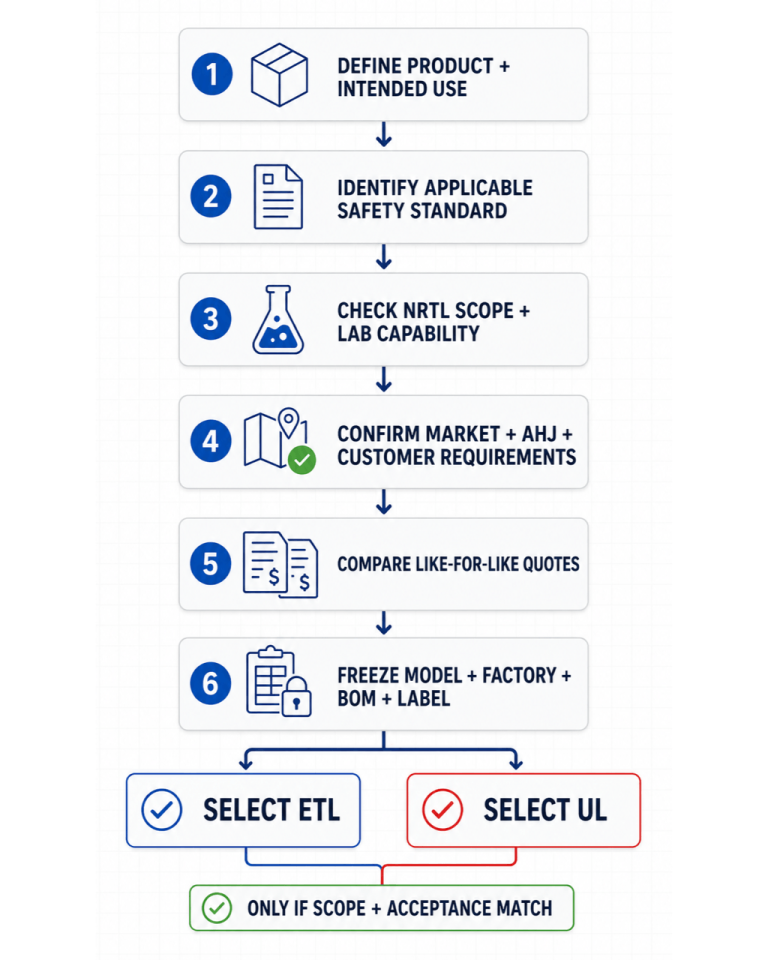
If a customer specification explicitly requires UL Listed, do not assume ETL can replace it. Ask the customer or specifier to approve the substitution in writing. Conversely, if the requirement is certification by an NRTL recognized for the applicable standard, either may be viable if all other conditions are satisfied.
How to verify an ETL or UL certification before buying
Verification has one job: connect the mark on the product to the exact goods you are ordering.
1. Inspect the complete product label
Request clear photos of the certification label on a production unit. Look for the full mark, country identifiers, model number, electrical ratings, and any control or file number. A logo pasted into a quotation is not evidence.
2. Search the official directory
Use Intertek’s directory for ETL records or UL Product iQ for UL records. UL Product iQ supports searches by terms such as file number, CCN, assembly number, design number, and construction number.
3. Match the details
Compare the directory record with the purchase order and sample:
- legal listing holder or manufacturer
- exact model or covered model family
- product category and intended use
- applicable standard
- country coverage
- file or control number
- certification status
- manufacturing location when listed or controlled by the program
4. Confirm finished-product coverage
Do not confuse a component’s certification with a finished-product listing. Ask the supplier to point to the exact finished model in the official record.
5. Control changes after approval
Changing a power supply, enclosure material, fuse, wire, PCB spacing, motor, factory, or model designation can affect the certified construction. Require the supplier to disclose changes and obtain the certification body’s authorization where needed.
An approved sample does not control mass production by itself. Fulfillbot’s guide to why an Alibaba bulk order can differ from the sample explains why the approved unit should be backed by a written specification, change control, and inspection.
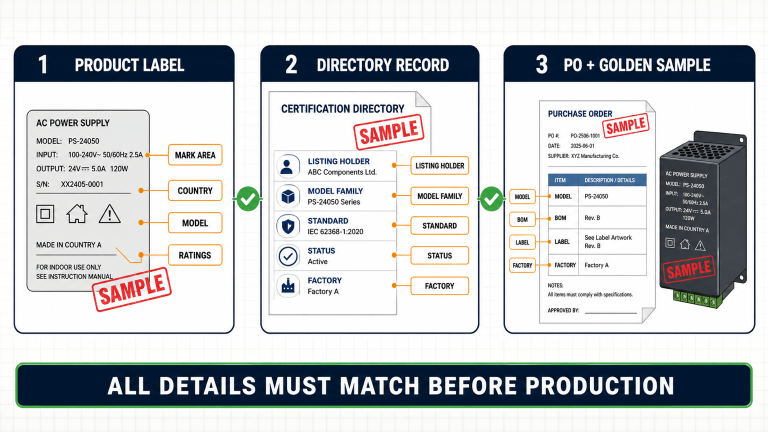
Red flags include a certificate holder unrelated to the supplier, a similar but different model number, a report without an active listing, a component record presented as finished-product certification, a mark with the wrong country scope, and a supplier refusing to share label photos or a directory link.
Common ETL and UL myths
Myth: ETL is a weaker safety standard
ETL is a certification mark, not a separate weaker standard. An ETL Listed product may be evaluated to the same product safety standard used for a UL-certified product. The comparison still needs to match standard, scope, market, and product construction.
Myth: UL is legally required for every electrical product
Some rules and specifications require third-party certification or approval, but the exact obligation depends on the product and use. OSHA does not say every electrical consumer product must be UL Listed.
Myth: ETL is always cheaper and faster
Project scope, test failures, documentation, component choices, lab availability, factory locations, and follow-up requirements all affect price and schedule. Obtain comparable written quotes.
Myth: Certified components make the finished product certified
Component recognition can make an end-product evaluation easier, but it does not automatically certify the complete assembly.
Myth: CE can replace ETL or UL in the United States
OSHA says the CE mark is unrelated to U.S. NRTL requirements. CE may be relevant for the European market, but it is not a substitute where U.S. rules call for NRTL approval.
Myth: A safety listing guarantees overall product quality
A listing addresses specified safety requirements. It does not automatically rate lifespan, finish, customer satisfaction, performance, or freedom from defects.
Final recommendation
Choose ETL or UL only after confirming the applicable standard, the NRTL’s scope, the destination-market marking, and the requirements of the party that will approve or buy the product. If both paths meet those conditions, compare written quotes, lab capability, communication, follow-up costs, and change-control support.
For buyers sourcing from China, match the record to the production model, listing holder, factory, label, and BOM before paying for mass production. A familiar logo cannot repair a mismatch between a certificate and the goods in the container. If you need China-side help coordinating supplier checks, samples, specifications, and production handoff, review Fulfillbot’s China sourcing service.
Frequently asked questions
Is ETL certification accepted in the United States?
Yes, a properly certified ETL Listed product can satisfy applicable OSHA NRTL requirements when Intertek is recognized for the relevant standard and the certification is within its scope. Local code enforcement, project specifications, and customer requirements can still affect acceptance.
Is ETL Listed as good as UL Listed?
For conformity to the same applicable safety standard, OSHA does not prefer one recognized NRTL over another. That does not make every ETL and UL record identical or guarantee the same commercial acceptance. Check the standard, scope, market, product, and gatekeeper.
Does ETL test products to UL standards?
Yes. Intertek can test and certify products to applicable UL standards within its recognized scope. The resulting product carries the ETL Mark, not a UL certification mark.
Is ETL cheaper or faster than UL?
Sometimes one quote may be lower or quicker, but no universal difference can be stated responsibly. Compare written quotes for the same models, standards, markets, testing assumptions, factory inspections, follow-up service, and change fees.
Can ETL replace UL when a project specification says UL Listed?
Not automatically. The underlying code may accept another qualified NRTL, but the written project or customer specification may still require UL. Obtain approval from the specifier or customer in writing before changing the certification path.