Dead stock is inventory that has remained unsold beyond its expected selling window and has little demand through your normal sales process. It ties up purchasing cash and storage space, even when the products are still usable.
The difficult part is deciding what to do next. A discount can recover cash, but packing, delivery, advertising, and another month of storage can consume much of the proceeds. Waiting can also be reasonable if there is a credible seasonal selling opportunity.
Start with the affected SKUs. Check why they stopped moving, compare the cash each disposal or sales route could return, and give the decision a deadline. Then use what you learned before placing the next purchase order.
What is dead stock?
Dead stock can be perfectly usable. A particular size, color, or accessory may stop selling while the rest of the product line performs well. The problem is the money and space committed to goods that have little prospect of moving through their intended sales channel.
The term needs context. In sneaker resale, “deadstock” often describes new, unworn merchandise rather than unwanted warehouse inventory. Shopify explains this distinction in its dead stock guide. This article covers inventory held by sellers.
Dead stock, slow-moving stock, excess stock, and obsolete stock
These terms overlap in practice. For deciding what to do with a SKU, use the following working distinctions:
| Inventory condition | What to investigate | Possible response |
|---|---|---|
| Slow-moving | Sales continue, but more slowly than expected | Review quantity, price, visibility, and replenishment |
| Excess | Supply exceeds the quantity needed for expected demand | Reduce new purchases and work through the surplus |
| Dead stock | The expected selling window has passed with little credible demand remaining | Choose a recovery route and an exit date |
| Obsolete | The item has lost its intended use or market fit | Check whether any suitable resale, reuse, or disposal route remains |
NetSuite’s obsolete inventory guide describes how inventory can progress from slow-moving to excess and obsolete. Those categories are useful warnings, but they do not create a universal age cutoff.
A seasonal item with a supported next-season forecast deserves a different decision from an accessory for a discontinued device. Record when you expect demand to return and what evidence supports that forecast.
How to identify dead stock by SKU and variant
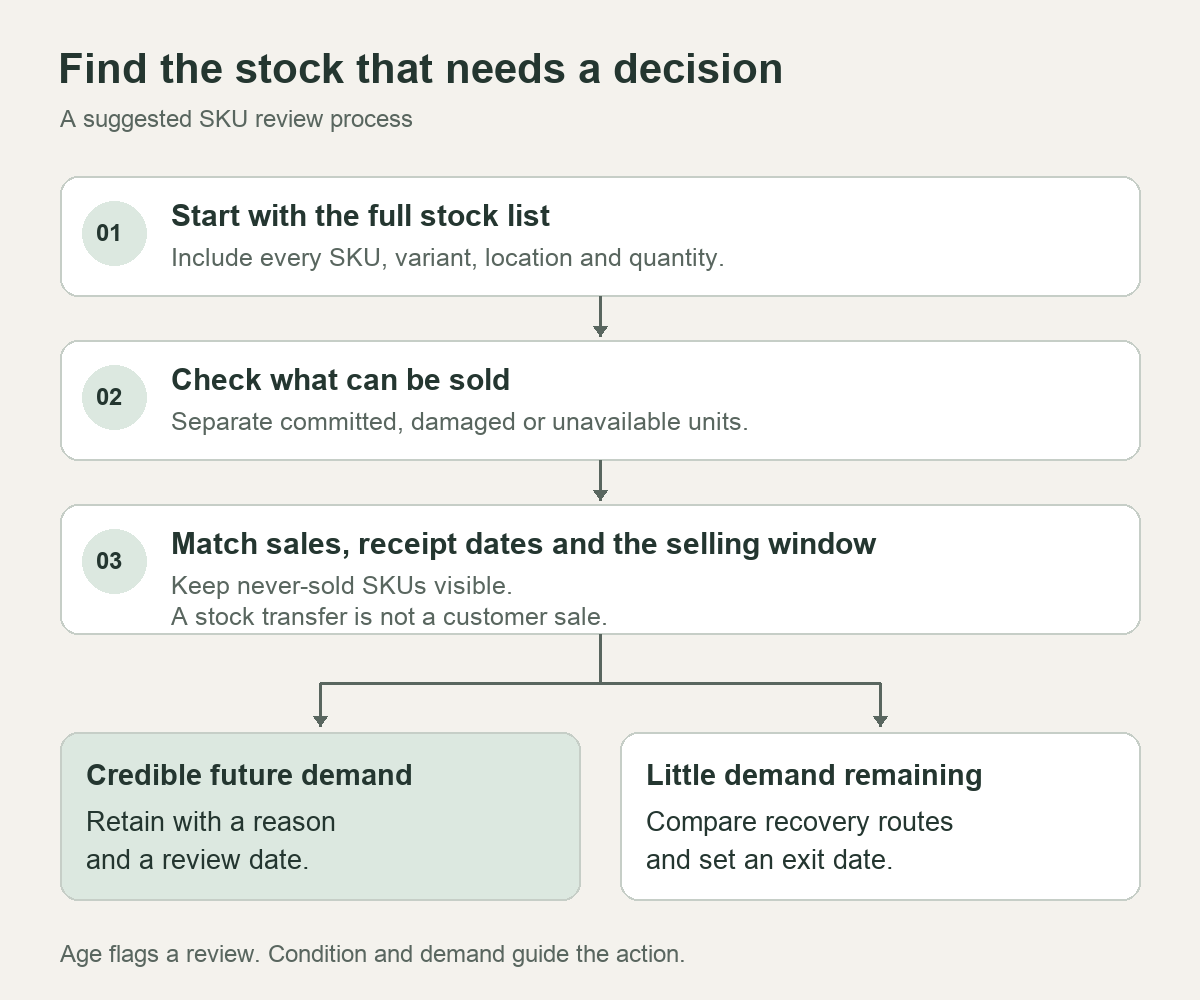
Start with a complete inventory list, then match it to sales and receiving records. Keep products with no sales in the review, even if they are absent from your sales reports.
Work at SKU or variant level and separate locations where necessary. If black medium shirts sell and orange extra-small shirts do not, a product-level total can hide the problem. Check the physical quantity and condition before committing stock to a clearance order.
Separate inventory age from time since the last sale
These measurements answer different questions:
- Receipt or batch age shows how long particular units have been held.
- Time since the last customer sale shows how long demand has been absent.
- Sales over a selected period show the recent pace of demand.
A warehouse transfer changes location without creating a customer sale. A recent receipt also does not make the older units of the same SKU new. Where batches matter, retain receiving dates rather than assigning every unit the latest receipt date.
For a SKU with no sales history, mark “never sold” and check when it became available for sale. Otherwise, a blank last-sale date can disappear from an aging filter.
Use a review sheet with these fields:
| Field | What it helps you decide |
|---|---|
| SKU, variant, location | Which exact stock needs attention |
| Quantity and sellable condition | What can actually be offered to customers |
| Receipt dates and last sale | Whether age and demand tell the same story |
| Sales period and units sold | Whether movement is slowing or absent |
| Expected selling window | Whether seasonality or the product life cycle explains the delay |
| Unit cost and future holding cost | How much cash is involved |
| Proposed action, owner, review date | Who will act and when the decision will be revisited |
Choose review windows that fit the category. For example, 90 and 180 days can be filters for investigation; they should not automatically trigger the same decision for seasonal goods, spare parts, and fashion accessories.
Check whether customers can actually buy the item
Before cutting the price, check the listing, channel availability, product information, and variant selection. An item hidden from the storefront has a visibility problem that a discount alone may not fix. Also separate damaged, expired, or restricted goods from stock suitable for ordinary resale.
For Shopify stores, the official inventory-report documentation contains two useful limits: the sell-through report only includes variants that have sold at least once before or during the selected period, and zero recent sales can produce an N/A value for days of inventory remaining. Cross-check the full inventory list; neither a missing row nor N/A proves an item is healthy or dead.
The same documentation says inventory reports switched from Available to On hand quantity on October 1, 2026. On hand also includes Committed and Unavailable units. Check that distinction when comparing periods or deciding how much stock you can offer.
Why dead stock builds up
Use the review to find the purchasing or operating decision that needs to change.
Start with the original quantity decision. If a supplier’s price break pushed you into a larger order, compare the saving with the quantity left over. A lower unit price can still produce a larger cash commitment and more unsold goods.
Uneven sales across variants call for a look at the original size or color allocation. Reordering the same mix because the product sold well in total can repeat the problem.
For goods that arrived after the season, revisit the order date and the whole lead time. Production, inspection, transit, and receiving all affect when stock becomes available to customers.
Quality complaints and returns need a batch-level check before you add promotion. Discounting does not correct a defective product.
Finally, look for duplicate purchases and misleading demand signals. Inventory held in another location or already on order can be overlooked. A promotion may also create a sales spike that will not continue at the normal price. Record what changed before using those sales to justify another order.
What dead stock costs—and how much cash you can recover
Keep the original inventory investment separate from the cost of the next decision.
For an operational review, estimate the original cost of the remaining units using a consistent cost basis. If you source from China, calculate your landed cost to a named location. The factory price alone does not describe what you paid to get goods there. This purchasing calculation does not replace your accounting inventory valuation.
Then estimate the costs that change with each option: additional storage, handling, packaging, selling fees, delivery, promotion, and any expected return expense. Check which costs are already included in a quote so you do not subtract them twice.
Cash tied up in stock may also prevent another purchase. Treat that as an opportunity to evaluate, rather than automatically counting a hypothetical missed sale as a cash expense.
A 300-unit clearance example
Suppose 300 unsold units originally cost $10 each landed, so $3,000 was committed to this stock. You are comparing two ways to sell the whole batch.
Every amount below is hypothetical. Both routes assume all 300 units sell and payment is collected. These are not supplier quotes, typical recovery rates, or customer results.
| Cash item | Targeted clearance over 30 days | Immediate bulk sale |
|---|---|---|
| Selling price per unit | $8.00 | $5.00 |
| Gross receipts | $2,400 | $1,500 |
| New selling/handling/delivery costs | $900 ($3/unit) | $150 ($0.50/unit) |
| Campaign spending | $60 | $0 |
| Additional holding cost | $120 | $0 |
| Net recovery from today | $1,320 | $1,350 |
Clearance returns 300 × $8 − $900 − $60 − $120 = $1,320. The bulk sale returns 300 × $5 − $150 = $1,350.
The bulk buyer offers a much lower selling price, yet this example leaves $30 more cash after the listed costs. It also assumes immediate collection, while clearance takes up to 30 days. A different quote or cost estimate can change the result.
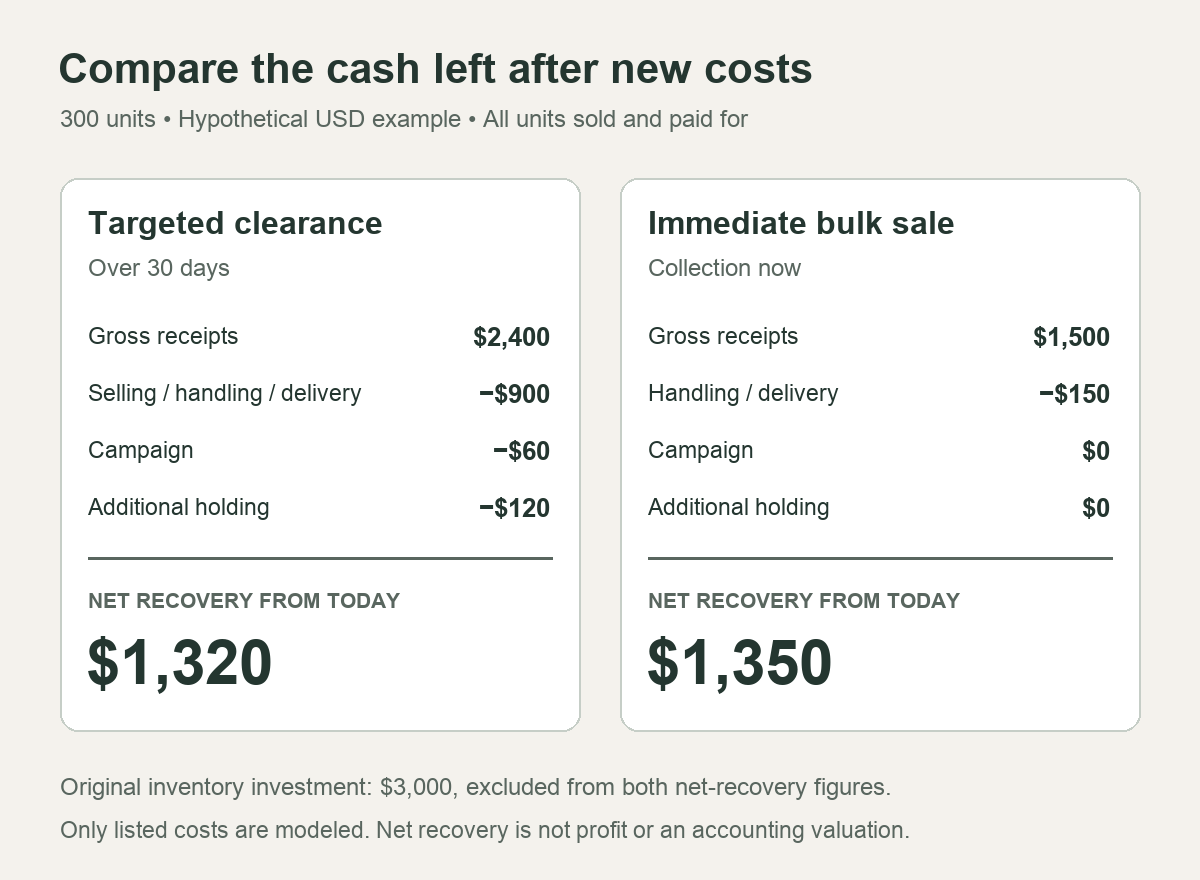
The original $3,000 still matters when reviewing the purchase. The two options leave $1,680 and $1,650 of that original investment unrecovered, respectively. Those are simplified cash shortfalls, not accounting write-downs or net-profit figures. The model excludes tax treatment, the time value of money, and any costs not listed.
If clearance sells only part of the batch, use that lower quantity in the calculation and record the remaining units separately. Add their expected holding costs and next action. Do not count an estimated residual value as collected cash.
For bundles, compare the order with and without the extra product. Charge the additional packing, shipping, discount, and return exposure to the decision. Attributing the whole bundle’s revenue to the slow item would overstate what it contributed.
How to clear dead stock: choose the route that fits
Choose a route based on remaining demand, condition, net recovery, time, and brand fit. Shopify’s overview of recovery options includes markdowns, bundles, alternative selling channels, donation, and disposal. The practical task is deciding which option suits the stock you actually hold.
| Route | When to consider it | What to check before acting |
|---|---|---|
| Improve the listing or change channel | The item is usable but poorly presented or reaching the wrong buyers | Setup work, channel fees, and evidence of demand |
| Run a targeted markdown | There is a reason to expect a lower price to generate sales | Net recovery, campaign cost, and a firm end date |
| Bundle or offer a gift with purchase | The item is useful alongside another purchase | Incremental order economics and whether customers want the combination |
| Negotiate a supplier return or exchange | The supplier is willing and the goods meet agreed conditions | Written acceptance, freight, deductions, and what credit can buy |
| Sell the lot to a bulk buyer | You need a defined exit and have a credible offer | Accepted quantities, inspection deductions, payment, and collection |
| Donate, recycle, or dispose | Suitable resale is unavailable or uneconomic | Recipient acceptance, product condition, handling, and applicable requirements |
A supplier return is an agreement to obtain, not an entitlement to assume. Likewise, a bulk buyer’s headline price needs to survive inspection, collection costs, and payment terms before it becomes a useful comparison.
Do not put unusable or unsafe goods into a bundle to get them out of the warehouse. Keep them separate while arranging an appropriate route. Donation also creates no sale proceeds; this article does not assume a tax benefit.
Give a markdown an end date. At that point, check the opening quantity, units sold, cash collected, incremental costs, and units left. Use those results to choose the next action. Another round of the same discount needs a reason.
How to prevent dead stock before the next purchase order
Attach the clearance result to the SKU record before reordering. The next buyer needs to see why the previous batch stalled and what it cost to clear.
Set quantities by variant
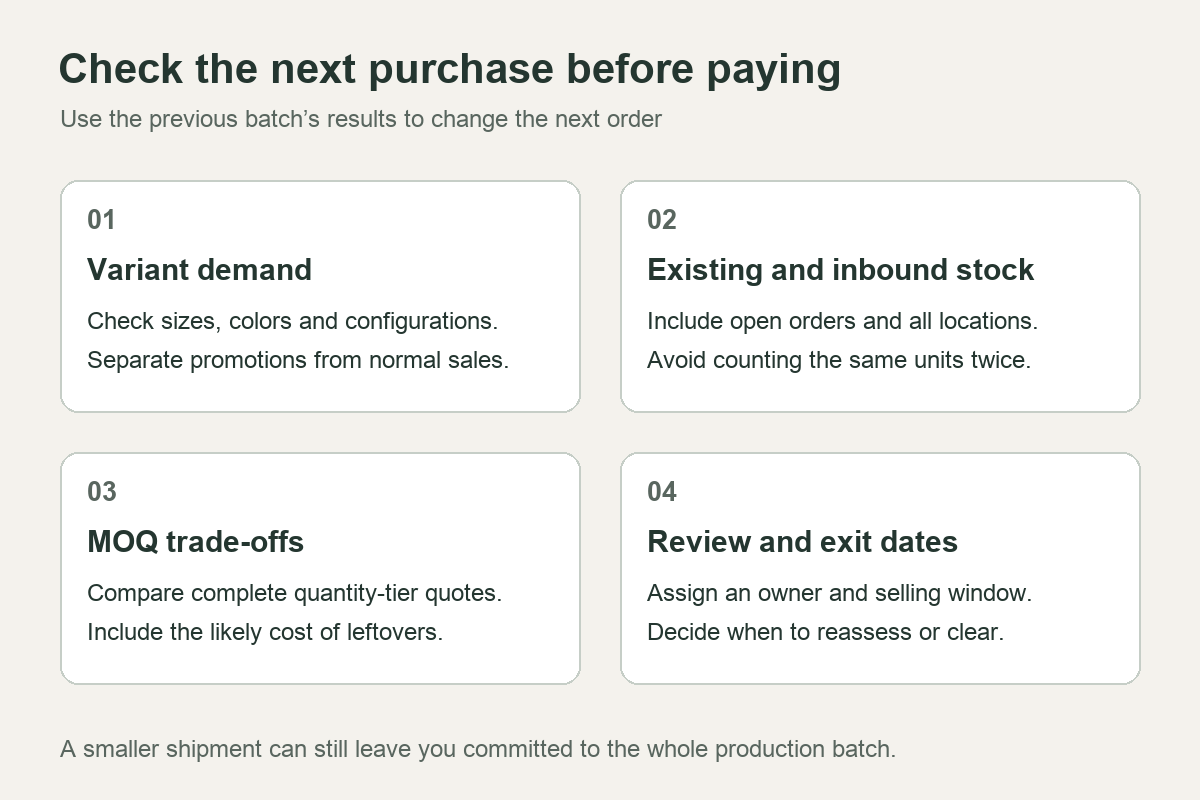
Review demand for each size, color, and configuration. Include stock across locations, confirmed inbound quantities, and open purchase orders, taking care not to count the same units twice. Separate customer-committed quantities from stock available for new orders.
Compare the expected selling window with the full replenishment lead time. A seasonal purchase needs a useful arrival date as well as an acceptable factory price. Review promotional spikes and returns before treating last month’s gross sales as next month’s demand.
Compare MOQ with the cost of leftovers
Ask suppliers about a smaller trial, fewer variants, standard materials, or simpler packaging where those changes would suit the product. Availability and pricing depend on the supplier’s constraints.
Compare complete quotes at each quantity. A smaller order can cost more per unit while putting less cash at risk; it can also become too expensive after setup and freight. Our guide to negotiating a smaller, viable order explains how to evaluate those trade-offs.
Staged shipping needs a separate check. If you buy the entire production batch now, shipping it in portions does not reduce the quantity you own. Confirm payment dates, ownership, storage charges, damage responsibility, and the final collection date.
Fulfillbot’s China warehousing and consolidation service can receive and consolidate goods from multiple suppliers and support the shipping handoff. Assess that service against your location and dispatch needs; moving inventory by itself does not create customer demand.
Set review dates and an exit plan before buying
Give each unproven or seasonal purchase a named owner, a selling window, and a review date. Agree what would justify reordering, testing a markdown, or seeking a bulk offer. Use the product’s economics and selling cycle to set those triggers.
When the review arrives, record a decision. Keeping the stock can be reasonable, but it should have a demand assumption, a cost estimate, and another review date attached.
If you need help with the China purchasing side, Fulfillbot can compare supplier quotes and MOQ options, coordinate samples, and arrange agreed checks and shipping preparation. Send the product specifications, quantities by variant, existing MOQ, destination, and required timing. That gives the sourcing review something concrete to assess before you commit to the next batch.
Dead stock FAQ
How long before inventory becomes dead stock?
Judge the product against its expected selling window and remaining demand. A 90- or 180-day filter is a prompt to investigate. Seasonal goods and long-cycle parts may need a longer window, supported by a reason to keep them.
Can dead stock still be sold?
Sometimes. A lower price, relevant bundle, different buyer, or bulk offer may recover cash. Compare the net proceeds with the additional work and costs. Recovery of some cash does not mean the original purchase was profitable.
Is deadstock the same as dead stock?
The meaning depends on context. In inventory management, it refers to stock that is not selling as expected. In sneaker resale, the term often describes unworn condition. Check how a seller or report uses it.
Is moving stock to another warehouse enough?
A move can help if it improves access to buyers or lowers future costs enough to cover transfer expenses. If the goods simply sit elsewhere, the demand problem remains.