You can ship goods bought on 1688 to the USA, but confirm who handles each part of the trip before you pay. A supplier’s delivery charge may cover only a Chinese address. For a multi-supplier order, one workable route is to send purchases to a receiving warehouse in China, check them, consolidate suitable items, and book onward transport to your U.S. destination.
For brands, Amazon sellers and retailers buying replenishment stock, planning 1688 shipping to the USA starts before the cartons reach a carrier. Decide what needs checking, which orders can wait, and what the quote must cover.
Featured image: AI-generated illustration; this is not a photograph of a Fulfillbot facility or customer shipment.
Does 1688 ship directly to the USA?
A supplier’s delivery charge may cover only delivery within China. Check the destination in the order rather than assuming it includes the USA. WorldFirst’s guide to buying from 1688 outside China explains the domestic-market focus and forwarding arrangement; its Australian payment guidance should not be treated as U.S. account eligibility.
Decide who will handle the purchase and the shipment:
- The supplier arranges international delivery, with the destination and included charges agreed in writing.
- You buy directly and appoint a forwarder to receive and ship the goods.
- A purchasing agent helps coordinate buying and logistics, within an agreed service scope.
Fulfillbot can help coordinate purchasing, or receive goods from suppliers you already use for checks, storage, preparation and shipping. Choose the scope you need; a freight-only order does not require a full sourcing project. Confirm separately who buys the goods, pays the supplier and handles any supplier dispute.
How to ship 1688 orders to the USA, step by step
1. Confirm the receiving address before ordering
Get the Chinese warehouse address, contact details, and customer reference from your logistics provider. Give every supplier the same receiving instructions. Confirm that the warehouse accepts your product category and ask about receiving fees, storage terms, and delivery hours.
For a Fulfillbot shipment, obtain the assigned receiving address and reference from the team before instructing suppliers; a general office address is not a receiving instruction. Decide whether the stock is going to your premises, a U.S. 3PL or Amazon. If you want ongoing delivery to individual customers instead, agree on that fulfillment setup separately.
2. Track each supplier order separately
Record the 1688 order number and domestic tracking number against each SKU. One supplier may send several parcels; a delivered tracking number does not prove the entire purchase arrived.
Use these fields in your inventory system or a shared receiving sheet. The entries below are fictional examples, not customer results.
| Supplier / order | SKU | Expected / received | Domestic tracking | Issue | Remaining goods ETA | Release |
|---|---|---|---|---|---|---|
| A / PO-01 | Blue pouch | 100 / 100 | Add every parcel ID | None recorded | All received | Await QC |
| B / PO-02 | Small organizer | 60 / 48 | Add every parcel ID | 12 units missing | Supplier to confirm | Hold |
Separate arrival, quantity confirmation, QC acceptance and release status. A parcel marked delivered can still contain a shortage, and received stock may still be on hold. Retain this distinction in the inventory record.
3. Check the goods before releasing them
Agree on the inspection scope before arrival: carton or unit counts, visible defects, sampled or full checks, and any requested functional testing. Fulfillbot can arrange checks and pre-shipment photos within the agreed scope; a photo set does not prove that every unit works or replace required product testing.
Specify the SKU, materials, dimensions, color, quantity, packaging and defects that trigger a hold. For a branded product, include approved artwork or a reference sample. If goods fail the check, document the issue before deciding on replacement, domestic return or exclusion from the shipment. Contact the supplier promptly: return approval and costs depend on the purchase terms, and Fulfillbot’s return assistance does not guarantee a seller refund.
Name the person who can approve release. A disputed carton needs a decision: hold it, return it, or ship the accepted units.
4. Consolidate, repack and measure the shipment
Consolidation means grouping suitable purchases for onward shipping. It may involve repacking several supplier parcels into fewer export cartons, though some goods should retain their protective packaging.
Tell the warehouse which retail boxes, inserts, labels and protective materials must stay. Keep each SKU traceable to its export carton, especially when the order will be split between destinations. Ask for final carton counts, outside dimensions, gross weights and packing photos. Use those measurements to update the freight quote; supplier estimates are only the starting point.
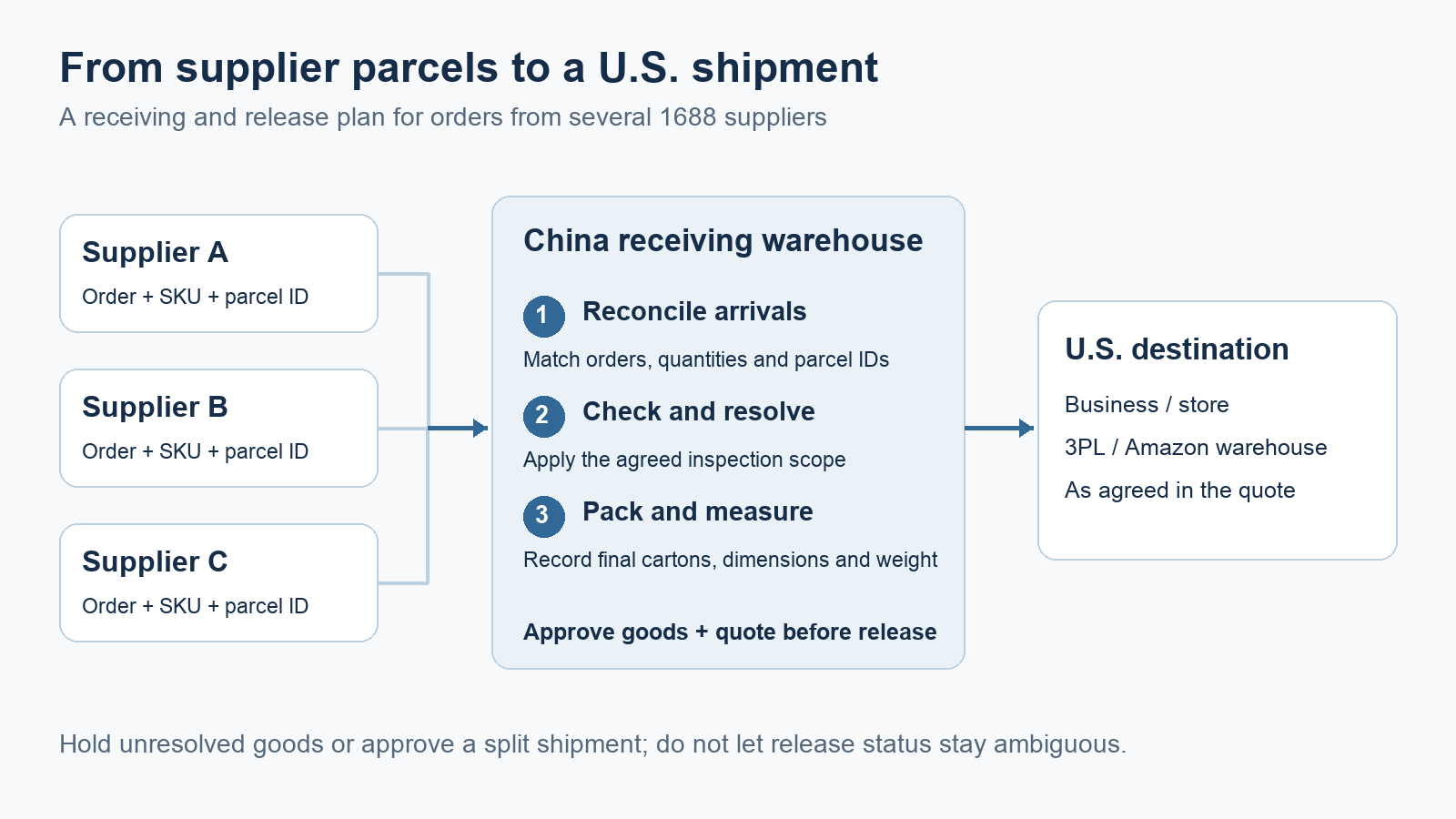
5. Approve the quote and delivery scope
Match the quote to those final measurements and your destination ZIP code. Check the service, collection point, delivery endpoint, validity period, and excluded charges.
Before release, get the delivery estimate’s start point and name the person handling documents and carrier questions. If you want cargo insurance, confirm its cost, coverage and claim procedure in the quote. Retain packing photos, carton records and delivery receipts in case goods arrive short or damaged.
How much does shipping from 1688 to the USA cost?
Your 1688 shipping cost depends on the packed goods, route, service and delivery scope. Build the budget in stages, then check which charges the quote already includes.
| Cost component | What to check |
|---|---|
| Optional purchasing service | Sourcing, supplier coordination or payment assistance when ordered; separate from freight |
| China domestic delivery | Each supplier’s delivery to the receiving warehouse |
| Warehouse work | Receiving, agreed checks, storage, consolidation, packing materials and labor |
| International freight | Service, packed measurements, minimum charges, surcharges and optional cargo insurance |
| Import clearance and charges | Brokerage scope, applicable duties and other entry-related charges |
| U.S. delivery | Final address, residential or warehouse conditions, appointments and accessorial charges |
Fulfillbot’s pricing plans separate service options and list QC photography as an extra: $1.50 per product for four photos, checked October 17, 2026. Confirm which inspection work and photos your quote includes. Free storage also depends on the service arrangement; some plans list one month, while China warehousing advertises up to 60 days. Get your allowance, start date and any overage charges in writing.
Keep product cost separate when comparing freight quotes, then include it when calculating inventory margin. Our China landed cost calculator helps organize the wider cost calculation. Avoid adding a charge twice when it is already included in a bundled price.
Actual weight versus dimensional weight
Light products in large boxes can cost more to ship than their scale weight suggests. Dimensional weight accounts for the space a parcel occupies. FedEx’s dimensional-weight explanation describes comparing dimensional and actual weight and using the greater figure. The divisor, rounding, and applicable limits depend on the quoted service.
For the Fulfillbot shipping channels discussed here, calculate dimensional weight using outside carton dimensions in centimeters:
| Shipping option | Dimensional weight in kg |
|---|---|
| Express courier | Length × width × height ÷ 5,000 |
| Air freight plus final delivery (air delivery service) | Length × width × height ÷ 6,000 |
| Sea freight plus final delivery (sea delivery service) | Length × width × height ÷ 6,000 |
Compare that result with the carton’s actual gross weight and use the greater figure, then apply the quoted rounding and minimum-charge rules. The sea-delivery formula describes the kilogram-based channel here; conventional LCL and full-container ocean quotes use their own billing basis.
Here is a hypothetical express-courier packing example using the 5,000 divisor. The dimensions and weights are illustrative:
| Measurement | Before repacking | After repacking |
|---|---|---|
| Cartons | Two, each 40 × 30 × 30 cm | One, 50 × 40 × 25 cm |
| Actual gross weight | 4 kg each; 8 kg total | 8 kg total, assumed unchanged |
| Dimensional weight | 7.2 kg each; 14.4 kg total | 10 kg |
| Greater of actual and dimensional weight | 14.4 kg across two cartons | 10 kg |
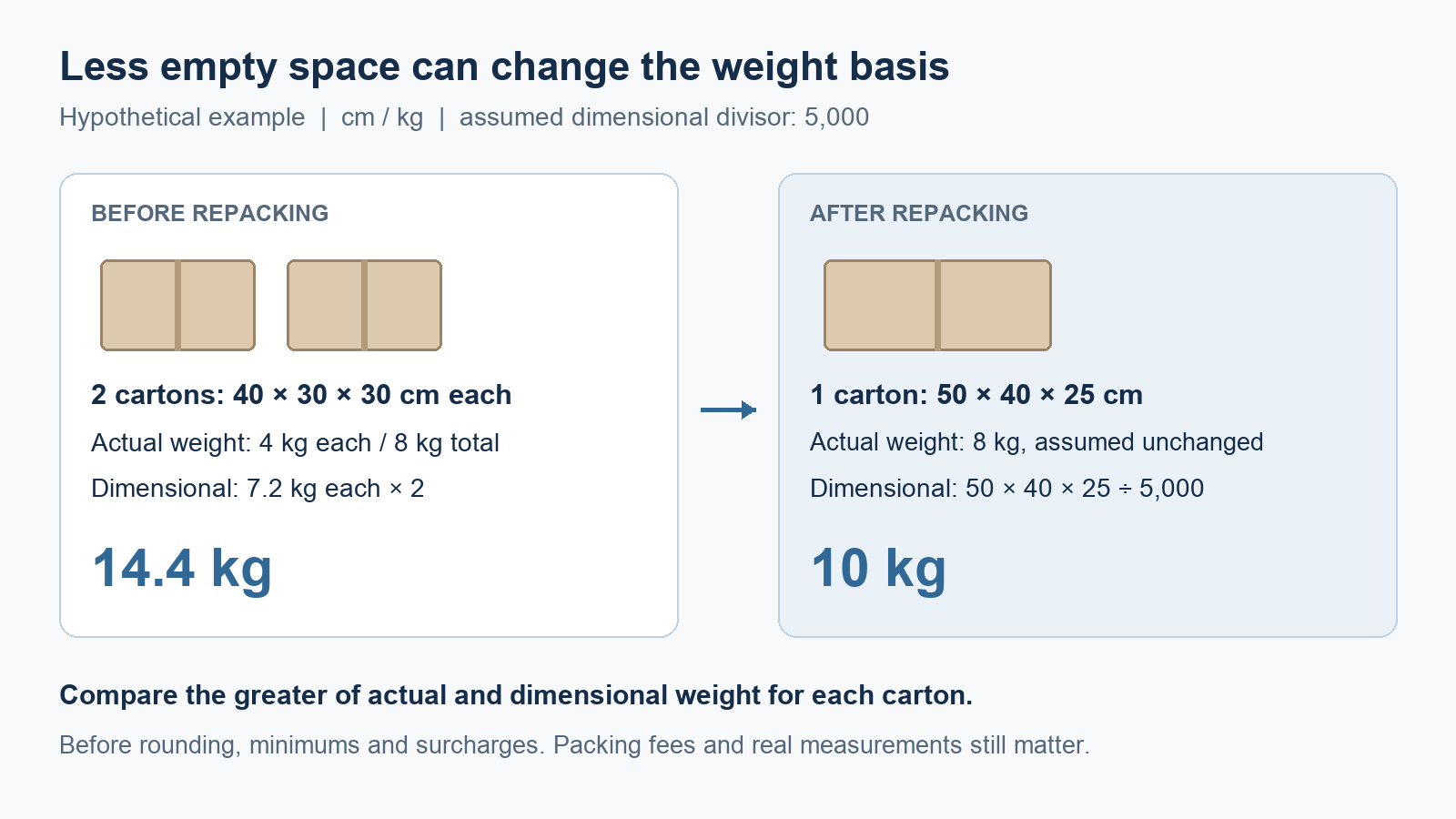
The express example reduces the calculated weight basis by 4.4 kg. With the 6,000 divisor used for the air- and sea-delivery channels above, the same dimensions give 12 kg before repacking and approximately 8.33 kg afterward, before rounding. Both remain above the assumed 8 kg actual weight. These calculations do not establish a dollar saving. Check the actual repacked weight, packing fee, rate bracket, and parcel-size limits before deciding whether consolidation pays.
Estimated versus confirmed quotes
A quote based on product links is provisional if carton measurements are missing. Ask the provider to state its packing assumptions. After receiving and repacking, request an updated quote tied to the measured cartons, service, destination, and booking date. Keep both versions so you can see why the price changed.
Should you consolidate all suppliers into one shipment?
Consolidate when the packing and freight savings justify the handling cost and wait. Waiting for a late supplier can leave an otherwise ready SKU out of stock.
| Situation | Decision to evaluate |
|---|---|
| Suppliers are ready together; cartons contain removable empty space | Compare consolidated packing with separate parcels |
| One supplier is late; other goods replenish an almost-empty SKU | Price a split shipment and compare it with the cost of waiting |
| Goods need protective retail packaging | Keep that protection in the packing calculation |
| Products include batteries, liquids, or other special handling needs | Get acceptance and packing instructions before combining them |
| Goods have different U.S. destinations | Compare separate dispatch with a documented distribution plan |
Set a cutoff before the first cartons arrive: after that date, ready inventory can ship separately if the missing order still has no reliable completion date. You can also retain agreed stock in China and release it in batches. Compare the storage and repeated handling costs with the stock you need in the U.S.; buying together does not require shipping everything at once.
Which shipping method fits your 1688 order?
Compare three options for moving your 1688 inventory: express courier, air freight with final delivery, and sea freight with final delivery. The latter two combine the international leg with local delivery arranged through the logistics provider. Here, “air delivery” and “sea delivery” refer to those combined services, rather than airport-to-airport or port-to-port transport.
| Order type | Option to evaluate | Main tradeoff |
|---|---|---|
| Samples or a small urgent replenishment | Express courier | Get the named courier service and delivery estimate; dimensional weight uses ÷ 5,000 for the channel described here |
| Replenishment that needs a shorter lead time than sea delivery | Air freight plus final delivery | Planning reference: about 12 days; dimensional weight uses ÷ 6,000 |
| Less urgent inventory | Sea freight plus final delivery | Planning reference: about 20–30 days; dimensional weight uses ÷ 6,000 |
Compare quotes to the same destination and check the clearance and final-delivery scope. Air or sea delivery does not, by itself, tell you who pays duties or what import arrangements are included.
Shipping ongoing orders from a China warehouse to individual U.S. shoppers is a separate fulfillment decision. For a broader comparison, including conventional ocean freight, see our guide to shipping from China to the USA.
How long does 1688 shipping to the USA take?
For the U.S. channels covered here, Fulfillbot uses about 12 days for air delivery and about 20–30 days for sea delivery as planning references. For express courier, request the estimate for the named service and destination ZIP code.
These are approximate channel estimates, not guaranteed delivery dates or order-to-door promises starting when you pay on 1688. Have the quote specify the timing start point, whether it counts calendar or business days, and the final delivery endpoint. Supplier preparation, domestic receiving, inspection and consolidation also need time in your purchasing schedule.
Allow separately for the destination warehouse to receive and check in the stock before planning its sale or onward dispatch.
Ask for a schedule with these milestones:
- Each supplier’s ready date and expected warehouse arrival.
- The consolidation cutoff and time allowed for checks or corrections.
- The booking or pickup date and the carrier’s transit scope.
- The estimated final delivery date, including any warehouse appointment.
Some preparation stages overlap; build a dated schedule instead of adding every supplier’s lead time together. For an ocean quote, distinguish port arrival from delivery to your warehouse. For a hard restock deadline, work backward from the date you need sellable inventory and ask which stages still have uncertain dates.
What should you confirm before U.S. delivery?
Prepare accurate product descriptions, quantities, values, origin information, and package details. U.S. invoice requirements under 19 CFR 141.86 include detailed descriptions, quantities, purchase prices for purchased goods, and country of origin. The rule also addresses English-language invoices or translations and package contents. A 1688 order screenshot alone may not provide the complete information needed.
Confirm the importer and broker arrangements for your shipment, who supplies missing documents, and how applicable import charges will be handled. Have the broker check product-specific requirements and current treatment before booking; do not build the budget around an assumed duty exemption.
If the provider calls its quote “DDP,” ask for the named delivery point, included charges, exclusions, and import arrangements in writing. DDP describes delivery responsibilities; it is not a separate transport mode. Our DDP shipping and quote-scope guide explains the questions to resolve.
For a U.S. 3PL or Amazon destination, get the current receiving instructions before packing: shipment references, product and carton labels, pallet requirements, and appointment arrangements where applicable. Use the addresses and labels for the actual shipment plan, and keep quantities consistent with the packed goods. Confirm who supplies the labels and books delivery.
Fulfillbot’s Amazon FBA prep services include repackaging, labeling, set preparation, poly bagging and photo documentation. Agree on the required work before export. These preparation services do not, by themselves, certify that a product meets U.S. safety or other market-entry requirements.
Get a usable quote for your 1688 shipment
Send one shipment brief containing:
- Product links, specifications, SKU quantities, declared goods value, and any batteries, liquids or fragile items.
- Supplier locations, ready dates, and whether you need purchasing assistance or already own the goods.
- Carton counts, outside dimensions, and gross weights, marked as estimated or measured.
- Destination ZIP code, address type, and receiving requirements.
- Required delivery date and whether partial dispatch is acceptable.
- The checks, QC photos, consolidation, repacking, storage, labeling or cargo insurance you need.
Fulfillbot’s freight forwarding from China service covers supplier coordination, warehouse receiving, consolidation, and shipment preparation. Follow the contact link on that page to send your brief and ask which services and transport options fit your goods. If dimensions are still unknown, request a provisional estimate first and confirm the price after packing.
Frequently asked questions
Can I use a forwarder if I buy from 1688 myself?
Yes. Fulfillbot can receive goods from your existing suppliers for agreed checks, storage, preparation and shipping. Confirm the assigned address and order references before dispatch. Tell the team whether you need freight only or purchasing support as well.
Can orders from different 1688 suppliers be shipped together?
They can be consolidated when the receiving provider accepts the goods and the products, packing, delivery dates, and destination fit the same shipment. Ask what happens if one order arrives late or fails inspection.
Why does the shipping quote change after warehouse packing?
The initial estimate may use supplier measurements. Final dimensions, gross weight, packing work, service selection, or surcharges can change the price. Ask for a comparison against the original assumptions.
Can my 1688 order be delivered to a U.S. 3PL or Amazon warehouse?
Yes, with a provider that supports the destination and receiving requirements. Give the provider the shipment instructions before packing and confirm acceptance, labels, appointment responsibilities, and the quoted delivery endpoint.
Before placing the orders, settle the Chinese receiving address and the U.S. delivery endpoint. Then agree on a release cutoff. With those decisions made, you can compare quotes for the shipment you actually intend to send.