
The label on a container is not the space you can actually use. A 40ft container may be roughly twice as long as a 20ft container, but it does not give you twice the payload. The door is smaller than the interior, too. And the theoretical cubic capacity assumes your cartons tessellate like perfect Lego bricks. They rarely do.
So start here:
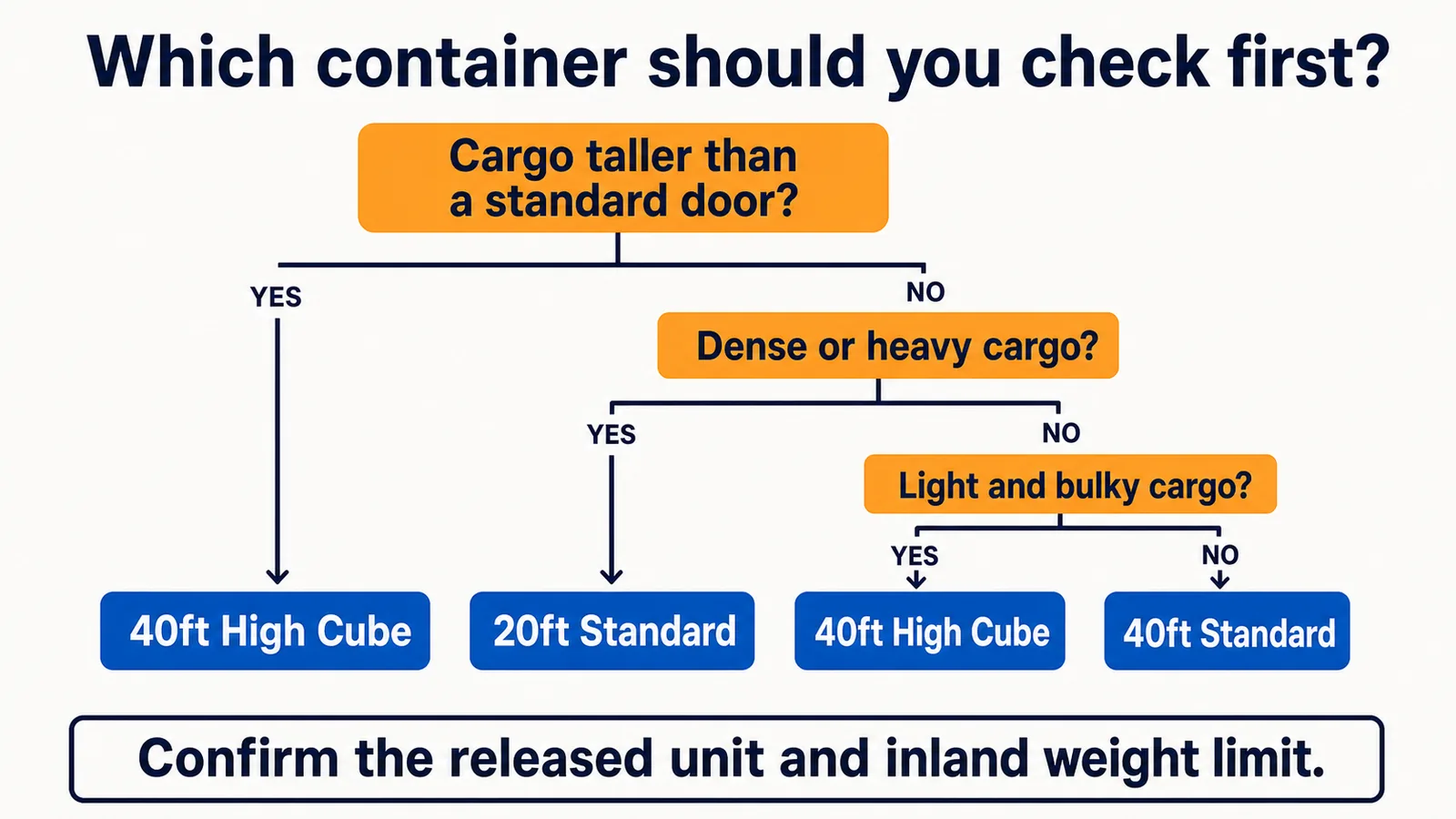
- Choose a 20ft standard container for dense cargo or a moderate shipment that needs a full container.
- Choose a 40ft standard container for higher-volume cargo that does not need extra height.
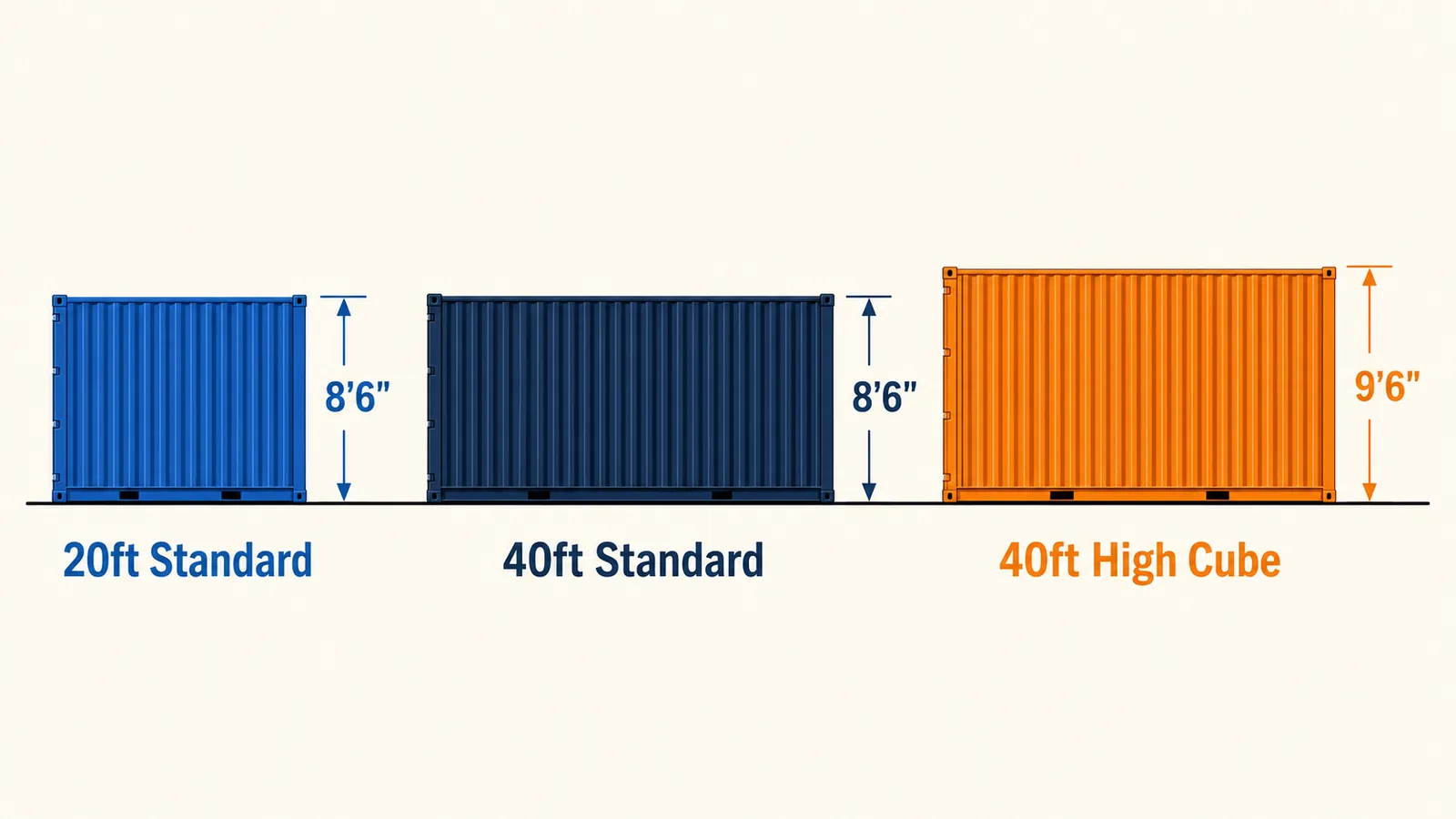
- Choose a 40ft High Cube for light, bulky, or tall cargo. It has about 12.7% more nominal capacity than the representative 40ft standard shown below.
- Confirm the exact released unit, cargo weight, loading plan, and inland limits before treating any chart as final.
Shipping container size chart
Here are the dimensions most importers need for 20ft, 40ft, 40ft High Cube, and 45ft High Cube dry containers. External dimensions follow the standard size categories. Internal dimensions, door openings, cubic capacity, and weights are representative examples from Hapag-Lloyd’s fleet.
| Container type | External L x W x H | Representative internal L x W x H | Door opening W x H | Nominal capacity | Max gross / tare / payload |
|---|---|---|---|---|---|
| 20ft Standard | 6,058 x 2,438 x 2,591 mm (20′ x 8′ x 8’6″) | 5,900 x 2,352 x 2,395 mm (19’4 1/4″ x 7’8 5/8″ x 7’10 1/4″) | 2,340 x 2,292 mm (7’8 1/8″ x 7’6 1/4″) | 33.2 m3 / 1,172 ft3 | 30,480 / 2,350 / 28,130 kg |
| 40ft Standard | 12,192 x 2,438 x 2,591 mm (40′ x 8′ x 8’6″) | 12,032 x 2,352 x 2,395 mm (39’5 5/8″ x 7’8 5/8″ x 7’10 1/4″) | 2,340 x 2,292 mm (7’8 1/8″ x 7’6 1/4″) | 67.7 m3 / 2,390 ft3 | 32,500 / 3,750 / 28,750 kg |
| 40ft High Cube | 12,192 x 2,438 x 2,896 mm (40′ x 8′ x 9’6″) | 12,032 x 2,350 x 2,700 mm (39’5 5/8″ x 7’8 1/2″ x 8’10 1/4″) | 2,340 x 2,597 mm (7’8 1/8″ x 8’6 1/4″) | 76.3 m3 / 2,694 ft3 | 32,500 / 3,900 / 28,600 kg |
| 45ft High Cube | 13,716 x 2,438 x 2,896 mm (45′ x 8′ x 9’6″) | 13,556 x 2,352 x 2,700 mm (44’5 5/8″ x 7’8 5/8″ x 8’10 1/4″) | 2,340 x 2,597 mm (7’8 1/8″ x 8’6 1/4″) | 86.0 m3 / 3,037 ft3 | 32,500 / 4,800 / 27,700 kg |
Sources: ISO 668:2020 and Hapag-Lloyd’s equipment pages for 20ft Standard, 40ft Standard, 40ft Standard High Cube, and 45ft Standard High Cube.
Here is the caveat that belongs beside the chart. Hapag-Lloyd says these specifications are examples from its fleet and that dimensions can vary by manufacturer. If 10 mm decides whether a machine clears the door, ask the carrier or freight forwarder to confirm the released container. A generic web chart is not precise enough for that job.
What the measurements actually mean
Four numbers get mixed together in container planning. They answer different questions.
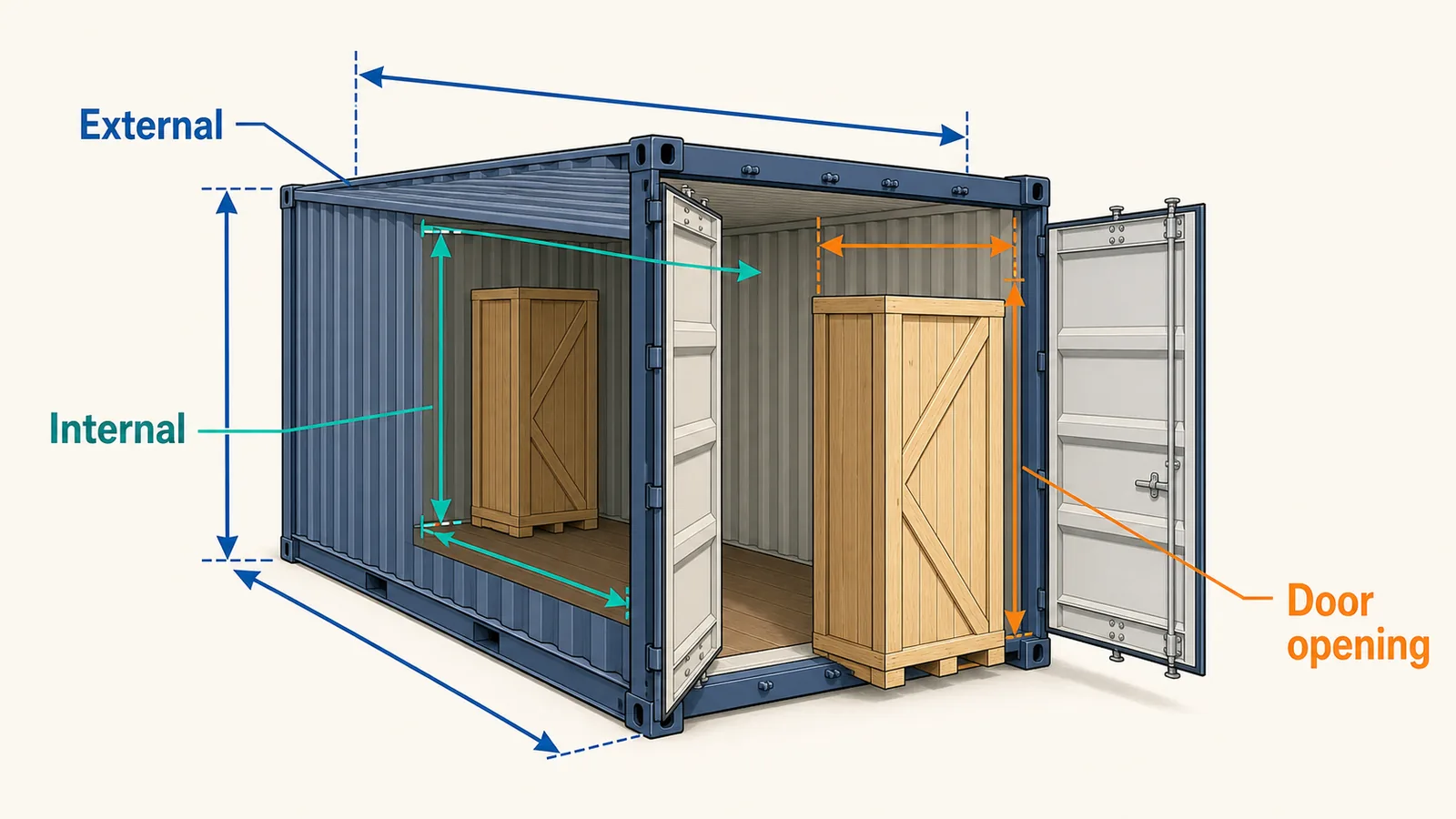
External dimensions tell you the overall footprint and height of the box. They matter for equipment classification, handling, clearance, and site access. ISO 668 classifies Series 1 freight containers by their external dimensions and ratings.
Internal dimensions tell you the rectangular space inside the walls and above the floor. This is the starting point for a load plan. It is not the same as usable space after pallets, dunnage, air bags, bracing, and awkward carton geometry take their share.
Door opening dimensions tell you what can physically enter through the rear doors. A piece of cargo can fit inside the theoretical interior yet fail at the door because the opening is narrower and lower. That is a particularly expensive way to learn the difference.
Capacity is the nominal cubic volume of the interior. Payload is the cargo mass the container can carry under its equipment rating. Maximum gross mass is the packed container’s upper equipment rating:
maximum gross mass = tare mass + payload
That equation still does not settle the shipment. Carrier rules, road limits, chassis configuration, axle distribution, and country-specific regulations can impose a lower operational limit.
20ft shipping container dimensions and best uses
A 20ft standard dry container has external dimensions of 20′ x 8′ x 8’6″. In the representative Hapag-Lloyd specification, its interior is 5,900 x 2,352 x 2,395 mm, its door opening is 2,340 x 2,292 mm, and its nominal capacity is 33.2 m3.
The 20-footer makes sense when cargo is dense. Metal parts, stone, tiles, canned products, and other heavy goods may hit an operational weight limit before they run out of cubic space. A longer container does not fix a weight problem. It may only buy empty air.
It can also suit a shipment that is large enough to justify FCL but nowhere near a 40ft load. That decision should be made with current LCL and FCL quotes, not a permanent CBM rule. Rates, origin charges, destination handling, season, and delivery terms can move the crossover.
A common mistake is to treat 33.2 m3 as a packing promise. It is a geometric volume. Real cartons leave gaps. Pallets consume floor area and height. Loading equipment needs clearance. Cargo may need bracing, moisture protection, or weight distribution that leaves visible space unused.
40ft shipping container dimensions and best uses
A 40ft standard dry container has external dimensions of 40′ x 8′ x 8’6″. The representative interior is 12,032 x 2,352 x 2,395 mm, with a 2,340 x 2,292 mm door opening and 67.7 m3 of nominal capacity.
The useful difference is length. Its nominal volume is just over twice the representative 20ft capacity. Payload barely changes: 28,750 kg in this 40ft example versus 28,130 kg for the 20ft. That is only 620 kg more.
For light or moderately dense cartons, furniture, consumer goods, and palletized merchandise, a 40ft can reduce the cost per cubic meter compared with splitting the same volume across smaller equipment. But a dense product can make it a bad fit. Once weight becomes the controlling constraint, the extra floor space is not automatically useful.
The 40ft container also needs more room for pickup, positioning, unloading, and turning at the destination. A warehouse dock may handle it routinely. A narrow retail street may not. Container selection is partly a cargo problem and partly a last-mile access problem.
40ft High Cube dimensions: when the extra foot matters
A 40ft High Cube has the same nominal length and width as a 40ft standard container, but its external height is 9’6″ instead of 8’6″. In the representative specification, internal height rises from 2,395 mm to 2,700 mm and door height rises from 2,292 mm to 2,597 mm.
That extra foot produces 76.3 m3 of nominal capacity, 8.6 m3 more than the 40ft standard example. The increase is about 12.7%, not a rounding error.
High Cube is usually the better question for:
- tall cartons or machinery that will not clear a standard door;
- lightweight, bulky products such as furniture, plastic goods, or bedding;
- palletized cargo where the extra internal height enables a workable stacking plan;
- shipments that are volume-limited well before they become weight-limited.
High Cube can still be the wrong box. Its tare is slightly higher in the example above, so the representative payload is slightly lower than the 40ft standard. Height can also affect inland clearance and equipment availability. Ask whether the extra cube solves a real packing constraint. Otherwise, “High Cube” is just a more impressive line on the booking request.
20ft vs 40ft vs 40ft High Cube
Use the controlling constraint, not the biggest-looking number.
| Cargo situation | Usually investigate first | Why |
|---|---|---|
| Dense, heavy cargo | 20ft Standard | High density may hit weight limits before cube; a longer box may not add useful payload |
| Moderate FCL volume | 20ft Standard | Avoid paying for unused length, subject to a current LCL/FCL comparison |
| High-volume cartons with standard height | 40ft Standard | Roughly twice the nominal volume of a 20ft, with similar representative payload |
| Light, bulky, or tall cargo | 40ft High Cube | Extra internal and door height plus about 12.7% more nominal cube than the 40ft standard example |
| Cargo near a door clearance | Exact released unit | Generic dimensions are not precise enough for a tight fit |
| Cargo near road weight limits | Route-specific transport plan | Container payload does not override inland law or chassis limits |
A quick decision rule: check height first, then weight, then layout, then price. Height can eliminate a box immediately. Weight may eliminate the theoretical maximum. Layout tells you whether the remaining space is usable. Only then is the freight quote comparing realistic options.
How much cargo actually fits?
Start with carton-level data, not the supplier’s total CBM alone. For each SKU, collect:
- packed carton length, width, and height;
- cartons per SKU and total carton count;
- gross weight per carton;
- whether cartons can be rotated, stacked, or clamped;
- pallet dimensions, pallet height, and pallet weight if palletized;
- clearance, dunnage, blocking, bracing, and moisture-control requirements.
Calculate carton volume in meters:
carton CBM = length (m) x width (m) x height (m)
Then test orientations against the internal length, width, and height. A carton may fit with its longest edge along the container length but waste an entire row across the width. Pure CBM division misses that.
Theoretical CBM vs usable space
There is no honest universal loading percentage. Small uniform cartons can use space efficiently. Mixed SKUs, pallets, fragile goods, cylinders, machinery, and “do not stack” cargo cannot.
The safe planning method is:
- use nominal capacity only for a rough comparison;
- build a SKU-level or pallet-level load plan;
- reserve space for securing and handling;
- check both total cargo weight and weight distribution;
- verify the plan against the booked equipment.
If a supplier says, “It is only 68 CBM, so it will fit in a 40HQ,” ask for carton dimensions and a loading plan before agreeing.
How many pallets fit?
Pallet counts depend on the pallet standard and whether overhang, double-stacking, or pinwheeling is allowed. As a rough floor-loading reference, published forwarder guides commonly show:
- a 20ft container at about 10 US pallets (48 x 40 in) or 11 Euro pallets (1,200 x 800 mm);
- a 40ft container at about 20 US pallets or roughly 23 to 24 Euro pallets.
Treat those as planning figures, not guarantees. Cargo height, pallet quality, load securing, door clearance, and axle distribution can change the answer. If the pallet count matters commercially, request a drawn pallet layout with the orientation shown.
Other container sizes and types
Standard dry containers work for a lot of cargo, but not all of it.
A 45ft High Cube offers more length and about 86 m3 of nominal capacity in the representative specification. Availability is more route-dependent than 20ft and 40ft equipment, so confirm it before designing the shipment around it.
Reefer containers are insulated and temperature-controlled. Their machinery and insulation reduce internal capacity compared with a dry container of similar external size. Use them for cargo that needs a controlled temperature, not simply as a different-sized dry box.
Open Top containers allow loading through a removable roof covering and suit cargo that is too tall or must be lifted by crane.
Flat Racks have end structures but no conventional side walls or roof. They are used for oversized or heavy cargo that cannot fit through a standard container door.
Tank containers carry compatible liquids or gases under specialized requirements.
North American 48ft and 53ft domestic containers belong to a different operating context. They are common in domestic intermodal networks but are not interchangeable with the standard 20ft and 40ft ocean equipment assumed in most international bookings.
The useful question is: which available equipment can legally and safely accept this cargo on this route?
Weight limits, VGM, and container markings
The payload printed in an equipment table is not permission to load that much cargo for every route.
Maersk states that cargo weight limits vary by container type and size, and that specific limits can vary by country. That is why a global chart cannot settle a US drayage move, a European road leg, or a delivery using a particular chassis. Your freight forwarder needs the cargo gross weight and route before confirming the practical limit.
On the container, check the maximum gross and tare markings. The Bureau International des Containers says the maximum gross mass marking must match the CSC approval plate. Some owners also show available payload below the tare. High containers also carry height warning marks.
For ocean loading, the shipper is responsible for providing the Verified Gross Mass (VGM). Under the IMO’s SOLAS rules, VGM is a condition for loading a packed container. The two permitted approaches are:
- weigh the packed container; or
- weigh all packages and cargo items, including pallets, dunnage, and securing material, then add the container tare using a certified method approved by the competent authority where packing took place.
VGM is the verified mass of the packed container. It is not the same as payload, and it does not erase the carrier’s or inland transporter’s lower limit.
Booking checklist
Send your forwarder enough information to check the shipment instead of guessing:
- origin address or port;
- destination port and final delivery address;
- Incoterm;
- ready date;
- commodity and HS code if known;
- dangerous-goods, temperature, or special-handling status;
- carton count and packed dimensions by SKU;
- total cargo CBM and gross weight;
- pallet count and pallet dimensions;
- stackability and orientation limits;
- proposed container type;
- door clearance or oversized-cargo concerns;
- whether you need loading, consolidation, customs, drayage, warehousing, or final delivery.
For shipments from China, a freight forwarder can compare the equipment, route, and inland constraints rather than pricing a container label in isolation. If the destination is the United States, use the shipping from China to the USA guide to map the wider process.
If the cargo should be consolidated before export or split after arrival, warehousing and distribution may change the best loading plan. Amazon sellers should also include FBA labeling, pallet, and appointment requirements when arranging Amazon FBA prep.
Frequently asked questions
What are the standard dimensions of a shipping container?
The most common dry ocean containers are 20ft Standard, 40ft Standard, and 40ft High Cube. They are typically 8ft wide. Standard units are 8ft 6in high, while High Cube units are 9ft 6in high. Internal and door dimensions vary by manufacturer and equipment series.
What are the inside dimensions of a 20ft container?
One representative 20ft dry-container specification is 5,900 x 2,352 x 2,395 mm internally, with a door opening of 2,340 x 2,292 mm. Confirm the carrier’s actual equipment if clearance is tight.
What are the inside dimensions of a 40ft container?
One representative 40ft standard specification is 12,032 x 2,352 x 2,395 mm internally. Its nominal capacity is 67.7 m3. A 40ft High Cube example has the same representative internal length, about the same width, and 2,700 mm internal height.
Is a 40ft container twice the size of a 20ft container?
It has roughly twice the nominal cubic capacity, but not twice the payload. In the representative table above, the 20ft payload is 28,130 kg and the 40ft standard payload is 28,750 kg.
How much taller is a High Cube container?
A High Cube is 1ft, or 305 mm, taller externally than a standard container of the same nominal length. The representative 40ft High Cube door is also 305 mm taller than the 40ft standard door.
How many CBM fit in a 20ft or 40ft container?
Representative nominal capacities are 33.2 m3 for a 20ft standard, 67.7 m3 for a 40ft standard, and 76.3 m3 for a 40ft High Cube. Actual cargo volume will be lower or differently constrained because carton geometry, pallets, securing, handling clearance, and weight all matter.
Can I use payload as my cargo weight limit?
Not by itself. Payload is an equipment rating. The practical cargo limit can be lower because of carrier rules, national road limits, chassis and axle restrictions, or route conditions. Confirm the container and inland move before loading.
Bottom line
A container dimension chart narrows the options. It does not approve the load.
The 20ft is often the sensible box for dense cargo. The 40ft standard buys length and volume, not double the payload. The 40ft High Cube earns its keep when height or bulky cargo is the actual problem. Tight clearances and heavy loads need exact-unit and route checks.
Once you have carton dimensions, total weight, pallet details, origin, and destination, request a loading review and freight quote. That small amount of homework is cheaper than discovering at the warehouse door that the cargo fits on paper and nowhere else.
Sources and methodology
This guide was fact-checked on July 29, 2026. Container classifications and dimension scope were checked against ISO 668:2020. Representative equipment values came from current Hapag-Lloyd fleet pages. VGM requirements came from the International Maritime Organization. Weight-limit caveats came from Maersk, and operational marking guidance came from the Bureau International des Containers.
The figures in this article are planning references. They are not a substitute for the booking confirmation, the released container’s markings, an approved loading plan, or route-specific legal advice.