ePacket is a postal shipping service for small ecommerce parcels sent mainly from China or Hong Kong to overseas buyers. It was built for light, low-value goods: phone cases, accessories, small fashion items, hobby parts, and the kind of products that used to make AliExpress dropshipping feel almost too easy.
That last part matters. ePacket is still a real shipping method in many situations, but the old ePacket story is out of date. It is no longer the cheap, simple answer for every China-to-U.S. order. Delivery expectations have changed. U.S. customs rules have changed. Customers compare everything with Amazon. Sellers cannot just pick the cheapest postal line and hope the tracking page keeps buyers calm.
Short answer: ePacket can still work for lightweight, low-value parcels when the route is available and the buyer can wait. For U.S. ecommerce sellers, it now needs a cost check against duties, delivery speed, tracking reliability, and alternatives such as dedicated parcel lines, private line shipping, YunExpress, 4PX, or fulfillment from local inventory. If you are comparing it with other routes, Fulfillbot’s broader guide to shipping from China to the USA gives a better view of where postal parcel shipping fits.
Quick answer: what is ePacket?
ePacket, also called EUB or e Youbao, is a China Post / postal-network shipping product for small international ecommerce parcels. The origin post handles export from China or Hong Kong, then a local postal carrier handles the last mile in the destination country. In the United States, that usually means USPS for final delivery when the shipment is accepted into the postal network.
It normally includes a trackable 13-character postal tracking number, often ending in CN for China-origin shipments. The package must stay within strict limits for weight, value and size. The common limit is 2 kg, or 4.4 lb, although some destinations have different rules.
For years, ePacket was popular because it was cheap and trackable. That is still the reason people search for it. The problem is that “cheap and trackable” is no longer enough for many ecommerce businesses.
How ePacket works
The route is simple on paper.
| Step | What happens |
|---|---|
| Seller hands over the parcel | The supplier, marketplace seller or shipping agent gives the parcel to China Post, Hongkong Post or an approved postal logistics channel. |
| Export processing | The parcel is scanned, sorted and prepared for export. |
| International transport | It moves by air or postal line-haul to the destination country. |
| Customs and postal handoff | The package clears import processing and enters the local postal network. |
| Last-mile delivery | A local carrier such as USPS, Royal Mail, Canada Post or Australia Post delivers it to the customer. |
This is why tracking can look strange. A parcel may show several scans in China, then go quiet while it is in airline or customs handoff, then appear again when the local post receives it. That gap is normal, but it is also where customer anxiety starts.
If you sell online, you need to plan for that gap. A buyer who paid $7 for a product might still open a dispute if tracking does not move for a week. This is where a basic track a package from China workflow helps, because you can tell whether the parcel is still in China, between postal systems, in customs, or already with the final-mile carrier.
What Is ePacket Delivery?
ePacket delivery started as a quick and inexpensive delivery option for both Hong Kong and Chinese merchants. It has grown to over 40 countries in less than nine years.
The China Post will deliver the parcel to the local area.than a local carrier handles the ePacket delivery to the final destination. By local, we mean carriers operating within the package destination country — USPS, Royal Mail, Canada Post, Australia Post, etc. Each carrier has its own fees, package dimensions, and delivery processes.
What does an ePacket tracking number look like?
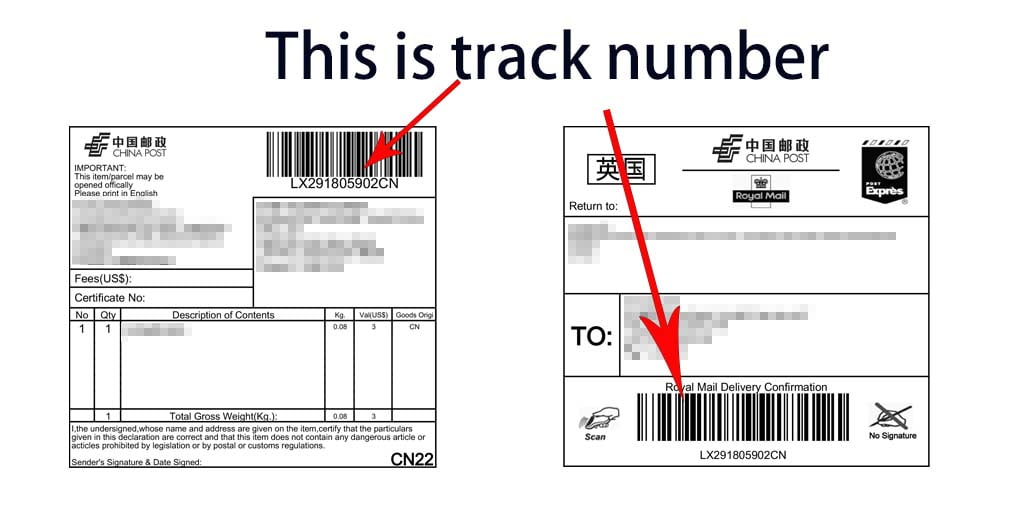
Most ePacket tracking numbers follow the Universal Postal Union S10 format: two letters, nine digits and two letters at the end.6
Examples:
| Example | What it means |
|---|---|
LZ123456789CN | A common China-origin postal tracking format. |
LW123456789CN | Another common tracked packet format. |
LX123456789HK | Possible Hong Kong-origin format, route availability depends on the post and destination. |
The final two letters usually show the origin postal operator’s country or region code. CN means China. HK means Hong Kong.
You can usually track an ePacket package through:
- the seller’s order page;
- China Post or EMS tracking pages;
- USPS Tracking for many U.S.-bound parcels once USPS receives the shipment;7
- third-party tracking tools such as 17TRACK, AfterShip, TrackingMore or ParcelPanel.
If USPS does not show the package yet, it may simply not have entered the U.S. postal system. Check the China-side tracking first before assuming the number is fake.
For buyers coming from AliExpress, it is also worth comparing the seller’s promise with realistic AliExpress shipping time ranges. A listing can say “fast shipping” and still use an economy route.
ePacket requirements
Here are certain guidelines that your ePacket delivery from China or Hong Kong should abide by:
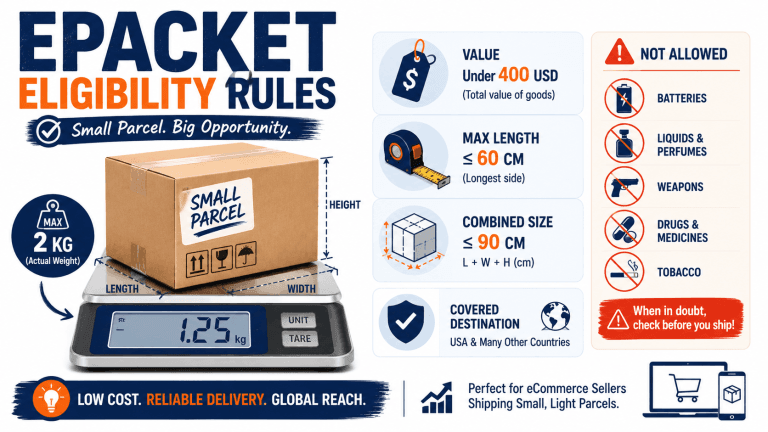
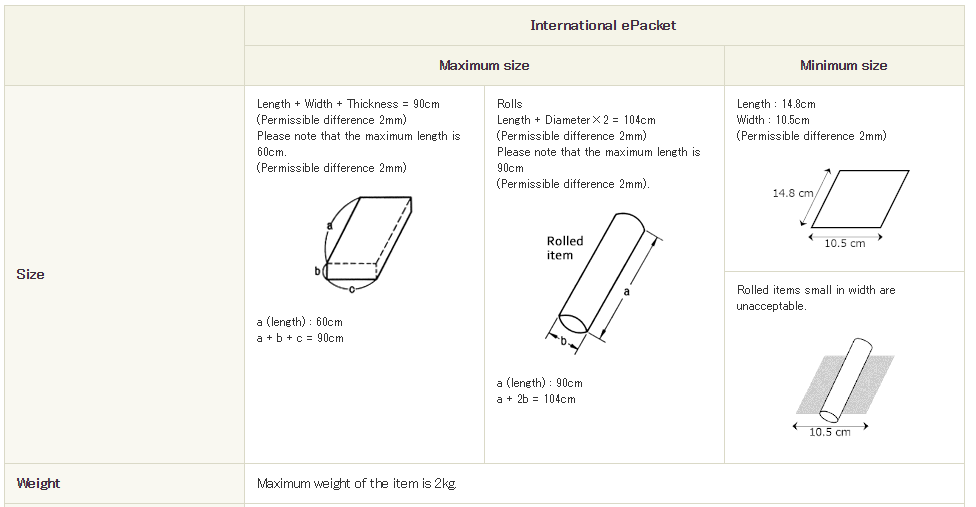
-The shipment must weight not more than 2 kilograms(4.4 pounds),but Israel and UK max weight is 5kg(11lb).
-The order value must be less than $400
-There are restrictions on the package’s maximum length as well. It should not be longer than 24 inches by 36 inches in length
| Requirement | Common rule |
|---|---|
| Weight | Up to 2 kg, or 4.4 lb, for most destinations. Some destinations may allow more. |
| Product value | Usually under $400. |
| Maximum length | Commonly up to 24 inches, or about 60 cm. |
| Combined size | Length + width + height commonly must stay within about 36 inches, or about 90 cm. |
| Origin | Usually China or Hong Kong postal channels. |
| Product type | Small, low-value goods. No restricted or prohibited products. |
Which countries support ePacket in 2026?
| NO | Country | Max Weight(g) |
|---|---|---|
1 |
Ireland |
2000 |
2 |
Austria |
2000 |
3 |
Australia |
2000 |
4 |
Brazil |
2000 |
5 |
Belgium |
2000 |
6 |
Poland |
2000 |
7 |
Germany |
2000 |
8 |
Russia |
2000 |
9 |
France |
2000 |
10 |
Finland |
2000 |
11 |
Kazakhstan |
2000 |
12 |
Korea |
2000 |
13 |
Netherlands |
2000 |
14 |
Canada |
2000 |
15 |
Luxembourg |
2000 |
16 |
Malaysia |
2000 |
17 |
United States |
2000 |
18 |
Mexico |
2000 |
19 |
Norway |
2000 |
20 |
Portugal |
2000 |
21 |
Japan |
2000 |
22 |
Sweden |
2000 |
23 |
Switzerland |
2000 |
24 |
Saudi Arabia |
2000 |
25 |
Thailand |
2000 |
26 |
Turkey |
2000 |
27 |
Ukraine |
2000 |
28 |
Spain |
2000 |
29 |
Greece |
2000 |
30 |
Singapore |
2000 |
31 |
New Zealand |
2000 |
32 |
Hungary |
2000 |
33 |
Israel |
5000 |
34 |
Italy |
2000 |
35 |
Indonesia |
2000 |
36 |
United Kingdom |
5000 |
37 |
Vietnam |
2000 |
38 |
Hong Kong China |
2000 |
39 |
Denmark |
2000 |
U.S.: all territorial and overseas military postal addresses, both domestic and foreign;
UK: Mainland and Channel Islands, Isle of man;
France: only local area, French overseas territory can not be delivered
Here are the zip codes of French overseas territories:
| French overseas territories | Zip codes |
|---|---|
Guadeloupe: Pointe A Pitre |
97100—97199 |
Martinique: Fort De France |
97200—97299 |
Guyane Française: Cayenne |
97300—97399 |
Réunion: Saint Denis |
97400—97499 |
St Pierre et Miquelon: St Pierre |
97500—97599 |
Mayotte: Mamoudzou |
97600—97699 |
St Barthelemy: Saint Barthelemy |
97700—97799 |
St Martin: Saint Martin |
97800—97899 |
How long does ePacket take?
For many routes, sellers historically planned around 7-30 days. In better periods, a U.S. or U.K. parcel might arrive in about 10-20 days. In worse periods, it can take longer.
A practical 2026 planning range:
| Route type | Planning range | Notes |
|---|---|---|
| Strong postal route, normal season | 7-15 business days | Possible on some routes, not a guarantee. |
| Typical economy postal route | 10-25 business days | More realistic for many ecommerce parcels. |
| Remote area or peak season | 20-40+ days | Tracking gaps and customer complaints become more likely. |
| Customs or duty-collection issue | Unpredictable | The package may stall until processing is resolved. |
If you are shipping one personal order, waiting may be fine. If you are running a store, a 20-day delivery time is not just a logistics number. It affects refunds, chargebacks, customer emails and ad performance.
If delivery speed is the main problem, compare ePacket with the routes in Fulfillbot’s guide to fast shipping on AliExpress. Some “fast” options still ship from China, but the tracking and handoff can be more predictable than a basic postal packet.
How much does ePacket cost?
There is no single ePacket price. The cost depends on the origin, destination, parcel weight, size, service account, platform rate, fuel/airline cost, duty collection and whether a shipping agent adds handling.
Older examples often made ePacket look unbeatable. One internal research note in our knowledge base compared a 2 lb parcel from Shanghai to the U.S. at about $14.06 by ePacket, versus much higher rates for China Post Air, EMS and FedEx. That history explains why ePacket became famous.
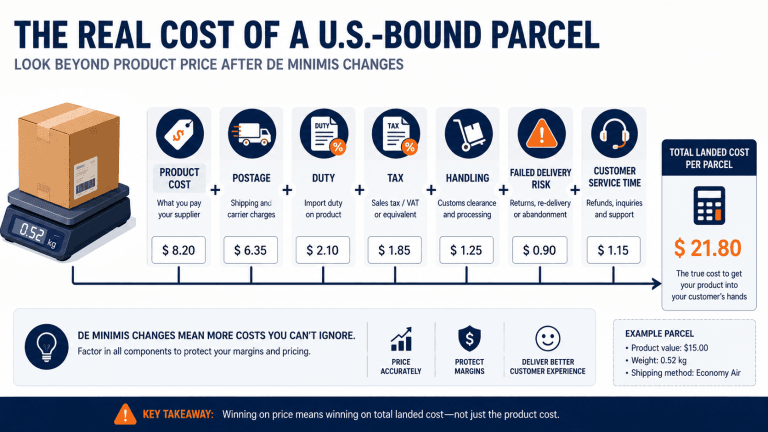
But the U.S. math changed. In 2025, the U.S. removed duty-free de minimis treatment for many low-value imports from China and Hong Kong. CBP guidance later stated that covered low-value postal shipments from China and Hong Kong entering through the international mail network would be subject to either an ad valorem duty rate or a flat specific duty for a period, with the handling method changing over time.2 CBP’s ecommerce FAQ also notes the broader suspension of duty-free treatment for low-value shipments.1
For a seller, that means the postage price is only one line in the calculation.
| Cost item | Why it matters |
|---|---|
| Base postage | The amount charged for the parcel by weight, destination and service. |
| Handling fee | The agent, warehouse or platform may charge pick, pack, label or processing fees. |
| Duties and taxes | Especially important for U.S.-bound China/Hong Kong goods after de minimis changes. |
| Failed-delivery cost | Lost parcels, long delays and buyer disputes can wipe out the savings. |
| Customer-service time | Cheap shipping can become expensive if every tenth buyer asks where the order is. |
If you are selling to the U.S., compare landed cost, not postage. Landed cost means product cost, packaging, shipping, duties, taxes, platform fees, failed-delivery risk and customer support.
The ePacket rates vary by region, and different service providers may receive different discounts. It really depends on the logistics provider you are working with. We also offer ePacket parcel services.
Is ePacket still good for dropshipping?
Sometimes. But the easy ePacket era is over.
ePacket helped the old AliExpress dropshipping model because sellers could list cheap products, ship one order at a time from China and give buyers a tracking number. It was not perfect, but it was workable when ads were cheaper, customers were more patient and low-value U.S. parcels could often enter duty-free.
That setup is much harder now.
Customers expect faster delivery. Marketplaces expect cleaner tracking. U.S. customs rules are less friendly to low-value China parcels. And if you sell the same product as 50 other dropshippers, slow shipping gives buyers one more reason to choose someone else.
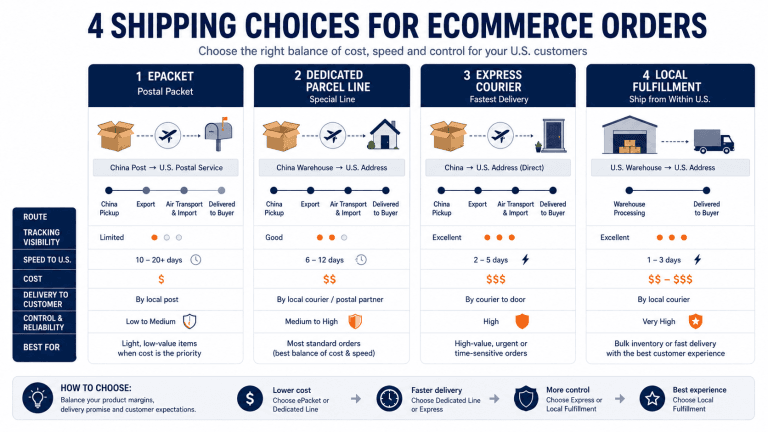
For a beginner testing a low-risk product, ePacket can still be useful if the route is available and the delivery promise is honest. For a real brand, it is usually better to compare these options. If you are still using marketplace sellers one order at a time, read Fulfillbot’s dropshipping agent guide before you scale, because shipping is only one piece of the customer experience.
| Method | Best for | Tradeoff |
|---|---|---|
| ePacket / postal packet | Low-cost, low-risk, lightweight goods | Slower, less predictable, customs changes can hurt margins. |
| Dedicated parcel line | Repeat B2C orders from a China warehouse | Better tracking and speed, usually higher cost than postal economy. |
| YunExpress / 4PX-style services | Ecommerce parcels needing more reliable delivery | Service quality varies by lane and agent. |
| Express courier | Samples, urgent orders, high-value small parcels | Fast but expensive. |
| Bulk import + local fulfillment | Products with stable sales volume | Requires inventory planning and upfront stock. |
If you are getting regular orders, the better question is not “Can I still use ePacket?” It is “At what order volume should I stop using postal shipping and move to a more controlled fulfillment setup?”
ePacket vs EMS vs private line vs YunExpress
| Shipping method | Speed | Tracking | Cost | Good fit | Poor fit |
|---|---|---|---|---|---|
| ePacket | Economy to moderate | Usually trackable | Low to moderate | Small, light, low-value parcels | Time-sensitive orders, fragile goods, high-ticket products |
| EMS | Faster postal express | Stronger postal tracking | Higher than ePacket | Important postal shipments, some urgent parcels | Very price-sensitive orders |
| Private line / dedicated line | Often faster than postal economy | Usually better ecommerce tracking | Moderate | Shopify, Amazon, TikTok Shop and repeat B2C orders | One-off ultra-cheap products |
| YunExpress / 4PX-style ecommerce lines | Often built for cross-border ecommerce | Usually designed for buyer-facing tracking | Moderate | Dropshipping and direct-to-consumer parcels | Oversized or restricted goods |
| Express courier | Fast | Strong | High | Samples, urgent products, high-value orders | Low-margin products |
| Local fulfillment | Fast final delivery | Strong | Requires inventory | Repeat sellers with proven demand | Untested products |
Postal shipping is cheap because it is shared infrastructure. That is also why it can be hard to control. If a seller cares about delivery promises, packaging, branded inserts, replacement handling and repeat customer experience, a managed China warehouse or local fulfillment plan usually wins.
This is the point where a dropshipping fulfillment service can make sense. You are no longer just buying postage. You are controlling how the product is checked, packed, labeled and handed to the right shipping line.
When should you use ePacket?
Use ePacket only when the product and customer promise fit the method.
Good use cases:
- small accessories;
- lightweight, low-value items;
- non-urgent orders;
- product tests where buyers accept longer delivery;
- countries where the route is stable and customs costs are clear;
- orders where a delay will not destroy the customer relationship.
Poor use cases:
- products over 2 kg;
- bulky items;
- fragile products that need better packaging;
- high-value goods;
- branded orders where packaging matters;
- U.S. orders where duties erase the savings;
- customers expecting delivery in under 10 days;
- any product with battery, liquid, powder, magnet, chemical or other restricted-shipping risk.
Here is the blunt version: ePacket is a postage method, not a fulfillment strategy.
It can carry a package. It cannot fix weak supplier quality, bad packaging, customs surprises, slow customer service or a product that should have been stocked closer to the buyer.
Once the same SKU sells every day, it may be time to look beyond parcel-by-parcel shipping and move into order fulfillment or stocked inventory near the buyer.
How to track ePacket from China
- China Post Official Site Free
- USPS Free(only track sent to the United States)
- 17track Free(do not support API)
Common tracking statuses:
| Status | What it usually means |
|---|---|
| Acceptance | The sender handed the parcel to the postal channel. |
| Processed through facility | The parcel moved through sorting. |
| Dispatch from outward office | It is leaving the origin postal system. |
| Airline departure / handed to carrier | It may be between postal systems. Tracking can pause here. |
| Arrival at destination country | The parcel reached the destination side. |
| Customs processing | It is being reviewed by customs or waiting for import handling. |
| Delivered | The local carrier marked final delivery. |
If tracking stops after export, wait a few days before opening a dispute. If it stops for two weeks or more, ask the seller or shipping agent to check the backend tracking, not just the public page.
Does USPS deliver ePacket in the United States?
Usually, yes, when the parcel is accepted into the U.S. postal network. USPS can handle final delivery for many China Post or ePacket-style parcels after they arrive in the United States.
But USPS cannot solve every issue. If the parcel has not reached the U.S. side, USPS may show no record or limited information. If customs processing changes the package flow, tracking can be slower than buyers expect. And if the package is sent through a private ecommerce line instead of true postal ePacket, the final mile might be USPS, DHL eCommerce, UniUni, OnTrac or another carrier depending on the lane.
For sellers, this is another reason to ask your supplier or agent for the actual shipping product, not just the word “ePacket.”
Is ePacket reliable?
It is reliable enough for some low-value parcels, but not reliable enough to carry a premium customer promise.
The good parts:
- it is usually cheaper than express;
- it gives better tracking than unregistered small packet;
- it works for many lightweight products;
- it can be simple for marketplace sellers.
The weak parts:
- speed varies by country and season;
- tracking can pause between postal systems;
- customs changes can affect cost and availability;
- support is limited compared with courier or managed parcel-line services;
- the customer sees the package is shipping from China.
That last point is easy to overlook. Some buyers are fine with China-origin shipping if the listing is honest. Others are not. If your store promises a local brand experience, a China Post tracking number can damage trust before the package even arrives.
What changed for U.S. sellers after de minimis?
For years, many low-value goods entered the U.S. under Section 321 de minimis rules. In plain English, packages valued at or under $800 often avoided normal duties and taxes. That rule helped direct-from-China ecommerce grow quickly.
In 2025, the U.S. changed the treatment of low-value shipments from China and Hong Kong, then moved toward a broader suspension of duty-free de minimis treatment.345
For ePacket, the practical result is simple: the old “cheap parcel, no duty problem” assumption is unsafe for U.S. orders.
Sellers now need to ask:
- What is the HTS code?
- What is the declared value?
- Who pays duty?
- Does the postal method support the required data and duty collection?
- Will the buyer see surprise fees?
- Would a dedicated line, DDP plan or bulk import be cleaner?
This is not tax advice. It is the operational question every seller should ask before choosing a shipping method.
If you are moving from individual parcels to cartons, pallets or Amazon inventory, the conversation changes from postal shipping to freight forwarding from China, customs entry and delivery planning.
What are the best ePacket alternatives?
The best alternative depends on the order pattern.
If you ship one sample, use express. If you ship one low-value personal item, postal economy may be fine. If you ship daily ecommerce orders, look at a dedicated parcel line. If you have stable sales, move inventory closer to the buyer.
| Situation | Better option to check |
|---|---|
| Testing a few small products | ePacket, AliExpress Standard Shipping or another economy tracked parcel. |
| Need faster customer delivery from China | Dedicated parcel line, YunExpress, 4PX, Wanb Express or similar ecommerce lanes. |
| Need samples quickly | DHL, FedEx, UPS or EMS. |
| Have regular daily orders | China warehouse fulfillment with a dedicated parcel line. |
| Have proven demand in the U.S. | Bulk import and U.S. fulfillment. |
| Need branded packaging | Fulfillment partner with packaging control before shipping. |
| Need Amazon inventory | FBA prep and freight forwarding from China. |
FAQ
What is epacket from china mean
This means that the package was sent from China
What is epacket delivery from hong kong
Usually need 7-10 days
Is ePacket still available in 2026?
It depends on the route, origin, destination, product and postal operator. ePacket-style services still exist, but availability is not as simple as it was during the peak AliExpress dropshipping years. U.S.-bound goods from China and Hong Kong also need extra customs and duty checks after de minimis rule changes.
Who delivers ePacket in the U.S.?
USPS often handles final delivery for true postal ePacket parcels after they enter the United States. Before that point, China Post, Hongkong Post or another origin-side postal channel may handle the package. If the seller uses a private ecommerce line, the final-mile carrier may be different.
Conclusion
ePacket is still worth understanding because it shaped cross-border ecommerce. It made small China parcels cheap enough for a whole generation of AliExpress sellers and dropshippers.
But it is not 2021 anymore. If you are buying one small item, ePacket may be good enough. If you are building a store, treat it as one shipping option, not the plan.
The better plan starts with the product: weight, size, margin, destination, customer promise and customs cost. Once those numbers are clear, the shipping method usually becomes obvious. Sometimes that answer is ePacket. More often now, it is a dedicated parcel line, a managed China warehouse, or inventory placed closer to the customer.
Sources
U.S. Customs and Border Protection, “E-Commerce Frequently Asked Questions,” https://www.cbp.gov/trade/basic-import-export/e-commerce/faqs
U.S. Customs and Border Protection CSMS #65029543, “Update to guidance,” https://content.govdelivery.com/accounts/USDHSCBP/bulletins/3e045a7
The White House, “President Donald J. Trump Closes De Minimis Exemptions to Combat China’s Role in America’s Synthetic Opioid Crisis,” April 2, 2025, https://www.whitehouse.gov/fact-sheets/2025/04/fact-sheet-president-donald-j-trump-closes-de-minimis-exemptions-to-combat-chinas-role-in-americas-synthetic-opioid-crisis/
The White House, “Suspending Duty-Free De Minimis Treatment for All Countries,” July 2025, https://www.whitehouse.gov/presidential-actions/2025/07/suspending-duty-free-de-minimis-treatment-for-all-countries/
The White House, “Continuing the Suspension of Duty-Free De Minimis Treatment for All Countries,” February 2026, https://www.whitehouse.gov/presidential-actions/2026/02/continuing-the-suspension-of-duty-free-de-minimis-treatment-for-all-countries/
Universal Postal Union, “S10: Identification of postal items – 13-character identifier,” https://www.upu.int/UPU/media/upu/files/postalSolutions
/programmesAndServices/standards/S10-12.pdfUSPS Tracking, https://tools.usps.com/
Hong Kong SAR Government, “Hongkong Post suspends the postal service for items containing goods destined to the United States,” April 16, 2025, https://www.info.gov.hk/gia/general/202504/16/P2025041500835.htm