How to Find Vinted Supplier Without Getting Stuck With Low-Grade Stock

If you are searching for a Vinted supplier, the real problem is not finding a list of wholesale names. It is finding stock you can resell at a margin without getting trapped by weak grading, return-policy pressure, or cross-border admin that eats your profit.
In 2026, the winning move on Vinted is not “buy more bundles.” It is building a sourcing workflow you can verify. That means choosing the right supplier type, testing quality before scaling, and understanding how Vinted Pro rules affect cash flow.

The short answer: a good Vinted supplier is one you can verify, not just one with cheap bales

Many articles about Vinted suppliers stop at supplier names. That is not enough anymore.
As more sellers treat Vinted as a real resale channel rather than a casual decluttering app, wholesale demand has become more competitive. That creates two common problems:
  • better stock gets filtered out earlier
  • lower-quality mixed stock gets pushed to remote buyers who cannot inspect properly
So the right question is not just “Who supplies vintage clothing?” It is “Which sourcing model gives me enough quality control, margin visibility, and operational stability to keep reselling on Vinted?”
Why Vinted sourcing changed in 2026

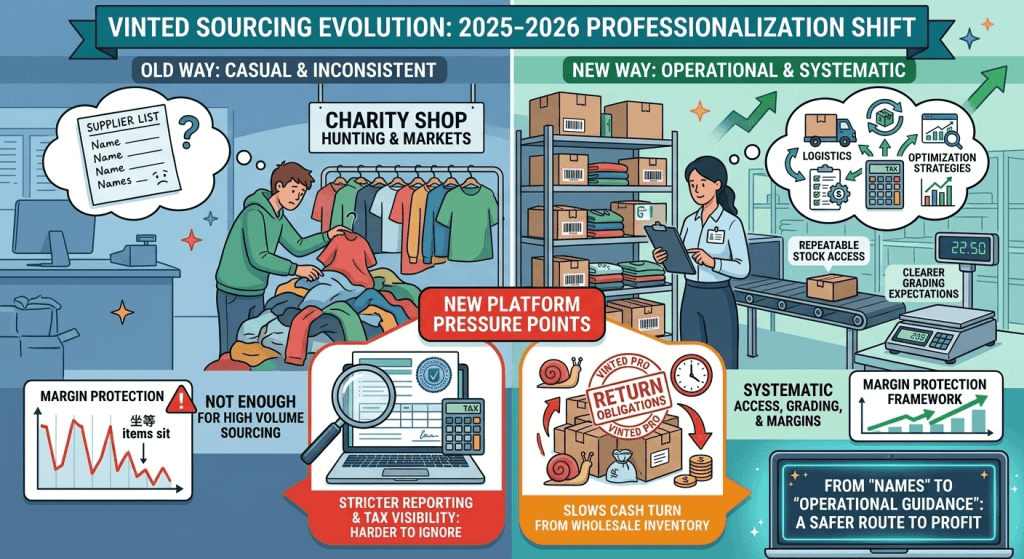
Why Vinted sourcing changed in 2025-2026

Vinted has become more professional, and sourcing has had to follow.
When sellers start operating at higher volume, charity-shop hunting and casual marketplace flips stop being enough. You need repeatable access to stock, clearer grading expectations, and a way to protect margin when some items sit longer than expected.
At the same time, the platform environment got stricter for professional sellers. The upstream research points to two pressure points that matter in practice:
  • platform reporting and tax visibility are now much harder to ignore
  • Vinted Pro return obligations can slow the speed at which wholesale inventory turns into usable cash
That is why “supplier list” content now underperforms serious operational guidance. Sellers do not only want names. They want a safer route from stock purchase to resale profit.

The three sourcing models Vinted sellers should compare

Not every Vinted supplier works the same way. These are the three models that matter most.
ModelHow it worksBest forMain risk
Digital wholesale platformsYou buy curated lots or listings onlineSellers who want lower friction and faster testingHigher unit cost and inconsistent curation quality
Rag houses and sorting plantsYou buy bundles, bales, or graded categories from industrial suppliersSellers who want scale and repeat access to stockRemote quality risk if you cannot verify the grade
Manual sourcing and marketplace snipingYou source from secondhand channels one item or bundle at a timeSellers who are strong at curation and niche selectionHard to scale and labor-heavy
The best option depends on your stage.
If you are still validating categories, digital suppliers and smaller trial lots usually make more sense. If you already know your average sale price, return rate, and processing capacity, industrial suppliers can be more attractive. If your edge is taste and curation, manual sourcing can still work, but it becomes hard to scale cleanly.

If you need a broader starting point on supplier discovery beyond Vinted, see Finding Reliable Wholesale Vendors Complete Guide.

Where to actually find Vinted suppliers

If you searched for a Vinted supplier, you probably want more than a sourcing framework. You want practical starting points.

The most useful way to find suppliers is to search by supplier type, not by the phrase “Vinted supplier.” Most wholesalers do not market themselves around Vinted. They market themselves as vintage wholesalers, used clothing exporters, rag houses, liquidation sellers, or wholesale marketplace vendors.

If you are still comparing broader sourcing routes, Ultimate Guide to Buy Wholesale from China can help frame the tradeoffs.

Here are the main places to look:

1. China wholesale site

These are the easiest starting point if you want low-friction testing. You can review listings, order smaller lots, and compare supplier presentation without committing to a warehouse visit.
What to look for:
  • category-specific lots instead of overly broad mixed bundles
  • clear grading language
  • recent stock photos or video
  • transparent minimum order rules
  • enough detail to estimate resale margin before buying
Best for: newer Vinted sellers who need a first test order, tighter category focus, and faster feedback.

2. Rag houses and sorting plants

If you want scale, this is where many serious resale suppliers sit. These businesses sort, grade, and move used clothing in bulk.
You can usually find them through regional vintage wholesale directories, trade networks, Google Maps searches for used clothing wholesalers, and social channels where suppliers post bale videos or warehouse clips. The catch is that supplier discovery is only step one. Remote rag-house buying carries much more grading risk if you cannot verify stock live.
Best for: sellers who already know what categories move well and can evaluate landed cost, defect rate, and processing burden.

3. Local wholesalers and cash-and-carry warehouses

For UK and EU Vinted sellers, local wholesale warehouses can be a strong middle ground. They may not be the cheapest source per kilo, but they reduce cross-border friction and make in-person inspection easier.

If you can physically inspect stock before buying, you remove a large part of the quality-risk problem that hurts remote buyers. For readers who are still learning how supplier checks work, this point pairs well with Is Alibaba Legit ? Ultimate Guide Buy from Alibaba.

Best for: sellers who care more about control and stock selection than squeezing the absolute lowest buy price.

4. Manual sourcing channels that can become repeat suppliers
Not every supplier starts as a formal wholesaler. Some sellers build early inventory through secondhand marketplaces, local clearances, shop closures, or recurring private sellers, then turn the best of those relationships into semi-repeatable supply.
This is less scalable, but it can work well when your edge is curation rather than warehouse volume.
Best for: niche Vinted sellers who win on taste, brand selection, or specific categories instead of broad inventory throughput.
Sourcing agents or inspection partners

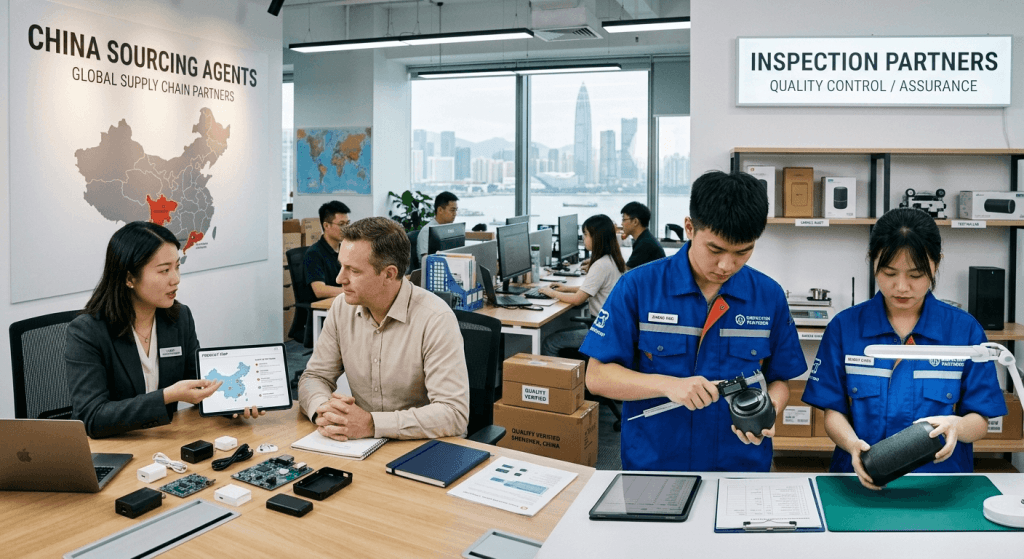
5. China Sourcing agents or inspection partners

If you find stock opportunities but cannot easily verify them, a sourcing or inspection partner can help bridge the gap. This is especially useful when the supplier is overseas, communication is patchy, or the order size is big enough that one bad batch will damage margin.
Best for: sellers who are moving beyond casual resale and need more control than a blind bale purchase allows.
A practical rule: start with two or three supplier candidates from two different sourcing models. Do not collect twenty names. You do not need a giant list. You need a short list you can actually test.
Some agent can give you suggestions. And Collecting goods in China and then sending them to your address will save on shipping costs and help you check the quality and quantity.

6.Some Online community

Like reddit/discord, Some sellers sell things on it. You can check if their products are profitable to sell on Vinted. If so, contact them to cooperate and help them sell. These sellers’ goods are often not local, but may be in China, so you need to prepare some inventory when you start selling.and let China sourcing agent send to you.

If you need a more controlled sourcing and inbound logistics workflow than blind wholesale bundles, talk to our team that can help verify suppliers, inspect goods, and manage stock before it reaches your resale pipeline.

What most sellers get wrong about rag houses

A rag house can improve access to stock, but it also magnifies mistakes.
The usual mistake is treating a supplier relationship as real before proving four things:
  1. the grading language means what you think it means
  2. the supplier can show current stock, not only marketing photos
  3. the landed cost still works after shipping, duties, and rejects
  4. your Vinted sell-through speed can absorb slower-moving pieces

That is why “cheap per kilo” is one of the least useful buying metrics on its own. A lower purchase price does not help if too much of the bale is off-season, damaged, overpicked, or wrong for your audience. The same logic shows up in Wholesale Clothing Vendors – Exclusive Guide to Import Clothes from China!, where supplier fit matters more than headline price.

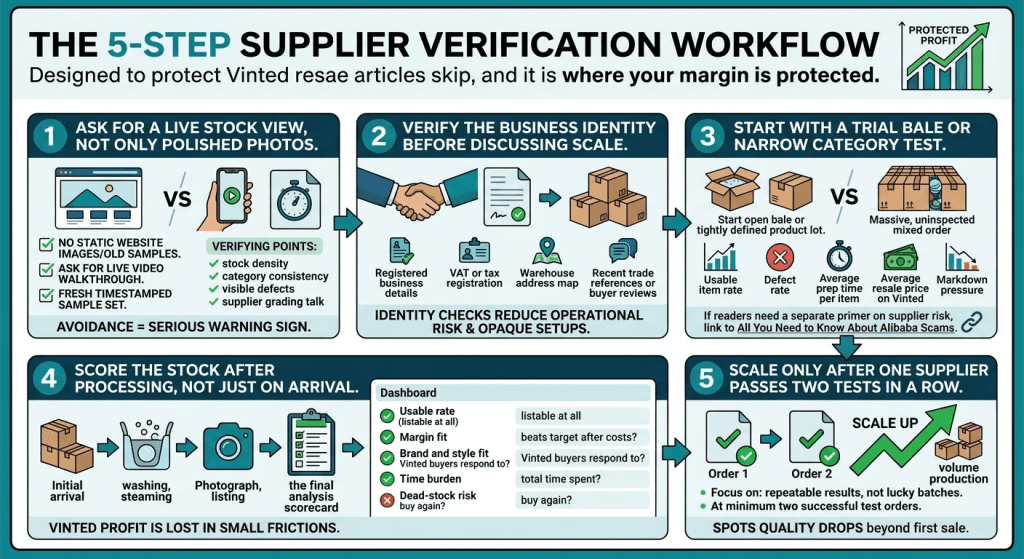
5 step supplier verification workflow

The 5-step supplier verification workflow

This is the part most competitor articles skip, and it is where your margin is protected.

1. Ask for a live stock view, not only polished photos

Do not rely on static website images or old WhatsApp samples. Ask for a live video walkthrough or a fresh timestamped sample set.
You are trying to verify:
  • stock density
  • category consistency
  • visible defects
  • how the supplier talks about grading in real time
If a supplier avoids live proof, that is a serious warning sign.

2. Verify the business identity before discussing scale

Before you care about volume pricing, verify the supplier itself.
That can include:
  • registered business details
  • VAT or tax registration where relevant
  • warehouse address
  • export experience if you are buying cross-border
  • recent trade references or buyer reviews
A supplier can have good stock and still be operationally risky. Identity checks reduce the chance that you are sending deposit money into a weak or opaque setup.

3. Start with a trial bale or narrow category test

Never jump from zero to a large mixed order if you cannot inspect in person.
A better first move is a trial bale, a small curated lot, or a tightly defined product group. This gives you real data on:
  • usable item rate
  • defect rate
  • average prep time per item
  • average resale price on Vinted
  • markdown pressure if the stock is weaker than expected

This is how you move from supplier promises to actual unit economics. If readers need a separate primer on supplier risk before placing money, link to All You Need to Know About Alibaba Scams.

4. Score the stock after processing, not just on arrival

A bale that looks decent on open can still perform badly once you clean, photograph, list, and sell it.
Use a simple post-processing review:
CheckpointWhat to measure
Usable rateHow many items were listable at all
Margin fitWhether the expected sale price still beats your target after all costs
Brand and style fitWhether the pieces match what your Vinted buyers actually respond to
Time burdenHow long steaming, repair, cleaning, and photography took
Dead-stock riskHow many pieces you would not buy again
This matters because Vinted profit is usually lost in the “small frictions” between buying stock and actually converting it into sold listings.

5. Scale only after one supplier passes two tests in a row

Do not scale after one acceptable order.
A supplier is worth scaling only when they can produce repeatable results, not one lucky batch. At minimum, you want two successful test orders before increasing volume. That helps you spot whether quality drops once the relationship moves beyond a first sale.

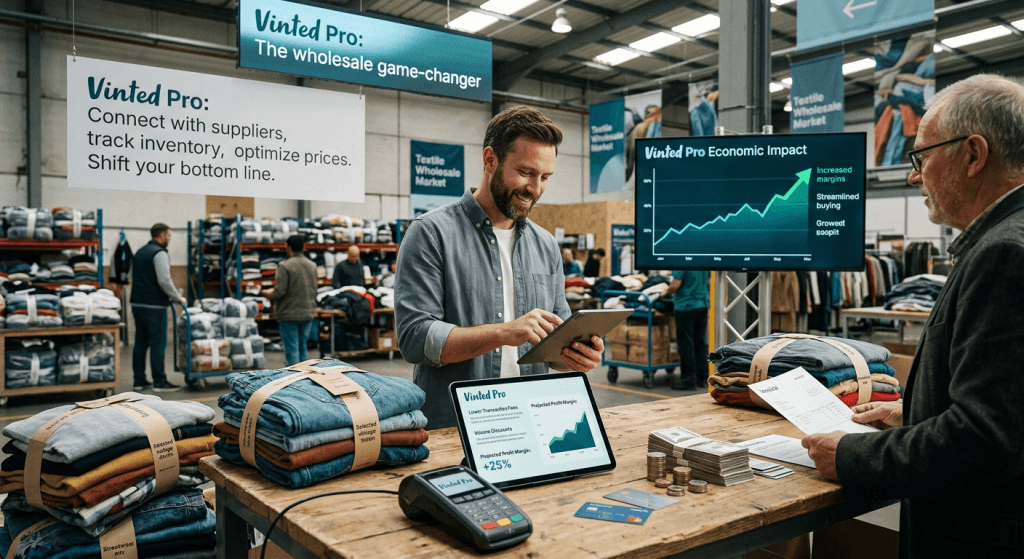
How Vinted Pro changes the economics of wholesale buying

If you sell as a professional, sourcing mistakes get more expensive.
The upstream research highlights a practical issue many listicles ignore: Vinted Pro sellers must work inside a more formal return framework, including a 14-day return window. Even when buyers do not return items at high rates, that window changes how quickly stock turns into fully settled cash.
That matters for wholesale because you are paying upfront for inventory, then paying again in time and labor to process it. If cash is tied up longer, your next buying cycle slows down.
In plain terms, Vinted Pro pushes you to care more about:
  • stock accuracy
  • fewer problem items
  • tighter pricing discipline
  • stronger working-capital planning
A weak supplier relationship is annoying for a hobby seller. For a Pro seller, it can choke growth.
Vinted Pro
Vinted Pro

Do HMRC and DAC7-style reporting rules matter when choosing a Vinted supplier?

Yes, because they affect how disciplined your stock buying needs to be.
Public guidance around digital platform reporting makes one point clear: online selling is more visible than many casual resellers assume. In the UK context, reporting thresholds tied to transaction count and revenue make it easier for platforms to pass seller data to HMRC. That does not automatically mean every seller owes tax, but it does mean sloppy recordkeeping becomes more dangerous.
For a Vinted seller buying wholesale stock, the practical implication is simple: treat sourcing like a business process.
Keep records for:
  • supplier invoices
  • payment proof
  • shipping documents
  • customs charges
  • per-bale or per-lot item counts
  • resale revenue and return data
This is not only about compliance. It also gives you the data you need to know whether a supplier is actually profitable.

How customs and cross-border buying can destroy margin

A supplier can look cheap until the stock crosses a border.
This is especially important for UK sellers buying from EU suppliers after Brexit, or for any seller importing mixed used clothing without a clear view of duties, shipping cost, and delay risk. If you do not model landed cost properly, your “great deal” becomes slow, expensive stock.
Before placing a larger cross-border order, check:
  • shipping method and volumetric impact
  • customs classification and likely charges
  • whether the supplier has export experience with used clothing
  • transit time relative to seasonality
  • whether your average item value still works after import cost

This is why many resellers make better decisions with a trial shipment than with a big first order. The goal is not just to buy stock. It is to buy stock that survives logistics and still sells profitably. For a wider shipping and landed-cost context, this section can point to Buy Direct from China A to Z Guide.

What makes a Vinted supplier worth keeping?

The best suppliers are rarely the ones with the flashiest listicle presence. They are the ones that help you build a repeatable operating rhythm.
A supplier is worth keeping when:
  • the grade is consistent enough to forecast margin
  • the stock mix fits your buyer profile
  • defects stay within an acceptable range
  • Smooth communication and timely responses
  • repeat orders do not degrade in quality
  • Timely send out
A supplier is probably not worth keeping when:
  • they dodge live verification
  • every lot feels materially different from the last
  • they push urgency before proof
  • the best pieces seem to exist only in sample photos
  • landed cost makes pricing on Vinted too tight

A practical sourcing plan for 2026

If you want to scale on Vinted without taking unnecessary supplier risk, use this order.

Stage 1: Define the category before the supplier

Choose the product lane first: denim, outerwear, knitwear, branded sportswear, workwear, or another niche you already understand. A clear lane makes supplier testing much easier.

Stage 2: Test two supplier types, not five names at once

Compare one digital source and one more industrial source. You want clearer signal, not more noise.

Stage 3: Run a small economics review after each lot

Track the full chain:
  • purchase cost
  • shipping and duties
  • prep time
  • photography time
  • return rate
  • sell-through speed
  • net margin

Stage 4: Increase volume only after repeatability shows up

You are not looking for one good bale. You are looking for a stable sourcing input.

Final takeaway

A good Vinted supplier in 2026 is not just a wholesaler with inventory. It is a supplier that survives verification, supports margin after landed cost, and fits the slower cash-conversion reality of professional resale.
If you are serious about scaling, stop shopping for supplier names alone. Find suppliers through the right channels, build a short test list, verify hard, record real numbers, and scale only when a supplier proves repeatable.

FAQ

Where can I find Vinted suppliers?

Most Vinted suppliers do not describe themselves as “Vinted suppliers.” A better approach is to search by supplier type: vintage wholesalers, rag houses, used clothing exporters, local cash-and-carry warehouses, and digital wholesale marketplaces. Start with two or three candidates you can actually test instead of building a long list you will never verify.

Are rag houses good for Vinted sellers?

They can be, especially if you already understand your category and sell-through speed. The risk is that rag houses often look better in photos than they perform in real inventory. That is why live stock checks, trial bales, and post-processing review matter before you scale.

What is the safest way to test a new Vinted supplier?

In most cases, the safest first move is a trial bale, a small curated lot, or a narrow category test. That gives you data on usable rate, defect rate, average resale value, prep time, and margin before you commit to a larger buy.

Should I buy from local wholesalers or import stock?

That depends on your margin model and how much operational risk you can absorb. Local wholesalers usually offer more control and easier inspection. Imported stock can sometimes improve buying cost, but shipping, duties, delays, and grading risk can erase the savings if you do not model landed cost carefully.

How do I know if a Vinted supplier is worth keeping?

A supplier is worth keeping when stock quality is repeatable, the grade is consistent enough to forecast margin, communication stays clear, and repeat orders do not deteriorate. If every order feels like a gamble, the supplier is not stable enough to support scale.

Related Posts

0 0 votes
Article Rating
Subscribe
Notify of
guest
0 Comments
Oldest
Newest Most Voted
Inline Feedbacks
View all comments
© 2026 Fulfillbot. All rights reserved
Made with by Bebonsourcing
Index